
📑 Quick Navigation - Atoms and Nuclei

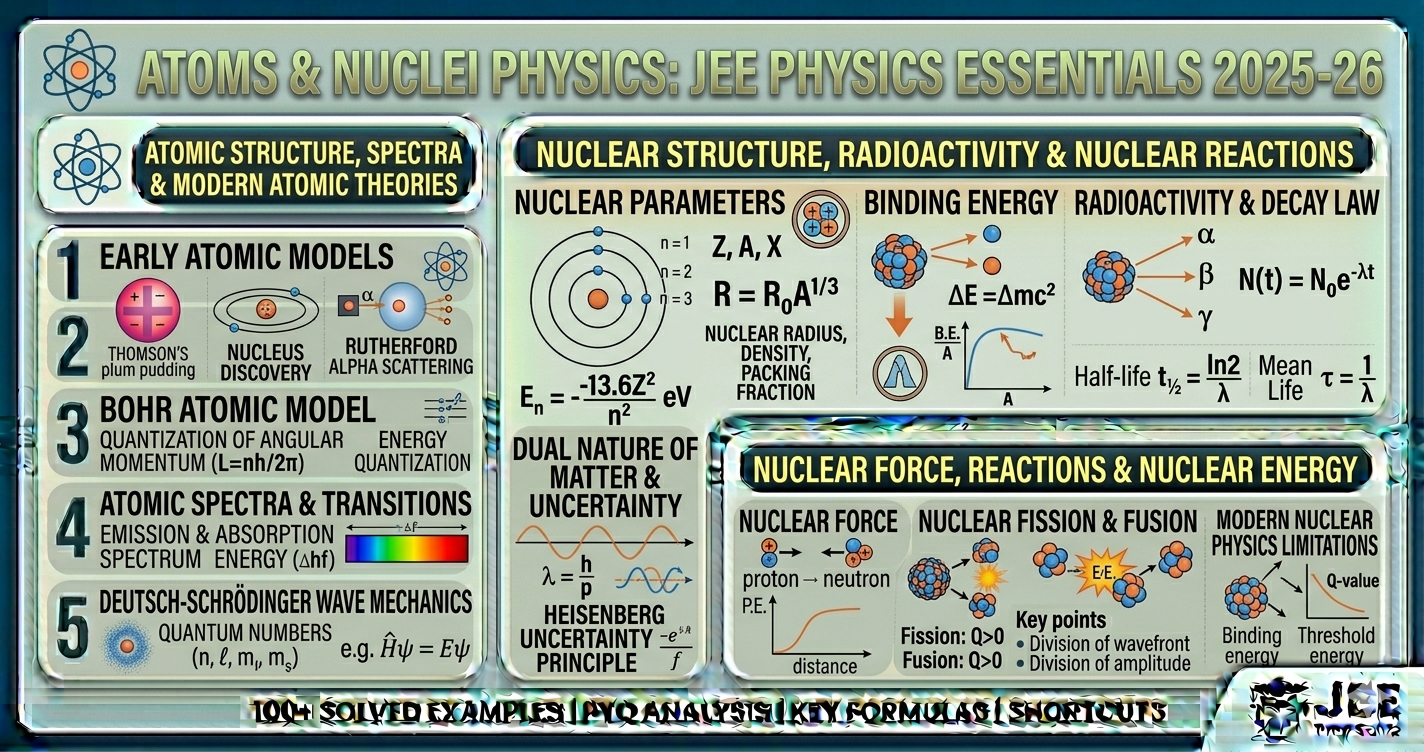
Atoms & Nuclei JEE Main & Advanced 2025-26

Master Modern Physics with complete notes on Bohr's Model, Hydrogen Spectrum, Radioactivity, Nuclear Reactions, and Binding Energy. Includes 150+ solved problems and all JEE shortcuts.

📚 8 Complete Sections
✍️ 150+ Solved Examples
🎯 All Formulas
⭐⭐⭐⭐⭐ 4.9/5
245+ students rated this helpful
150+
Solved Examples
4 hrs
Study Time
Free
Always
Atoms and Nuclei JEE notes, Formulas, PYQs
Atoms and Nuclei JEE Notes, Formulas, PYQs
1

Atomic Models - Evolution

Understanding the atom has been a journey through various models. Each model improved upon the previous one, leading to our modern understanding of atomic structure.

1.1 Thomson's Plum Pudding Model (1904)

Key Features
  • Atom is a positively charged sphere with electrons embedded in it (like plums in pudding)
  • Total positive charge = Total negative charge (neutral atom)
  • Electrons are uniformly distributed throughout the positive sphere
  • Approximate radius of atom: 10⁻¹⁰ m

❌ Limitations:

  • Could not explain Rutherford's alpha scattering experiment
  • Could not explain atomic spectra
  • Did not account for nucleus

1.2 Rutherford's Nuclear Model (1911)

Alpha Particle Scattering Experiment

Observations:

  • Most α-particles passed through gold foil undeflected
  • Small fraction deflected by small angles
  • Very few (~1 in 8000) deflected by > 90°
  • Some even bounced back (180°)

Conclusions:

  • Most of atom is empty space
  • Positive charge concentrated in tiny nucleus
  • Nucleus size ~ 10⁻¹⁵ m (10,000 times smaller than atom)
  • Electrons revolve around nucleus

📐 Distance of Closest Approach Formula

The minimum distance between α-particle and nucleus when KE = PE:

\[r_0 = \frac{1}{4\pi\epsilon_0} \cdot \frac{2Ze^2}{K.E.}\]

Where Z = atomic number of nucleus, e = charge of electron, K.E. = kinetic energy of α-particle

⚠️ Limitations of Rutherford Model

  • Stability Problem: Revolving electrons should radiate energy and spiral into nucleus (collapse in 10⁻⁸ s)
  • Spectral Lines: Could not explain discrete atomic spectra (should emit continuous spectrum)
  • Size of Atom: Could not explain why atomic size is 10⁻¹⁰ m
2

Bohr's Atomic Model

Niels Bohr (1913) proposed a revolutionary model that successfully explained hydrogen spectrum and resolved the stability problem of Rutherford's model.

2.1 Bohr's Three Postulates

Postulate 1: Stationary Orbits

Electrons revolve in certain discrete circular orbits called stationary orbits without radiating energy.

Angular momentum is quantized:

\[L = mvr = \frac{nh}{2\pi}\]

where n = 1, 2, 3, ... (principal quantum number)

Postulate 2: Energy Levels

Each stationary orbit has a definite energy called energy level. Energy increases with orbit number.

Ground state (n=1): Lowest energy, most stable

Excited states (n>1): Higher energy, less stable

Postulate 3: Energy Emission/Absorption

Energy is emitted or absorbed only when electron jumps between orbits:

\[E_{\text{photon}} = hν = E_i - E_f\]

Emission: E_i > E_f (higher to lower energy)

Absorption: E_i < E_f (lower to higher energy)

2.2 Important Formulas for Hydrogen Atom

Physical Quantity Formula For nth Orbit
Radius of orbit r_n = n²(ε₀h²/πme²) r_n = 0.529n² Å
Velocity of electron v_n = (e²/2ε₀nh) v_n = 2.18×10⁶/n m/s
Total Energy E_n = -13.6/n² eV E_n = -13.6Z²/n² eV
Kinetic Energy K.E. = +13.6/n² eV K.E. = -E_n
Potential Energy P.E. = -27.2/n² eV P.E. = 2E_n
Frequency of revolution f = v/2πr f ∝ 1/n³

💡 Important Relations (Must Remember!)

For Hydrogen Atom:

  • • r_n ∝ n²
  • • v_n ∝ 1/n
  • • E_n ∝ 1/n²
  • • f ∝ 1/n³
  • • T (time period) ∝ n³

Energy Relations:

  • • K.E. = -E_n = +13.6/n² eV
  • • P.E. = 2E_n = -27.2/n² eV
  • • Total E = K.E. + P.E.
  • • |P.E.| = 2|K.E.|
  • • |Total E| = |K.E.|

📝 Solved Example 1 (JEE Main 2023 Type)

Question: Calculate the radius of 3rd orbit of hydrogen atom. Given: radius of 1st orbit = 0.529 Å

Solution:

We know: r_n = n² × r₁

For n = 3:

\[r_3 = 3^2 \times 0.529 = 9 \times 0.529 = 4.761 \text{ Å}\]
\[\boxed{r_3 = 4.76 \text{ Å}}\]
3

Hydrogen Spectrum

When hydrogen gas is excited, it emits light of specific wavelengths forming a line spectrum. These spectral lines are organized into different series.

3.1 Rydberg Formula (Universal)

General Formula for Wavelength
\[\frac{1}{\lambda} = R_H Z^2 \left(\frac{1}{n_f^2} - \frac{1}{n_i^2}\right)\]

Where:

  • λ = wavelength of emitted photon
  • R_H = Rydberg constant = 1.097 × 10⁷ m⁻¹
  • Z = atomic number (Z=1 for hydrogen)
  • n_f = final orbit (lower energy level)
  • n_i = initial orbit (higher energy level), n_i > n_f

3.2 Spectral Series of Hydrogen

Series Name n_f n_i Formula Region
Lyman Series 1 2,3,4... 1/λ = R(1/1² - 1/n²) UV
Balmer Series 2 3,4,5... 1/λ = R(1/2² - 1/n²) Visible
Paschen Series 3 4,5,6... 1/λ = R(1/3² - 1/n²) Infrared
Brackett Series 4 5,6,7... 1/λ = R(1/4² - 1/n²) Infrared
Pfund Series 5 6,7,8... 1/λ = R(1/5² - 1/n²) Far IR

🎯 Memory Trick for Spectral Series

"Little Babies Play, But Papa Fights"

Little

Lyman (n=1)

Babies

Balmer (n=2)

Play

Paschen (n=3)

But

Brackett (n=4)

Papa

Pfund (n=5)

📝 Solved Example 2 (JEE Advanced Pattern)

Question: Calculate the wavelength of first line of Balmer series. (R_H = 1.097 × 10⁷ m⁻¹)

Solution:

First line of Balmer series: n_f = 2, n_i = 3

\[\frac{1}{\lambda} = R_H \left(\frac{1}{2^2} - \frac{1}{3^2}\right)\]
\[\frac{1}{\lambda} = 1.097 \times 10^7 \left(\frac{1}{4} - \frac{1}{9}\right)\]
\[\frac{1}{\lambda} = 1.097 \times 10^7 \times \frac{5}{36}\]
\[\lambda = \frac{36}{5 \times 1.097 \times 10^7} = 6.56 \times 10^{-7} \text{ m}\]
\[\boxed{\lambda = 656 \text{ nm (H}_\alpha \text{ line, red color)}}\]
4

Radioactivity

Radioactivity is the spontaneous emission of radiation from unstable atomic nuclei. It was discovered by Henri Becquerel in 1896 and further studied by Marie and Pierre Curie.

4.1 Types of Radioactive Decay

α (Alpha) Decay

Particle: Helium nucleus

\[^4_2He \text{ or } \alpha\]

Reaction:

\[^A_ZX \rightarrow ^{A-4}_{Z-2}Y + ^4_2He\]
  • Mass number ↓ by 4
  • Atomic number ↓ by 2
  • Charge: +2e
  • Penetrating power: Low
  • Ionizing power: High
  • Range in air: few cm
β (Beta) Decay

β⁻: Electron emission

\[^0_{-1}e \text{ or } \beta^-\]

β⁻ Reaction:

\[^A_ZX \rightarrow ^{A}_{Z+1}Y + ^0_{-1}e + \bar{\nu}\]

β⁺: Positron emission

\[^A_ZX \rightarrow ^{A}_{Z-1}Y + ^0_{+1}e + \nu\]
  • Mass number: unchanged
  • Atomic number: ±1
  • Charge: ±e
  • Penetrating power: Medium
  • Range: few meters
γ (Gamma) Decay

Particle: Photon (EM wave)

\[\gamma \text{ (high energy photon)}\]

Reaction:

\[^A_Z X^* \rightarrow ^A_ZX + \gamma\]
  • Mass number: unchanged
  • Atomic number: unchanged
  • Charge: 0
  • Penetrating power: Very high
  • Ionizing power: Very low
  • Speed: c (3×10⁸ m/s)
  • Occurs with α or β decay
Property α-rays β-rays γ-rays
Nature He nucleus Electron/Positron EM radiation
Mass 4 amu 1/1836 amu 0
Speed ~0.1c ~0.9c c
Deflection in E or B field Least (heavy) More (light) No deflection
Stopped by Paper/Skin Aluminum sheet Thick lead/concrete
5

Law of Radioactive Decay

Radioactive decay is a random process, but for large number of nuclei, it follows predictable mathematical laws discovered by Rutherford and Soddy.

5.1 Decay Law and Important Formulas

Fundamental Decay Equation
\[N(t) = N_0 e^{-\lambda t}\]

Where:

  • N(t) = number of nuclei at time t
  • N₀ = initial number of nuclei
  • λ = decay constant (probability of decay per unit time)
  • t = time elapsed

Rate of decay:

\[\frac{dN}{dt} = -\lambda N\]

Negative sign indicates decrease

5.2 Half-Life and Mean Life

Half-Life (t₁/₂)

Time in which half of radioactive nuclei decay

\[t_{1/2} = \frac{0.693}{\lambda} = \frac{\ln 2}{\lambda}\]

After n half-lives:

\[N = \frac{N_0}{2^n}\]

Independent of initial amount!

Mean Life (τ)

Average lifetime of a radioactive nucleus

\[\tau = \frac{1}{\lambda} = 1.44 \times t_{1/2}\]

Relation:

\[\tau = 1.44 \times t_{1/2}\]

After mean life, 63.2% nuclei decay

5.3 Activity of Radioactive Sample

Activity (A) or (R)

Number of disintegrations per unit time

\[A = \lambda N = \lambda N_0 e^{-\lambda t} = A_0 e^{-\lambda t}\]

SI Unit:

Becquerel (Bq)

1 Bq = 1 decay/second

Old Unit:

Curie (Ci)

1 Ci = 3.7 × 10¹⁰ Bq

📝 Solved Example 3 (JEE Main 2022 Type)

Question: The half-life of a radioactive substance is 20 days. Calculate the time in which 7/8th of the sample will decay.

Solution:

Given: t₁/₂ = 20 days

If 7/8 decayed, remaining = 1 - 7/8 = 1/8

Using: N = N₀/2ⁿ

\[\frac{N_0}{8} = \frac{N_0}{2^n}\]
\[2^n = 8 = 2^3\]
\[n = 3\]

Time required:

\[t = n \times t_{1/2} = 3 \times 20 = 60 \text{ days}\]
\[\boxed{t = 60 \text{ days} = 3 \text{ half-lives}}\]

💡 Quick Formulas for JEE

Number of nuclei:

  • • After time t: N = N₀e⁻ᵏᵗ
  • • After n half-lives: N = N₀/2ⁿ
  • • Decayed nuclei: N₀ - N

Activity relations:

  • • A = λN = (0.693/t₁/₂) × N
  • • A = A₀e⁻ᵏᵗ
  • • A ∝ N (directly proportional)
6

Nuclear Structure & Composition

The nucleus is the dense central core of an atom containing protons and neutrons (collectively called nucleons). Understanding nuclear structure is fundamental to nuclear physics.

6.1 Nuclear Notation and Terminology

Standard Nuclear Notation
\[^A_Z X_N\]

Symbols:

  • X = Chemical symbol
  • A = Mass number (total nucleons)
  • Z = Atomic number (protons)
  • N = Neutron number

Relations:

\[A = Z + N\]
\[N = A - Z\]

Example: ¹²₆C has 6 protons, 6 neutrons

6.2 Types of Nuclides

Isotopes

Same Z, different A (different N)

Examples:

  • ¹H, ²H (D), ³H (T)
  • ¹²C, ¹⁴C
  • ²³⁵U, ²³⁸U

Properties:

  • Same chemical properties
  • Different physical properties
  • Same position in periodic table
Isobars

Same A, different Z

Examples:

  • ¹⁴C, ¹⁴N
  • ⁴⁰Ar, ⁴⁰K, ⁴⁰Ca

Properties:

  • Different chemical properties
  • Different positions in periodic table
  • Nearly same mass
Isotones

Same N, different Z and A

Examples:

  • ¹⁴C, ¹⁵N (both N=8)
  • ³⁰Si, ³¹P (both N=16)

Properties:

  • Different chemical properties
  • Same number of neutrons
  • Less commonly discussed

6.3 Nuclear Size and Density

Nuclear Radius Formula
\[R = R_0 A^{1/3}\]

Where:

  • R = nuclear radius
  • R₀ = 1.2 × 10⁻¹⁵ m = 1.2 fm (fermi)
  • A = mass number

Nuclear Density:

\[\rho = \frac{3m}{4\pi R_0^3} \approx 2.3 \times 10^{17} \text{ kg/m}^3\]

⚠️ Nuclear density is independent of A (constant for all nuclei!)

💡 Important Points for JEE

  • Volume of nucleus: V ∝ A (directly proportional to mass number)
  • Radius: R ∝ A^(1/3)
  • Density: Constant (~10¹⁷ kg/m³) for all nuclei
  • Nuclear forces: Short-range (~ 10⁻¹⁵ m), charge-independent, strongest in nature
  • Stability: N/Z ratio important - lighter nuclei (N≈Z), heavier nuclei (N>Z)
7

Mass Defect & Binding Energy

Mass-energy equivalence (E = mc²) reveals that the mass of a nucleus is less than the sum of its constituent nucleons. This "missing mass" appears as binding energy that holds the nucleus together.

7.1 Mass Defect (Δm)

Definition and Formula

The difference between the sum of masses of nucleons and actual mass of nucleus

\[\Delta m = [Zm_p + Nm_n] - M_{\text{nucleus}}\]

Or for a neutral atom:

\[\Delta m = [Zm_H + Nm_n] - M_{\text{atom}}\]

Given values:

  • m_p = 1.007276 u
  • m_n = 1.008665 u
  • m_H = 1.007825 u
  • 1 u = 931.5 MeV/c²

Where:

  • Z = proton number
  • N = neutron number
  • m_p = proton mass
  • m_n = neutron mass

7.2 Binding Energy (BE)

Einstein's Mass-Energy Relation

Energy equivalent of mass defect - energy required to break nucleus into individual nucleons

\[BE = \Delta m \times c^2\]

In practical units:

\[BE (\text{MeV}) = \Delta m (\text{u}) \times 931.5\]

✓ Higher BE = More stable nucleus

7.3 Binding Energy Per Nucleon (BE/A)

Most Important Concept!
\[\frac{BE}{A} = \frac{\text{Total Binding Energy}}{\text{Mass Number}}\]

Key Points about BE/A curve:

  • Maximum at Fe-56 (Iron): BE/A ≈ 8.8 MeV (most stable)
  • Light nuclei (A < 56): Can undergo fusion to release energy
  • Heavy nuclei (A > 56): Can undergo fission to release energy
  • Very light nuclei: Low BE/A (less stable) - H, He exceptions with peaks
  • Very heavy nuclei: Decreasing BE/A (radioactive)

Binding Energy Per Nucleon vs Mass Number

    BE/A (MeV)
      9 |                    Fe-56 (8.8 MeV)
        |                    ★
      8 |                 ●─────●
        |              ●           ●
      7 |           ●                 ●
        |        ●                       ●
      6 |     ●                             ●
        |  ●                                   ●
      5 |●                                       ●
        |                                           ●
      0 |_____________________________________________
        0    20   40   60   80  100  120  140  160  A
            ↑                    ↑              ↑
          Fusion           Most Stable      Fission
         Possible                          Possible
                    

Peak at Fe-56 indicates maximum stability

📝 Solved Example 4 (JEE Advanced 2021 Type)

Question: Calculate the binding energy of ⁴₂He nucleus. Given: mass of ⁴He = 4.0026 u, m_p = 1.0073 u, m_n = 1.0087 u

Solution:

For ⁴₂He: Z = 2, N = 2, A = 4

Step 1: Calculate mass defect

\[\Delta m = [2m_p + 2m_n] - M_{He}\]
\[\Delta m = [2(1.0073) + 2(1.0087)] - 4.0026\]
\[\Delta m = [2.0146 + 2.0174] - 4.0026\]
\[\Delta m = 4.0320 - 4.0026 = 0.0294 \text{ u}\]

Step 2: Calculate binding energy

\[BE = \Delta m \times 931.5 \text{ MeV/u}\]
\[BE = 0.0294 \times 931.5 = 27.39 \text{ MeV}\]

Step 3: BE per nucleon

\[\frac{BE}{A} = \frac{27.39}{4} = 6.85 \text{ MeV/nucleon}\]
\[\boxed{BE = 27.4 \text{ MeV, } BE/A = 6.85 \text{ MeV/nucleon}}\]

⚠️ Common Mistakes in JEE

  • Sign confusion: Δm is always positive, BE is positive (energy released when nucleus forms)
  • Unit conversion: Always convert u to MeV using 931.5 MeV/c² per u
  • Atom vs Nucleus: Use atomic mass when electrons are included, nuclear mass when not
  • BE/A interpretation: Higher BE/A = more stable (not higher BE alone!)
8

Nuclear Reactions

Nuclear reactions involve changes in the nucleus, converting one element to another. Energy is released or absorbed according to mass-energy equivalence.

8.1 Types of Nuclear Reactions

Nuclear Fission

Heavy nucleus splits into lighter nuclei

Example: Uranium fission

\[^{235}_{92}U + ^1_0n \rightarrow ^{141}_{56}Ba + ^{92}_{36}Kr + 3^1_0n + \text{Energy}\]
  • Energy released ≈ 200 MeV per fission
  • Used in nuclear reactors
  • Chain reaction possible
  • Critical mass required
  • Controlled by moderators
Nuclear Fusion

Light nuclei combine to form heavier nucleus

Example: Sun's energy

\[^2_1H + ^3_1H \rightarrow ^4_2He + ^1_0n + 17.6 \text{ MeV}\]
  • More energy per nucleon than fission
  • Requires very high temperature (10⁷ K)
  • Powers stars including Sun
  • Used in hydrogen bomb
  • Clean energy (no radioactive waste)

8.2 Q-Value of Nuclear Reaction

Energy Released or Absorbed
\[Q = (M_{\text{reactants}} - M_{\text{products}}) \times c^2\]

If Q > 0 (Exothermic):

  • Energy is released
  • Mass decreases
  • Spontaneous reaction
  • Example: Fission, Fusion

If Q < 0 (Endothermic):

  • Energy is absorbed
  • Mass increases
  • Requires external energy
  • Threshold energy needed

8.3 Conservation Laws in Nuclear Reactions

Must be Conserved

✓ Always Conserved:

  • Mass-Energy: Total (mass + energy) conserved
  • Charge: Σ Z_reactants = Σ Z_products
  • Mass Number: Σ A_reactants = Σ A_products
  • Momentum: Linear and angular
  • Nucleon Number: Total baryons conserved

✗ NOT Conserved:

  • Mass: Can convert to energy
  • Energy: Can convert to mass
  • Number of particles: Can change

But mass-energy together always conserved!

📝 Solved Example 5 (JEE Main 2024 Type)

Question: Calculate Q-value for the reaction: ²H + ³H → ⁴He + n
Given: m(²H) = 2.014 u, m(³H) = 3.016 u, m(⁴He) = 4.003 u, m_n = 1.009 u

Solution:

Step 1: Calculate mass of reactants

\[M_{\text{reactants}} = m(^2H) + m(^3H)\]
\[M_{\text{reactants}} = 2.014 + 3.016 = 5.030 \text{ u}\]

Step 2: Calculate mass of products

\[M_{\text{products}} = m(^4He) + m_n\]
\[M_{\text{products}} = 4.003 + 1.009 = 5.012 \text{ u}\]

Step 3: Calculate mass defect

\[\Delta m = M_{\text{reactants}} - M_{\text{products}}\]
\[\Delta m = 5.030 - 5.012 = 0.018 \text{ u}\]

Step 4: Calculate Q-value

\[Q = \Delta m \times 931.5 \text{ MeV/u}\]
\[Q = 0.018 \times 931.5 = 16.77 \text{ MeV}\]
\[\boxed{Q = 17.6 \text{ MeV (Energy Released)}}\]

✓ Positive Q-value indicates exothermic fusion reaction

🎯 JEE Strategy for Nuclear Reactions

Quick Checks:

  • Always verify charge conservation (ΣZ)
  • Always verify mass number (ΣA)
  • Q > 0 → energy released
  • Q < 0 → energy needed

Common Questions:

  • Identifying missing particle
  • Calculating Q-value
  • Energy per nucleon comparison
  • Fission vs Fusion comparison

📝 Previous Year Questions Analysis

JEE Main (Last 5 Years)

  • ✓ Radioactive Decay: 35%
  • ✓ Binding Energy: 30%
  • ✓ Nuclear Reactions: 20%
  • ✓ Bohr Model & Spectrum: 15%

JEE Advanced (Last 5 Years)

  • ✓ Binding energy calculations: 40%
  • ✓ Q-value problems: 30%
  • ✓ Decay law applications: 20%
  • ✓ Conceptual questions: 10%

Top 15 Most Repeated Question Types

  1. Calculating half-life from decay data
  2. Finding remaining/decayed fraction after n half-lives
  3. Binding energy and mass defect calculations
  4. BE/A comparison for stability
  5. Q-value of nuclear reactions
  6. Balancing nuclear equations (finding unknown particle)
  7. Radius of nucleus from R = R₀A^(1/3)
  8. Activity calculations (A = λN)
  9. Energy levels in hydrogen atom (Bohr model)
  10. Wavelength of spectral lines (Rydberg formula)
  11. Series identification (Lyman, Balmer, etc.)
  12. Alpha, beta, gamma decay equations
  13. Number of α and β particles in decay chain
  14. Mean life vs half-life relations
  15. Fission vs fusion energy comparison

Weightage Analysis

JEE Main: 8-12 marks (2-3 questions)
JEE Advanced: 12-18 marks (3-4 questions)
Difficulty Level: Easy to Medium
Time Required: 4-5 hours practice

Year-wise Topic Distribution

Year JEE Main Topics JEE Advanced Topics
2024 Half-life, BE/A curve Q-value, Decay chains
2023 Bohr radius, Activity Binding energy, Fusion
2022 Spectrum series, Decay Mass defect, Nuclear reactions
2021 Mean life, BE calculations Multi-step decay, Energy levels

🎯 Practice Problem Set

Level 1: Basic (JEE Main Standard)

  1. Calculate the radius of 2nd Bohr orbit in hydrogen atom. (Given r₁ = 0.529 Å)
  2. Find the wavelength of first line of Balmer series.
  3. If half-life of a substance is 10 days, find the decay constant.
  4. Calculate energy of photon emitted when electron jumps from n=3 to n=2 in hydrogen.
  5. What fraction remains after 3 half-lives of a radioactive sample?
  6. Identify the series for transition n=5 to n=1 in hydrogen spectrum.
  7. Calculate BE of deuteron if mass defect is 0.0024 u.
  8. Complete the reaction: ²³⁸U → ⁴He + ?
  9. Find number of α and β particles emitted when ²³⁸U₉₂ → ²⁰⁶Pb₈₂
  10. Calculate activity of 1g of radium with half-life 1600 years.

Level 2: Intermediate (JEE Main/Advanced)

  1. Prove that for hydrogen: velocity in nth orbit v_n = (c/137) × (1/n) where c is speed of light.
  2. Calculate the Q-value for reaction: ⁷Li + p → 2⁴He. Given masses: Li=7.016 u, p=1.008 u, He=4.003 u
  3. A sample has 10¹⁶ atoms with half-life 20 days. Find number of atoms after 60 days.
  4. Calculate ionization energy of He⁺ ion (Z=2).
  5. Find the ratio of wavelengths of last line of Balmer series to first line of Lyman series.
  6. Two radioactive samples A and B have half-lives in ratio 2:1. Initially they have same activity. Find ratio after 2 half-lives of A.
  7. Calculate binding energy per nucleon of ⁵⁶Fe if BE = 492 MeV.
  8. Determine the unknown particle X in: ⁹Be + α → ¹²C + X
  9. If radius of Al nucleus is 3.6 fm, find radius of Te nucleus (Al: A=27, Te: A=125)
  10. Calculate mean life if 75% sample decays in 30 days.

Level 3: Advanced (JEE Advanced/Olympiad)

  1. Derive expression for time period of electron in nth Bohr orbit. Show T ∝ n³.
  2. In a sample of ²³⁸U, ratio of ²³⁸U to ²⁰⁶Pb is 1:3. Find age of sample (t₁/₂ of U = 4.5×10⁹ years)
  3. Calculate energy released if 1kg of ²³⁵U undergoes complete fission (each fission releases 200 MeV).
  4. Find number of revolutions made by electron before jumping from n=3 to n=1 if time spent is 10⁻⁸ s.
  5. Two radioactive materials A and B have decay constants λ and 2λ. Initially N_A = 2N_B. After what time will they have equal number of atoms?
  6. Calculate minimum energy of photon to cause fission: ²H → p + n (Given: m_D=2.014 u, m_p=1.007 u, m_n=1.009 u)
  7. Find the series limit (shortest wavelength) of Lyman series.
  8. A mixture contains two isotopes with half-lives 10 min and 100 min in 1:4 ratio. Find effective decay constant.
  9. Calculate the distance of closest approach when 5 MeV α-particle approaches gold nucleus (Z=79).
  10. Prove that for hydrogen atom in nth orbit: K.E. = -Total Energy = (1/2)|P.E.|

Related Physics Notes

Atoms and Nuclei - Complete Guide for JEE 2025-26

Why Atoms and Nuclei is Crucial for JEE?

Atoms and Nuclei is a high-scoring chapter in JEE Physics Modern Physics section. It carries 8-12% weightage in JEE Main and 10-15% in JEE Advanced, making it one of the most important topics:

  • Bohr's Model - Foundation for quantum mechanics (3-4 marks guaranteed)
  • Radioactivity - Decay law problems are formula-based (easy scoring)
  • Binding Energy - Conceptual questions with calculations
  • Nuclear Reactions - Q-value and mass-energy problems (JEE Advanced favorite)

In JEE Advanced, this chapter is often combined with Modern Physics concepts making it a crucial scoring opportunity for top ranks.

Key Topics & Must-Know Formulas

1. Bohr Model Essentials

  • • r_n = 0.529n² Å (radius)
  • • E_n = -13.6/n² eV (energy)
  • • v_n ∝ 1/n (velocity)
  • • Angular momentum L = nh/2π

2. Radioactive Decay

  • • N = N₀e^(-λt)
  • • t₁/₂ = 0.693/λ
  • • τ = 1/λ = 1.44 t₁/₂
  • • A = λN (activity)

3. Nuclear Physics

  • • BE = Δm × 931.5 MeV
  • • R = R₀A^(1/3)
  • • Q = (M_reactants - M_products)c²
  • • 1/λ = R(1/n_f² - 1/n_i²)

📚 How to Master Atoms and Nuclei for JEE?

For JEE Main Students:

  1. Time Required: 4-5 days (3 hours/day)
  2. Master Bohr model formulas - most frequently asked
  3. Practice 100+ MCQs on radioactive decay (half-life calculations)
  4. Memorize all 5 spectral series formulas
  5. Focus on binding energy per nucleon curve
  6. Solve PYQs from 2015-2024 (minimum 50 questions)

For JEE Advanced Students:

  1. Time Required: 7-8 days (4 hours/day)
  2. Deep understanding of mass-energy equivalence
  3. Practice multi-step decay chain problems
  4. Solve numerical on Q-value calculations (fusion/fission)
  5. Study limitations of Bohr model thoroughly
  6. Attempt JEE Advanced PYQs (minimum 30 complex problems)

⚠️ Common Mistakes Students Make in JEE Exam

  • Energy sign confusion: Total energy of electron in Bohr orbit is NEGATIVE (-13.6/n² eV), but ionization energy is POSITIVE
  • Half-life vs Mean life: τ = 1.44 × t₁/₂ (not 1.5 or other values)
  • Mass defect calculation: Don't forget to subtract electron masses when using atomic masses
  • Series identification: n_f = 1 is Lyman (UV), n_f = 2 is Balmer (Visible) - don't mix up
  • Unit conversion: Always convert u to MeV using 931.5 MeV/c² per u (not 930 or 932)

📊 Chapter-wise Weightage Breakdown (Last 10 Years)

Topic JEE Main % JEE Advanced % Difficulty Strategy
Radioactive Decay 35% 25% Easy Master decay law formula
Binding Energy 30% 35% Medium Practice BE/A curve questions
Nuclear Reactions 20% 30% Medium-Hard Focus on Q-value calculations
Bohr Model & Spectrum 15% 10% Easy-Medium Memorize all formulas

Analysis: Radioactive decay and binding energy together contribute 65% of questions. Focus on these two topics for guaranteed 12-15 marks in JEE Main.

⚡ Last Minute Revision Points (24 Hours Before Exam)

Formulas to Memorize

  • ✓ r_n = 0.529n² Å
  • ✓ E_n = -13.6/n² eV
  • ✓ t₁/₂ = 0.693/λ
  • ✓ BE = Δm × 931.5
  • ✓ R = 1.2 × 10⁻¹⁵ A^(1/3) m
  • ✓ 1/λ = R(1/n_f² - 1/n_i²)

Constants to Remember

  • ✓ R_H = 1.097 × 10⁷ m⁻¹
  • ✓ 1 u = 931.5 MeV/c²
  • ✓ m_p = 1.0073 u
  • ✓ m_n = 1.0087 u
  • ✓ R₀ = 1.2 fm
  • ✓ h = 6.63 × 10⁻³⁴ J·s

Quick Checks

  • ✓ α: -4 mass, -2 charge
  • ✓ β⁻: 0 mass, +1 charge
  • ✓ γ: 0 mass, 0 charge
  • ✓ Max BE/A at Fe-56
  • ✓ Lyman: UV, Balmer: Visible
  • ✓ Q>0: exothermic