
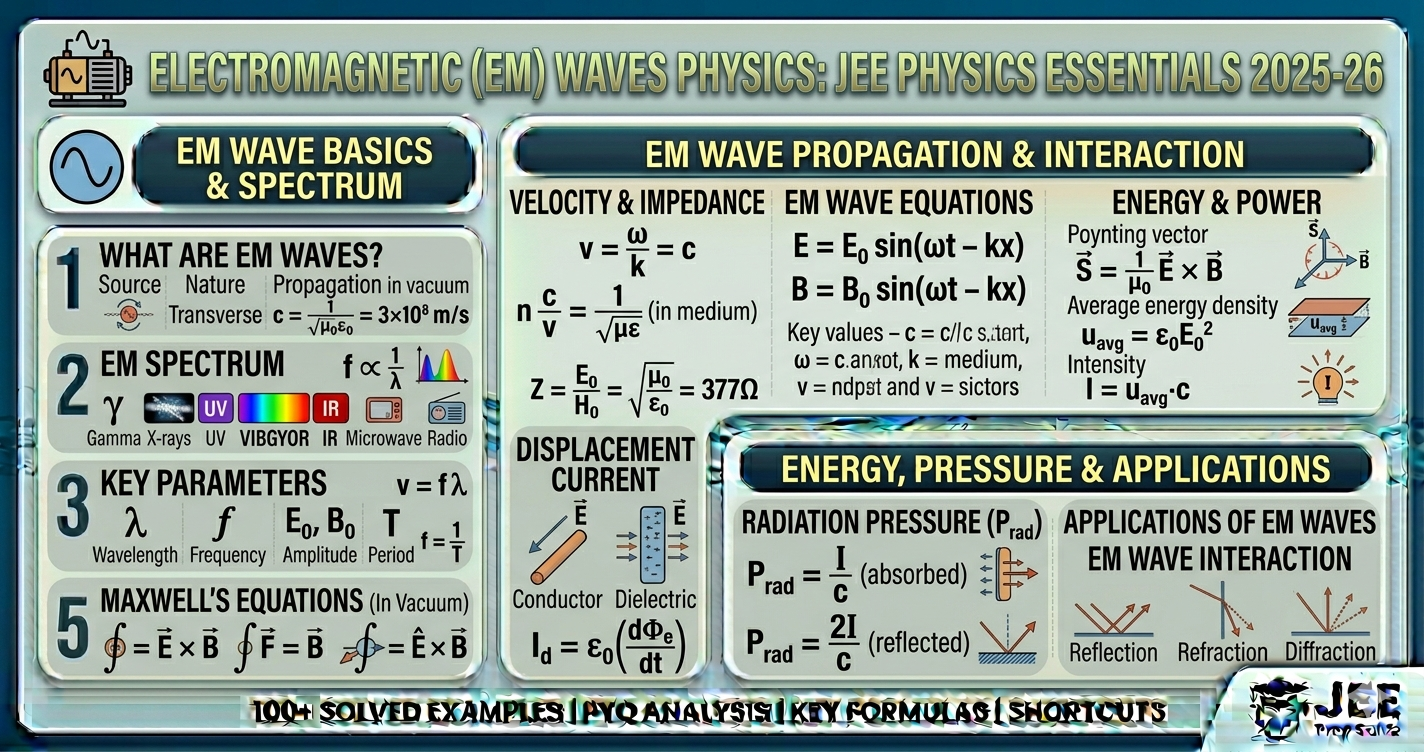
Electromagnetic Waves - Complete Guide for JEE 2025-26
Why Electromagnetic Waves is Important for JEE?
Electromagnetic Waves is a fundamental chapter bridging electricity, magnetism, and optics. It carries 4-6% weightage in JEE Main and 6-10% in JEE Advanced. Key reasons to master this chapter:
- Foundation for Optics: Understanding wave nature of light
- Maxwell's Equations: The crown jewel of classical physics
- Displacement Current: High-frequency JEE question topic
- EM Spectrum: Direct application-based questions
- Modern Physics Connection: Links to photon concepts
In JEE Advanced, expect conceptual questions on Maxwell's equations and numerical problems on displacement current, intensity, and radiation pressure.
Key Formulas to Remember
1. Speed of EM Waves
- • c = 1/√(μ₀ε₀) = 3 × 10⁸ m/s
- • v = c/n (in medium)
- • E/B = c (E-B ratio)
2. Displacement Current
- • I_d = ε₀(dΦ_E/dt)
- • I_d = ε₀A(dE/dt)
- • I_d = I_c (for capacitor)
3. Energy & Intensity
- • u = ε₀E² = B²/μ₀ (energy density)
- • I = ε₀cE₀²/2 = cB₀²/(2μ₀)
- • S = (E × B)/μ₀ (Poynting vector)
4. Radiation Pressure
- • P = I/c (absorption)
- • P = 2I/c (reflection)
- • E = hf = hc/λ (photon energy)
📚 How to Study Electromagnetic Waves Effectively?
For JEE Main Students:
- Time Required: 2-3 days (2 hours/day)
- Focus on EM spectrum - memorize all types, sources, applications
- Practice displacement current numerical problems
- Understand E-B relationship and wave equations
- Learn energy density and intensity formulas
- Solve all NCERT examples and exercises
For JEE Advanced Students:
- Time Required: 4-5 days (3 hours/day)
- Deep understanding of Maxwell's equations
- Master Poynting vector and energy flow
- Practice radiation pressure problems
- Understand wave equation derivation
- Solve problems combining EM waves with optics
- Study displacement current in detail with magnetic field calculations
⚠️ Common Mistakes to Avoid in JEE Exam
-
❌
Confusing E/B ratio: E/B = c (not E×B). The ratio equals speed of light, not the product.
-
❌
Wrong spectrum order: Remember - Radio has LONGEST wavelength (lowest frequency), Gamma has SHORTEST (highest frequency).
-
❌
Displacement current misconception: It's NOT real current (no charge flow). It's the effect of changing electric field.
-
❌
Radiation pressure formula: P = I/c for absorption, P = 2I/c for reflection. Don't mix them up!
-
❌
Speed in medium: EM waves slow down in media (v = c/n), but frequency remains unchanged - only wavelength decreases.
-
❌
Gamma vs X-ray source: Gamma rays come from NUCLEUS (nuclear transitions), X-rays from ELECTRONS (electronic transitions). Don't confuse their origins!
📊 JEE Previous Year Question Analysis (2019-2024)
| Year | JEE Main | JEE Advanced | Topic Focus |
|---|---|---|---|
| 2024 | 2 Questions (8 marks) | 2 Questions (8 marks) | EM spectrum, Displacement current, E-B relation |
| 2023 | 1 Question (4 marks) | 3 Questions (10 marks) | Intensity, Poynting vector, Wave equation |
| 2022 | 2 Questions (8 marks) | 2 Questions (7 marks) | Speed of EM waves, Spectrum properties |
| 2021 | 1 Question (4 marks) | 2 Questions (8 marks) | Radiation pressure, Maxwell equations |
| 2020 | 2 Questions (8 marks) | 1 Question (4 marks) | Energy density, Photon energy |
Trend: JEE Main focuses on EM spectrum identification and basic formulas. JEE Advanced increasingly tests conceptual understanding of Maxwell's equations and complex problems involving Poynting vector and displacement current.
⚡ Quick Revision - Must Remember Points
Maxwell's Equations:
- • ∮E·dA = q/ε₀ (Gauss E)
- • ∮B·dA = 0 (Gauss B)
- • ∮E·dl = -dΦ_B/dt (Faraday)
- • ∮B·dl = μ₀(I + I_d) (Ampere-Maxwell)
EM Spectrum Order:
- • Radio → Micro → IR → Visible
- • → UV → X-ray → Gamma
- • Increasing frequency →
- • Increasing energy →
- • Decreasing wavelength →
Key Numbers:
- • c = 3 × 10⁸ m/s
- • Visible: 400-700 nm
- • hc = 1240 eV·nm
- • ε₀ = 8.85 × 10⁻¹² F/m
- • μ₀ = 4π × 10⁻⁷ H/m
🔗 Connection with Other Chapters
| Chapter | Connection to EM Waves | Combined Questions Possible |
|---|---|---|
| Electromagnetic Induction | Faraday's law → Maxwell's third equation | Derivation-based questions |
| Capacitance | Displacement current in charging capacitor | Numerical problems on I_d |
| Wave Optics | Light as EM wave, polarization | Interference, diffraction with EM wave properties |
| Modern Physics | Photon energy E = hf, photoelectric effect | Photon calculations with spectrum |
| Communication Systems | Radio waves, modulation | Application-based questions |
📐 Important Diagrams for Exam
1. EM Wave Representation
- • E and B perpendicular to each other
- • Both perpendicular to propagation direction
- • E × B gives direction of wave travel
- • In phase oscillation
2. Displacement Current in Capacitor
- • E-field between plates
- • Circular B-field around axis
- • I_d = I_c for continuity
- • Amperian loop comparison
3. EM Spectrum
- • Linear scale with wavelength ranges
- • Visible light expanded (VIBGYOR)
- • Sources and applications for each type
4. Energy Distribution
- • u_E = u_B (equal energy density)
- • Total u = ε₀E² = B²/μ₀
- • Poynting vector direction