
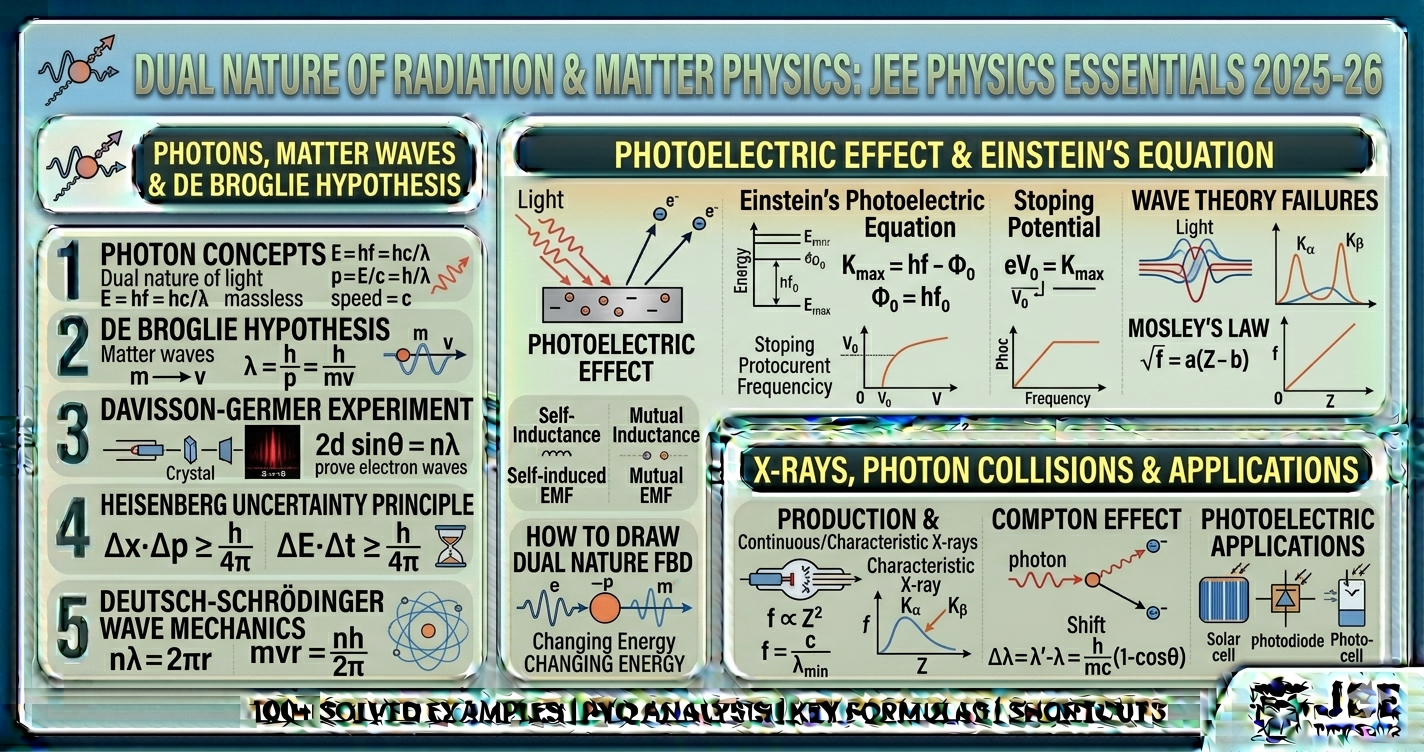
📑 Quick Navigation - Dual Nature of Radiation and Matter

Dual Nature of Radiation and Matter | JEE 2025-26

Master Modern Physics with complete notes on Photoelectric Effect, Einstein's Equation, De Broglie Waves, and Davisson-Germer Experiment. Includes 150+ solved problems and all JEE formulas.

📚 7 Complete Sections
✍️ 150+ Solved Examples
🎯 Graph Analysis
⭐⭐⭐⭐⭐ 4.9/5
278+ students rated this helpful
150+
Solved Examples
4 hrs
Study Time
Free
Always
Dual Nature of Radiation and Matter JEE notes, Formulas, PYQs
Dual Nature of Radiation and Matter - JEE Notes, Formulas, PYQs
1

Photon and Its Properties

According to Planck's quantum theory (1900) and Einstein's photon concept (1905), light consists of discrete packets of energy called photons or quanta. Each photon carries energy proportional to its frequency.

1.1 Properties of Photon

Fundamental Photon Properties

Energy of Photon:

\[E = h\nu = \frac{hc}{\lambda}\]

Where:

  • h = Planck's constant = 6.63 × 10⁻³⁴ J·s
  • ν = frequency of radiation
  • c = speed of light = 3 × 10⁸ m/s
  • λ = wavelength

Momentum of Photon:

\[p = \frac{E}{c} = \frac{h\nu}{c} = \frac{h}{\lambda}\]

Note: Photon has momentum despite having zero rest mass!

Complete Photon Formula Set (Must Memorize!)

Energy:

\[E = h\nu = \frac{hc}{\lambda}\]

Momentum:

\[p = \frac{h}{\lambda} = \frac{h\nu}{c} = \frac{E}{c}\]

Equivalent Mass:

\[m = \frac{E}{c^2} = \frac{h\nu}{c^2} = \frac{h}{\lambda c}\]

Rest Mass:

\[m_0 = 0\]

Always zero!

Speed:

\[v = c = 3 \times 10^8 \text{ m/s}\]

Always (in vacuum)

Charge:

\[q = 0\]

Photon is uncharged

1.2 Useful Conversion Formulas

Quick Calculation Formulas (JEE Shortcuts)

Energy in eV from wavelength:

\[E \text{ (eV)} = \frac{12400}{\lambda \text{ (Å)}} = \frac{1240}{\lambda \text{ (nm)}}\]

hc value (memorize!):

\[hc = 1240 \text{ eV·nm} = 12400 \text{ eV·Å}\]

Number of Photons:

\[n = \frac{\text{Total Energy}}{E_{\text{photon}}} = \frac{P \cdot t}{h\nu} = \frac{P \cdot t \cdot \lambda}{hc}\]

Where P = power, t = time

📝 Solved Example 1 (JEE Main Pattern)

Question: Calculate the energy and momentum of a photon of wavelength 6000 Å.

Solution:

Given: λ = 6000 Å = 6000 × 10⁻¹⁰ m

Method 1 (Energy using shortcut):

\[E = \frac{12400}{6000} \text{ eV} = 2.07 \text{ eV}\]

Method 2 (Energy in Joules):

\[E = \frac{hc}{\lambda} = \frac{6.63 \times 10^{-34} \times 3 \times 10^8}{6000 \times 10^{-10}}\]
\[E = 3.315 \times 10^{-19} \text{ J}\]

Momentum:

\[p = \frac{h}{\lambda} = \frac{6.63 \times 10^{-34}}{6000 \times 10^{-10}} = 1.105 \times 10^{-27} \text{ kg·m/s}\]
\[\boxed{E = 2.07 \text{ eV} = 3.315 \times 10^{-19} \text{ J}, \quad p = 1.1 \times 10^{-27} \text{ kg·m/s}}\]

💡 Important Constants (Must Memorize!)

  • • h = 6.63 × 10⁻³⁴ J·s
  • • c = 3 × 10⁸ m/s
  • • 1 eV = 1.6 × 10⁻¹⁹ J
  • • hc = 1240 eV·nm
  • • 1 Å = 10⁻¹⁰ m
  • • 1 nm = 10⁻⁹ m = 10 Å
  • • Visible light: 400-700 nm
  • • m_e = 9.1 × 10⁻³¹ kg
2

Photoelectric Effect

The photoelectric effect is the emission of electrons from a metal surface when light of sufficiently high frequency falls on it. Discovered by Hertz (1887) and explained by Einstein (1905), it provided direct evidence for the quantum nature of light.

2.1 Experimental Observations

Key Observations (All are JEE Important!)

1. Threshold Frequency (ν₀):

  • Minimum frequency below which no photoelectrons are emitted
  • Different for different metals
  • Independent of intensity
  • Related to work function: ν₀ = φ/h

2. Instantaneous Emission:

  • Photoelectrons are emitted instantaneously (within 10⁻⁹ s)
  • No time lag between light falling and electron emission
  • This cannot be explained by wave theory!

3. Effect of Intensity:

  • Number of photoelectrons ∝ intensity (at ν > ν₀)
  • Saturation current ∝ intensity
  • KE_max is independent of intensity
  • Stopping potential is independent of intensity

4. Effect of Frequency:

  • KE_max increases linearly with frequency (for ν > ν₀)
  • Stopping potential increases with frequency
  • No emission below threshold frequency (regardless of intensity!)

2.2 Key Terms and Definitions

Term Definition Symbol/Formula
Work Function (φ) Minimum energy needed to eject an electron from metal surface φ = hν₀
Threshold Frequency (ν₀) Minimum frequency required for photoelectric emission ν₀ = φ/h
Threshold Wavelength (λ₀) Maximum wavelength that can cause photoelectric emission λ₀ = c/ν₀ = hc/φ
Stopping Potential (V₀) Minimum negative potential to stop all photoelectrons eV₀ = KE_max
Saturation Current Maximum photocurrent when all emitted electrons reach anode I_sat ∝ intensity
Photoelectrons Electrons emitted due to photoelectric effect

⚠️ Failure of Wave Theory

Classical wave theory could NOT explain:

  • Threshold frequency: Wave theory predicts emission at any frequency with sufficient intensity
  • Instantaneous emission: Wave theory predicts time delay for energy accumulation
  • KE independent of intensity: Wave theory predicts KE should increase with intensity
  • KE depends on frequency: Wave theory cannot explain this

This led Einstein to propose the photon theory!

2.3 Work Function Values (Frequently Asked)

Work Function of Common Metals

Cesium (Cs)

φ = 1.9 eV

(Lowest)

Potassium (K)

φ = 2.3 eV

Sodium (Na)

φ = 2.3 eV

Calcium (Ca)

φ = 2.9 eV

Zinc (Zn)

φ = 4.3 eV

Copper (Cu)

φ = 4.7 eV

Silver (Ag)

φ = 4.7 eV

Platinum (Pt)

φ = 6.3 eV

(Highest)

💡 Lower work function → Easier to emit electrons → Better for photocells

3

Einstein's Photoelectric Equation

In 1905, Einstein explained the photoelectric effect using Planck's quantum theory. He proposed that light consists of photons, each carrying energy E = hν. Einstein received the Nobel Prize in Physics (1921) for this explanation.

3.1 The Equation

Einstein's Photoelectric Equation
\[h\nu = \phi + KE_{max}\]

OR equivalently:

\[KE_{max} = h\nu - \phi\]
\[KE_{max} = h(\nu - \nu_0)\]

Physical Interpretation:

Photon Energy = Work Function + Maximum Kinetic Energy of electron

  • hν = energy of incident photon
  • φ = work function (energy to free electron from surface)
  • KE_max = maximum kinetic energy of ejected electron

3.2 Related Formulas

Stopping Potential
\[eV_0 = KE_{max} = h\nu - \phi\]
\[V_0 = \frac{h\nu}{e} - \frac{\phi}{e}\]

V₀ is the minimum retarding potential to stop the fastest photoelectron

Maximum Velocity
\[KE_{max} = \frac{1}{2}mv_{max}^2\]
\[v_{max} = \sqrt{\frac{2(h\nu - \phi)}{m}}\]

where m = mass of electron = 9.1 × 10⁻³¹ kg

3.3 Special Cases

Condition Result KE_max
ν < ν₀ (or λ > λ₀) No emission (hν < φ) Not defined
ν = ν₀ (or λ = λ₀) Just emission starts (hν = φ) KE_max = 0
ν > ν₀ (or λ < λ₀) Emission with KE (hν > φ) KE_max = h(ν - ν₀)
ν = 2ν₀ KE equals work function KE_max = hν₀ = φ

📝 Solved Example 2 (JEE Main 2023)

Question: Light of wavelength 4000 Å falls on a metal surface with work function 2 eV. Calculate (a) stopping potential, (b) maximum velocity of photoelectrons.

Solution:

Given: λ = 4000 Å, φ = 2 eV, m_e = 9.1 × 10⁻³¹ kg

Step 1: Calculate photon energy

\[E = \frac{12400}{4000} = 3.1 \text{ eV}\]

Step 2: Calculate KE_max using Einstein's equation

\[KE_{max} = h\nu - \phi = 3.1 - 2 = 1.1 \text{ eV}\]

(a) Stopping potential:

\[V_0 = \frac{KE_{max}}{e} = 1.1 \text{ V}\]

(b) Maximum velocity:

\[KE_{max} = 1.1 \times 1.6 \times 10^{-19} = 1.76 \times 10^{-19} \text{ J}\]
\[v_{max} = \sqrt{\frac{2 \times KE_{max}}{m}} = \sqrt{\frac{2 \times 1.76 \times 10^{-19}}{9.1 \times 10^{-31}}}\]
\[v_{max} = \sqrt{3.87 \times 10^{11}} = 6.22 \times 10^5 \text{ m/s}\]
\[\boxed{V_0 = 1.1 \text{ V}, \quad v_{max} = 6.22 \times 10^5 \text{ m/s}}\]

📝 Solved Example 3 (JEE Advanced Pattern)

Question: When light of wavelength λ₁ = 400 nm falls on a metal, stopping potential is 2V. When wavelength λ₂ = 300 nm is used, stopping potential is 4V. Find work function and threshold wavelength.

Solution:

Using Einstein's equation: eV₀ = hc/λ - φ

For λ₁ = 400 nm, V₀₁ = 2V:

\[e(2) = \frac{hc}{400} - \phi \quad ...(1)\]

For λ₂ = 300 nm, V₀₂ = 4V:

\[e(4) = \frac{hc}{300} - \phi \quad ...(2)\]

Subtracting (1) from (2):

\[2e = hc\left(\frac{1}{300} - \frac{1}{400}\right) = \frac{hc \times 100}{300 \times 400}\]
\[2 = \frac{1240}{1200} = 1.033... \]

(Using hc = 1240 eV·nm and dividing by e)

From equation (1):

\[\phi = \frac{1240}{400} - 2 = 3.1 - 2 = 1.1 \text{ eV}\]

Threshold wavelength:

\[\lambda_0 = \frac{hc}{\phi} = \frac{1240}{1.1} = 1127 \text{ nm}\]
\[\boxed{\phi = 1.1 \text{ eV}, \quad \lambda_0 = 1127 \text{ nm (Infrared)}}\]
4

Important Graphs in Photoelectric Effect

Understanding graphs is crucial for JEE as 2-3 questions are directly based on graph interpretation. Master these graphs thoroughly!

4.1 Stopping Potential vs Frequency (V₀ vs ν)

      V₀ (V)
        ↑
        │              Metal 1 ╱
        │                    ╱  Metal 2
        │                  ╱   ╱
        │                ╱   ╱
        │              ╱   ╱
        │            ╱   ╱
        │          ╱   ╱
    ────┼────────●───●─────────→ ν
        │      ν₀₁  ν₀₂
        │
   -φ₁/e├─●
        │
   -φ₂/e├────●
        │
                
Key Features:
  • Equation: V₀ = (h/e)ν - φ/e
  • Slope: h/e (same for ALL metals)
  • X-intercept: ν₀ = threshold frequency
  • Y-intercept: -φ/e (negative)
  • Parallel lines: Different metals
  • From graph: h = e × slope

4.2 KE_max vs Frequency

      KE_max
        ↑
        │                    ╱
        │                  ╱
        │                ╱
        │              ╱
        │            ╱
        │          ╱
        │        ╱
    ────┼──────●───────────────→ ν
        │     ν₀
        │
        │ (No emission for ν < ν₀)
                
Key Features:
  • Equation: KE_max = h(ν - ν₀)
  • Slope: h (Planck's constant)
  • X-intercept: ν₀ (threshold)
  • Y-intercept: -hν₀ = -φ
  • KE = 0: At threshold frequency
  • Line starts at ν₀ (not origin)

4.3 Photocurrent vs Applied Voltage

      I (photocurrent)
        ↑
        │     I₂_sat ─────────────── High Intensity
        │           ╱
        │          ╱
        │    I₁_sat ─────────────── Low Intensity
        │        ╱╱
        │       ╱╱
        │      ╱╱
    ────┼─────●────────────────→ V
       -V₀    0
        │
   (V₀ is same for both intensities!)
                
Key Features:
  • At V = -V₀: Current = 0 (stopping potential)
  • At V > 0: Current saturates
  • Saturation current ∝ Intensity
  • V₀ independent of intensity
  • Higher intensity: Higher saturation current
  • Same stopping potential for same frequency

4.4 Photocurrent vs Intensity

      I (photocurrent)
        ↑
        │                    ╱
        │                  ╱
        │                ╱
        │              ╱
        │            ╱
        │          ╱
        │        ╱
        │      ╱
        │    ╱
    ────┼──●───────────────────→ Intensity
        │  0
        │
   (Linear relationship, passes through origin)
                
Key Features:
  • Linear graph through origin
  • I ∝ Intensity (for ν > ν₀)
  • Slope depends on: Frequency, metal type
  • No current if: ν < ν₀ (regardless of intensity)
  • Physical meaning: More photons → more electrons

🎯 Graph-Based JEE Questions Tricks

From V₀ vs ν graph:

  • h = e × slope
  • φ = |Y-intercept| × e
  • ν₀ = X-intercept

From I vs V graph:

  • V₀ from x-intercept (left side)
  • Compare intensities from saturation levels
  • Same V₀ = same frequency
5

De Broglie Hypothesis & Matter Waves

In 1924, Louis de Broglie proposed that just as light exhibits dual nature (wave and particle), all matter should also have wave-like properties. He received the Nobel Prize in 1929 for this revolutionary idea.

5.1 De Broglie Wavelength Formula

The De Broglie Equation
\[\lambda = \frac{h}{p} = \frac{h}{mv}\]

Where:

  • λ = de Broglie wavelength
  • h = Planck's constant = 6.63 × 10⁻³⁴ J·s
  • p = momentum of particle
  • m = mass of particle
  • v = velocity of particle

Physical Significance:

Every moving particle has an associated wave (matter wave). Heavier or faster particles have shorter wavelength.

5.2 De Broglie Wavelength for Different Cases

For Charged Particle (KE = qV)
\[\lambda = \frac{h}{\sqrt{2mqV}}\]

For electron accelerated through V volts:

\[\lambda = \frac{12.27}{\sqrt{V}} \text{ Å}\]

This is the most used formula in JEE!

For Particle with KE
\[\lambda = \frac{h}{\sqrt{2mKE}}\]

Since p = √(2mKE):

\[\lambda = \frac{h}{p} = \frac{h}{\sqrt{2mE}}\]
For Thermal Particles (at temperature T)

Average kinetic energy = (3/2)kT

\[\lambda = \frac{h}{\sqrt{3mkT}}\]

where k = Boltzmann constant = 1.38 × 10⁻²³ J/K

5.3 Comparison of De Broglie Wavelengths

Particle Formula Comparison
Electron (e⁻) λ_e = 12.27/√V Å Reference particle
Proton (p) λ_p = 0.286/√V Å λ_e/λ_p = √(m_p/m_e) ≈ 43
Alpha (α) λ_α = h/√(2m_α·2eV) λ_e/λ_α = √(4m_p·2/m_e) ≈ 86
Photon λ = hc/E = h/p No mass dependence

💡 Key Comparisons for JEE

For same KE:

\[\lambda \propto \frac{1}{\sqrt{m}} \Rightarrow \frac{\lambda_1}{\lambda_2} = \sqrt{\frac{m_2}{m_1}}\]

Lighter particle → Longer wavelength

For same momentum:

\[\lambda_1 = \lambda_2 \text{ (same wavelength!)}\]

For same velocity:

\[\lambda \propto \frac{1}{m} \Rightarrow \frac{\lambda_1}{\lambda_2} = \frac{m_2}{m_1}\]

📝 Solved Example 4 (JEE Main 2024 Type)

Question: An electron is accelerated through a potential difference of 100V. Calculate its de Broglie wavelength.

Solution:

Method 1 (Direct formula):

\[\lambda = \frac{12.27}{\sqrt{V}} = \frac{12.27}{\sqrt{100}} = \frac{12.27}{10} = 1.227 \text{ Å}\]

Method 2 (From first principles):

\[KE = eV = 100 \text{ eV} = 100 \times 1.6 \times 10^{-19} = 1.6 \times 10^{-17} \text{ J}\]
\[p = \sqrt{2m \cdot KE} = \sqrt{2 \times 9.1 \times 10^{-31} \times 1.6 \times 10^{-17}}\]
\[p = 5.4 \times 10^{-24} \text{ kg·m/s}\]
\[\lambda = \frac{h}{p} = \frac{6.63 \times 10^{-34}}{5.4 \times 10^{-24}} = 1.23 \times 10^{-10} \text{ m} = 1.23 \text{ Å}\]
\[\boxed{\lambda = 1.227 \text{ Å} \approx 1.23 \text{ Å}}\]

📝 Solved Example 5 (Comparison Problem)

Question: An electron and a proton have the same kinetic energy. Find the ratio of their de Broglie wavelengths.

Solution:

For same KE:

\[\lambda = \frac{h}{\sqrt{2mKE}}\]
\[\lambda \propto \frac{1}{\sqrt{m}}\]
\[\frac{\lambda_e}{\lambda_p} = \sqrt{\frac{m_p}{m_e}} = \sqrt{\frac{1836 m_e}{m_e}} = \sqrt{1836} \approx 42.8\]
\[\boxed{\frac{\lambda_e}{\lambda_p} \approx 43}\]

✓ Electron has much larger wavelength (since it's lighter)

6

Davisson-Germer Experiment

In 1927, Clinton Davisson and Lester Germer at Bell Labs accidentally discovered electron diffraction, providing the first experimental confirmation of de Broglie's matter wave hypothesis. They won the Nobel Prize in 1937.

6.1 Experimental Setup

Components and Procedure

Setup:

  • Electron gun (produces electron beam)
  • Nickel crystal target
  • Movable detector
  • Vacuum chamber
  • Variable accelerating potential

Procedure:

  • Electrons accelerated through potential V
  • Beam incident on nickel crystal
  • Scattered electrons detected at angle θ
  • Intensity measured vs angle

6.2 Key Observations and Results

Main Findings

Observation:

At V = 54V and θ = 50°, a strong peak (maximum intensity) was observed in the scattered electron beam.

Theoretical Wavelength (de Broglie):

\[\lambda = \frac{12.27}{\sqrt{54}} = \frac{12.27}{7.35} = 1.67 \text{ Å}\]

Experimental Wavelength (Bragg's Law):

\[n\lambda = 2d\sin\theta\]

For n=1, d=0.91 Å (nickel lattice spacing), θ=65° (angle with crystal plane):

\[\lambda = 2 \times 0.91 \times \sin(65°) = 2 \times 0.91 \times 0.906 = 1.65 \text{ Å}\]

✓ Conclusion:

Theoretical (1.67 Å) ≈ Experimental (1.65 Å)

This confirmed de Broglie's hypothesis that electrons have wave nature!

⚠️ Important Points for JEE

  • The experiment proves wave nature of electrons
  • Peak at 54V, 50° is the most important data point
  • Electrons show diffraction (a wave phenomenon)
  • This was the first experimental proof of matter waves
  • Similar experiment done by G.P. Thomson using thin metal foils
7

Wave-Particle Duality

Wave-particle duality is a fundamental concept of quantum mechanics stating that all matter and energy exhibit both wave-like and particle-like properties.

7.1 Summary of Dual Nature

Entity Particle Nature Evidence Wave Nature Evidence
Light/Radiation Photoelectric effect, Compton effect, Black body radiation Interference, Diffraction, Polarization
Electrons Cathode rays, e/m experiment, Millikan oil drop Davisson-Germer, G.P. Thomson diffraction
All Matter Localization, momentum, collision De Broglie wavelength, matter wave interference

7.2 Photon vs Electron (Comparison)

Property Photon Electron
Rest Mass m₀ = 0 m₀ = 9.1 × 10⁻³¹ kg
Charge q = 0 q = -1.6 × 10⁻¹⁹ C
Speed Always c v < c (variable)
Energy E = hν = pc E = p²/2m (non-rel)
Momentum p = h/λ = E/c p = mv = √(2mE)
Wavelength λ = h/p = hc/E λ = h/p = h/√(2mE)
Affected by E/B field No Yes
Important Relation: Same Wavelength

If photon and electron have the same wavelength:

Photon:

\[E_{photon} = \frac{hc}{\lambda} = pc\]

Electron:

\[E_{electron} = \frac{p^2}{2m} = \frac{h^2}{2m\lambda^2}\]

Ratio (Same λ):

\[\frac{E_{photon}}{E_{electron}} = \frac{hc/\lambda}{h^2/2m\lambda^2} = \frac{2mc\lambda}{h}\]

Since λ is usually very small, E_photon >> E_electron

📝 Solved Example 6 (JEE Advanced Pattern)

Question: A photon and an electron have the same de Broglie wavelength λ = 1 Å. Compare their energies.

Solution:

Photon energy:

\[E_{photon} = \frac{hc}{\lambda} = \frac{1240 \text{ eV·nm}}{0.1 \text{ nm}} = 12400 \text{ eV} = 12.4 \text{ keV}\]

Electron energy:

\[\lambda = \frac{12.27}{\sqrt{V}} \Rightarrow 1 = \frac{12.27}{\sqrt{V}}\]
\[V = (12.27)^2 = 150.5 \text{ V}\]
\[E_{electron} = 150.5 \text{ eV}\]

Ratio:

\[\frac{E_{photon}}{E_{electron}} = \frac{12400}{150.5} \approx 82\]
\[\boxed{E_{photon} = 12.4 \text{ keV}, \quad E_{electron} = 150.5 \text{ eV}, \quad \text{Ratio} \approx 82}\]

📝 Previous Year Questions Analysis

JEE Main (Last 5 Years)

  • ✓ Photoelectric Effect: 40%
  • ✓ De Broglie Wavelength: 35%
  • ✓ Graph Interpretation: 15%
  • ✓ Photon Properties: 10%

JEE Advanced (Last 5 Years)

  • ✓ Einstein's equation applications: 35%
  • ✓ Wavelength comparisons: 30%
  • ✓ Photon-electron comparisons: 20%
  • ✓ Conceptual problems: 15%

Top 15 Most Repeated Question Types

  1. Calculate stopping potential given wavelength and work function
  2. Find threshold wavelength from work function
  3. Calculate de Broglie wavelength for accelerated electron
  4. Compare de Broglie wavelengths (same KE, same momentum, same velocity)
  5. Graph-based: Identify V₀ vs ν characteristics
  6. Calculate maximum kinetic energy of photoelectrons
  7. Find work function from V₀ vs ν graph
  8. Photon energy and momentum calculations
  9. Number of photons emitted per second
  10. Effect of intensity vs frequency on photoelectric current
  11. Compare photon and electron energies for same wavelength
  12. Davisson-Germer experiment numerical
  13. Maximum velocity of photoelectrons
  14. Threshold frequency calculation
  15. De Broglie wavelength at temperature T

Weightage Analysis

JEE Main: 8-12 marks (2-3 questions)
JEE Advanced: 10-15 marks (2-4 questions)
Difficulty Level: Easy to Medium
Time Required: 4-5 hours practice

🎯 Practice Problem Set

Level 1: Basic (JEE Main Standard)

  1. Calculate energy of a photon of wavelength 5000 Å in eV.
  2. Find the momentum of a photon of frequency 5 × 10¹⁴ Hz.
  3. The work function of a metal is 2.5 eV. Find its threshold wavelength.
  4. Calculate the de Broglie wavelength of an electron moving with velocity 10⁶ m/s.
  5. Light of wavelength 4000 Å ejects electrons from a metal of work function 2.5 eV. Find the stopping potential.
  6. How many photons are emitted per second by a 60W bulb emitting light of wavelength 6000 Å?
  7. An electron is accelerated through 50V. Find its de Broglie wavelength.
  8. What is the maximum velocity of photoelectrons if photon energy is 4 eV and work function is 2 eV?
  9. Find threshold frequency for a metal with work function 4.2 eV.
  10. Calculate the de Broglie wavelength of a proton accelerated through 100V.

Level 2: Intermediate (JEE Main/Advanced)

  1. When light of wavelength 300 nm falls on a surface, stopping potential is 2V. When wavelength is 200 nm, stopping potential is 4.5V. Find h and work function.
  2. An electron and proton have same de Broglie wavelength. Compare their kinetic energies.
  3. Light of intensity 10⁻⁵ W/m² falls on a photosensitive surface of work function 1.9 eV. If 1% of incident photons emit electrons, find photocurrent for area 1 cm². (λ = 5000 Å)
  4. A photon and electron have same energy 10 keV. Find ratio of their de Broglie wavelengths.
  5. Find the ratio of de Broglie wavelengths of an α-particle and a proton accelerated through the same potential.
  6. Ultraviolet light of wavelength 280 nm is used to emit electrons from a metal of work function 3.5 eV. Find (a) KE_max (b) stopping potential (c) maximum velocity.
  7. What voltage must be applied to stop photoelectrons with maximum KE of 0.5 eV? What if intensity is doubled?
  8. An electron and a photon have same momentum. Compare their energies if electron KE is 100 eV.
  9. In Davisson-Germer experiment, a beam of 54 eV electrons is used. Find the de Broglie wavelength and verify the result.
  10. The threshold wavelength for photoelectric effect from tungsten is 2300 Å. Find maximum KE when light of wavelength 1800 Å is incident.

Level 3: Advanced (JEE Advanced/Olympiad)

  1. A metal surface emits photoelectrons when illuminated by light of wavelength λ₁. The stopping potential for wavelengths λ₁ and λ₂ are V₁ and V₂ respectively. Show that the Planck's constant h = e(V₁-V₂)λ₁λ₂/c(λ₂-λ₁).
  2. An α-particle and a proton are accelerated from rest through the same potential V. Find the ratio of their de Broglie wavelengths.
  3. Light of wavelength λ falls on a metal with stopping potential V₁. If wavelength is reduced to λ/2, stopping potential becomes V₂. Find V₂/V₁ if hc/λ = 3φ.
  4. A photon of energy E produces a positron-electron pair. If the positron is produced at rest, find the kinetic energy of the electron. (m_e·c² = 0.5 MeV)
  5. Calculate the de Broglie wavelength of a neutron at temperature 300K. (Mass of neutron = 1.67 × 10⁻²⁷ kg)
  6. A photon collides with a stationary electron and gives it a kinetic energy of 1 keV. If the wavelength increases by 25%, find the initial wavelength of the photon.
  7. The maximum kinetic energy of photoelectrons from a metal is 3.2 eV when light of wavelength 2000 Å is used. Find the maximum kinetic energy when light of wavelength 3000 Å is used.
  8. An electron and a photon have the same de Broglie wavelength of 1 Å. If the electron has non-relativistic kinetic energy, find the ratio of their energies.
  9. Show that the de Broglie wavelength of an electron accelerated from rest through a potential V is given by λ = 12.27/√V Å.
  10. A beam of electrons of kinetic energy K passes through a slit of width d. The de Broglie wavelength of the electrons is λ = d/2. Find the uncertainty in momentum and hence the spread in kinetic energy.

📋 Quick Formula Reference Sheet

Photon Properties

  • E = hν = hc/λ
  • p = h/λ = hν/c = E/c
  • m = h/cλ = E/c²
  • m₀ = 0 (rest mass)
  • E(eV) = 12400/λ(Å)

Photoelectric Effect

  • hν = φ + KE_max
  • KE_max = h(ν - ν₀)
  • eV₀ = KE_max
  • ν₀ = φ/h
  • λ₀ = hc/φ

De Broglie Wavelength

  • λ = h/p = h/mv
  • λ = h/√(2mKE)
  • λ = h/√(2mqV)
  • λ_e = 12.27/√V Å
  • λ = h/√(3mkT)

Constants

  • h = 6.63 × 10⁻³⁴ J·s
  • c = 3 × 10⁸ m/s
  • e = 1.6 × 10⁻¹⁹ C
  • m_e = 9.1 × 10⁻³¹ kg
  • hc = 1240 eV·nm

Comparison Formulas

  • Same KE: λ ∝ 1/√m
  • Same p: λ₁ = λ₂
  • Same v: λ ∝ 1/m
  • λ_e/λ_p = √(m_p/m_e) ≈ 43

Work Functions

  • Cs: 1.9 eV (lowest)
  • Na: 2.3 eV
  • Ca: 2.9 eV
  • Cu: 4.7 eV
  • Pt: 6.3 eV (highest)

Related Physics Notes

Dual Nature of Radiation and Matter - Complete Guide for JEE 2025-26

Why Dual Nature is Important for JEE?

Dual Nature of Radiation and Matter is one of the highest-scoring chapters in JEE Physics Modern Physics section. It carries 8-15% weightage in both JEE Main and Advanced:

  • Photoelectric Effect - Guaranteed 1-2 questions in every JEE exam
  • Einstein's Equation - Direct formula application, easy scoring
  • De Broglie Wavelength - Numerical problems are straightforward
  • Graph Analysis - Visual questions for quick marks

In JEE Advanced, expect conceptual questions comparing photon and electron properties, and multi-step numerical problems.

Key Topics & Must-Know Formulas

1. Photon Properties

  • • E = hν = hc/λ = 12400/λ(Å) eV
  • • p = h/λ = E/c
  • • Rest mass = 0

2. Photoelectric Effect

  • • hν = φ + KE_max
  • • eV₀ = KE_max
  • • ν₀ = φ/h, λ₀ = hc/φ

3. De Broglie Wavelength

  • • λ = h/mv = h/p
  • • λ = h/√(2mKE)
  • • λ_e = 12.27/√V Å

📚 How to Master Dual Nature for JEE?

For JEE Main Students:

  1. Time Required: 4-5 days (3 hours/day)
  2. Master Einstein's photoelectric equation thoroughly
  3. Memorize hc = 1240 eV·nm for quick calculations
  4. Practice all 4 types of graphs (V₀ vs ν, etc.)
  5. Learn de Broglie formula: λ = 12.27/√V Å
  6. Solve 50+ PYQs from 2015-2024

For JEE Advanced Students:

  1. Time Required: 6-7 days (4 hours/day)
  2. Deep understanding of photon-electron comparisons
  3. Practice problems on same λ, same p, same KE scenarios
  4. Understand Davisson-Germer experiment quantitatively
  5. Solve complex multi-step numerical problems
  6. Study wave-particle duality conceptually

⚠️ Common Mistakes Students Make in JEE Exam

  • Confusing threshold frequency and stopping potential: Threshold frequency (ν₀) depends on metal only, while stopping potential (V₀) depends on both frequency and metal.
  • Wrong unit conversion: Remember 1 Å = 10⁻¹⁰ m, 1 nm = 10⁻⁹ m. Use hc = 1240 eV·nm or 12400 eV·Å
  • Intensity vs Frequency confusion: Intensity affects number of electrons (saturation current), NOT their maximum KE. Frequency affects KE, NOT number of electrons.
  • De Broglie wavelength comparison: For same KE: λ ∝ 1/√m. For same momentum: λ is same for all particles!
  • Photon rest mass: Photon has ZERO rest mass, but has non-zero momentum and equivalent mass (m = E/c²).

📊 Topic-wise Weightage Breakdown (Last 10 Years)

Topic JEE Main % JEE Advanced % Difficulty Strategy
Photoelectric Effect 40% 35% Easy Master Einstein's equation
De Broglie Wavelength 35% 30% Easy-Medium Remember λ = 12.27/√V Å
Graph Analysis 15% 15% Medium Practice all 4 graph types
Photon Properties 10% 20% Easy E=hν, p=h/λ formulas

Pro Tip: Photoelectric effect and de Broglie wavelength together contribute 75% of questions. Focus on these two topics for guaranteed 12-15 marks in JEE.

⚡ Last Minute Revision Points (24 Hours Before Exam)

Critical Formulas

  • ✓ E = hν = hc/λ
  • ✓ hν = φ + KE_max
  • ✓ eV₀ = KE_max
  • ✓ λ = h/p = h/mv
  • ✓ λ_e = 12.27/√V Å
  • ✓ E(eV) = 12400/λ(Å)

Constants to Remember

  • ✓ h = 6.63 × 10⁻³⁴ J·s
  • ✓ c = 3 × 10⁸ m/s
  • ✓ hc = 1240 eV·nm
  • ✓ m_e = 9.1 × 10⁻³¹ kg
  • ✓ e = 1.6 × 10⁻¹⁹ C
  • ✓ 1 eV = 1.6 × 10⁻¹⁹ J

Quick Checks

  • ✓ Photon: m₀ = 0, q = 0
  • ✓ Same KE: λ ∝ 1/√m
  • ✓ Same p: λ₁ = λ₂
  • ✓ Slope of V₀ vs ν = h/e
  • ✓ V₀ independent of intensity
  • ✓ I_sat ∝ intensity

🧠 Conceptual Summary for Quick Revision

Wave Nature Evidence

  • Light: Interference, Diffraction, Polarization
  • Electrons: Davisson-Germer, G.P. Thomson
  • All Matter: De Broglie wavelength exists

Particle Nature Evidence

  • Light: Photoelectric effect, Compton effect
  • Electrons: Cathode rays, e/m experiment
  • All Matter: Momentum, collision, localization

Key Insight

Wave-Particle Duality: All matter and radiation exhibit BOTH wave and particle properties. The dominant behavior depends on the experimental setup. Small wavelength (high momentum) → particle behavior. Large wavelength (low momentum) → wave behavior.