
📑 Quick Navigation - Semiconductor Electronics

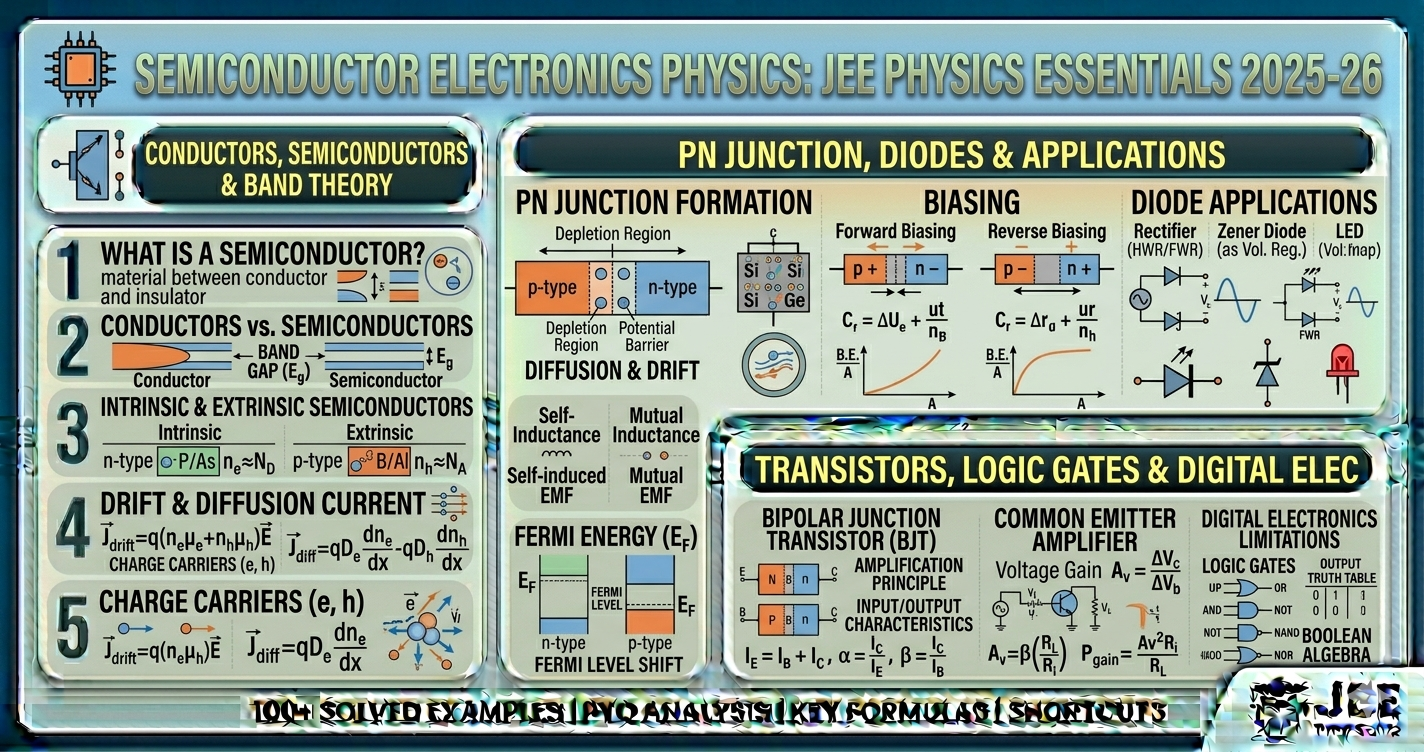
Semiconductor Electronics JEE Main & Advanced 2025-26

Master Modern Electronics with complete notes on PN Junction, Transistors, Rectifiers, Amplifiers, and Logic Gates. Includes 150+ solved problems and all JEE shortcuts.

📚 8 Complete Sections
✍️ 150+ Solved Examples
🎯 Truth Tables & Circuits
⭐⭐⭐⭐⭐ 4.8/5
312+ students rated this helpful
150+
Solved Examples
5 hrs
Study Time
Free
Always
Semiconductor Electronics JEE notes, Formulas, PYQs
Semiconductor Electronics JEE Notes, Formulas, PYQs
1

Energy Bands in Solids

When atoms come together to form a solid, their discrete energy levels split into continuous bands of energy due to electron interactions. Understanding energy bands is fundamental to classifying materials as conductors, insulators, or semiconductors.

1.1 Formation of Energy Bands

Key Concepts
  • Isolated Atom: Electrons occupy discrete energy levels (sharp lines)
  • Two Atoms Close: Each level splits into two (Pauli's exclusion principle)
  • N Atoms Close: Each level splits into N closely spaced levels → continuous band
  • Valence Band: Band formed by valence electrons (outermost electrons)
  • Conduction Band: Band above valence band where electrons can conduct
  • Forbidden Gap (Eg): Energy gap between valence and conduction bands

1.2 Classification of Solids Based on Band Gap

Conductors

Band Gap: Zero (Eg = 0)

  • Valence and conduction bands overlap
  • Free electrons always available
  • Resistivity: 10⁻² - 10⁻⁸ Ω·m
  • Examples: Cu, Ag, Au, Al

Conductivity increases with purity

σ decreases with temperature

Semiconductors

Band Gap: Small (Eg ≈ 1 eV)

  • Small forbidden gap
  • Some electrons jump to CB at room temp
  • Resistivity: 10⁻⁵ - 10⁶ Ω·m
  • Examples: Si (1.1 eV), Ge (0.7 eV)

σ increases with temperature

Negative temperature coefficient

Insulators

Band Gap: Large (Eg > 3 eV)

  • Large forbidden gap
  • No electrons can jump to CB normally
  • Resistivity: 10¹¹ - 10¹⁹ Ω·m
  • Examples: Diamond (6 eV), Glass

VB completely filled

CB completely empty

Energy Band Diagrams

   CONDUCTOR        SEMICONDUCTOR        INSULATOR
   
   ═══════════      ═══════════         ═══════════  ← Conduction Band
   Conduction       Conduction           Conduction
   Band             Band                 Band
   ─ ─ ─ ─ ─        
   ═══════════      ═ ═ ═ ═ ═                        
   Valence          (small gap)          (large gap)
   Band             Eg ≈ 1 eV            Eg > 3 eV
                    ═══════════          
                    Valence              ═══════════
                    Band                 Valence
                                         Band
                    
   (Overlapping)    (At room temp,      (No conduction
                    some e⁻ jump)        possible)
                    

💡 Important Points for JEE

  • At 0 K: Semiconductors behave like insulators (no thermal energy)
  • Conductivity vs Temperature: Metals ↓, Semiconductors ↑, Insulators ↑ (slightly)
  • Fermi Level: Highest occupied energy level at 0 K
  • Intrinsic semiconductor: Fermi level lies in middle of band gap
2

Types of Semiconductors

Semiconductors are classified based on their purity. Pure semiconductors are called intrinsic, while doped ones are called extrinsic. Doping dramatically changes the electrical properties.

2.1 Intrinsic Semiconductors

Pure Semiconductor Properties

Characteristics:

  • Pure Si or Ge crystal
  • Each atom has 4 valence electrons
  • Covalent bonding with neighbors
  • At 0 K: Behaves as insulator
  • At room temp: Some bonds break

Key Relations:

\[n_e = n_h = n_i\]

Where n_e = electron density, n_h = hole density

n_i = intrinsic carrier concentration

For Si at 300K: n_i ≈ 1.5 × 10¹⁶ /m³

2.2 Extrinsic Semiconductors (Doped)

N-Type Semiconductor

Dopant: Pentavalent (Group 15)

  • Dopants: P, As, Sb, Bi
  • 5 valence electrons → 4 bond, 1 free
  • Donor impurity (donates e⁻)
  • Majority carriers: Electrons
  • Minority carriers: Holes

Carrier Relation:

\[n_e \cdot n_h = n_i^2\]

n_e >> n_h (electrons dominate)

Fermi level: Shifts towards conduction band

P-Type Semiconductor

Dopant: Trivalent (Group 13)

  • Dopants: B, Al, Ga, In
  • 3 valence electrons → incomplete bonds
  • Acceptor impurity (accepts e⁻)
  • Majority carriers: Holes
  • Minority carriers: Electrons

Carrier Relation:

\[n_e \cdot n_h = n_i^2\]

n_h >> n_e (holes dominate)

Fermi level: Shifts towards valence band

Property Intrinsic N-Type P-Type
Purity Pure (99.9999%) Doped with pentavalent Doped with trivalent
Majority Carrier n_e = n_h Electrons Holes
Conductivity Low High (due to n_e) High (due to n_h)
Charge Neutral Neutral (overall) Neutral (overall)
Fermi Level Center of gap Near CB Near VB

⚠️ Common JEE Misconceptions

  • N-type is NOT negative: It's electrically neutral! "N" refers to majority carriers being electrons (negative)
  • P-type is NOT positive: It's also neutral! "P" refers to holes being majority carriers
  • Holes are NOT real particles: They represent absence of electrons in covalent bonds
  • Doping changes conductivity, NOT total charge

📝 Solved Example 1 (JEE Main 2023 Type)

Question: A pure silicon crystal has 5 × 10²⁸ atoms/m³. It is doped with 10²² phosphorus atoms/m³. Calculate electron and hole concentration if n_i = 1.5 × 10¹⁶/m³.

Solution:

Given: N_d (donor concentration) = 10²² /m³

n_i = 1.5 × 10¹⁶ /m³

Step 1: For N-type, electron concentration ≈ donor concentration

\[n_e \approx N_d = 10^{22} \text{ /m}^3\]

(Since N_d >> n_i)

Step 2: Using mass action law:

\[n_e \cdot n_h = n_i^2\]
\[n_h = \frac{n_i^2}{n_e} = \frac{(1.5 \times 10^{16})^2}{10^{22}}\]
\[n_h = \frac{2.25 \times 10^{32}}{10^{22}} = 2.25 \times 10^{10} \text{ /m}^3\]
\[\boxed{n_e = 10^{22} \text{ /m}^3, \quad n_h = 2.25 \times 10^{10} \text{ /m}^3}\]

✓ n_e >> n_h confirms N-type semiconductor

3

PN Junction Diode

When P-type and N-type semiconductors are joined together, a PN junction is formed. This is the fundamental building block of all semiconductor devices.

3.1 Formation of PN Junction

Depletion Region Formation

What Happens at Junction:

  1. Electrons diffuse from N to P region
  2. Holes diffuse from P to N region
  3. Immobile ions left behind (+ in N, - in P)
  4. Electric field develops (N→P direction)
  5. Field opposes further diffusion
  6. Equilibrium reached → Depletion region forms

Key Properties:

  • Depletion width: ~0.5 μm
  • Barrier potential (V_B):
    Si: ~0.7 V
    Ge: ~0.3 V
  • No free charge carriers in depletion region
  • Acts as insulator
  • Electric field exists across junction

3.2 Biasing of PN Junction

Forward Bias

Connection:

  • P → +ve terminal of battery
  • N → -ve terminal of battery

Effects:

  • External field opposes internal field
  • Depletion width ↓ (decreases)
  • Barrier potential ↓ (decreases)
  • When V > V_B: Current flows easily
  • Low resistance path

V_applied > 0.7V (Si) → conduction

Reverse Bias

Connection:

  • P → -ve terminal of battery
  • N → +ve terminal of battery

Effects:

  • External field aids internal field
  • Depletion width ↑ (increases)
  • Barrier potential ↑ (increases)
  • Very small reverse saturation current
  • High resistance path

I_reverse ≈ μA (due to minority carriers)

3.3 V-I Characteristics of Diode

Diode Equation (Shockley Equation)
\[I = I_0 \left(e^{eV/k_BT} - 1\right)\]

Where:

  • I = diode current
  • I₀ = reverse saturation current (μA order)
  • V = applied voltage
  • k_B = Boltzmann constant = 1.38 × 10⁻²³ J/K
  • T = absolute temperature
  • At room temp (300K): k_BT/e ≈ 26 mV

Forward Bias (V >> k_BT/e):

\[I \approx I_0 e^{eV/k_BT}\]

Exponential increase

Reverse Bias (V << 0):

\[I \approx -I_0\]

Small constant current

V-I Characteristics of PN Junction Diode

          I (mA)
           ↑
        100│                    ╱
           │                  ╱
         50│                ╱
           │              ╱
           │            ╱  Forward bias
           │          ╱    (exponential)
           │        ╱
    ───────┼──────┼────────────────→ V
   -V_B    │    V_knee (0.7V Si)
  (Reverse)│      
           │
        -μA│─────────────
           │ Reverse saturation
           │ current (I₀)
           │
    Breakdown
    (at V_BR)│╲
              │ ╲
              │  ╲ Zener breakdown
                    

🎯 Key Points for JEE

  • Knee voltage (Cut-in voltage): Si ≈ 0.7V, Ge ≈ 0.3V
  • Dynamic resistance: r_d = dV/dI (low in forward, high in reverse)
  • Diode behaves as: Short circuit (forward), Open circuit (reverse)
  • Depletion width formula: W ∝ √(V_B - V) for reverse bias
4

Rectifiers

Rectifiers convert AC (alternating current) to DC (direct current). This is one of the most important applications of diodes and a guaranteed topic in JEE.

4.1 Half-Wave Rectifier

Working Principle

Circuit Components:

  • Single PN junction diode
  • AC input source
  • Load resistor (R_L)
  • Transformer (optional)

Operation:

  • +ve half cycle: Diode forward biased → current flows
  • -ve half cycle: Diode reverse biased → no current
  • Only half of input cycle reaches output

Important Formulas:

\[V_{dc} = \frac{V_m}{\pi} = 0.318 V_m\]
\[I_{dc} = \frac{I_m}{\pi}\]
\[V_{rms} = \frac{V_m}{2}\]
\[\text{Ripple factor} = 1.21\]
\[\text{Efficiency} = 40.6\%\]

4.2 Full-Wave Rectifier

Center-Tap Full-Wave Rectifier

Circuit Components:

  • Two PN junction diodes
  • Center-tapped transformer
  • Load resistor (R_L)

Operation:

  • +ve half: D₁ conducts, D₂ off
  • -ve half: D₂ conducts, D₁ off
  • Both halves utilized → better DC

Important Formulas:

\[V_{dc} = \frac{2V_m}{\pi} = 0.636 V_m\]
\[I_{dc} = \frac{2I_m}{\pi}\]
\[V_{rms} = \frac{V_m}{\sqrt{2}}\]
\[\text{Ripple factor} = 0.48\]
\[\text{Efficiency} = 81.2\%\]

4.3 Bridge Rectifier (Most Efficient)

Four Diode Bridge Configuration

Advantages over Center-Tap:

  • No center-tap transformer needed
  • Higher PIV per diode = V_m (vs 2V_m in center-tap)
  • Better transformer utilization
  • Uses 4 diodes instead of 2

Same output characteristics as full-wave:

V_dc = 0.636 V_m
Ripple = 0.48
Efficiency = 81.2%
PIV = V_m per diode
Parameter Half-Wave Full-Wave
Number of diodes 1 2 (CT) or 4 (Bridge)
V_dc V_m/π = 0.318V_m 2V_m/π = 0.636V_m
Ripple factor 1.21 0.48
Efficiency 40.6% 81.2%
Ripple frequency f 2f
PIV V_m 2V_m (CT), V_m (Bridge)

📝 Solved Example 2 (JEE Main Pattern)

Question: A full-wave rectifier uses a transformer of turns ratio 5:1. If primary voltage is 220V (rms), calculate the DC output voltage. (Assume ideal diodes)

Solution:

Given: Turns ratio = 5:1, V_primary = 220V (rms)

Step 1: Find secondary voltage

\[V_{secondary} = \frac{V_{primary}}{5} = \frac{220}{5} = 44V \text{ (rms)}\]

Step 2: Find peak secondary voltage

\[V_m = V_{rms} \times \sqrt{2} = 44 \times 1.414 = 62.2V\]

Step 3: Calculate DC output for full-wave rectifier

\[V_{dc} = \frac{2V_m}{\pi} = \frac{2 \times 62.2}{3.14} = 39.6V\]
\[\boxed{V_{dc} \approx 40V}\]
5

Special Purpose Diodes

5.1 Zener Diode

Working in Breakdown Region

Key Features:

  • Heavily doped PN junction
  • Operates in reverse breakdown
  • Voltage remains constant in breakdown
  • Used as voltage regulator

Breakdown Mechanisms:

  • Zener breakdown: V_Z < 6V (field ionization)
  • Avalanche breakdown: V_Z > 6V (impact ionization)

Zener as Voltage Regulator:

Output voltage = V_Z (constant)

\[I_S = \frac{V_{in} - V_Z}{R_S}\]
\[I_L = \frac{V_Z}{R_L}\]
\[I_Z = I_S - I_L\]

For regulation: I_Z > I_Z(min)

5.2 Photodiode

Working Principle
  • Operated in reverse bias
  • Light incident on junction
  • Photons generate electron-hole pairs
  • Reverse current increases with light intensity

Applications:

  • Light sensors
  • Optical communication
  • Solar cells
Key Relation

Photocurrent depends on intensity:

\[I_{photo} \propto \text{Light Intensity}\]

Condition for generation:

\[h\nu \geq E_g\]

Photon energy ≥ Band gap

5.3 Light Emitting Diode (LED)

Working Principle
  • Operated in forward bias
  • Electrons recombine with holes at junction
  • Energy released as photons (light)
  • Uses direct band gap semiconductors

Materials for Different Colors:

  • GaAs: Infrared
  • GaAsP: Red, Yellow
  • GaP: Green
  • InGaN: Blue, White
Key Relation

Wavelength of emitted light:

\[\lambda = \frac{hc}{E_g}\]
\[\lambda (\text{nm}) = \frac{1240}{E_g (\text{eV})}\]

Higher E_g → shorter wavelength → blue/violet

Lower E_g → longer wavelength → red/infrared

5.4 Solar Cell (Photovoltaic Cell)

Working Principle
  • Converts light energy directly to electrical energy
  • No external bias required (generates its own EMF)
  • Electron-hole pairs created by sunlight
  • Internal electric field separates carriers
  • Open circuit voltage: 0.5-1V per cell

Common Materials:

Si (most common), GaAs (high efficiency), CdTe, CIGS

📝 Solved Example 3 (Zener Diode)

Question: A Zener diode of V_Z = 6V is used with series resistance R_S = 100Ω. If input varies from 10V to 16V, find range of Zener current for R_L = 1kΩ.

Solution:

Load current (constant):

\[I_L = \frac{V_Z}{R_L} = \frac{6}{1000} = 6 \text{ mA}\]

When V_in = 10V:

\[I_S = \frac{V_{in} - V_Z}{R_S} = \frac{10-6}{100} = 40 \text{ mA}\]
\[I_Z = I_S - I_L = 40 - 6 = 34 \text{ mA}\]

When V_in = 16V:

\[I_S = \frac{16-6}{100} = 100 \text{ mA}\]
\[I_Z = 100 - 6 = 94 \text{ mA}\]
\[\boxed{I_Z \text{ ranges from } 34 \text{ mA to } 94 \text{ mA}}\]
6

Bipolar Junction Transistors (BJT)

A transistor is a three-terminal semiconductor device used for amplification and switching. It consists of three alternating regions: Emitter, Base, and Collector.

6.1 Types of Transistors

NPN Transistor

Structure: N-P-N

  • Emitter: N-type (heavily doped)
  • Base: P-type (thin, lightly doped)
  • Collector: N-type (moderately doped)

Current Flow:

  • Majority carriers: Electrons
  • Current: Collector → Emitter
  • Electron flow: Emitter → Collector
I_E = I_B + I_C (Current relation)
PNP Transistor

Structure: P-N-P

  • Emitter: P-type (heavily doped)
  • Base: N-type (thin, lightly doped)
  • Collector: P-type (moderately doped)

Current Flow:

  • Majority carriers: Holes
  • Current: Emitter → Collector
  • Hole flow: Emitter → Collector
I_E = I_B + I_C (Same relation)

6.2 Transistor Action

Biasing for Active Mode (NPN)

Biasing Conditions:

  • Emitter-Base: Forward biased
  • Collector-Base: Reverse biased

Current Flow Mechanism:

  1. E-B forward bias → electrons enter base
  2. Base thin → most electrons reach collector
  3. C-B reverse bias → electrons swept to collector
  4. Small base current controls large collector current

Key Current Relations:

\[I_E = I_B + I_C\]
\[\alpha = \frac{I_C}{I_E} \approx 0.95 - 0.99\]
\[\beta = \frac{I_C}{I_B} \approx 20 - 500\]
\[\beta = \frac{\alpha}{1-\alpha}\]
\[\alpha = \frac{\beta}{1+\beta}\]

6.3 Transistor Configurations

Parameter Common Base (CB) Common Emitter (CE) Common Collector (CC)
Input Emitter Base Base
Output Collector Collector Emitter
Current Gain α < 1 β >> 1 (20-500) β + 1
Voltage Gain High (~150) High (~500) ~1 (Unity)
Power Gain Medium Very High Medium
Input Resistance Low (~100Ω) Medium (~1kΩ) High (~100kΩ)
Output Resistance High (~1MΩ) Medium (~50kΩ) Low (~100Ω)
Phase Shift 0° (in phase) 180° (inverted) 0° (in phase)
Application High freq circuits Audio amplifiers Impedance matching

🎯 Most Important for JEE

Must Memorize:

  • I_E = I_B + I_C
  • β = I_C/I_B = α/(1-α)
  • α = I_C/I_E = β/(1+β)
  • CE has highest power gain
  • CC is called emitter follower

Common Question Types:

  • Find β given α (or vice versa)
  • Calculate I_C given I_B and β
  • Identify configuration from circuit
  • Calculate voltage/current gain

📝 Solved Example 4 (JEE Main 2024 Type)

Question: In a transistor, α = 0.98. Find β, and if I_B = 50 μA, calculate I_C and I_E.

Solution:

Step 1: Calculate β

\[\beta = \frac{\alpha}{1-\alpha} = \frac{0.98}{1-0.98} = \frac{0.98}{0.02} = 49\]

Step 2: Calculate I_C

\[I_C = \beta \times I_B = 49 \times 50 = 2450 \text{ μA} = 2.45 \text{ mA}\]

Step 3: Calculate I_E

\[I_E = I_B + I_C = 50 + 2450 = 2500 \text{ μA} = 2.5 \text{ mA}\]

Verification:

\[\alpha = \frac{I_C}{I_E} = \frac{2450}{2500} = 0.98 \checkmark\]
\[\boxed{\beta = 49, \quad I_C = 2.45 \text{ mA}, \quad I_E = 2.5 \text{ mA}}\]
7

Transistor as Amplifier & Switch

7.1 Transistor as Amplifier (CE Configuration)

Amplifier Parameters

Current Gain:

\[A_i = \beta = \frac{\Delta I_C}{\Delta I_B}\]

Voltage Gain:

\[A_v = \beta \times \frac{R_{out}}{R_{in}} = \frac{\Delta V_{out}}{\Delta V_{in}}\]

Power Gain:

\[A_p = A_v \times A_i = \beta^2 \times \frac{R_{out}}{R_{in}}\]

In Decibels:

\[G_p = 10 \log_{10}(A_p) \text{ dB}\]

7.2 Transistor as Switch

Cut-off Region (OFF)

Condition:

  • I_B = 0 (no base current)
  • Both junctions reverse biased
  • I_C ≈ 0
  • V_CE ≈ V_CC (supply voltage)

Output: HIGH (Logic 1)

Transistor acts as open switch

Saturation Region (ON)

Condition:

  • I_B > I_B(sat)
  • Both junctions forward biased
  • I_C = I_C(sat) = V_CC/R_C
  • V_CE ≈ 0 (nearly zero)

Output: LOW (Logic 0)

Transistor acts as closed switch

⚠️ Important Note for Digital Circuits

When transistor is used as switch in digital circuits:

  • Input HIGH (1): Transistor ON (saturated) → Output LOW (0)
  • Input LOW (0): Transistor OFF (cut-off) → Output HIGH (1)
  • This is why single transistor acts as NOT gate (Inverter)
8

Logic Gates & Digital Electronics

Logic gates are the building blocks of digital circuits. They perform basic logical operations on binary inputs (0 and 1). This is one of the most scoring topics in JEE with guaranteed 1-2 questions.

8.1 Basic Logic Gates

AND Gate

Y = A · B (A AND B)

Output is 1 only when ALL inputs are 1

ABY
000
010
100
111
OR Gate

Y = A + B (A OR B)

Output is 1 when ANY input is 1

ABY
000
011
101
111
NOT Gate (Inverter)

Y = Ā (NOT A)

Output is complement of input

AY
01
10

Single transistor can work as NOT gate

8.2 Universal Gates (NAND & NOR)

NAND Gate (Universal)

Y = A · B (NOT AND)

Output is 0 only when ALL inputs are 1

ABY
001
011
101
110

Universal: Can make any gate using only NAND!

NOR Gate (Universal)

Y = A + B (NOT OR)

Output is 1 only when ALL inputs are 0

ABY
001
010
100
110

Universal: Can make any gate using only NOR!

8.3 XOR and XNOR Gates

XOR Gate (Exclusive OR)

Y = A ⊕ B = Ā·B + A·B̄

Output is 1 when inputs are DIFFERENT

ABY
000
011
101
110

Used in comparators and adders

XNOR Gate (Exclusive NOR)

Y = A ⊕ B = A·B + Ā·B̄

Output is 1 when inputs are SAME

ABY
001
010
100
111

Also called Equality gate

8.4 Making Gates from NAND Only

NAND as Building Block

NOT from NAND:

Connect both inputs together

Ā = NAND(A,A)

Uses: 1 NAND gate

AND from NAND:

NAND followed by NOT

A·B = NOT(NAND(A,B))

Uses: 2 NAND gates

OR from NAND:

NOT both inputs, then NAND

A+B = NAND(Ā,B̄)

Uses: 3 NAND gates

🎯 Memory Tricks for Truth Tables

  • AND: Both must be 1 for output 1 (multiplication)
  • OR: Any 1 gives output 1 (addition, max 1)
  • NAND: NOT AND - just invert AND output
  • NOR: NOT OR - just invert OR output
  • XOR: "Different = 1" (odd number of 1s)
  • XNOR: "Same = 1" (even number of 1s)
  • Universal gates: NAND and NOR only!
  • Quick check: NAND of (1,1)=0; NOR of (0,0)=1

📝 Solved Example 5 (JEE Main Pattern)

Question: Find the output Y for the given circuit if A=1, B=0, C=1.
Circuit: Y = (A + B) · C̄

Solution:

Step 1: Calculate (A + B)

\[A + B = 1 + 0 = 1 \text{ (OR operation)}\]

Step 2: Calculate C̄

\[\bar{C} = \bar{1} = 0 \text{ (NOT operation)}\]

Step 3: Calculate final output

\[Y = (A + B) \cdot \bar{C} = 1 \cdot 0 = 0 \text{ (AND operation)}\]
\[\boxed{Y = 0}\]

8.5 Boolean Algebra Laws (Quick Reference)

Law AND Form OR Form
Identity A · 1 = A A + 0 = A
Null A · 0 = 0 A + 1 = 1
Idempotent A · A = A A + A = A
Complement A · Ā = 0 A + Ā = 1
Commutative A · B = B · A A + B = B + A
Associative (A·B)·C = A·(B·C) (A+B)+C = A+(B+C)
Distributive A·(B+C) = A·B + A·C A+(B·C) = (A+B)·(A+C)
De Morgan's A·B = Ā + B̄ A+B = Ā · B̄
Absorption A·(A+B) = A A + A·B = A

⚠️ De Morgan's Theorem (Most Important!)

First Theorem:

\[\overline{A \cdot B} = \bar{A} + \bar{B}\]

NOT of AND = OR of NOTs

NAND = OR with inverted inputs

Second Theorem:

\[\overline{A + B} = \bar{A} \cdot \bar{B}\]

NOT of OR = AND of NOTs

NOR = AND with inverted inputs

💡 Memory Trick: "Break the bar, change the sign" (· ↔ +)

📝 Solved Example 6 (Boolean Simplification)

Question: Simplify: Y = A·B + A·B̄ + Ā·B

Solution:

Step 1: Factor out A from first two terms

\[Y = A(B + \bar{B}) + \bar{A} \cdot B\]

Step 2: Apply complement law (B + B̄ = 1)

\[Y = A \cdot 1 + \bar{A} \cdot B = A + \bar{A} \cdot B\]

Step 3: Apply absorption law (A + Ā·B = A + B)

\[Y = A + B\]
\[\boxed{Y = A + B \text{ (OR gate)}}\]

📝 Previous Year Questions Analysis

JEE Main (Last 5 Years)

  • ✓ Logic Gates & Truth Tables: 35%
  • ✓ PN Junction & Diodes: 30%
  • ✓ Transistors (α, β relations): 20%
  • ✓ Rectifiers & Special Diodes: 15%

JEE Advanced (Last 5 Years)

  • ✓ Transistor configurations: 35%
  • ✓ Boolean algebra & De Morgan: 25%
  • ✓ Energy bands & doping: 25%
  • ✓ Circuit analysis: 15%

Top 15 Most Repeated Question Types

  1. Identify output of combined logic gates circuit
  2. Find β given α (or α given β) for transistors
  3. Calculate DC output voltage of rectifier
  4. Identify N-type vs P-type from doping information
  5. Truth table completion for given Boolean expression
  6. Zener diode voltage regulation calculations
  7. Simplify Boolean expressions using laws
  8. Apply De Morgan's theorem
  9. Calculate I_C, I_B, I_E relationships
  10. Identify universal gates (NAND/NOR)
  11. Forward vs reverse bias identification
  12. Making basic gates from NAND only
  13. Energy band gap and conductivity questions
  14. LED wavelength from band gap energy
  15. Transistor as switch (cut-off/saturation)

Weightage Analysis

JEE Main: 8-12 marks (2-3 questions)
JEE Advanced: 6-10 marks (2 questions)
Difficulty Level: Easy to Medium
Time Required: 5-6 hours practice

Year-wise Topic Distribution

Year JEE Main Topics JEE Advanced Topics
2024 Logic gates output, Transistor β Boolean simplification, CE amplifier
2023 NAND/NOR truth tables, Rectifier De Morgan's theorem, Zener
2022 N-type/P-type, XOR gate Transistor configurations, LED
2021 Diode characteristics, α-β relation Energy bands, Photodiode

🎯 Practice Problem Set

Level 1: Basic (JEE Main Standard)

  1. What is the band gap energy of Silicon and Germanium?
  2. In N-type semiconductor, which are majority and minority carriers?
  3. If α = 0.95, find the value of β.
  4. Draw the truth table for NAND gate.
  5. What is the knee voltage for Silicon and Germanium diodes?
  6. Calculate V_dc for a half-wave rectifier if V_m = 100V.
  7. Identify whether the gate with truth table (00→1, 01→0, 10→0, 11→0) is OR, NOR, AND, or NAND.
  8. What happens to depletion region width in forward bias?
  9. Calculate I_E if I_B = 20 μA and β = 100.
  10. Name two universal gates.

Level 2: Intermediate (JEE Main/Advanced)

  1. A Si crystal has 5×10²² atoms/m³. It is doped with 10²⁰ arsenic atoms/m³. Find majority and minority carrier concentrations. (n_i = 1.5×10¹⁶/m³)
  2. In a transistor, I_C = 4.9 mA and I_E = 5 mA. Find α, β, and I_B.
  3. A Zener diode (V_Z = 5V) is used with R_S = 200Ω and R_L = 1kΩ. If V_in = 12V, find I_Z.
  4. Simplify: Y = (A + B)(A + C) using Boolean algebra.
  5. Design an AND gate using only NAND gates. How many NAND gates are needed?
  6. A full-wave rectifier has input 220V (rms) with transformer ratio 10:1. Find DC output voltage.
  7. Find the output Y for: Y = (A ⊕ B) · C when A=1, B=1, C=1.
  8. In CE configuration, if input resistance = 1kΩ, output resistance = 10kΩ, and β = 50, find voltage gain.
  9. Apply De Morgan's theorem to simplify: Y = (A+B)·(C+D)
  10. Calculate the wavelength of light emitted by an LED with E_g = 1.8 eV.

Level 3: Advanced (JEE Advanced/Olympiad)

  1. In a transistor, the base current changes from 50 μA to 150 μA and collector current changes from 2 mA to 6 mA. Find dynamic values of α and β.
  2. Design a circuit using only NOR gates to implement: Y = A·B + C.
  3. A semiconductor has n_e = 10²⁰/m³ and μ_e = 0.4 m²/V·s, n_h = 10¹⁸/m³ and μ_h = 0.2 m²/V·s. Find conductivity.
  4. Prove that XNOR can be expressed as: Y = A·B + Ā·B̄.
  5. In a CE amplifier, V_CC = 12V, R_C = 2kΩ, β = 100, and V_BE = 0.7V. If R_B = 100kΩ, find I_C and V_CE.
  6. Simplify using K-map: Y = Σm(0,1,2,4,5,6) where inputs are A, B, C.
  7. The reverse saturation current of a diode doubles for every 10°C rise in temperature. If I_0 = 10 nA at 27°C, find I_0 at 57°C.
  8. Design a half-adder using only NAND gates.
  9. A photodiode has responsivity 0.5 A/W. If 1 mW light of suitable wavelength falls on it, find photocurrent.
  10. Prove that any Boolean function can be implemented using only NAND gates.

📋 Quick Formula Reference Sheet

Semiconductor Basics

  • n_e · n_h = n_i²
  • σ = e(n_e·μ_e + n_h·μ_h)
  • E_g(Si) = 1.1 eV
  • E_g(Ge) = 0.7 eV

PN Junction

  • V_knee(Si) = 0.7V
  • V_knee(Ge) = 0.3V
  • I = I_0(e^(eV/kT) - 1)
  • kT/e ≈ 26 mV at 300K

Rectifiers

  • HW: V_dc = V_m/π = 0.318V_m
  • FW: V_dc = 2V_m/π = 0.636V_m
  • HW: η = 40.6%
  • FW: η = 81.2%

Transistor

  • I_E = I_B + I_C
  • α = I_C/I_E (0.95-0.99)
  • β = I_C/I_B (20-500)
  • β = α/(1-α)
  • α = β/(1+β)

Amplifier Gains

  • A_i = β (current gain)
  • A_v = β·R_out/R_in
  • A_p = A_v·A_i
  • G = 10log₁₀(A_p) dB

LED/Photodiode

  • λ = hc/E_g
  • λ(nm) = 1240/E_g(eV)
  • Photocurrent ∝ Intensity
  • hν ≥ E_g for generation

Logic Gates Quick Reference

Gate Symbol Expression When Output = 1
AND·Y = A·BBoth inputs = 1
OR+Y = A+BAny input = 1
NOTY = ĀInput = 0
NAND·̄Y = A·BNOT all inputs = 1
NORY = A+BAll inputs = 0
XORY = A⊕BInputs different
XNORY = A⊕BInputs same

Related Physics Notes

Semiconductor Electronics - Complete Guide for JEE 2025-26

Why Semiconductor Electronics is Important for JEE?

Semiconductor Electronics is one of the most scoring chapters in JEE Physics. It carries 6-10% weightage and offers easy marks if you understand the concepts properly:

  • Logic Gates - Guaranteed 1-2 questions in JEE Main (direct formula application)
  • Transistor α-β relations - Simple calculations, high scoring
  • PN Junction - Conceptual questions, easy if understood properly
  • Rectifiers - Formula-based, straightforward problems

In JEE Advanced, expect more complex Boolean algebra simplification and transistor circuit analysis questions.

Key Topics & Must-Know Formulas

1. Semiconductor Basics

  • • n_e · n_h = n_i² (Mass action law)
  • • N-type: Pentavalent dopants (P, As)
  • • P-type: Trivalent dopants (B, Al)

2. Transistor Relations

  • • I_E = I_B + I_C
  • • β = α/(1-α) = I_C/I_B
  • • α = β/(1+β) = I_C/I_E

3. Rectifier Outputs

  • • Half-wave: V_dc = 0.318 V_m
  • • Full-wave: V_dc = 0.636 V_m
  • • Full-wave efficiency = 81.2%

📚 How to Master Semiconductor Electronics for JEE?

For JEE Main Students:

  1. Time Required: 5-6 days (3 hours/day)
  2. Master all 7 logic gate truth tables - memorize them!
  3. Practice α-β conversions until you can do them in 10 seconds
  4. Learn rectifier formulas (V_dc, efficiency, ripple)
  5. Understand N-type vs P-type conceptually
  6. Solve 50+ JEE Main PYQs (2015-2024)

For JEE Advanced Students:

  1. Time Required: 7-8 days (4 hours/day)
  2. Master Boolean algebra and De Morgan's theorems
  3. Practice building gates from NAND/NOR only
  4. Understand transistor as amplifier and switch in depth
  5. Study Zener diode voltage regulation circuits
  6. Solve JEE Advanced PYQs + Boolean simplification

⚠️ Common Mistakes Students Make in JEE Exam

  • Confusing α and β: Remember α < 1 (always!), β >> 1. Use β = α/(1-α) to convert.
  • Wrong truth table for NAND: NAND gives 0 ONLY when both inputs are 1. All other combinations give 1.
  • N-type is negative charge: NO! N-type is electrically neutral. "N" refers to negative charge carriers (electrons) being majority.
  • De Morgan's application: When breaking the bar, change AND to OR (or vice versa). Don't forget to invert BOTH terms!
  • Rectifier formulas: Half-wave uses 1/π, Full-wave uses 2/π. Don't mix them up!

📊 Topic-wise Weightage Breakdown (Last 10 Years)

Topic JEE Main % JEE Advanced % Difficulty Strategy
Logic Gates 35% 25% Easy Memorize all truth tables
Transistors 25% 35% Medium Master α-β relations
PN Junction & Diodes 25% 20% Easy-Medium Understand biasing clearly
Rectifiers & Zener 15% 20% Easy Learn V_dc formulas

Pro Tip: Logic gates alone can fetch you 8-12 marks in JEE Main if you've memorized all truth tables and can identify gate combinations quickly.

⚡ Last Minute Revision Points (24 Hours Before Exam)

Truth Tables to Remember

  • ✓ AND: 1 only when both 1
  • ✓ OR: 0 only when both 0
  • ✓ NAND: 0 only when both 1
  • ✓ NOR: 1 only when both 0
  • ✓ XOR: 1 when different
  • ✓ XNOR: 1 when same

Critical Values

  • ✓ Si: E_g=1.1eV, V_knee=0.7V
  • ✓ Ge: E_g=0.7eV, V_knee=0.3V
  • ✓ α range: 0.95 - 0.99
  • ✓ β range: 20 - 500
  • ✓ HW efficiency: 40.6%
  • ✓ FW efficiency: 81.2%

Key Relations

  • ✓ I_E = I_B + I_C
  • ✓ β = α/(1-α)
  • ✓ n_e · n_h = n_i²
  • ✓ λ = 1240/E_g(eV) nm
  • ✓ De Morgan: Break bar, change sign
  • ✓ Universal gates: NAND, NOR