
📑 Quick Navigation - Chemical Kinetics

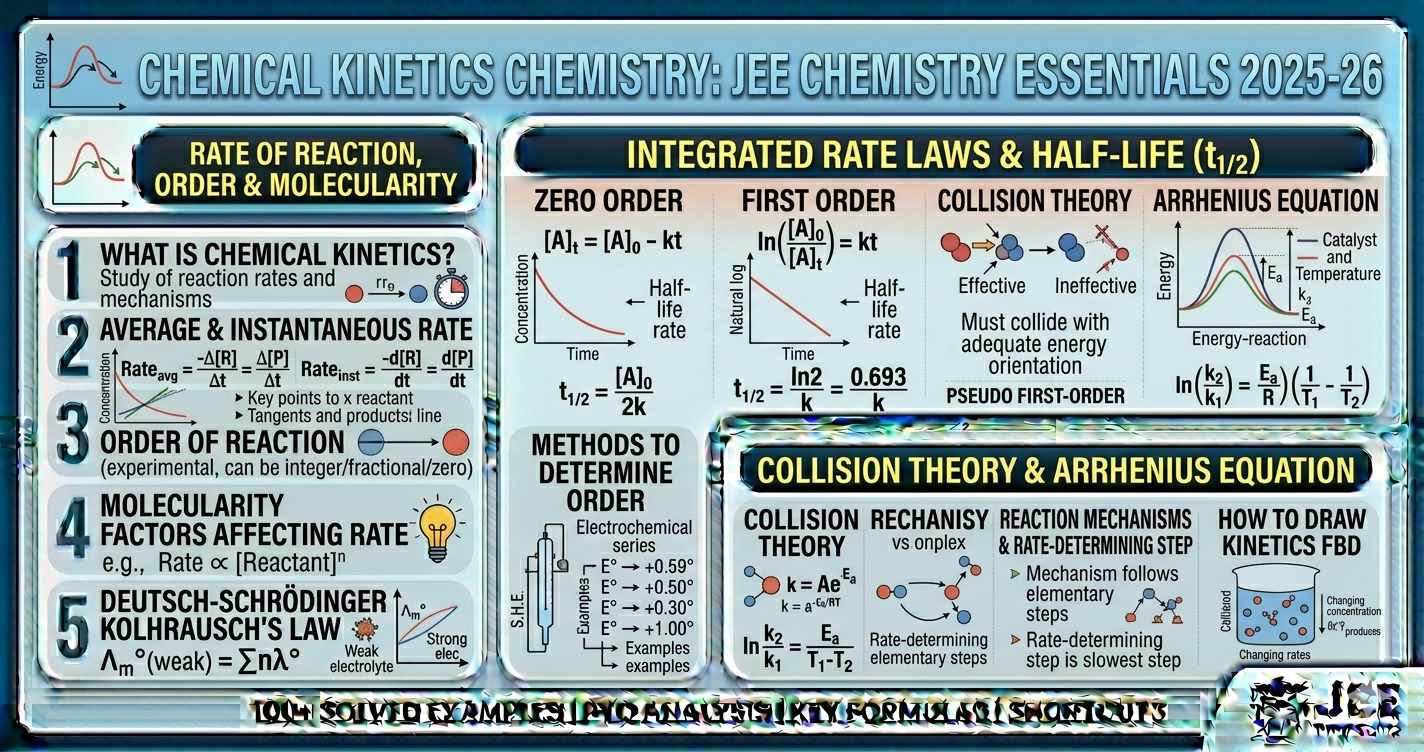
Chemical Kinetics JEE Main & Advanced 2025-26

Master Chemical Kinetics with complete notes on Rate of Reaction, Order, Integrated Rate Laws, Arrhenius Equation, and Reaction Mechanisms. Includes 100+ solved problems and all JEE formulas.

📚 8 Complete Sections
✍️ 100+ Solved Examples
🎯 Quick Formulas
⭐⭐⭐⭐⭐ 4.9/5
280+ students rated this helpful
100+
Solved Examples
4 hrs
Study Time
Free
Always
Chemical Kinetics JEE notes, Formulas, PYQs
Chemical Kinetics JEE Notes, Formulas, PYQs
1

Rate of Reaction

Rate of reaction measures how fast reactants are converted into products. It is defined as the change in concentration of reactants or products per unit time.

1.1 Definition of Rate

General Reaction: aA + bB → cC + dD

Rate can be expressed in terms of any reactant or product:

\[\text{Rate} = -\frac{1}{a}\frac{d[A]}{dt} = -\frac{1}{b}\frac{d[B]}{dt} = +\frac{1}{c}\frac{d[C]}{dt} = +\frac{1}{d}\frac{d[D]}{dt}\]

Important Notes:

  • Negative sign for reactants (concentration decreases)
  • Positive sign for products (concentration increases)
  • Division by stoichiometric coefficient to make rate same for all species
  • Unit: mol L⁻¹ s⁻¹ or M/s

1.2 Types of Rate

Average Rate

Rate measured over a time interval Δt

\[r_{\text{avg}} = -\frac{\Delta[A]}{\Delta t}\]

Example: Change from t₁ to t₂

Instantaneous Rate

Rate at a particular instant (Δt → 0)

\[r = -\frac{d[A]}{dt}\]

Slope of tangent to concentration-time curve

1.3 Factors Affecting Rate of Reaction

Factor Effect Explanation
Concentration Rate ↑ with concentration ↑ More molecules → More collisions
Temperature Rate ↑ with temperature ↑ More kinetic energy → More effective collisions
Surface Area Rate ↑ with surface area ↑ More contact area for heterogeneous reactions
Catalyst Rate ↑ significantly Lowers activation energy, provides alternate pathway
Nature of Reactants Varies Ionic reactions faster than covalent

1.4 Rate Law

Definition

Rate law expresses the relationship between rate and concentration of reactants.

\[\text{For: } aA + bB \rightarrow \text{Products}\] \[\text{Rate} = k[A]^x[B]^y\]

Where:

  • k = rate constant (characteristic of reaction at given temperature)
  • x, y = order with respect to A and B (determined experimentally)
  • x + y = overall order of reaction
  • Important: x ≠ a and y ≠ b (unless elementary reaction)

⚠️ JEE Important Point

Rate law cannot be written from balanced equation! It must be determined experimentally. The exponents in rate law are NOT necessarily equal to stoichiometric coefficients.

2

Order and Molecularity

Understanding the difference between order and molecularity is crucial for JEE. These are frequently confused concepts with distinct definitions.

2.1 Order of Reaction

Definition

Order is the sum of powers of concentration terms in the experimentally determined rate law.

\[\text{Rate} = k[A]^x[B]^y\] \[\text{Order with respect to A} = x\] \[\text{Order with respect to B} = y\] \[\text{Overall Order} = x + y\]

Characteristics:

  • Experimental quantity - determined from rate measurements
  • Can be zero, fractional, or whole number
  • Can be positive or negative (rare)
  • Applies to overall reaction
  • Example: Rate = k[A]1.5[B]0 → Order = 1.5

2.2 Molecularity

Definition

Molecularity is the number of reacting species (molecules, atoms, or ions) that must collide simultaneously in an elementary reaction.

Characteristics:

  • Theoretical quantity - from reaction mechanism
  • Always a whole number (1, 2, or 3)
  • Never zero or fractional
  • Applies to elementary steps only
  • Molecularity > 3 is extremely rare (low probability)

2.3 Types Based on Molecularity

Unimolecular

Only one molecule involved

Example:

NH₄NO₂ → N₂ + 2H₂O

PCl₅ → PCl₃ + Cl₂

Bimolecular

Two molecules collide

Example:

2HI → H₂ + I₂

CH₃Br + OH⁻ → CH₃OH + Br⁻

Trimolecular

Three molecules collide

Example:

2NO + O₂ → 2NO₂

(Very rare due to low probability)

2.4 Order vs Molecularity - Comparison Table

Property Order Molecularity
Definition Sum of exponents in rate law Number of molecules in elementary step
Nature Experimental Theoretical
Possible Values 0, fractional, integer, negative Only 1, 2, or 3 (whole numbers)
Applies To Overall reaction Elementary steps only
Can Be Zero? Yes No (minimum 1)
Can Be Fractional? Yes (e.g., 1.5, 2.5) No (always integer)
Temperature Effect Generally independent Always independent
Example 2N₂O₅ → 4NO₂ + O₂ (Order = 1) 2NO + O₂ → 2NO₂ (Molecularity = 3)

💡 JEE Memory Trick

"MOTEL" for Molecularity vs Order:

  • Molecularity - Only for eLementary reactions
  • Molecularity - Theoretical, Experiment not needed
  • Order - Experimental
  • Order - for overLl reaction

2.5 Determining Order from Experimental Data

Initial Rate Method

Compare rates when concentrations are varied

For reaction: A + B → Products

Rate = k[A]x[B]y

Step 1: Keep [B] constant, vary [A]

Rate₁/Rate₂ = ([A]₁/[A]₂)ˣ

Step 2: Keep [A] constant, vary [B]

Rate₁/Rate₂ = ([B]₁/[B]₂)ʸ

📝 Solved Example 1

Question: For reaction 2A + B → C, determine order with respect to A and B from data:

Exp. [A] (M) [B] (M) Rate (M/s)
1 0.1 0.1 2.0 × 10⁻³
2 0.2 0.1 8.0 × 10⁻³
3 0.1 0.2 4.0 × 10⁻³

Solution:

Step 1: Find order w.r.t. A (compare Exp 1 & 2, [B] constant)

\[\frac{r_2}{r_1} = \left(\frac{[A]_2}{[A]_1}\right)^x\] \[\frac{8.0 \times 10^{-3}}{2.0 \times 10^{-3}} = \left(\frac{0.2}{0.1}\right)^x\] \[4 = 2^x \Rightarrow x = 2\]

Step 2: Find order w.r.t. B (compare Exp 1 & 3, [A] constant)

\[\frac{r_3}{r_1} = \left(\frac{[B]_3}{[B]_1}\right)^y\] \[\frac{4.0 \times 10^{-3}}{2.0 \times 10^{-3}} = \left(\frac{0.2}{0.1}\right)^y\] \[2 = 2^y \Rightarrow y = 1\]

Answer:

Order w.r.t. A = 2

Order w.r.t. B = 1

Overall Order = 2 + 1 = 3

Rate law: Rate = k[A]²[B]

3

Zero Order Reaction

A zero-order reaction is one whose rate is independent of the concentration of reactants. The rate remains constant throughout the reaction.

3.1 Rate Law and Integrated Form

For Reaction: A → Products

Rate Law:

\[\text{Rate} = k[A]^0 = k\]

Integrated Rate Law:

\[[A] = [A]_0 - kt\]

where [A]₀ = initial concentration, [A] = concentration at time t

Half-Life:

\[t_{1/2} = \frac{[A]_0}{2k}\]

Depends on initial concentration!

Unit of k:

mol L⁻¹ s⁻¹ or M s⁻¹

3.2 Characteristics of Zero Order Reaction

Graph: [A] vs time

Linear graph with negative slope

Slope = -k

Intercept = [A]₀

Graph: Rate vs [A]

Horizontal line parallel to x-axis

Rate = constant = k

Independent of concentration

3.3 Examples of Zero Order Reactions

  • 1.

    Photochemical reactions:

    H₂ + Cl₂ → 2HCl (in presence of light)

    Rate depends on light intensity, not reactant concentration

  • 2.

    Enzyme-catalyzed reactions (at high substrate concentration):

    Enzyme gets saturated, rate becomes constant

  • 3.

    Heterogeneous reactions on metal surface:

    2NH₃(g) → N₂(g) + 3H₂(g) on Pt surface

    Surface gets saturated with reactant molecules

📝 Solved Example 2

Question: A zero-order reaction has k = 0.02 mol L⁻¹ min⁻¹. If initial concentration is 0.8 M, calculate:
(a) Concentration after 10 minutes
(b) Half-life
(c) Time for 75% completion

Solution:

(a) Concentration after 10 min:

\[[A] = [A]_0 - kt\] \[[A] = 0.8 - (0.02)(10)\] \[[A] = 0.8 - 0.2 = 0.6 \text{ M}\]

(b) Half-life:

\[t_{1/2} = \frac{[A]_0}{2k} = \frac{0.8}{2 \times 0.02}\] \[t_{1/2} = \frac{0.8}{0.04} = 20 \text{ min}\]

(c) Time for 75% completion:

75% completion means 25% remains

\[[A] = 0.25 \times [A]_0 = 0.25 \times 0.8 = 0.2 \text{ M}\] \[0.2 = 0.8 - 0.02t\] \[0.02t = 0.6\] \[t = 30 \text{ min}\]

Answers:

(a) 0.6 M

(b) 20 min

(c) 30 min

⚠️ JEE Trap

For zero-order reactions, half-life depends on initial concentration! This is opposite to first-order reactions. Each successive half-life is half of the previous one.

Example: If t₁/₂ = 20 min for [A]₀ = 0.8 M, then for remaining 0.4 M, t₁/₂ = 10 min

4

First Order Reaction

First-order reactions are the most important for JEE. The rate is directly proportional to the concentration of one reactant. Most radioactive decay and many decomposition reactions follow first-order kinetics.

4.1 Rate Law and Integrated Form

For Reaction: A → Products

Rate Law:

\[\text{Rate} = k[A]\]

Integrated Rate Law (Exponential form):

\[[A] = [A]_0 e^{-kt}\]

Integrated Rate Law (Logarithmic form - Most Used in JEE):

\[\ln[A] = \ln[A]_0 - kt\] \[\text{or}\] \[\log[A] = \log[A]_0 - \frac{kt}{2.303}\] \[\text{or}\] \[k = \frac{2.303}{t}\log\frac{[A]_0}{[A]}\]

Half-Life (Independent of initial concentration!):

\[t_{1/2} = \frac{0.693}{k} = \frac{\ln 2}{k}\]

Characteristic property: t₁/₂ is CONSTANT!

Unit of k:

s⁻¹ or min⁻¹ or time⁻¹

4.2 Important Formulas for First Order

Time for n half-lives:

\[t_n = n \times t_{1/2}\] \[[A] = [A]_0 \left(\frac{1}{2}\right)^n\]

Time for x% completion:

\[t = \frac{2.303}{k}\log\frac{100}{100-x}\]

Time for 99% completion:

\[t_{99\%} = 2 \times 2.303 \times t_{1/2}\] \[t_{99\%} \approx 6.64 \times t_{1/2}\]

Ratio of times for same %:

\[\frac{t_1}{t_2} = \frac{\log([A]_0/[A]_1)}{\log([A]_0/[A]_2)}\]

4.3 Graphical Representation

Graph: ln[A] vs t

✓ Straight line with negative slope

✓ Slope = -k

✓ Intercept = ln[A]₀

Best way to confirm first-order!

Graph: [A] vs t

✓ Exponential decay curve

✓ Not linear

✓ Asymptotic to time axis

✓ Never reaches zero in finite time

📝 Solved Example 3 (JEE Main 2023 Pattern)

Question: A first-order reaction is 20% complete in 10 minutes. Calculate:
(a) Rate constant
(b) Half-life
(c) Time for 75% completion

Solution:

(a) Rate constant:

20% complete means 80% remains

Let [A]₀ = 100, then [A] = 80

\[k = \frac{2.303}{t}\log\frac{[A]_0}{[A]}\] \[k = \frac{2.303}{10}\log\frac{100}{80}\] \[k = \frac{2.303}{10}\log 1.25\] \[k = \frac{2.303}{10} \times 0.0969\] \[k = 0.0223 \text{ min}^{-1}\]

(b) Half-life:

\[t_{1/2} = \frac{0.693}{k} = \frac{0.693}{0.0223}\] \[t_{1/2} = 31.08 \text{ min}\]

(c) Time for 75% completion:

75% complete means 25% remains

\[t = \frac{2.303}{k}\log\frac{100}{25}\] \[t = \frac{2.303}{0.0223}\log 4\] \[t = \frac{2.303}{0.0223} \times 0.602\] \[t = 62.16 \text{ min}\]

Alternative for (c): Using t₁/₂

75% completion = 2 half-lives (100→50→25)

t = 2 × 31.08 = 62.16 min ✓

4.4 Pseudo First Order Reactions

Definition

Higher-order reactions that appear to follow first-order kinetics when one or more reactants are present in large excess.

Classic Example: Acid-catalyzed hydrolysis of ester

CH₃COOC₂H₅ + H₂O → CH₃COOH + C₂H₅OH

True rate law: Rate = k[CH₃COOC₂H₅][H₂O]

Since water is in large excess, [H₂O] ≈ constant

Observed rate law: Rate = k'[CH₃COOC₂H₅] where k' = k[H₂O]

Appears first-order!

Other Examples:

  • Inversion of cane sugar: C₁₂H₂₂O₁₁ + H₂O → C₆H₁₂O₆ + C₆H₁₂O₆
  • Hydrolysis of ethyl acetate in dilute HCl

4.5 Examples of First Order Reactions

Reaction Type Importance
All radioactive decay Nuclear t₁/₂ independent of amount
N₂O₅ → N₂O₄ + ½O₂ Decomposition Classic JEE example
H₂O₂ → H₂O + ½O₂ Decomposition Common in labs
2N₂O → 2N₂ + O₂ Decomposition On gold surface
CH₃Cl + H₂O → CH₃OH + HCl Pseudo first-order Excess water

💡 JEE Quick Tips for First Order

  • t₁/₂ = constant is the signature of first-order
  • For n half-lives: Remaining = (1/2)ⁿ × initial
  • Time for 87.5% completion = 3 × t₁/₂ (100→50→25→12.5)
  • If graph of log[A] vs t is linear → first-order confirmed
  • Radioactive decay questions ALWAYS follow first-order
5

Second Order Reaction

5.1 Key Formulas

Rate Law: 2A → Products

\[\text{Rate} = k[A]^2\]

Integrated Rate Law:

\[\frac{1}{[A]} = \frac{1}{[A]_0} + kt\]

Half-Life:

\[t_{1/2} = \frac{1}{k[A]_0}\]

Depends on initial concentration!

Unit of k:

L mol⁻¹ s⁻¹ or M⁻¹ s⁻¹

Examples: 2HI → H₂ + I₂, 2NO₂ → 2NO + O₂

Graph of 1/[A] vs t gives straight line with slope = k

6

Arrhenius Equation & Activation Energy

6.1 Arrhenius Equation

Temperature Dependence of Rate Constant

Exponential Form:

\[k = Ae^{-E_a/RT}\]

Logarithmic Form (Most used in JEE):

\[\ln k = \ln A - \frac{E_a}{RT}\] \[\log k = \log A - \frac{E_a}{2.303RT}\]

Where:

  • A = Pre-exponential factor (frequency factor)
  • Ea = Activation energy (J/mol or kJ/mol)
  • R = Gas constant = 8.314 J/(mol·K)
  • T = Temperature in Kelvin

6.2 Two-Temperature Formula (Very Important!)

Comparing Rate Constants at Two Temperatures

\[\log\frac{k_2}{k_1} = \frac{E_a}{2.303R}\left(\frac{1}{T_1} - \frac{1}{T_2}\right)\]
\[\ln\frac{k_2}{k_1} = \frac{E_a}{R}\left(\frac{T_2 - T_1}{T_1 T_2}\right)\]

This is the MOST frequently asked formula in JEE for activation energy calculations!

6.3 Activation Energy

Definition: Minimum energy required for reactants to overcome energy barrier and form products.

Graphical Method:

Plot ln k vs 1/T

Slope = -Ea/R

Intercept = ln A

Effect on Rate:

Higher Ea → Slower reaction

Lower Ea → Faster reaction

Catalyst lowers Ea

📝 Solved Example 4 (JEE Advanced Pattern)

Question: Rate constant of a reaction doubles when temperature increases from 300 K to 310 K. Calculate activation energy. (R = 8.314 J/mol·K)

Solution:

Given:

T₁ = 300 K, T₂ = 310 K

k₂/k₁ = 2

Using formula:

\[\log\frac{k_2}{k_1} = \frac{E_a}{2.303R}\left(\frac{T_2 - T_1}{T_1 T_2}\right)\] \[\log 2 = \frac{E_a}{2.303 \times 8.314}\left(\frac{310 - 300}{300 \times 310}\right)\] \[0.301 = \frac{E_a}{19.147}\left(\frac{10}{93000}\right)\] \[0.301 = \frac{E_a}{19.147} \times 1.075 \times 10^{-4}\] \[E_a = \frac{0.301 \times 19.147}{1.075 \times 10^{-4}}\]
\[E_a = 53,580 \text{ J/mol} = 53.58 \text{ kJ/mol}\]

⚠️ Common JEE Mistakes

  • Temperature in Kelvin! Never use Celsius in Arrhenius equation
  • R value: Use 8.314 J/(mol·K) when Ea in J/mol, or 8.314×10⁻³ kJ/(mol·K) for kJ/mol
  • Log vs ln: Use log with 2.303, ln without it
  • In fraction (1/T₁ - 1/T₂), higher temperature T₂ comes second!
7

Collision Theory

Collision theory explains how reactions occur at molecular level.

Key Points:

  • Effective collisions: Must have sufficient energy (E ≥ Ea) and proper orientation
  • Rate ∝ (Number of collisions) × (Fraction with E ≥ Ea) × (Steric factor)
  • Threshold energy: Minimum kinetic energy for reaction
  • Activation energy: Ea = Ethreshold - Eaverage
8

Reaction Mechanisms

Elementary vs Complex Reactions

  • Elementary reaction: Single step, molecularity = order
  • Complex reaction: Multiple steps, has intermediates
  • Rate-determining step (RDS): Slowest step controls overall rate
  • Steady-state approximation: d[intermediate]/dt ≈ 0

Example: H₂ + I₂ → 2HI appears simple but actually multi-step!

📝 Previous Year Questions Analysis

JEE Main (Last 5 Years)

  • ✓ First Order Reactions: 40%
  • ✓ Arrhenius Equation: 30%
  • ✓ Order & Molecularity: 15%
  • ✓ Half-life Calculations: 10%
  • ✓ Graphical Questions: 5%

JEE Advanced (Last 5 Years)

  • ✓ Activation Energy Calculations: 35%
  • ✓ Multi-step Mechanisms: 25%
  • ✓ Integrated Rate Laws: 20%
  • ✓ Temperature Dependence: 15%
  • ✓ Conceptual (theory): 5%

Top 10 Most Repeated Question Types

  1. Calculating rate constant from concentration-time data for first-order reactions
  2. Determining half-life and time for x% completion (first-order)
  3. Finding activation energy using Arrhenius equation (two-temperature method)
  4. Order determination using initial rate method from experimental data
  5. Graphical identification of order (ln[A] vs t, 1/[A] vs t plots)
  6. Calculating Ea from graph of ln k vs 1/T
  7. Pseudo first-order reactions and their rate laws
  8. Effect of temperature on rate constant (doubling/tripling of k)
  9. Radioactive decay problems (first-order kinetics)
  10. Deriving rate law from reaction mechanism (rate-determining step)

Weightage Analysis

JEE Main: 12-16 marks (3-4 questions)
JEE Advanced: 16-20 marks (4-5 questions)
Difficulty Level: Medium to High
Time Required: 5-6 hours practice

🎯 Practice Problem Set

Level 1: Basic (JEE Main Standard)

  1. A first-order reaction is 75% complete in 60 minutes. Find the half-life.
  2. For zero-order reaction with k = 0.05 M/min, calculate time for [A] to change from 0.8 M to 0.2 M.
  3. Determine order w.r.t. A if doubling [A] quadruples the rate.
  4. Rate constant of a reaction at 300 K is 0.02 s⁻¹. If Ea = 50 kJ/mol, find k at 310 K.
  5. Calculate half-life for second-order reaction with k = 0.1 M⁻¹s⁻¹ and [A]₀ = 0.5 M.
  6. For first-order reaction with t₁/₂ = 20 min, find time for 87.5% completion.
  7. Which order has concentration-independent half-life?
  8. Identify order if plot of log[A] vs t gives straight line.

Level 2: Intermediate (JEE Main/Advanced)

  1. A first-order reaction is 40% complete in 50 min. Calculate: (a) k, (b) t₁/₂, (c) time for 80% completion
  2. Rate constant increases from 0.01 to 0.04 s⁻¹ when temperature rises from 27°C to 37°C. Calculate Ea.
  3. For reaction A + B → Products, determine order from data: [A]=0.1M, [B]=0.1M, r=2×10⁻³; [A]=0.2M, [B]=0.1M, r=4×10⁻³; [A]=0.2M, [B]=0.2M, r=16×10⁻³
  4. Show that t₃/₄ = 2 × t₁/₂ for first-order reaction.
  5. For A → B, if A decreases from 1 M to 0.25 M in 40 min, find order and k (given it's first-order).
  6. Calculate activation energy if k doubles every 10°C rise near 300 K.
  7. A reaction has Ea = 80 kJ/mol. By what factor does k increase from 300 K to 320 K?
  8. Prove that for first-order: t = (2.303/k) log([A]₀/[A])

Level 3: Advanced (JEE Advanced/Olympiad)

  1. For parallel first-order reactions A →k₁ B and A →k₂ C, derive expression for [B]/[C] at any time.
  2. A substance decomposes by first-order with t₁/₂ = 30 min. What fraction remains after 90 min?
  3. Derive the integrated rate law for second-order reaction: 2A → Products
  4. For consecutive reactions A →k₁ B →k₂ C (both first-order), if k₁ = 2k₂, find time when [B] is maximum.
  5. Ea(forward) = 100 kJ/mol, Ea(backward) = 150 kJ/mol. Calculate ΔH for reaction.
  6. Show that for nth order: t₁/₂ ∝ [A]₀^(1-n)
  7. Rate constant of a reaction is 2×10⁻³ s⁻¹ at 27°C and 8×10⁻³ s⁻¹ at 37°C. Calculate: (a) Ea, (b) A, (c) k at 47°C
  8. For pseudo first-order hydrolysis of ester in 95% water: True k = 0.02 M⁻¹s⁻¹. Find observed k'.

Related Chemistry Notes

Chemical Kinetics - Complete Guide for JEE 2025-26

Why Chemical Kinetics is Important for JEE?

Chemical Kinetics carries 12-16% weightage in JEE Physical Chemistry. Key reasons:

  • First-order reactions - Most scoring (guaranteed 2-3 questions)
  • Arrhenius equation - Direct formula-based numericals
  • Graphical questions - Easy marks if concepts clear
  • Predictable pattern - Same types repeat every year

JEE Advanced loves multi-concept problems combining kinetics with thermodynamics and equilibrium.

Must-Remember Formulas

First Order (Most Important!):

k = (2.303/t) log([A]₀/[A])

t₁/₂ = 0.693/k

Arrhenius Equation:

log(k₂/k₁) = (Ea/2.303R)(1/T₁ - 1/T₂)

Zero Order:

[A] = [A]₀ - kt

t₁/₂ = [A]₀/(2k)

Second Order:

1/[A] = 1/[A]₀ + kt

t₁/₂ = 1/(k[A]₀)

📚 Study Strategy

For JEE Main (12-16 marks expected)

  1. Master first-order formulas - 60% questions
  2. Practice Arrhenius equation numericals (50+)
  3. Learn order determination methods thoroughly
  4. Memorize all integrated rate laws
  5. Solve last 10 years PYQs (must!)

For JEE Advanced (16-20 marks expected)

  1. Derive all integrated rate law equations
  2. Master reaction mechanisms and RDS concept
  3. Practice graphical problems (ln k vs 1/T plots)
  4. Study multi-step reactions and steady-state approximation
  5. Solve previous 15 years JEE Advanced questions

⚠️ Top 5 Mistakes to Avoid

  • Confusing order with molecularity: Order is experimental (can be fractional), molecularity is theoretical (always whole number 1, 2, or 3)
  • Using wrong formula for half-life: t₁/₂ = 0.693/k is ONLY for first-order! For zero-order: t₁/₂ = [A]₀/(2k), for second-order: t₁/₂ = 1/(k[A]₀)
  • Temperature in Celsius in Arrhenius equation: ALWAYS convert to Kelvin! T(K) = T(°C) + 273
  • Wrong R value in Arrhenius equation: Use R = 8.314 J/(mol·K) when Ea is in J/mol, or 8.314×10⁻³ kJ/(mol·K) when Ea is in kJ/mol
  • Assuming order = stoichiometric coefficient: Order must be determined experimentally! It's NOT equal to coefficients in balanced equation (unless elementary reaction)

📊 Quick Comparison Table - All Orders

Property Zero Order First Order Second Order
Rate Law r = k r = k[A] r = k[A]²
Integrated Form [A] = [A]₀ - kt ln[A] = ln[A]₀ - kt 1/[A] = 1/[A]₀ + kt
Half-Life [A]₀/(2k) 0.693/k 1/(k[A]₀)
t₁/₂ Dependence ∝ [A]₀ Independent! ∝ 1/[A]₀
Unit of k M s⁻¹ s⁻¹ M⁻¹ s⁻¹
Linear Plot [A] vs t ln[A] vs t 1/[A] vs t
Examples Photochemical H₂+Cl₂ All radioactive decay, N₂O₅ decomposition 2HI → H₂+I₂

🎯 JEE Exam Strategy

Time Management:

  • First-order numericals: 2-3 minutes each
  • Arrhenius equation: 3-4 minutes
  • Order determination: 3-4 minutes
  • Graphical questions: 1-2 minutes (if concepts clear)
  • Total time for kinetics section: 12-15 minutes

Accuracy Boosters:

  • Always check: Is temperature in Kelvin?
  • Write given data clearly before solving
  • For log calculations, use log 2 = 0.301, log 3 = 0.477
  • Double-check units of rate constant 'k'
  • Verify if half-life formula matches the order

🔥 Golden Rules for 100% in Kinetics

1

Master First-Order Inside-Out

60% of kinetics questions are first-order. If you can solve first-order in sleep, you've secured 8-10 marks!

2

Memorize Arrhenius Two-Temperature Formula

log(k₂/k₁) = (Ea/2.303R)(1/T₁ - 1/T₂) - Write this 50 times! It's in EVERY JEE paper.

3

Practice Graphical Questions Daily

JEE Advanced loves asking: "Which graph is linear?" Practice identifying ln[A] vs t, 1/[A] vs t plots.

4

Solve PYQs Religiously

Same question types repeat with changed numbers. Solve 2015-2024 PYQs at least 3 times.

5

Make Formula Flashcards

Write all integrated rate laws, half-life formulas, and Arrhenius equations on flashcards. Revise daily!