
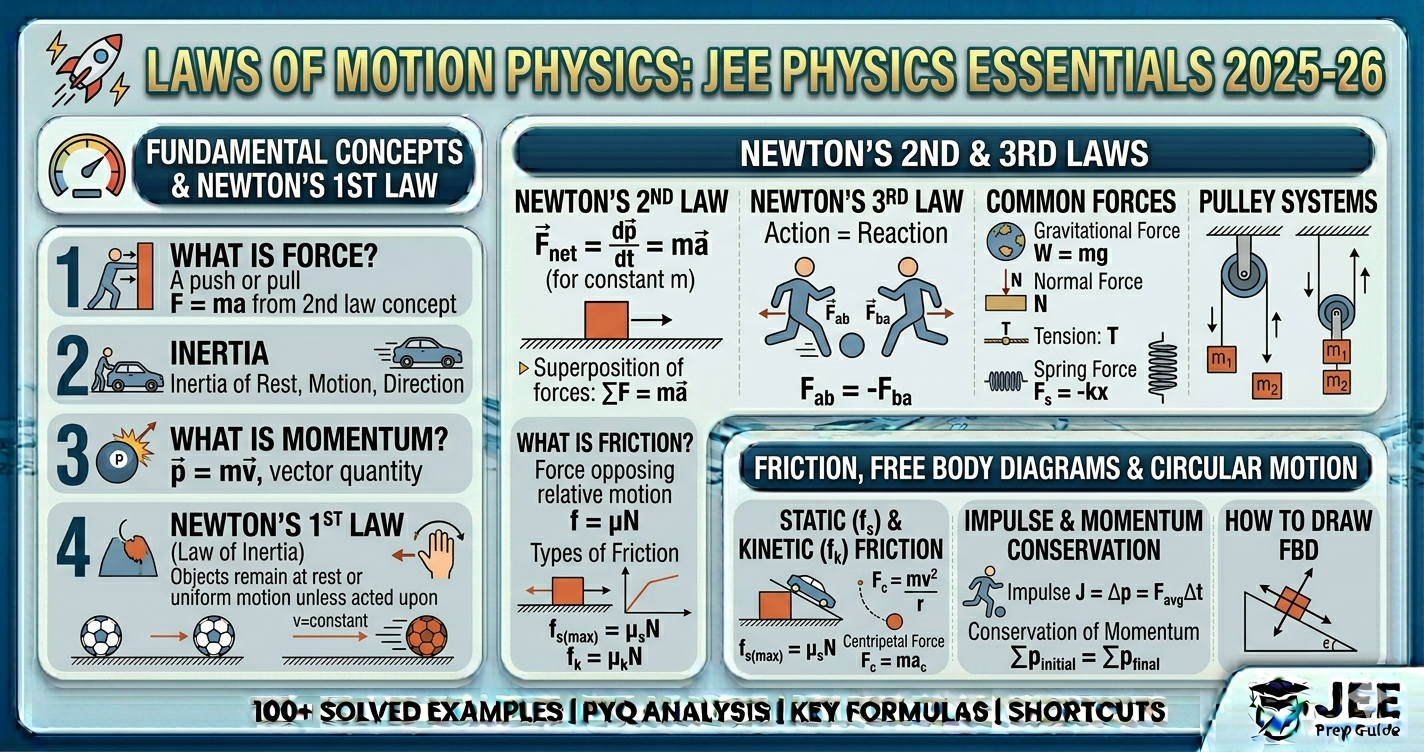
Laws of Motion - Complete Guide for JEE 2025-26
Why Laws of Motion is Crucial for JEE?
Laws of Motion is one of the most important chapters in JEE Physics with 8-15% direct weightage. The concepts form the foundation for:
- Rotational Dynamics - Extension of Newton's Laws to rotating bodies
- Gravitation - Orbital mechanics uses circular motion concepts
- Work-Energy - Force × displacement relationship
- SHM - Restoring force concepts from Newton's Second Law
Key Topics & Their Weightage
High Priority Topics
- • Free Body Diagrams (40% of problems)
- • Friction - Static, Kinetic, Rolling
- • Connected Bodies & Pulley Systems
- • Motion on Inclined Planes
Medium Priority Topics
- • Circular Motion & Centripetal Force
- • Banking of Roads
- • Pseudo Forces in Non-inertial Frames
📚 How to Study Laws of Motion Effectively?
For JEE Main Students:
- Time Required: 4-5 days (3 hours/day)
- Master Free Body Diagrams first
- Focus on Friction and Inclined Plane problems
- Practice 75+ MCQs from previous years
- Memorize all standard formulas
For JEE Advanced Students:
- Time Required: 7-10 days (4 hours/day)
- Deep dive into constraint motion problems
- Master pseudo force applications
- Solve multi-body complex systems
- Practice integer-type and matrix match questions
⚠️ Common Mistakes to Avoid
-
❌
Wrong FBD: Not isolating the body properly, including reaction forces on the same body
-
❌
Friction direction: Drawing friction in wrong direction - it opposes relative motion/tendency
-
❌
Normal ≠ mg always: On incline N = mg cos θ, not mg
-
❌
Not checking if block moves: Compare applied force with maximum static friction first