
📑 Quick Navigation - Units and Dimensions

Units & Dimensions JEE Main & Advanced 2025-26

Master the foundation of Physics with complete notes on SI Units, Dimensional Analysis, Error Calculations, and Significant Figures. Includes 100+ solved problems and all JEE shortcuts.

📚 7 Complete Sections
✍️ 100+ Solved Examples
🎯 Quick Formulas
⭐⭐⭐⭐⭐ 4.9/5
180+ students rated this helpful
100+
Solved Examples
2 hrs
Study Time
Free
Always
Units and Dimensions Jee notes, Formulas, PYQs
Units and Dimensions JEE Notes, Formulas, PYQs
1

Physical Quantities

A physical quantity is any property of a material or system that can be quantified by measurement. Understanding the classification of physical quantities is fundamental to all of Physics and forms the basis of dimensional analysis.

1.1 Classification of Physical Quantities

Fundamental Quantities

Quantities that are independent and cannot be expressed in terms of other quantities.

  • Length (L)
  • Mass (M)
  • Time (T)
  • Temperature (K)
  • Electric Current (I)
  • Amount of Substance (mol)
  • Luminous Intensity (cd)
Derived Quantities

Quantities that are dependent and can be expressed in terms of fundamental quantities.

  • Area = Length²
  • Volume = Length³
  • Velocity = Length/Time
  • Force = Mass × Acceleration
  • Energy = Force × Distance
  • Power = Energy/Time

💡 JEE Memory Trick

Remember the 7 fundamental quantities using: "My Large Tiger Can Eat Little Ants"
Mass, Length, Time, Current, (Thermodynamic) Temperature, Luminous Intensity, Amount of Substance

1.2 Scalar vs Vector Quantities

Aspect Scalar Quantity Vector Quantity
Definition Has only magnitude Has both magnitude and direction
Examples Mass, Time, Temperature, Energy, Speed Displacement, Velocity, Force, Momentum
Addition Rule Simple arithmetic (a + b) Vector addition (triangle/parallelogram law)
Representation Single number with unit Arrow notation or bold letter
2

SI Units System

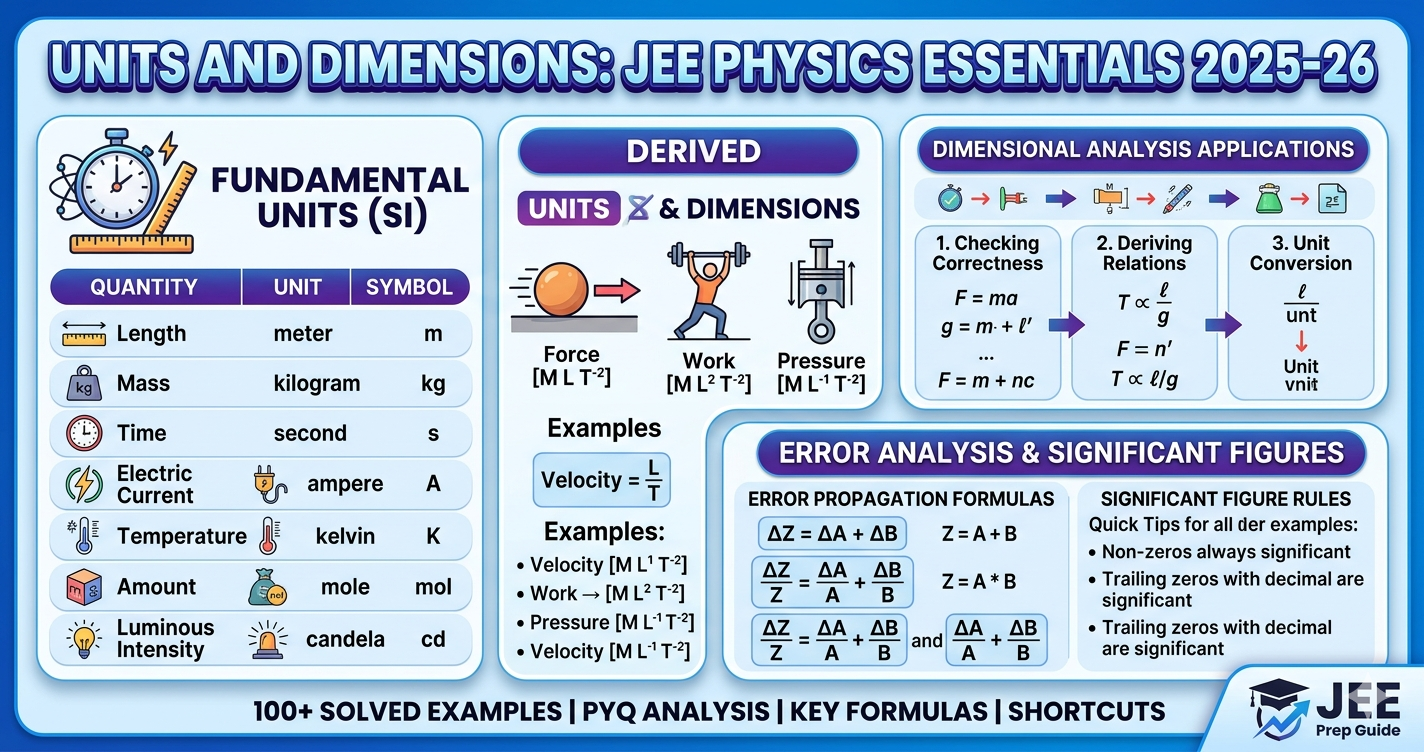
The International System of Units (SI) is the modern form of the metric system and is the most widely used system of measurement. It consists of 7 base units from which all other units are derived.

2.1 The Seven SI Base Units

Quantity SI Unit Symbol Dimension
Length meter m [L]
Mass kilogram kg [M]
Time second s [T]
Electric Current ampere A [I]
Temperature kelvin K [K]
Amount of Substance mole mol [mol]
Luminous Intensity candela cd [cd]

2.2 Important Derived Units (JEE Specific)

Physical Quantity SI Unit Symbol In Base Units
Force newton N kg·m·s⁻²
Energy/Work joule J kg·m²·s⁻²
Power watt W kg·m²·s⁻³
Pressure pascal Pa kg·m⁻¹·s⁻²
Frequency hertz Hz s⁻¹
Electric Charge coulomb C A·s
Potential Difference volt V kg·m²·s⁻³·A⁻¹
Resistance ohm Ω kg·m²·s⁻³·A⁻²

2.3 SI Prefixes (Powers of 10)

Large Multiples
deca (da)10¹
hecto (h)10²
kilo (k)10³
mega (M)10⁶
giga (G)10⁹
tera (T)10¹²
Small Multiples
deci (d)10⁻¹
centi (c)10⁻²
milli (m)10⁻³
micro (μ)10⁻⁶
nano (n)10⁻⁹
pico (p)10⁻¹²

⚠️ Common JEE Traps

  • kg is the base unit, not gram (only base unit with prefix)
  • Temperature: Kelvin (K), not °K or degrees Kelvin
  • Symbol case matters: m = meter, M = mega prefix
  • Space between number and unit: 5 m, not 5m
3

Dimensions & Dimensional Formulas

The dimension of a physical quantity is the power to which the fundamental units must be raised to represent that quantity. Dimensional formulas are essential for checking equations, deriving relationships, and converting units.

3.1 Seven Fundamental Dimensions

[M]

Mass

[L]

Length

[T]

Time

[I]

Current

[K]

Temperature

[mol]

Amount

[cd]

Luminous Int.

[M⁰L⁰T⁰]

Dimensionless

3.2 Dimensional Formulas - Complete List

Physical Quantity Formula/Definition Dimensional Formula
Area Length × Breadth [M⁰L²T⁰]
Volume Length × Breadth × Height [M⁰L³T⁰]
Density Mass/Volume [ML⁻³T⁰]
Velocity Displacement/Time [M⁰LT⁻¹]
Acceleration Velocity/Time [M⁰LT⁻²]
Force Mass × Acceleration [MLT⁻²]
Momentum Mass × Velocity [MLT⁻¹]
Impulse Force × Time [MLT⁻¹]
Work/Energy Force × Distance [ML²T⁻²]
Power Work/Time [ML²T⁻³]
Pressure Force/Area [ML⁻¹T⁻²]
Surface Tension Force/Length [M¹L⁰T⁻²]
Angular Velocity Angle/Time [M⁰L⁰T⁻¹]
Torque Force × Distance [ML²T⁻²]
Moment of Inertia Mass × (Distance)² [ML²T⁰]
Gravitational Constant (G) F = Gm₁m₂/r² [M⁻¹L³T⁻²]
Planck's Constant (h) E = hν [ML²T⁻¹]
Gas Constant (R) PV = nRT [ML²T⁻²K⁻¹mol⁻¹]

3.3 Dimensionless Quantities (JEE Favorite)

Pure Numbers (No Dimensions)

Angle

(radian)

Solid Angle

(steradian)

Strain

(ΔL/L)

Refractive Index

(c/v)

Relative Density

(ρ/ρ_water)

π, e, sin θ, cos θ

(Mathematical)

📝 Solved Example 1

Question: Find the dimensional formula of (a) Kinetic Energy (b) Coefficient of Viscosity

Solution:

(a) Kinetic Energy:

\[KE = \frac{1}{2}mv^2\]

Dimensions: [M] × [LT⁻¹]² = [M] × [L²T⁻²]

\[[KE] = [ML²T⁻²]\]

(b) Coefficient of Viscosity (η):

From Stokes' Law: F = 6πηrv

\[\eta = \frac{F}{rv}\]

Dimensions: [MLT⁻²] / ([L] × [LT⁻¹]) = [MLT⁻²] / [L²T⁻¹]

\[[\eta] = [ML⁻¹T⁻¹]\]

🎯 Quick Derivation Tricks

  • Energy Family: All have [ML²T⁻²] - KE, PE, Heat, Work
  • Per unit X: Multiply dimension by [X⁻¹] - Energy per unit volume = [ML⁻¹T⁻²]
  • Time rate: Add [T⁻¹] - Power = Energy/time = [ML²T⁻³]
  • Per unit area: Divide by [L²] - Pressure = Force/Area = [ML⁻¹T⁻²]
4

Dimensional Analysis

Dimensional analysis is one of the most powerful tools in Physics. It helps verify equations, derive formulas, and convert units. This is a high-scoring topic in JEE with direct 4-6 marks guaranteed.

4.1 Principle of Homogeneity

The Golden Rule

In any correct physical equation, the dimensions of all terms on both sides must be identical.

Example: s = ut + ½at²

LHS: [s] = [L]

RHS Term 1: [ut] = [LT⁻¹][T] = [L] ✓

RHS Term 2: [½at²] = [LT⁻²][T²] = [L] ✓

All terms have [L] → Equation is dimensionally correct!

⚠️ Important Note

Dimensionally correct ≠ Physically correct
An equation can be dimensionally correct but have wrong numerical constants.
Example: s = ut + at² is dimensionally correct but physically wrong (missing ½)

4.2 Applications of Dimensional Analysis

1. Check Correctness

Verify if a given equation is dimensionally valid

🔄
2. Derive Formulas

Find relationships between physical quantities

🔢
3. Convert Units

Transform quantities between different unit systems

4.3 Method to Derive Formulas

📝 Solved Example 2 (JEE Main 2022 Type)

Question: The time period T of a simple pendulum depends on length L and acceleration due to gravity g. Derive the formula for T using dimensional analysis.

Solution:

Step 1: Assume T depends on L and g

\[T \propto L^a g^b\]
\[T = k L^a g^b\]

(where k is a dimensionless constant)

Step 2: Write dimensions

\[[T] = [L]^a [LT^{-2}]^b\]
\[[M^0L^0T^1] = [L^{a+b}T^{-2b}]\]

Step 3: Compare powers on both sides

For M: 0 = 0 (satisfied automatically)

For L: 0 = a + b → a = -b

For T: 1 = -2b → b = -1/2

Therefore: a = 1/2

Step 4: Substitute values

\[T = k L^{1/2} g^{-1/2}\]
\[T = k\sqrt{\frac{L}{g}}\]

Note: Dimensional analysis gives us k ≈ 1, but actual value k = 2π can only be found by calculus/experiment.

📝 Solved Example 3 (JEE Advanced Pattern)

Question: The velocity v of a particle depends on time t as v = A sin(Bt + C). Find dimensions of A, B, and C.

Solution:

For A:

Since v = A sin(…), and sin function is dimensionless

\[[v] = [A]\]
\[[A] = [LT^{-1}]\]

For B:

Argument of sin must be dimensionless (angle)

\[[Bt] = [M^0L^0T^0]\]
\[[B][T] = [M^0L^0T^0]\]
\[[B] = [T^{-1}]\]

For C:

C is added to Bt, so must have same dimension as Bt

\[[C] = [M^0L^0T^0]\text{ (Dimensionless)}\]

4.4 Limitations of Dimensional Analysis

What Dimensional Analysis CANNOT Do

  • Cannot find dimensionless constants (like 2π, ½, e, etc.)
  • Cannot distinguish between scalar and vector quantities
  • Cannot handle equations with multiple terms of same dimensions (e.g., s = ut + ½at²)
  • Cannot work with trigonometric, exponential, or logarithmic functions
  • Cannot determine if equation is exact - only checks dimensional correctness
5

Significant Figures

Significant figures indicate the precision of a measurement. Understanding significant figures is crucial for experimental physics and error analysis - a guaranteed 2-3 marks topic in JEE.

5.1 Rules for Counting Significant Figures

Rule Example Significant Figures
All non-zero digits are significant 1234 4 S.F.
Zeros between non-zero digits are significant 1002 4 S.F.
Leading zeros are NOT significant 0.0025 2 S.F.
Trailing zeros after decimal ARE significant 2.500 4 S.F.
Trailing zeros in whole number (ambiguous) 2500 2 or 3 or 4 S.F.
Scientific notation removes ambiguity 2.50 × 10³ 3 S.F. (clear)
Exact numbers have infinite S.F. 12 eggs, π = 3.14159... ∞ S.F.

💡 Quick Memory Trick

"Atlantic Pacific Rule" for zeros:

  • Atlantic (A comes before P): If decimal is Absent, start counting from Pacific (right) side
  • Pacific (P comes after A): If decimal is Present, start counting from Atlantic (left) side

Example 1: 0.00340 (decimal Present → start from left)

0.00340 → 3 S.F.

Example 2: 34000 (decimal Absent → start from right)

34000 → 2 S.F. (ambiguous, use scientific notation)

5.2 Arithmetic Operations with Significant Figures

Addition & Subtraction

Result should have decimal places equal to the least precise measurement

12.11 (2 decimal places)

+ 18.0 (1 decimal place) ←least

+ 1.012 (3 decimal places)

= 31.1 (1 decimal place)

Multiplication & Division

Result should have S.F. equal to the least number of S.F. in any factor

2.5 (2 S.F.) ←least

× 3.42 (3 S.F.)

× 4.125 (4 S.F.)

= 35 (2 S.F.)

📝 Solved Example 4

Question: Calculate with proper significant figures: (2.36 × 10⁴) + (4.5 × 10³) - (3.25 × 10²)

Solution:

Step 1: Convert to same power of 10

2.36 × 10⁴ = 23.6 × 10³

4.5 × 10³ = 4.5 × 10³

3.25 × 10² = 0.325 × 10³

Step 2: Perform addition/subtraction

= (23.6 + 4.5 - 0.325) × 10³

= 27.775 × 10³

Step 3: Round to least decimal places

4.5 has only 1 decimal place (least precise)

\[\text{Answer: } 27.8 \times 10^3 = 2.78 \times 10^4\]

5.3 Rounding Off Rules

Rounding Rules (JEE Standard)

Rule 1: If digit after rounding position is < 5

Drop it, keep preceding digit same

3.142 → 3.14 (rounding to 2 decimals)

Rule 2: If digit after rounding position is > 5

Drop it, increase preceding digit by 1

3.147 → 3.15 (rounding to 2 decimals)

Rule 3: If digit is exactly 5 (or 5000...)

Make preceding digit even (round to nearest even number)

3.145 → 3.14 (4 is even)

3.155 → 3.16 (make 5→6 even)

6

Error Analysis & Measurements

No measurement is perfectly accurate. Understanding errors, their types, and how they propagate is essential for experimental physics and forms 10-15% of JEE Physics numerical questions.

6.1 Types of Errors

1. Systematic Errors

Consistent errors in the same direction (always + or always -)

  • Instrumental errors
  • Zero error
  • Calibration errors
  • Personal errors

✓ Can be eliminated by correction

2. Random Errors

Unpredictable fluctuations (+ or - randomly)

  • Environmental changes
  • Observational errors
  • Electronic noise
  • Human limitations

✓ Reduced by repeated measurements

3. Gross Errors

Human mistakes or negligence

  • Wrong reading
  • Calculation mistakes
  • Wrong recording
  • Procedural errors

✗ Must be avoided by care

6.2 Absolute, Relative & Percentage Errors

Absolute Error
\[\Delta a = |a_{\text{measured}} - a_{\text{true}}|\]

Has same unit as quantity

Relative Error
\[\frac{\Delta a}{a_{\text{true}}}\]

Dimensionless (no unit)

Percentage Error
\[\frac{\Delta a}{a_{\text{true}}} \times 100\%\]

Expressed in %

6.3 Error Propagation Formulas (Most Important)

Operation Formula Error Propagation
Addition Z = A + B ΔZ = ΔA + ΔB
Subtraction Z = A - B ΔZ = ΔA + ΔB
Multiplication Z = A × B ΔZ/Z = ΔA/A + ΔB/B
Division Z = A / B ΔZ/Z = ΔA/A + ΔB/B
Power Z = Aⁿ ΔZ/Z = n(ΔA/A)
General Function Z = AᵖBᵍCʳ ΔZ/Z = p(ΔA/A) + q(ΔB/B) + r(ΔC/C)

🎯 Golden Rules for Error Propagation

  • Addition/Subtraction: Add ABSOLUTE errors (ΔZ = ΔA + ΔB)
  • Multiplication/Division: Add RELATIVE errors (ΔZ/Z = ΔA/A + ΔB/B)
  • Power/Root: Multiply relative error by power (ΔZ/Z = n × ΔA/A)
  • Constants: Have zero error (Δk = 0)

📝 Solved Example 5 (JEE Main 2023 Type)

Question: The resistance R = V/I where V = (100 ± 5) volts and I = (10 ± 0.2) amperes. Calculate percentage error in R.

Solution:

Given: V = 100 V, ΔV = 5 V

I = 10 A, ΔI = 0.2 A

R = V/I (division operation)

For division, add relative errors:

\[\frac{\Delta R}{R} = \frac{\Delta V}{V} + \frac{\Delta I}{I}\]
\[\frac{\Delta R}{R} = \frac{5}{100} + \frac{0.2}{10}\]
\[\frac{\Delta R}{R} = 0.05 + 0.02 = 0.07\]

Percentage error:

\[\text{Percentage error} = 0.07 \times 100 = 7\%\]

📝 Solved Example 6 (JEE Advanced Pattern)

Question: The period of a pendulum is T = 2π√(L/g). If L is measured with 2% error and g with 3% error, find percentage error in T.

Solution:

Given: ΔL/L = 2% = 0.02, Δg/g = 3% = 0.03

Step 1: Rewrite formula without constants

\[T = L^{1/2} g^{-1/2}\]

Step 2: Apply power rule for error propagation

\[\frac{\Delta T}{T} = \frac{1}{2}\frac{\Delta L}{L} + \left|-\frac{1}{2}\right|\frac{\Delta g}{g}\]

(Take absolute value of power)

Step 3: Substitute values

\[\frac{\Delta T}{T} = \frac{1}{2}(0.02) + \frac{1}{2}(0.03)\]
\[\frac{\Delta T}{T} = 0.01 + 0.015 = 0.025\]
\[\text{Percentage error in T} = 2.5\%\]
7

Unit Conversions

Converting between different unit systems is a practical skill tested frequently in JEE. Master the conversion factors and dimensional methods to solve these problems in under 30 seconds.

7.1 Common Conversion Factors

Length Conversions
1 inch= 2.54 cm
1 foot= 30.48 cm
1 mile= 1.609 km
1 angstrom (Å)= 10⁻¹⁰ m
1 light year= 9.46 × 10¹⁵ m
1 AU= 1.496 × 10¹¹ m
Mass Conversions
1 pound (lb)= 0.4536 kg
1 ounce= 28.35 g
1 tonne= 1000 kg
1 u (atomic mass)= 1.66 × 10⁻²⁷ kg
1 quintal= 100 kg
Time Conversions
1 hour= 3600 s
1 day= 86400 s
1 year= 3.156 × 10⁷ s
1 shake= 10⁻⁸ s
Energy Conversions
1 eV= 1.6 × 10⁻¹⁹ J
1 calorie= 4.186 J
1 kWh= 3.6 × 10⁶ J
1 erg= 10⁻⁷ J

7.2 Dimensional Method for Conversion

📝 Solved Example 7

Question: Convert 1 newton into dynes using dimensional analysis.

Solution:

Step 1: Write dimensional formula

[Force] = [MLT⁻²]

Step 2: Use conversion formula

\[n_2 = n_1 \left[\frac{M_1}{M_2}\right]^a \left[\frac{L_1}{L_2}\right]^b \left[\frac{T_1}{T_2}\right]^c\]

where a=1, b=1, c=-2 (from [MLT⁻²])

Step 3: SI to CGS conversion

M₁ = 1 kg, M₂ = 1 g = 10⁻³ kg

L₁ = 1 m, L₂ = 1 cm = 10⁻² m

T₁ = 1 s, T₂ = 1 s

\[n_2 = 1 \times \left[\frac{1}{10^{-3}}\right]^1 \left[\frac{1}{10^{-2}}\right]^1 \left[\frac{1}{1}\right]^{-2}\]
\[n_2 = 10^3 \times 10^2 \times 1 = 10^5\]
\[1 \text{ newton} = 10^5 \text{ dynes}\]

💡 Quick Conversion Tricks

  • SI to CGS: Most derived units differ by powers of 10
  • Energy units: 1 J = 10⁷ erg (remember this!)
  • Pressure units: 1 Pa = 10 dyne/cm²
  • Power units: 1 W = 10⁷ erg/s
  • km/h to m/s: Multiply by 5/18 (or divide by 3.6)

📝 Previous Year Questions Analysis

JEE Main (Last 5 Years)

  • ✓ Dimensional Analysis: 40%
  • ✓ Error Analysis: 30%
  • ✓ Significant Figures: 20%
  • ✓ Unit Conversions: 10%

JEE Advanced (Last 5 Years)

  • ✓ Deriving formulas: 35%
  • ✓ Error propagation: 35%
  • ✓ Checking correctness: 20%
  • ✓ Mixed concepts: 10%

Top 10 Most Repeated Question Types

  1. Finding dimensional formula of physical constants (G, h, R)
  2. Checking dimensional correctness of given equations
  3. Deriving formula using dimensional analysis (pendulum, viscosity)
  4. Error propagation in density/volume calculations
  5. Significant figures in arithmetic operations
  6. Converting SI to CGS units for derived quantities
  7. Finding dimensions of coefficients in given equations
  8. Percentage error in derived quantities (area, volume, power)
  9. Identifying dimensionless quantities
  10. Application of principle of homogeneity

Weightage Analysis

JEE Main: 4-8 marks (1-2 questions)
JEE Advanced: 6-12 marks (2-3 questions)
Difficulty Level: Easy to Medium
Time Required: 2-3 hours practice

🎯 Practice Problem Set

Level 1: Basic (JEE Main Standard)

  1. Write the dimensional formula of: (a) Pressure (b) Energy (c) Power (d) Force constant
  2. Check if the equation s = ut + ½at² is dimensionally correct.
  3. Convert 72 km/h to m/s using dimensional analysis.
  4. Find number of significant figures in: (a) 0.00340 (b) 2.500 (c) 34000
  5. Calculate 2.5 × 3.42 with correct significant figures.
  6. If L = (5.0 ± 0.2) m and B = (2.0 ± 0.1) m, find error in area.
  7. Which of the following is dimensionless: angle, strain, refractive index?
  8. Write SI units of: (a) Momentum (b) Impulse (c) Torque

Level 2: Intermediate (JEE Main/Advanced)

  1. Derive the formula for time period of simple pendulum T = 2π√(L/g) using dimensional analysis.
  2. Find dimensional formula of coefficient of viscosity η from Stokes' law F = 6πηrv.
  3. The velocity v of sound in a medium depends on elasticity E and density ρ. Find v using dimensions.
  4. If F = (100 ± 2) N and d = (5.0 ± 0.1) m, find percentage error in work W = Fd.
  5. Check dimensional correctness: v² - u² = 2as + kt where k is a constant. Find dimension of k.
  6. Convert 1 joule to erg using dimensional method.
  7. The area A = (5.2 ± 0.1) cm². Find percentage error in A.
  8. Round off to 3 significant figures: (a) 2.7482 (b) 0.007089 (c) 3.1415

Level 3: Advanced (JEE Advanced/Olympiad)

  1. Find dimensions of a and b in equation: F = ax + bt² where F is force, x is distance, t is time.
  2. Planck's constant h, speed of light c, and gravitational constant G can form a quantity with dimension of length. Find it.
  3. In the formula P = (a/V²)(b - V), P is pressure and V is volume. Find dimensions of a and b.
  4. The density ρ of a sphere is ρ = (12 ± 0.3) g/cm³ and radius r = (2.0 ± 0.1) cm. Find maximum percentage error in mass.
  5. Using dimensional analysis, show that time period of spring-mass system depends on √(m/k).
  6. If energy E, velocity v, and force F are fundamental, find dimensional formula of mass.
  7. The Van der Waals equation is (P + a/V²)(V - b) = RT. Find dimensions of a and b.
  8. In measurement of g by simple pendulum, if L has 2% error and T has 3% error, find error in g.

Related Physics Notes

Units and Dimensions - Complete Guide for JEE 2025-26

Why Units and Dimensions is Important for JEE?

Units and Dimensions is the foundational chapter of JEE Physics. Though it carries only 2-3% direct weightage in JEE Main, the concepts are used throughout Physics, especially in:

  • Dimensional Analysis - Quick formula derivation (saves 5-10 minutes in exam)
  • Error Calculation - Used in experimental physics questions
  • Significant Figures - Required in numerical answer questions
  • Unit Conversion - Essential for solving problems in different unit systems

In JEE Advanced, dimensional analysis questions are often combined with complex derivations making this a high-scoring opportunity.

Key Topics & Formulas to Remember

1. Seven Fundamental Quantities

Length (m), Mass (kg), Time (s), Current (A), Temperature (K), Amount (mol), Luminous Intensity (cd)

2. Most Asked Dimensional Formulas

  • • Force: [MLT⁻²]
  • • Energy: [ML²T⁻²]
  • • Power: [ML²T⁻³]
  • • Pressure: [ML⁻¹T⁻²]
  • • Gravitational Constant (G): [M⁻¹L³T⁻²]
  • • Planck's Constant (h): [ML²T⁻¹]

3. Error Propagation Rules

Addition/Subtraction: Add absolute errors | Multiplication/Division: Add relative errors | Power: Multiply relative error by power

📚 How to Study Units and Dimensions Effectively?

For JEE Main Students:

  1. Time Required: 2-3 days (2 hours/day)
  2. Focus on dimensional analysis and significant figures
  3. Practice 50+ MCQs from previous year questions
  4. Memorize dimensional formulas of 20 important quantities
  5. Master error propagation for at least 2 numerical questions

For JEE Advanced Students:

  1. Time Required: 4-5 days (3 hours/day)
  2. Deep dive into principle of homogeneity
  3. Practice deriving complex formulas using dimensional analysis
  4. Solve multi-concept problems (dimensions + other chapters)
  5. Study all limitations and special cases

⚠️ Common Mistakes to Avoid in JEE Exam

  • Dimensionally correct ≠ Physically correct: Just because an equation passes dimensional analysis doesn't mean it's correct (numerical constants like π, 1/2 can't be found)
  • Angle is NOT dimensionless in calculations: While angle has no dimension, you must use radians (not degrees) in formulas
  • Significant figures in final answer: Many students lose marks by writing all calculator digits instead of rounding to correct significant figures
  • Forgetting to convert units: Always convert to SI units before solving unless explicitly asked otherwise

📊 JEE Previous Year Question Analysis (2015-2024)

Year JEE Main JEE Advanced Topic Focus
2024 1 Question (4 marks) 2 Questions (6 marks) Error propagation, Dimensional analysis
2023 2 Questions (8 marks) 1 Question (3 marks) Significant figures, Unit conversion
2022 1 Question (4 marks) 2 Questions (7 marks) Deriving formulas, Homogeneity

Trend: JEE Advanced is increasingly asking multi-concept questions where dimensional analysis is combined with calculus or other physics concepts. Pure dimensional analysis questions are becoming rare.