
Jee prep guide

JEE PREP GUIDE

Path to IIT

📑 Quick Jump to Topics

Kinematics JEE Main & Advanced 2025-26

Master motion analysis with comprehensive notes covering 1D/2D motion, projectiles, relative velocity, graphs, and circular motion. Includes 150+ solved problems and all previous year JEE questions.

📚 6 Complete Chapters
✍️ 150+ Solved Examples
🎯 PYQ Analysis
⭐⭐⭐⭐⭐
4.9/5
320 reviews
150+
Solved Examples
6
Major Topics
4 hrs
Study Time
35%
JEE Weightage
Kinematics Jee notes, Formulas, PYQs
Kinematics JEE Notes, Formulas, PYQs
1

Fundamental Concepts of Motion

Kinematics is the foundational pillar of mechanics that deals with the mathematical description of motion without analyzing the forces that cause it. Understanding these core concepts is crucial for solving 30-40% of JEE Main Physics questions.

1.1 Reference Frame & Point Object

A reference frame is a coordinate system from which observations are made. Motion is always relative to the chosen reference frame. A point object is one whose dimensions are negligible compared to the distance it travels.

💡 JEE Pro Tip

Always clearly identify your reference frame before solving problems. Most errors in relative motion questions occur due to confusion about the reference frame. Practice converting between different frames.

1.2 Position, Displacement & Distance

Key Definitions & Formulas

Position Vector:
\[\vec{r} = x\hat{i} + y\hat{j} + z\hat{k}\]
Displacement: Change in position vector (vector quantity)
\[\vec{s} = \Delta\vec{r} = \vec{r}_2 - \vec{r}_1\]
Distance: Total path length traveled (scalar quantity)
\[\text{Distance} \geq |\text{Displacement}|\]

1.3 Velocity - Average & Instantaneous

Average Velocity
\[\vec{v}_{avg} = \frac{\Delta\vec{r}}{\Delta t} = \frac{\vec{r}_2 - \vec{r}_1}{t_2 - t_1}\]

Vector quantity directed along displacement

Instantaneous Velocity
\[\vec{v} = \lim_{\Delta t \to 0} \frac{\Delta\vec{r}}{\Delta t} = \frac{d\vec{r}}{dt}\]

Velocity at a particular instant

📝 Solved Example 1

Question: A particle moves along a circle of radius 10 m with uniform speed completing one revolution in 4 seconds. Find (a) displacement and (b) average velocity in half revolution.

Solution:

(a) Displacement = Diameter = 2R = 20 m

(b) Time for half revolution = 2 s

\[v_{avg} = \frac{\text{Displacement}}{\text{Time}} = \frac{20}{2} = 10 \text{ m/s}\]

Note: Average speed = (πR×2)/4 = 5π m/s ≠ average velocity

1.4 Acceleration

Acceleration Formulas

Average Acceleration:
\[\vec{a}_{avg} = \frac{\Delta\vec{v}}{\Delta t} = \frac{\vec{v}_2 - \vec{v}_1}{t_2 - t_1}\]
Instantaneous Acceleration:
\[\vec{a} = \frac{d\vec{v}}{dt} = \frac{d^2\vec{r}}{dt^2}\]

⚠️ Common Mistake Alert

Many students confuse deceleration with negative acceleration. Remember: Deceleration means speed is decreasing, which happens when velocity and acceleration are in opposite directions, regardless of their signs.

2

Motion in One Dimension

One-dimensional motion is the simplest form of motion where an object moves along a straight line. This chapter covers uniformly accelerated motion - the foundation for 25% of JEE Physics Mechanics problems.

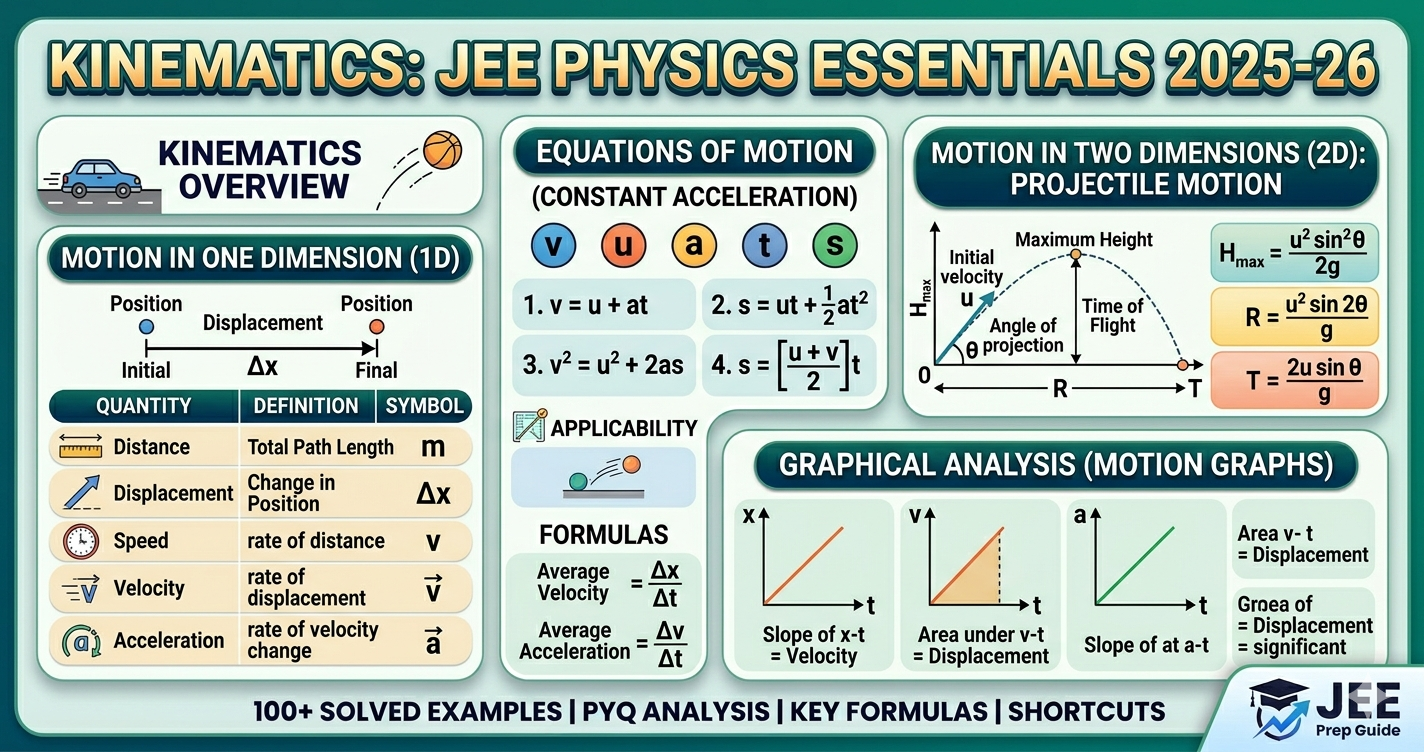
2.1 Equations of Motion (Uniform Acceleration)

First Equation

\[v = u + at\]

Velocity-time relation

Second Equation

\[s = ut + \frac{1}{2}at^2\]

Position-time relation

Third Equation

\[v^2 = u^2 + 2as\]

Independent of time

🎯 Derivation Shortcut for JEE Mains

Never memorize these equations! Derive them in 30 seconds using v-t graph:

  • Slope of v-t graph = acceleration → v = u + at
  • Area under v-t graph = displacement → s = ut + ½at²
  • Eliminate t from above two → v² = u² + 2as

This method fetches you full marks even if you forget formulas during exam!

2.2 Additional Important Formulas

Formula Expression Use Case
Distance in nth second \(s_n = u + \frac{a}{2}(2n-1)\) Finding displacement in specific time intervals
Average velocity \(v_{avg} = \frac{u+v}{2}\) Only for uniform acceleration
Displacement ratio \(s_1:s_2:s_3:... = 1:3:5:7...\) Equal time intervals from rest
Time ratio \(t_1:t_2:t_3:... = 1:\sqrt{2}:\sqrt{3}...\) Equal distance intervals from rest

📝 Solved Example 2 (JEE Main 2023 Pattern)

Question: A car accelerates from rest at a constant rate α for some time, after which it decelerates at a constant rate β to come to rest. If the total time elapsed is t, find the maximum velocity achieved.

Solution:

Let maximum velocity = vmax

Time of acceleration = t₁, Time of deceleration = t₂

Given: t₁ + t₂ = t ... (1)

\[v_{max} = \alpha t_1 = \beta t_2\]
\[t_1 = \frac{v_{max}}{\alpha}, \quad t_2 = \frac{v_{max}}{\beta}\]

Substituting in equation (1):

\[\frac{v_{max}}{\alpha} + \frac{v_{max}}{\beta} = t\]
\[v_{max}\left(\frac{1}{\alpha} + \frac{1}{\beta}\right) = t\]
\[v_{max} = \frac{\alpha\beta t}{\alpha + \beta}\]

Key Concept: This is the harmonic mean formula pattern - appears frequently in JEE!

2.3 Motion Under Gravity (Free Fall)

Free Fall Equations (Taking downward as positive)

Velocity after time t:

\[v = u + gt\]

Height fallen:

\[h = ut + \frac{1}{2}gt^2\]

Velocity-height relation:

\[v^2 = u^2 + 2gh\]

Velocity at height h:

\[v = \sqrt{2gh}\]

📝 Solved Example 3 (Classic JEE Problem)

Question: A stone is dropped from a height h. Another stone is thrown upward from ground with such a velocity that it reaches a height h. When and where will they meet?

Solution:

For stone 1 (dropped from height h):

\[y_1 = h - \frac{1}{2}gt^2\]

For stone 2 (thrown upward):

To reach height h: v² = 2gh → v = √(2gh)

\[y_2 = vt - \frac{1}{2}gt^2 = \sqrt{2gh} \cdot t - \frac{1}{2}gt^2\]

At meeting point: y₁ = y₂

\[h - \frac{1}{2}gt^2 = \sqrt{2gh} \cdot t - \frac{1}{2}gt^2\]
\[h = \sqrt{2gh} \cdot t\]
\[t = \sqrt{\frac{h}{2g}}\]

Height from ground:

\[y = \sqrt{2gh} \times \sqrt{\frac{h}{2g}} - \frac{1}{2}g\left(\frac{h}{2g}\right)\]
\[y = \frac{3h}{4}\]

Answer: They meet at height 3h/4 from ground after time √(h/2g)

3

Motion Graphs Analysis

Graphical analysis is one of the most scoring topics in JEE. Understanding slopes and areas under curves can solve 90% of problems in under 60 seconds. Master this chapter to gain significant advantage in competitive exams.

3.1 Position-Time (x-t) Graphs

Key Points for x-t Graphs

📌
Slope of x-t graph = Instantaneous velocity
\[\text{Slope} = \tan\theta = \frac{dx}{dt} = v\]
📌

Horizontal line → Object at rest (v = 0)

📌

Straight line with slope → Uniform velocity

📌

Curved line → Non-uniform velocity (acceleration present)

📌

Increasing slope → Increasing velocity (positive acceleration)

📌

Decreasing slope → Decreasing velocity (negative acceleration)

3.2 Velocity-Time (v-t) Graphs

Key Points for v-t Graphs

📌
Slope of v-t graph = Acceleration
\[\text{Slope} = \frac{dv}{dt} = a\]
📌
Area under v-t graph = Displacement
\[\text{Area} = \int v \, dt = s\]
📌

Horizontal line → Uniform velocity (a = 0)

📌

Straight line with positive slope → Uniform positive acceleration

📌

Straight line with negative slope → Uniform negative acceleration

JEE 2024 Graph Trick

For any v-t graph problem asking for displacement:

  • If graph is above time axis → displacement is positive
  • If graph is below time axis → displacement is negative
  • Net displacement = Area above - Area below
  • Total distance = |Area above| + |Area below|

3.3 Acceleration-Time (a-t) Graphs

Key Points for a-t Graphs

📌
Area under a-t graph = Change in velocity
\[\text{Area} = \int a \, dt = \Delta v = v - u\]
📌

Horizontal line above t-axis → Constant positive acceleration

📌

Zero line → Uniform velocity motion

📝 Solved Example 4 (JEE Advanced 2022 Pattern)

Question: The velocity-time graph of a particle moving in a straight line is shown. Find (a) displacement in first 6 seconds (b) total distance traveled.

[Graph: v-t graph with following points]

t=0, v=20 m/s → t=2s, v=20 m/s → t=4s, v=0 → t=5s, v=-10 m/s → t=6s, v=-10 m/s

Solution:

(a) Displacement = Area under v-t graph

Area from 0 to 2s = 20 × 2 = 40 m (rectangle)

Area from 2s to 4s = ½ × 2 × 20 = 20 m (triangle)

Area from 4s to 5s = ½ × 1 × (-10) = -5 m (triangle below axis)

Area from 5s to 6s = -10 × 1 = -10 m (rectangle below axis)

\[\text{Net Displacement} = 40 + 20 - 5 - 10 = 45 \text{ m}\]

(b) Total Distance = Sum of absolute areas

\[\text{Total Distance} = 40 + 20 + 5 + 10 = 75 \text{ m}\]

🎯 Graph Interpretation Masterclass

Graph Type Slope Gives Area Gives
x-t graph Velocity (v) Not used
v-t graph Acceleration (a) Displacement (s)
a-t graph Rate of change of acceleration Change in velocity (Δv)
4

Relative Motion

Relative motion is the study of motion of one object with respect to another. This is a high-weightage topic in JEE Advanced with conceptual depth. Questions often combine relative velocity with projectile motion or collisions.

4.1 Relative Velocity in 1D

Fundamental Formula

Velocity of A relative to B (or velocity of A as seen by B):

\[\vec{v}_{AB} = \vec{v}_A - \vec{v}_B\]

Similarly, velocity of B relative to A:

\[\vec{v}_{BA} = \vec{v}_B - \vec{v}_A = -\vec{v}_{AB}\]
When Moving in Same Direction
\[v_{AB} = v_A - v_B\]

Relative velocity is difference of speeds

When Moving in Opposite Direction
\[v_{AB} = v_A + v_B\]

Relative velocity is sum of speeds

4.2 Relative Velocity in 2D

Vector Form (Most Important for JEE Advanced)

\[\vec{v}_{AB} = \vec{v}_A - \vec{v}_B\]

Magnitude of relative velocity:

\[|\vec{v}_{AB}| = \sqrt{v_A^2 + v_B^2 - 2v_Av_B\cos\theta}\]

where θ = angle between \(\vec{v}_A\) and \(\vec{v}_B\)

💡 Component Method (Easier for JEE)

Break velocities into components along x and y axes:

\[v_{AB,x} = v_{A,x} - v_{B,x}\]
\[v_{AB,y} = v_{A,y} - v_{B,y}\]
\[|\vec{v}_{AB}| = \sqrt{v_{AB,x}^2 + v_{AB,y}^2}\]

📝 Solved Example 5 (Rain-Man Problem)

Question: Rain is falling vertically with speed 30 m/s. A man is running on the road with speed 10 m/s. At what angle should he hold his umbrella to protect himself from rain?

Solution:

Let's find velocity of rain relative to man

\(\vec{v}_{rain} = 30\hat{j}\) m/s (downward)

\(\vec{v}_{man} = 10\hat{i}\) m/s (horizontal)

\[\vec{v}_{rain,man} = \vec{v}_{rain} - \vec{v}_{man}\]
\[\vec{v}_{rain,man} = -10\hat{i} - 30\hat{j}\]

The umbrella should be held along this direction

\[\tan\theta = \frac{v_{horizontal}}{v_{vertical}} = \frac{10}{30} = \frac{1}{3}\]
\[\theta = \tan^{-1}\left(\frac{1}{3}\right) \approx 18.43°\text{ from vertical}\]

4.3 Shortest Distance / Closest Approach

Condition for Closest Approach

Two objects will be closest when their relative velocity is perpendicular to the line joining them.

\[\vec{v}_{AB} \perp \vec{r}_{AB}\]

Minimum distance formula:

\[d_{min} = \frac{|\vec{r}_{AB} \times \vec{v}_{AB}|}{|\vec{v}_{AB}|}\]

📝 Solved Example 6 (JEE Advanced Type)

Question: Two ships A and B are 10 km apart on a line running south to north. Ship A is south of B and is moving north at 20 km/h. Ship B is moving east at 20 km/h. Find the distance of closest approach and time taken.

Solution:

Let north be +y direction and east be +x direction

\(\vec{v}_A = 20\hat{j}\) km/h

\(\vec{v}_B = 20\hat{i}\) km/h

Initial position: \(\vec{r}_{AB} = 10\hat{j}\) km

\[\vec{v}_{AB} = \vec{v}_A - \vec{v}_B = 20\hat{j} - 20\hat{i} = -20\hat{i} + 20\hat{j}\]
\[|\vec{v}_{AB}| = \sqrt{20^2 + 20^2} = 20\sqrt{2} \text{ km/h}\]

Minimum distance (using perpendicular component):

\[d_{min} = |\vec{r}_{AB}| \sin\alpha\]

where α = angle between \(\vec{r}_{AB}\) and \(\vec{v}_{AB}\)

\[\cos\alpha = \frac{\vec{r}_{AB} \cdot \vec{v}_{AB}}{|\vec{r}_{AB}||\vec{v}_{AB}|} = \frac{(10\hat{j}) \cdot (-20\hat{i} + 20\hat{j})}{10 \times 20\sqrt{2}} = \frac{200}{200\sqrt{2}} = \frac{1}{\sqrt{2}}\]
\[\sin\alpha = \frac{1}{\sqrt{2}}\]
\[d_{min} = 10 \times \frac{1}{\sqrt{2}} = 5\sqrt{2} \text{ km}\]

Time to reach closest approach:

\[t = \frac{|\vec{r}_{AB}|\cos\alpha}{|\vec{v}_{AB}|} = \frac{10 \times \frac{1}{\sqrt{2}}}{20\sqrt{2}} = \frac{10}{40} = 0.25 \text{ h} = 15 \text{ min}\]

⚠️ Common Mistakes in Relative Motion

  • Sign convention: Always subtract in correct order \(\vec{v}_{AB} = \vec{v}_A - \vec{v}_B\)
  • Don't confuse: \(\vec{v}_{AB} \neq \vec{v}_{BA}\) (they are opposite)
  • In 2D problems: Never add/subtract magnitudes directly - use vector addition
  • Rain problems: Man's velocity appears with negative sign in rain's frame
5

Projectile Motion - The Rank Decider

Projectile motion is the most important topic in kinematics for JEE. Every year 2-4 questions (direct + integrated) appear from this chapter. Mastering projectile motion gives you a competitive edge as it combines concepts from vectors, calculus, and relative motion.

5.1 Basic Concepts & Equations

Fundamental Understanding

Projectile motion is a 2D motion under constant acceleration (gravity). It can be analyzed by breaking into two independent components:

Horizontal Motion (x-direction):

  • Acceleration: ax = 0
  • Velocity: vx = u cos θ (constant)
  • Position: x = (u cos θ)t

Vertical Motion (y-direction):

  • Acceleration: ay = -g
  • Initial velocity: vy0 = u sin θ
  • Position: y = (u sin θ)t - ½gt²

5.2 Key Formulas (Must Remember)

Parameter Formula Maximum Value
Time of Flight (T) \(T = \frac{2u\sin\theta}{g}\) At θ = 90° (vertical throw)
Maximum Height (H) \(H = \frac{u^2\sin^2\theta}{2g}\) At θ = 90°, Hmax = u²/2g
Range (R) \(R = \frac{u^2\sin 2\theta}{g}\) At θ = 45°, Rmax = u²/g
Velocity at time t \(v = \sqrt{u^2 - 2gu\sin\theta \cdot t + g^2t^2}\) -
Equation of Trajectory \(y = x\tan\theta - \frac{gx^2}{2u^2\cos^2\theta}\) Parabola equation

🎯 Quick Derivation Trick

Derive all formulas from these two equations in 20 seconds:

1. \(v_y = u\sin\theta - gt\)
2. \(y = u\sin\theta \cdot t - \frac{1}{2}gt^2\)
  • At max height: vy = 0 → Find time, substitute in y to get H
  • At landing: y = 0 → Solve for t to get T
  • Range: R = (horizontal velocity) × T = u cos θ × T

5.3 Important Results & Shortcuts

Complementary Angles

For angles θ and (90° - θ):

\[R_\theta = R_{90°-\theta}\]

Same range for complementary angles

Relation: H, R, T
\[R = \frac{4H}{\tan\theta}\]
\[T = 2\sqrt{\frac{2H}{g}}\]
Velocity at highest point
\[v_H = u\cos\theta\]

Only horizontal component remains

Angle of velocity with horizontal
\[\tan\beta = \frac{v_y}{v_x} = \frac{u\sin\theta - gt}{u\cos\theta}\]

📝 Solved Example 7 (Classic JEE Problem)

Question: A projectile is fired at an angle of 30° with horizontal with velocity 40 m/s. Find (a) Maximum height (b) Range (c) Time of flight. [g = 10 m/s²]

Solution:

Given: u = 40 m/s, θ = 30°, g = 10 m/s²

(a) Maximum Height:

\[H = \frac{u^2\sin^2\theta}{2g} = \frac{40^2 \times \sin^2 30°}{2 \times 10}\]
\[H = \frac{1600 \times (1/2)^2}{20} = \frac{1600 \times 0.25}{20}\]
\[H = 20 \text{ m}\]

(b) Range:

\[R = \frac{u^2\sin 2\theta}{g} = \frac{40^2 \times \sin 60°}{10}\]
\[R = \frac{1600 \times \frac{\sqrt{3}}{2}}{10} = \frac{800\sqrt{3}}{10}\]
\[R = 80\sqrt{3} \approx 138.56 \text{ m}\]

(c) Time of Flight:

\[T = \frac{2u\sin\theta}{g} = \frac{2 \times 40 \times \sin 30°}{10}\]
\[T = \frac{80 \times 0.5}{10}\]
\[T = 4 \text{ s}\]

5.4 Projectile on Inclined Plane (JEE Advanced Favorite)

When thrown up the incline (angle α with horizontal)

Projection angle with horizontal = θ

Range along incline:
\[R = \frac{u^2\sin 2(\theta - \alpha)}{g\cos^2\alpha}\]
Maximum range on incline:
\[\text{At } \theta = 45° + \frac{\alpha}{2}\]
\[R_{max} = \frac{u^2}{g(1 + \sin\alpha)}\]
Time of flight:
\[T = \frac{2u\sin(\theta - \alpha)}{g\cos\alpha}\]

📝 Solved Example 8 (JEE Advanced 2021 Pattern)

Question: A particle is projected up an inclined plane of inclination 30° with velocity 20 m/s at angle 60° with horizontal. Find the range along the plane.

Solution:

Given: u = 20 m/s, α = 30°, θ = 60°, g = 10 m/s²

\[R = \frac{u^2\sin 2(\theta - \alpha)}{g\cos^2\alpha}\]
\[R = \frac{20^2 \times \sin 2(60° - 30°)}{10 \times \cos^2 30°}\]
\[R = \frac{400 \times \sin 60°}{10 \times (\frac{\sqrt{3}}{2})^2}\]
\[R = \frac{400 \times \frac{\sqrt{3}}{2}}{10 \times \frac{3}{4}} = \frac{200\sqrt{3}}{7.5}\]
\[R = \frac{800\sqrt{3}}{30} = \frac{80\sqrt{3}}{3} \approx 46.19 \text{ m}\]

🔥 JEE 2024-25 Trend Analysis

Based on last 5 years of JEE Main & Advanced:

  • Projectile on inclined plane: 30% of projectile questions
  • Two projectiles (relative motion): 25% questions
  • Hitting a target problems: 20% questions
  • Trajectory equation applications: 15% questions
  • Energy + Projectile combined: 10% questions

Practice minimum 50 PYQs from projectile on incline and relative projectile motion!

6

Circular Motion

Circular motion is motion along a circular path. Despite constant speed, the velocity continuously changes direction, resulting in acceleration. This chapter is crucial as it bridges kinematics with rotational mechanics and appears in 15-20% of JEE questions.

6.1 Uniform Circular Motion

Key Definitions

Angular Displacement (θ): Angle swept by radius vector
\[\theta = \frac{s}{r}\]

where s = arc length, r = radius

Angular Velocity (ω): Rate of change of angular displacement
\[\omega = \frac{d\theta}{dt} = \frac{v}{r}\]

Unit: rad/s

Time Period (T): Time for one complete revolution
\[T = \frac{2\pi}{\omega} = \frac{2\pi r}{v}\]
Frequency (f): Number of revolutions per second
\[f = \frac{1}{T} = \frac{\omega}{2\pi}\]

Unit: Hz or s⁻¹

6.2 Centripetal Acceleration

Acceleration in Uniform Circular Motion

Even though speed is constant, velocity changes direction continuously. This causes acceleration directed towards the center called centripetal acceleration.

Form 1

\[a_c = \frac{v^2}{r}\]

Form 2

\[a_c = \omega^2 r\]

Form 3

\[a_c = v\omega\]

Direction: Always towards the center of circular path

💡 Derivation in 30 Seconds

Consider two velocity vectors separated by small angle dθ:

\[|\Delta\vec{v}| = v \cdot d\theta\]
\[a = \frac{|\Delta\vec{v}|}{dt} = v \cdot \frac{d\theta}{dt} = v\omega = \frac{v^2}{r}\]

6.3 Non-Uniform Circular Motion

Two Components of Acceleration

When speed also changes (non-uniform circular motion):

1. Centripetal Acceleration (ac)

\[a_c = \frac{v^2}{r}\]

• Directed towards center

• Changes direction of velocity

• Always present in circular motion

2. Tangential Acceleration (at)

\[a_t = \frac{dv}{dt} = r\alpha\]

• Directed along tangent

• Changes magnitude of velocity

• Zero for uniform circular motion

Net Acceleration:

\[|\vec{a}| = \sqrt{a_c^2 + a_t^2} = \sqrt{\left(\frac{v^2}{r}\right)^2 + \left(\frac{dv}{dt}\right)^2}\]

📝 Solved Example 9

Question: A particle is moving in a circle of radius 5 m with a constant speed of 10 m/s. Find (a) angular velocity (b) centripetal acceleration (c) time period.

Solution:

Given: r = 5 m, v = 10 m/s

(a) Angular velocity:

\[\omega = \frac{v}{r} = \frac{10}{5} = 2 \text{ rad/s}\]

(b) Centripetal acceleration:

\[a_c = \frac{v^2}{r} = \frac{10^2}{5} = \frac{100}{5} = 20 \text{ m/s}^2\]

(c) Time period:

\[T = \frac{2\pi r}{v} = \frac{2\pi \times 5}{10} = \pi \text{ s} \approx 3.14 \text{ s}\]

Alternative for (c):

\[T = \frac{2\pi}{\omega} = \frac{2\pi}{2} = \pi \text{ s}\]

6.4 Important Formulas Summary

Quantity Linear Angular Relation
Displacement s θ s = rθ
Velocity v ω v = rω
Acceleration at α at = rα
Time Period T = 2πr/v T = 2π/ω -
Frequency f = v/2πr f = ω/2π -

📝 Solved Example 10 (JEE Advanced Level)

Question: A particle moves in a circle of radius 20 cm. Its linear speed is given by v = 2t where t is in seconds and v in m/s. Find the radial and tangential acceleration at t = 2s.

Solution:

Given: r = 20 cm = 0.2 m, v = 2t

At t = 2s:

\[v = 2 \times 2 = 4 \text{ m/s}\]

Radial (Centripetal) Acceleration:

\[a_c = \frac{v^2}{r} = \frac{4^2}{0.2} = \frac{16}{0.2} = 80 \text{ m/s}^2\]

Tangential Acceleration:

\[a_t = \frac{dv}{dt} = \frac{d(2t)}{dt} = 2 \text{ m/s}^2\]

Net Acceleration:

\[a_{net} = \sqrt{a_c^2 + a_t^2} = \sqrt{80^2 + 2^2}\]
\[a_{net} = \sqrt{6400 + 4} = \sqrt{6404} \approx 80.02 \text{ m/s}^2\]

Answer:

Radial acceleration = 80 m/s² (towards center)

Tangential acceleration = 2 m/s² (along tangent)

Net acceleration ≈ 80.02 m/s²

⚠️ Common Mistakes in Circular Motion

  • Confusing speed and velocity: In uniform circular motion, speed is constant but velocity is NOT (direction changes)
  • Wrong acceleration direction: Centripetal acceleration is always towards center, never outward
  • Unit confusion: Angular velocity ω is in rad/s, NOT revolutions per second (multiply by 2π for that)
  • Formula selection: Use ac = v²/r when speed is given, ω²r when angular velocity is given
  • Non-uniform motion: Don't forget tangential component when speed is changing

📝 Previous Year Questions Analysis

JEE Main (Last 5 Years)

  • ✓ Projectile Motion: 35%
  • ✓ Relative Velocity: 25%
  • ✓ Motion Graphs: 20%
  • ✓ Circular Motion: 15%
  • ✓ 1D Motion: 5%

JEE Advanced (Last 5 Years)

  • ✓ Projectile on Incline: 30%
  • ✓ Relative Motion (2D): 30%
  • ✓ Non-uniform Circular: 20%
  • ✓ Complex Graphs: 15%
  • ✓ Variable Acceleration: 5%

Top 10 Most Repeated Question Types

  1. Projectile hitting a target at specific angle
  2. Rain-man problem with variable velocities
  3. Two particles meeting/colliding problems
  4. Finding range on inclined plane
  5. Displacement from v-t graph (with area below axis)
  6. Closest approach distance between two objects
  7. Time to cross river with current
  8. Maximum height in projectile with air resistance
  9. Centripetal acceleration at different points in vertical circle
  10. Relative acceleration calculations

🎯 Practice Problem Set

Level 1: Basic (JEE Main Standard)

  1. A car accelerates from 10 m/s to 30 m/s in 5 seconds. Find acceleration and distance covered.
  2. A stone is dropped from height 45 m. Find time to reach ground and velocity just before hitting.
  3. Two trains 100 m and 150 m long are running at 40 km/h and 50 km/h in same direction. Find time to cross.
  4. A projectile is thrown at 45° with speed 20 m/s. Find maximum height and range.
  5. A particle moves in circle of radius 10 m with constant speed 5 m/s. Find centripetal acceleration.

Level 2: Intermediate (JEE Main/Advanced)

  1. Rain falls at 10 m/s vertically. A man runs at 5 m/s. At what angle should he hold umbrella?
  2. A projectile is fired up a 30° incline with velocity 50 m/s at 60° from horizontal. Find range along plane.
  3. From v-t graph: v = 20 for 0-2s, then linearly decreases to -10 at 5s. Find displacement and distance.
  4. Two particles A and B are 100 m apart. A moves at 10 m/s east, B at 10 m/s north. Find closest approach distance.
  5. A particle moves in circle with v = 3t. At t = 2s, radius is 5m. Find radial and tangential acceleration.

Level 3: Advanced (JEE Advanced/Olympiad)

  1. A projectile clears two walls of equal height h at distances d₁ and d₂ from starting point. Find angle of projection.
  2. A boat crosses a river of width d. Current velocity is u and boat velocity in still water is v. Find condition for minimum drift and the drift distance.
  3. Acceleration of particle is a = -kv where k is constant. If v = v₀ at t = 0, find v(t) and x(t).
  4. A particle moves on trajectory y = 3x - x². Prove it's a projectile and find angle and initial velocity.
  5. In vertical circular motion, prove minimum velocity at top is √(gr) for completing the circle.

Complete Kinematics Mastery Guide for JEE 2025-26

🎯 Why Kinematics is THE Most Important Chapter

Kinematics is not just another chapter - it's the foundation of entire JEE Physics Mechanics. Here's why it's crucial:

  • Highest Weightage: 12-15% direct questions in JEE Main, 15-18% in JEE Advanced
  • Foundation for 8 chapters: Laws of Motion, Work-Energy, Rotational Motion, Gravitation, SHM, Waves, Modern Physics all use kinematics
  • Easy to Master: With right approach, you can score 100% in kinematics in just 7 days
  • Rank Booster: Projectile motion questions decide AIR under 1000 in JEE Advanced

Topic-wise Weightage Analysis

Projectile Motion 35%
Relative Velocity 25%
Motion Graphs 20%
Circular Motion 15%
1D Motion & Graphs 5%

📐 Must-Remember Formulas

1D Motion (Uniform Acceleration)

v = u + at

s = ut + ½at²

v² = u² + 2as

Projectile Motion (Must Know!)

T = 2u sinθ / g

H = u² sin²θ / 2g

R = u² sin2θ / g

R_max = u²/g at θ=45°

Relative Velocity

v_AB = v_A - v_B

|v_AB| = √(v_A² + v_B² - 2v_Av_Bcosθ)

Circular Motion

v = rω

a_c = v²/r = ω²r

T = 2π/ω = 2πr/v

15-Minute Exam Strategy

  1. 1
    Draw diagram FIRST - 80% mistakes happen due to wrong visualization
  2. 2
    Write given & to find - Saves 30 seconds in comprehension
  3. 3
    Check units - Convert km/h to m/s, degrees to radians
  4. 4
    Use component method - For projectile & relative velocity, components NEVER fail
  5. 5
    Verify answer - Check if velocity/displacement direction makes physical sense

📅 7-Day Kinematics Mastery Roadmap

Day 1

1D Motion Basics

  • • 3 equations derivation
  • • 50 MCQs
  • • Free fall problems
Day 2

Variable Acceleration

  • • v = dx/dt problems
  • • Integration method
  • • 40 problems
Day 3

Motion Graphs

  • • x-t, v-t, a-t graphs
  • • Slope & area method
  • • 60 graph problems
Day 4

Projectile (Basic)

  • • T, H, R formulas
  • • Trajectory equation
  • • 70 problems
Day 5

Projectile (Advanced)

  • • Projectile on incline
  • • Two projectiles
  • • 50 JEE Adv. PYQs
Day 6

Relative + Circular

  • • Rain-man problems
  • • River-boat problems
  • • Circular motion
Day 7

Revision & Test

  • • Full chapter revision
  • • 100 PYQ marathon
  • • Mock test

⚠️ Top 10 Mistakes That Cost You Rank

Using v² = u² + 2as for variable acceleration

This equation ONLY works for constant acceleration. Use calculus for variable a.

Forgetting to break projectile into components

ALWAYS resolve into horizontal (ucosθ) and vertical (usinθ) first.

Wrong sign convention in relative velocity

v_AB = v_A - v_B (not +). Direction matters in vector subtraction!

Confusing distance with displacement in graphs

Area under v-t below time-axis is NEGATIVE displacement, not distance.

Using degrees instead of radians in circular motion

s = rθ ONLY works when θ is in radians. Convert 360° = 2π rad.

Projectile on incline - using g instead of g cosα

Perpendicular component = g cosα, parallel = g sinα. This is 100% asked.

📊 Previous Year Question Trend (2015-2024)

Year JEE Main Questions JEE Advanced Questions Most Asked Topic Difficulty
2024 3 Qs (12 marks) 4 Qs (15 marks) Projectile on incline + Relative velocity Hard
2023 4 Qs (16 marks) 3 Qs (12 marks) Two projectiles meeting, Graphs Medium
2022 3 Qs (12 marks) 5 Qs (18 marks) Relative velocity in 2D, Circular motion Hard
2021 2 Qs (8 marks) 4 Qs (14 marks) Projectile trajectory, Variable acceleration Medium
2020 4 Qs (16 marks) 3 Qs (11 marks) Rain-man, Motion graphs integration Easy

🔥 2025 Prediction

Expect 2-3 questions on projectile motion with calculus (finding angle when given constraints), 1-2 on relative motion in 2D (river-swimmer, rain problems), and 1 conceptual graph question. Total weightage: 14-18 marks in JEE Main.