
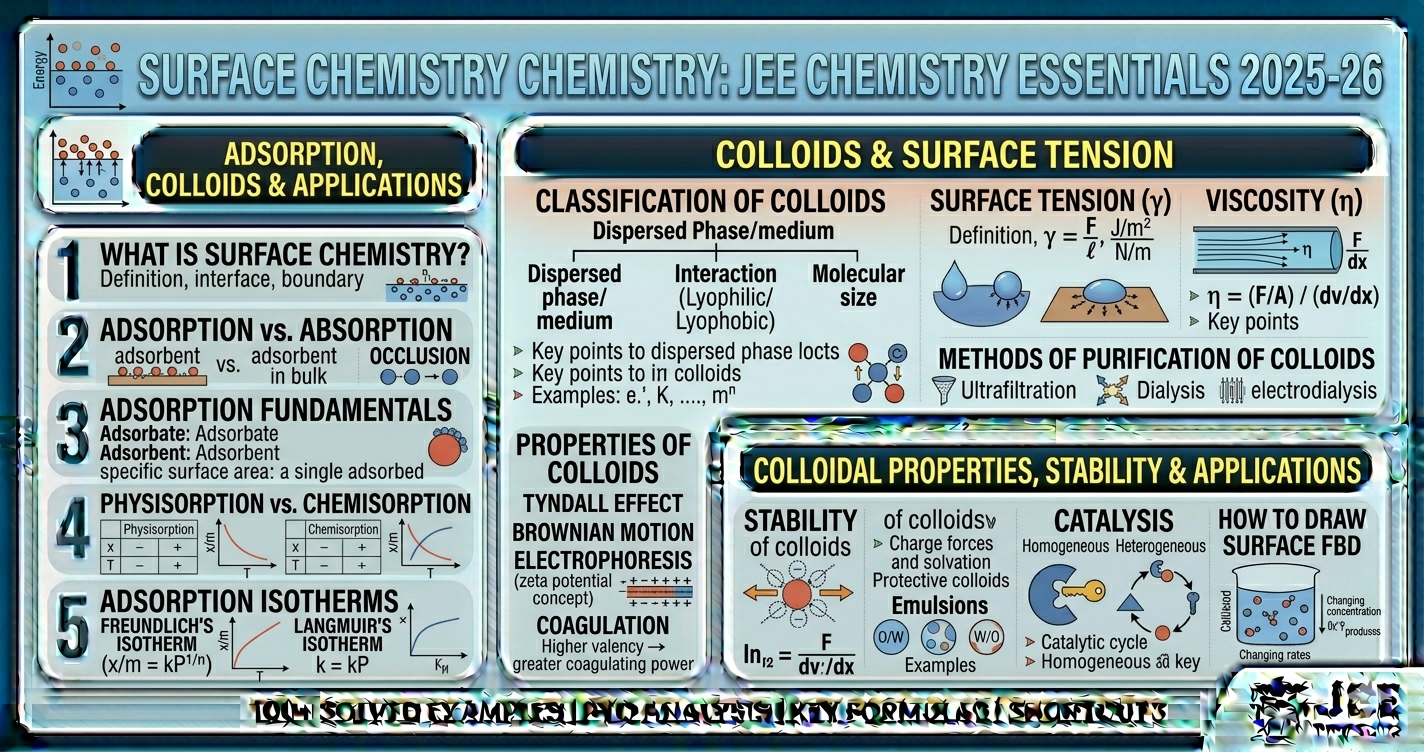
 Surface Chemistry JEE Notes, Formulas, PYQs
Adsorption
Adsorption is the phenomenon of accumulation of molecular species (adsorbate) at the surface rather than in the bulk of a solid or liquid (adsorbent). It's a surface phenomenon.
1.1 Adsorption vs Absorption
| Property | Adsorption | Absorption |
|---|---|---|
| Definition | Surface phenomenon | Bulk phenomenon |
| Location | Only on surface | Throughout the material |
| Rate | Rapid initially, then slow | Uniform throughout |
| Concentration | Higher on surface | Uniform throughout |
| Temperature Effect | Decreases with temperature ↑ | Independent |
| Examples | Silica gel adsorbs water, activated charcoal adsorbs gases | Water absorbed by sponge, anhydrous CaCl₂ absorbs water |
💡 Sorption
Sorption: When both adsorption and absorption occur simultaneously, the process is called sorption.
Example: Dye on cotton - initially adsorbed on surface, then absorbed into fibers.
1.2 Physisorption vs Chemisorption
| Property | Physisorption | Chemisorption |
|---|---|---|
| Forces Involved | Weak van der Waals forces | Strong chemical bonds (covalent/ionic) |
| Nature | Physical, reversible | Chemical, irreversible |
| Enthalpy (ΔH) | Low (20-40 kJ/mol) | High (80-240 kJ/mol) |
| Temperature Effect | Decreases with T ↑ | First increases, then decreases |
| Activation Energy | Very low or zero | High (like chemical reaction) |
| Specificity | Not specific | Highly specific |
| Layers | Multi-molecular layers possible | Only mono-molecular layer |
| Pressure | Occurs at low temperature and high pressure | Occurs at high temperature |
| Examples | N₂ on mica at 77K, gases on charcoal | O₂ on tungsten, H₂ on nickel |
1.3 Factors Affecting Adsorption
1. Nature of Adsorbent
- Greater surface area → More adsorption
- Porous substances are better adsorbents
- Activated charcoal, silica gel, alumina gel
- Finely divided metals (Ni, Pt, Pd)
2. Nature of Adsorbate
- Easily liquefiable gases (higher critical temp) adsorb more
- Order: NH₃ > HCl > CO₂ > CH₄ > O₂ > N₂
- Higher molecular weight → More adsorption
- Polar molecules adsorb more than non-polar
3. Temperature
- Physisorption: Decreases with T ↑ (exothermic)
- Chemisorption: First increases (activation needed), then decreases
- Generally: Adsorption ∝ 1/T
4. Pressure
- At constant T: Adsorption ↑ with pressure ↑
- At high pressure: Saturation occurs
- Relation described by adsorption isotherms
⚠️ JEE Important: Adsorption is Exothermic
Adsorption is always exothermic (ΔH < 0) because:
- Molecules on surface have residual forces
- When adsorbate attaches, these forces are satisfied
- Energy is released in the process
- By Le Chatelier's principle: Low temperature favors adsorption
Adsorption Isotherms
Adsorption isotherm is the relationship between the amount of substance adsorbed per unit mass of adsorbent (x/m) and pressure (or concentration) at constant temperature.
2.1 Freundlich Adsorption Isotherm
Empirical Relationship
Basic Equation:
where x = mass adsorbed, m = mass of adsorbent, P = pressure, k and n are constants (n > 1)
Logarithmic Form (Most useful for JEE):
Graph: log(x/m) vs log P
- Straight line with positive slope
- Slope = 1/n
- Intercept = log k
- From slope and intercept, k and n can be determined
Behavior at Different Pressures:
Low Pressure
x/m ∝ P (1/n = 1)
Linear relationship
Moderate Pressure
x/m ∝ P^(1/n)
n > 1 (typical)
High Pressure
x/m ∝ P⁰ (constant)
Saturation (1/n = 0)
2.2 Langmuir Adsorption Isotherm
Theoretical Approach (Based on Kinetics)
Assumptions:
- Surface has fixed number of adsorption sites
- Each site can hold only ONE molecule (mono-molecular layer)
- All sites are energetically equivalent
- No interaction between adsorbed molecules
- Dynamic equilibrium between adsorption and desorption
Langmuir Equation:
where a and b are constants, θ = fraction of surface covered
In terms of θ (surface coverage):
Linear Form (for graphing):
Graph of 1/(x/m) vs 1/P gives straight line
📝 Solved Example 1
Question: For adsorption of a gas on solid, following data is obtained:
| P (atm) | 0.5 | 1.0 | 2.0 | 4.0 |
|---|---|---|---|---|
| x/m (g/g) | 0.10 | 0.14 | 0.20 | 0.28 |
Show that it follows Freundlich isotherm and find values of k and n.
Solution:
Using Freundlich equation: log(x/m) = log k + (1/n) log P
| P | log P | x/m | log(x/m) |
|---|---|---|---|
| 0.5 | -0.301 | 0.10 | -1.00 |
| 1.0 | 0.000 | 0.14 | -0.854 |
| 2.0 | 0.301 | 0.20 | -0.699 |
| 4.0 | 0.602 | 0.28 | -0.553 |
Calculating slope (1/n):
Finding k from intercept:
At P = 1.0 atm, log P = 0, so log(x/m) = log k
Answer:
The data follows Freundlich isotherm
k = 0.14, n = 2
Equation: x/m = 0.14 P^(1/2)
💡 Freundlich vs Langmuir - Quick Comparison
| Property | Freundlich | Langmuir |
|---|---|---|
| Type | Empirical | Theoretical (kinetic) |
| Surface | Heterogeneous | Homogeneous |
| Layers | Multi-molecular | Mono-molecular only |
| Validity | Moderate pressure | All pressures |
| JEE Frequency | More common | Less common |
Catalysis
A catalyst is a substance that increases the rate of a chemical reaction without itself being consumed in the reaction. The phenomenon is called catalysis.
3.1 Characteristics of Catalyst
-
✓
Remains unchanged:
Catalyst is not consumed in the reaction (chemically and quantitatively unchanged)
-
✓
Small quantity sufficient:
Very small amount can catalyze large amount of reactants
-
✓
Does not initiate reaction:
Cannot start a reaction that is thermodynamically not feasible (ΔG > 0)
-
✓
Does not change equilibrium:
Only increases rate - both forward and backward equally. Keq remains same
-
✓
Specific in nature:
A catalyst is usually specific for a particular reaction
-
✓
Lowers activation energy:
Provides alternative pathway with lower Ea
3.2 Types of Catalysis
Homogeneous Catalysis
Catalyst and reactants are in the same phase
Examples:
- 2SO₂(g) + O₂(g) →NO(g) 2SO₃(g)
- CH₃COOCH₃ + H₂O →HCl CH₃COOH + CH₃OH
- 4NH₃ + 5O₂ →NO 4NO + 6H₂O (Ostwald process)
Characteristics:
• Cannot be separated easily
• Reaction mechanism well understood
Heterogeneous Catalysis
Catalyst and reactants are in different phases
Examples:
- N₂(g) + 3H₂(g) →Fe(s) 2NH₃(g) (Haber)
- Vegetable oils(l) + H₂(g) →Ni(s) Vanaspati (hydrogenation)
- 2H₂O₂(aq) →MnO₂(s) 2H₂O + O₂ (decomposition)
Characteristics:
• Usually solid catalyst, gas/liquid reactants
• Can be separated by filtration
3.3 Mechanism of Heterogeneous Catalysis
Involves following steps on catalyst surface:
Step 1: Diffusion
Reactant molecules diffuse to catalyst surface
Step 2: Adsorption
Reactants are adsorbed on catalyst surface (usually chemisorption)
Step 3: Reaction
Chemical reaction occurs on surface forming intermediates/products
Step 4: Desorption
Products are desorbed from surface, freeing active sites
Step 5: Diffusion
Product molecules diffuse away from surface
3.4 Important Industrial Catalytic Processes
| Process | Reaction | Catalyst | Product |
|---|---|---|---|
| Haber Process | N₂ + 3H₂ → 2NH₃ | Fe + Mo/Al₂O₃ | Ammonia |
| Contact Process | 2SO₂ + O₂ → 2SO₃ | V₂O₅ or Pt | SO₃ (for H₂SO₄) |
| Ostwald Process | 4NH₃ + 5O₂ → 4NO + 6H₂O | Pt-Rh | NO (for HNO₃) |
| Hydrogenation | Oils + H₂ → Fats | Ni | Vanaspati ghee |
| Deacon Process | 4HCl + O₂ → 2Cl₂ + 2H₂O | CuCl₂ | Chlorine |
| Cracking | Heavy hydrocarbons → Light | Al₂O₃ + SiO₂ | Petrol, diesel |
⚠️ Catalytic Poisoning
Certain substances decrease or destroy the activity of a catalyst. These are called catalytic poisons.
- Haber process: CO, H₂S poison Fe catalyst
- Contact process: As₂O₃ poisons V₂O₅ catalyst
- Hydrogenation: S, P, As, Hg poison Ni catalyst
Mechanism: Poison preferentially adsorbs on active sites, blocking reactants
💡 Auto-Catalysis & Promoters
Auto-Catalysis:
Product of reaction itself acts as catalyst
Example: CH₃COOC₂H₅ + H₂O → CH₃COOH + C₂H₅OH (CH₃COOH catalyzes reaction)
Promoters:
Substances that enhance catalyst activity but are not catalysts themselves
Example: Mo acts as promoter for Fe in Haber process
Colloids
Colloidal solutions (colloids) are heterogeneous mixtures where particle size is between 1-1000 nm (10⁻⁹ to 10⁻⁶ m). Cannot be seen by naked eye but show Tyndall effect.
4.1 Classification of Colloids
| Dispersed Phase | Dispersion Medium | Name | Examples |
|---|---|---|---|
| Solid | Solid | Solid Sol | Colored glasses, Gemstones |
| Solid | Liquid | Sol | Paints, Gold sol, Muddy water |
| Solid | Gas | Aerosol | Smoke, Dust in air |
| Liquid | Solid | Gel | Cheese, Jellies, Butter |
| Liquid | Liquid | Emulsion | Milk, Cod liver oil |
| Liquid | Gas | Aerosol | Fog, Mist, Cloud |
| Gas | Solid | Solid foam | Pumice stone, Foam rubber |
| Gas | Liquid | Foam | Soap lather, Whipped cream |
| Gas | Gas | — | Not possible (forms solution) |
4.2 Lyophilic vs Lyophobic Colloids
| Property | Lyophilic (Solvent-loving) | Lyophobic (Solvent-hating) |
|---|---|---|
| Meaning | Hydrophilic (if water is medium) | Hydrophobic (if water is medium) |
| Preparation | Easy - direct mixing | Difficult - special methods needed |
| Stability | Very stable | Unstable |
| Viscosity | Higher than medium | Same as medium |
| Reversibility | Reversible | Irreversible |
| Coagulation | Difficult (need large amount of electrolyte) | Easy (small amount sufficient) |
| Examples | Starch, gelatin, protein, gum | Metal sols (Au, Ag), metal sulfides (As₂S₃) |
Properties of Colloids
5.1 Key Properties (JEE Important)
1. Tyndall Effect
Scattering of light by colloidal particles
- Path of light becomes visible
- True solutions don't show this
- Example: Sunlight through fog, cinema hall beam
2. Brownian Motion
Zig-zag random motion of colloidal particles
- Due to unequal bombardment by medium molecules
- Prevents settling of particles
- Provides stability to colloid
3. Electrophoresis
Movement of colloidal particles under electric field
- Positive sol → Moves to cathode
- Negative sol → Moves to anode
- Proves colloidal particles carry charge
4. Coagulation/Flocculation
Settling of colloidal particles
- By adding electrolytes
- By heating or boiling
- By adding oppositely charged sol
5.2 Hardy-Schulze Rule (Very Important for JEE)
Coagulation of Colloids by Electrolytes
Greater the valency of the coagulating ion (opposite charge to sol), greater is its coagulating power.
For Negative Sols (e.g., As₂S₃):
Cations coagulate negative sols
For Positive Sols (e.g., Fe(OH)₃):
Anions coagulate positive sols
⚠️ Gold Number
Gold number: Minimum mass (in mg) of protective colloid required to prevent coagulation of 10 mL gold sol by 1 mL of 10% NaCl solution.
Lower gold number → Better protective power
Example: Gelatin (0.005-0.01) > Gum arabic (0.15-0.25) > Starch (20-25)
Emulsions
Emulsion: Colloidal dispersion of liquid in liquid
Types:
Oil-in-Water (O/W)
Oil dispersed in water
Examples: Milk, Vanishing cream
Test: Conducts electricity
Water-in-Oil (W/O)
Water dispersed in oil
Examples: Butter, Cold cream
Test: Does not conduct
Emulsifying Agents:
Stabilize emulsions - Soap, Detergents, Proteins, Gums
Applications of Colloids
🏥 Medicine:
Colloidal silver (antiseptic), Colloidal gold (medicine)
💧 Water Purification:
Alum coagulates dirt particles
🏭 Industrial:
Paints, inks, rubber, photography
🥛 Food:
Milk, ice cream, whipped cream
📝 Previous Year Questions Analysis
JEE Main (Last 5 Years)
- ✓ Colloids Classification: 30%
- ✓ Adsorption & Isotherms: 25%
- ✓ Properties of Colloids: 20%
- ✓ Catalysis: 15%
- ✓ Emulsions: 10%
JEE Advanced (Last 5 Years)
- ✓ Freundlich Isotherm: 35%
- ✓ Catalysis Mechanisms: 25%
- ✓ Coagulation & Hardy-Schulze: 20%
- ✓ Physisorption vs Chemisorption: 15%
- ✓ Conceptual (theory): 5%
Top 10 Most Repeated Question Types
- Calculating k and n from Freundlich isotherm data
- Distinguishing between physisorption and chemisorption
- Identifying type of colloid from dispersed phase and medium
- Applying Hardy-Schulze rule for coagulation
- Identifying homogeneous vs heterogeneous catalysis
- Determining O/W or W/O emulsion type
- Explaining Tyndall effect and Brownian motion
- Industrial catalytic processes (Haber, Contact, Ostwald)
- Properties of lyophilic vs lyophobic colloids
- Preparation methods of colloids
Weightage Analysis
🎯 Practice Problem Set
Level 1: Basic (JEE Main Standard)
- Differentiate between adsorption and absorption with examples.
- Why is adsorption always exothermic?
- Name the catalyst used in: (a) Haber process (b) Contact process (c) Hydrogenation
- Classify: Milk, Smoke, Fog, Butter, Jellies based on dispersed phase and medium.
- What is Tyndall effect? Give two examples.
- Arrange Al³⁺, Ba²⁺, Na⁺ in order of coagulating power for As₂S₃ sol.
- Distinguish between O/W and W/O emulsions.
- What are lyophilic and lyophobic colloids? Give two examples of each.
Level 2: Intermediate (JEE Main/Advanced)
- For Freundlich isotherm x/m = kP^(1/n), what happens when: (a) n = 1 (b) n = ∞
- Compare physisorption and chemisorption on five different parameters.
- Explain mechanism of heterogeneous catalysis with Haber process as example.
- What is Hardy-Schulze rule? Why is Al³⁺ better coagulating agent than Na⁺ for negative sol?
- Explain: (a) Brownian motion (b) Electrophoresis (c) Peptization
- Calculate k and n if at P = 2 atm, x/m = 0.2 and at P = 4 atm, x/m = 0.3
- Why is finely divided substance more effective as adsorbent?
- Explain catalytic poisoning with two industrial examples.
Level 3: Advanced (JEE Advanced/Olympiad)
- Derive Langmuir adsorption isotherm equation. What are its assumptions?
- For adsorption of gas on solid: at P = 0.5, 1, 2, 4 atm, x/m = 2, 3, 4, 5. Verify Freundlich isotherm graphically.
- Explain why physisorption decreases and chemisorption first increases then decreases with temperature.
- How will you distinguish between: (a) Lyophilic and lyophobic sols (b) Sols and gels (c) O/W and W/O emulsions
- A negative sol is coagulated by: NaCl (50 mM), CaCl₂ (0.8 mM), AlCl₃ (0.1 mM). Verify Hardy-Schulze rule.
- Explain: (a) Gold number (b) Protective colloids (c) Peptization
- Why does physisorption form multi-layers while chemisorption forms only monolayer?
- Derive relationship between Freundlich and Langmuir isotherms at low pressure.