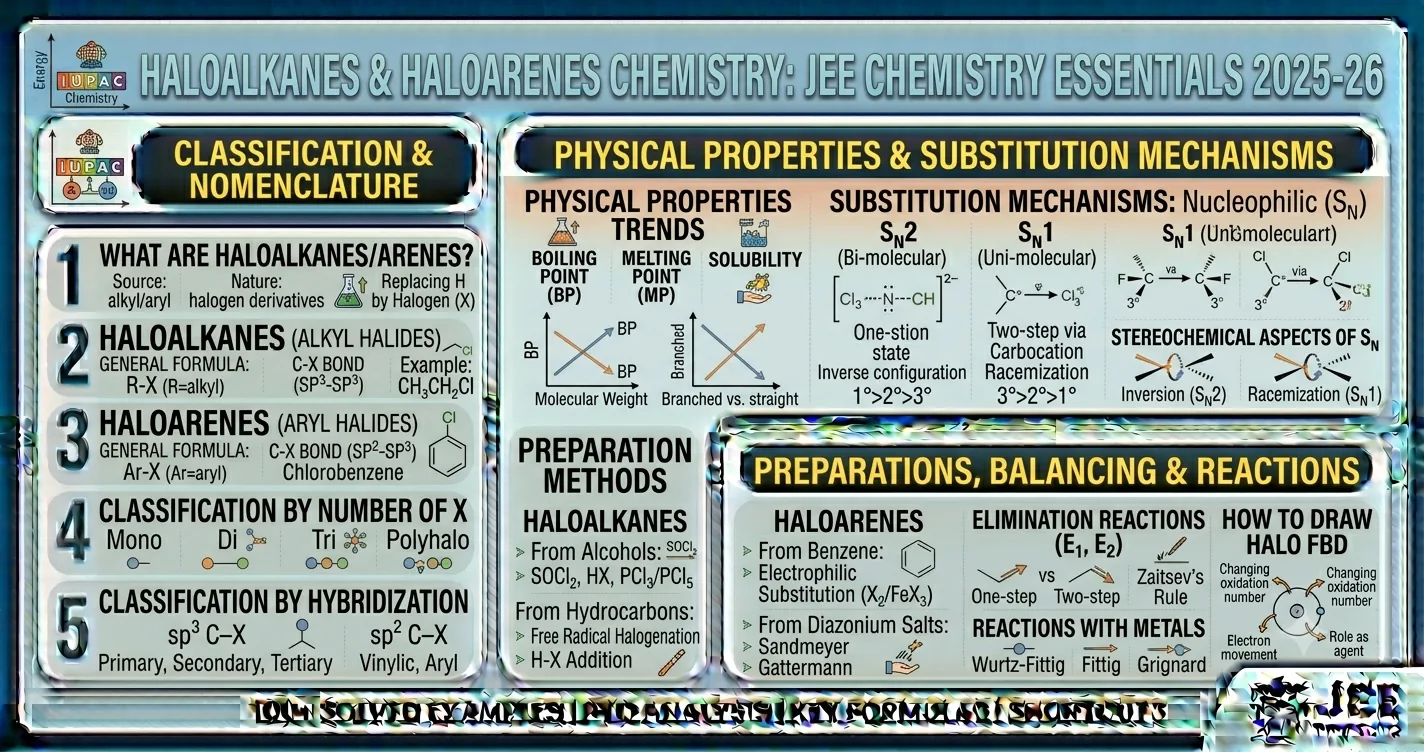
Classification & Nature of C-X Bond
Replacement of one or more hydrogen atoms from a hydrocarbon by an equivalent number of halogen atoms yields halogen derivatives. They are broadly classified into Haloalkanes (Alkyl halides) and Haloarenes (Aryl halides).
1.1 Classification of Haloalkanes
Based on Number of Halogen Atoms
- Mono-halides: Contain one halogen atom (e.g., $\text{CH}_3\text{Cl}$)
- Di-halides: Contain two halogen atoms
- Geminal (Gem): Both X on same carbon ($\text{CH}_3\text{CHX}_2$)
- Vicinal (Vic): X on adjacent carbons ($\text{XCH}_2\text{CH}_2\text{X}$)
- Tri-halides: Contain three halogen atoms (e.g., $\text{CHX}_3$, $\text{CHCl}_3$)
Important for JEE — Bond Enthalpy & Dipole Moment
The carbon-halogen bond (C-X) is polar because halogens are more electronegative than carbon. However, the bond enthalpy and bond length trends are crucial for predicting reactivity.
| Property | C-F | C-Cl | C-Br | C-I |
|---|---|---|---|---|
| Bond Length (pm) | 139 | 178 | 193 | 214 |
| Bond Enthalpy (kJ/mol) | 485 | 339 | 284 | 213 |
| Dipole Moment (D) | 1.41 | 1.46 | 1.38 | 1.29 |
Trend in Dipole Moment: $\text{C-Cl} > \text{C-F} > \text{C-Br} > \text{C-I}$
Why is C-Cl dipole moment > C-F? Though F is more electronegative, the bond length of C-F is very short. Dipole moment = Charge × Distance. The larger distance in C-Cl makes its dipole moment slightly higher.
PYQ — JEE Main 2023
Question: The correct order of bond dissociation enthalpy of C-X bond in haloalkanes is:
(a) $\text{C-F} < \text{C-Cl} < \text{C-Br} < \text{C-I}$
(b) $\text{C-I} < \text{C-Br} < \text{C-Cl} < \text{C-F}$
(c) $\text{C-Cl} < \text{C-F} < \text{C-Br} < \text{C-I}$
(d) $\text{C-F} < \text{C-I} < \text{C-Br} < \text{C-Cl}$
Solution:
Down the group (F → I), atomic size increases. Hence, bond length increases.
Larger bond length leads to weaker bonds, making them easier to break.
Answer: (b) $\text{C-I} < \text{C-Br} < \text{C-Cl} < \text{C-F}$
Preparation of Haloalkanes & Haloarenes
Understanding the synthesis pathways is essential. Methods differ for aliphatic (alkyl halides) and aromatic (aryl halides) compounds.
2.1 Preparation of Haloalkanes
High PYQ Frequency — Finkelstein & Swarts Reaction
1. Finkelstein Reaction (Halogen Exchange)
Used to prepare Alkyl Iodides (R-I) from Alkyl Chlorides/Bromides.
Mechanism: SN2. Why dry acetone? NaCl and NaBr are insoluble in dry acetone and precipitate out, driving the equilibrium forward (Le Chatelier's principle).
2. Swarts Reaction
Used to prepare Alkyl Fluorides (R-F) by heating alkyl chloride/bromide with a metallic fluoride (AgF, Hg₂F₂, CoF₂, SbF₃).
From Alcohols
$ \text{R-OH} \xrightarrow{\text{Reagent}} \text{R-X} $
- For Chlorides (R-Cl): Use $\text{SOCl}_2$ (Thionyl chloride) + Pyridine. (Best method as byproducts are gases)
- For Bromides (R-Br): Use $\text{HBr}$ or $\text{KBr} + \text{H}_2\text{SO}_4$ or $\text{PBr}_3$
- For Iodides (R-I): Use $\text{HI}$ or $\text{PI}_3$ (Red phosphorus + I₂)
2.2 Preparation of Haloarenes
Sandmeyer vs Gattermann Reaction
Sandmeyer Reaction
Diazonium salt treated with CuX / HX.
Yield is high. Specific for Cl, Br, CN.
Gattermann Reaction
Diazonium salt treated with Cu powder / HX.
Yield is lower than Sandmeyer.
PYQ — JEE Main 2022
Question: Which of the following reagents is used in the Finkelstein reaction to convert alkyl chlorides to alkyl iodides?
(a) NaCl in ethanol
(b) NaI in dry acetone
(c) KI in water
(d) AgF in acetic acid
Solution:
The Finkelstein reaction is a halogen exchange reaction specifically to make alkyl iodides.
The reagent is NaI (Sodium Iodide) in dry acetone.
Dry acetone is used because NaI is soluble in it, but the byproducts NaCl and NaBr are insoluble and precipitate out, shifting the equilibrium to the product side.
Answer: (b) NaI in dry acetone
Physical Properties
3.1 Boiling Point Trends
Important Concept — BP Depends on van der Waals Forces
Boiling points of haloalkanes follow these rules:
- Same alkyl group, different halogen: $\text{R-I} > \text{R-Br} > \text{R-Cl} > \text{R-F}$ (Due to increasing molecular mass and van der Waals forces).
- Same halogen, different alkyl group: $\text{3°} > \text{2°} > \text{1°}$ (Due to increasing surface area and branching decreases surface area).
- Isomeric alkyl halides: Branching decreases boiling point. $\text{n-butyl} > \text{isobutyl} > \text{sec-butyl} > \text{tert-butyl}$.
3.2 Solubility
Haloalkanes and haloarenes are only slightly soluble in water but completely soluble in organic solvents.
Reason for Low Water Solubility
Although polar, haloalkanes cannot form hydrogen bonds with water. To dissolve, they must break existing strong hydrogen bonds between water molecules, which requires more energy than is released during new dipole-dipole interactions.
PYQ — JEE Main 2021
Question: The correct order of boiling points of isomeric pentyl chlorides is:
(a) n-pentyl chloride > isopentyl chloride > neopentyl chloride
(b) neopentyl chloride > isopentyl chloride > n-pentyl chloride
(c) isopentyl chloride > n-pentyl chloride > neopentyl chloride
(d) n-pentyl chloride > neopentyl chloride > isopentyl chloride
Solution:
For isomeric halides, boiling point decreases with increased branching because branching reduces the surface area of the molecule.
Lower surface area = weaker van der Waals forces = lower boiling point.
Order of branching: Neopentyl (max) > Isopentyl > n-pentyl (min).
Therefore, BP order: n-pentyl > isopentyl > neopentyl.
Answer: (a)
Nucleophilic Substitution Reactions (SN1 & SN2)
This is the most important topic for JEE in this chapter. A nucleophile ($\text{Nu}^-$) replaces the halogen (leaving group) in an alkyl halide. There are two distinct mechanisms: $\text{S}_\text{N}1$ and $\text{S}_\text{N}2$.
Most Repeated Topic — SN1 vs SN2 Comparison
| Feature | SN1 (Substitution Nucleophilic Unimolecular) | SN2 (Substitution Nucleophilic Bimolecular) |
|---|---|---|
| Steps | Two steps | One step (single transition state) |
| Rate Law | Rate = k[R-X] (1st order) | Rate = k[R-X][Nu⁻] (2nd order) |
| Intermediate | Carbocation (planar) | No intermediate (transition state) |
| Substrate Reactivity | 3° > 2° > 1° (stable carbocation) | 1° > 2° > 3° (less steric hindrance) |
| Stereochemistry | Racemization (inversion + retention) | 100% Inversion (Walden inversion) |
| Nucleophile | Weak nucleophile favored | Strong nucleophile favored |
| Solvent | Polar protic (H₂O, ROH) | Polar aprotic (DMSO, DMF, Acetone) |
| Leaving Group | Good leaving group needed | Good leaving group needed |
Walden Inversion in SN2
In $\text{S}_\text{N}2$, the nucleophile attacks from the back side (opposite to the leaving group). This causes the rest of the molecule to flip like an umbrella in a storm, resulting in complete inversion of configuration.
PYQ — JEE Main 2024
Question: Which of the following alkyl halides will undergo an $\text{S}_\text{N}2$ reaction most readily?
(a) 2-bromo-2-methylpropane (tert-butyl bromide)
(b) 2-bromobutane (sec-butyl bromide)
(c) 1-bromo-2-methylpropane (isobutyl bromide)
(d) 1-bromobutane (n-butyl bromide)
Solution:
$\text{S}_\text{N}2$ reactions require the nucleophile to attack the carbon from the back side.
Steric hindrance around the carbon slows down or prevents the reaction.
Reactivity order for $\text{S}_\text{N}2$: $\text{CH}_3\text{X} > 1^\circ > 2^\circ > 3^\circ$
Option (a) is 3°, (b) is 2°, (c) and (d) are 1°. However, (c) is a branched 1° (isobutyl) which has more steric hindrance than (d), a straight-chain 1° halide.
Therefore, the unbranched primary halide (n-butyl bromide) reacts fastest via $\text{S}_\text{N}2$.
Answer: (d) 1-bromobutane (n-butyl bromide)
Elimination Reactions (E1 & E2)
When a haloalkane is treated with a strong base (like alcoholic KOH), it undergoes dehydrohalogenation to form an alkene. The preferred product is governed by Saytzeff's Rule.
Highly Repeated Concept — Saytzeff's Rule
Saytzeff's Rule: In an elimination reaction, the preferred product is the alkene that is more highly substituted (i.e., has more alkyl groups attached to the double-bonded carbons).
Reason: More substituted alkenes are more stable due to hyperconjugation and inductive effects of alkyl groups.
E1 vs E2 Mechanisms
| Feature | E1 Mechanism | E2 Mechanism |
|---|---|---|
| Steps | Two steps (Carbocation forms first) | One step (Concerted) |
| Rate Law | Rate = k[R-X] | Rate = k[R-X][Base] |
| Substrate | 3° > 2° > 1° | 3° > 2° > 1° (requires good leaving group) |
| Base | Weak base | Strong base |
| Solvent | Polar protic | Polar aprotic |
| Rearrangement | Possible (via carbocation shift) | Not possible |
PYQ — JEE Main 2023
Question: What is the major product formed when 2-bromobutane is heated with alcoholic KOH?
(a) But-1-ene
(b) But-2-ene
(c) Butane
(d) Butan-2-ol
Solution:
Alcoholic KOH causes elimination (dehydrohalogenation).
2-bromobutane ($\text{CH}_3\text{CHBrCH}_2\text{CH}_3$) can eliminate HBr to form either But-1-ene or But-2-ene.
Saytzeff's Rule: The more substituted alkene is the major product.
But-2-ene ($\text{CH}_3\text{CH}=\text{CHCH}_3$) has alkyl groups on both sides of the double bond, whereas But-1-ene has only one.
Answer: (b) But-2-ene
Reactions of Haloarenes (Aryl Halides)
Aryl halides (like chlorobenzene) are extremely unreactive towards nucleophilic substitution reactions compared to alkyl halides. JEE tests the reasons for this low reactivity heavily.
High PYQ Frequency — Why Haloarenes are Unreactive
Reasons for low reactivity of aryl halides towards SN reactions:
- Resonance Effect: In chlorobenzene, the lone pair of Cl is delocalized into the benzene ring. This gives the C-Cl bond partial double bond character, making it shorter (169 pm vs 178 pm in alkyl chlorides) and stronger.
- Difference in Hybridization: Carbon in benzene is $\text{sp}^2$ hybridized (more s-character), making it more electronegative and holding the C-X bond tighter than the $\text{sp}^3$ carbon in alkyl halides.
- Instability of Phenyl Cation: In $\text{S}_\text{N}1$, the phenyl cation formed would be highly unstable because the positive charge is on an $\text{sp}^2$ carbon and cannot be stabilized by resonance.
- Steric / Electronic Repulsion: The electron-rich benzene ring repels the incoming electron-rich nucleophile ($\text{Nu}^-$).
6.1 Electrophilic Substitution Reactions
Halogens are ortho- and para-directing but deactivating groups. They withdraw electrons inductively (deactivating) but donate via resonance (+R effect), which increases electron density at ortho and para positions.
6.2 Nucleophilic Substitution (Specific Cases)
Aryl halides do undergo SN reactions under drastic conditions if strong electron-withdrawing groups (like $-\text{NO}_2$) are present at ortho/para positions.
Exception: Dow Process
Chlorobenzene can be converted to phenol when heated with NaOH at 623 K and 300 atm pressure, followed by acidification.
PYQ — JEE Main 2022
Question: Which of the following statements is incorrect regarding the reactivity of chlorobenzene towards nucleophilic substitution?
(a) The C-Cl bond in chlorobenzene has partial double bond character due to resonance.
(b) The carbon attached to Cl is sp² hybridized, making the bond shorter and stronger.
(c) The phenyl cation formed is highly stable due to resonance.
(d) The electron-rich nucleophile is repelled by the benzene ring.
Solution:
Let's evaluate the statements:
(a) is TRUE: Resonance gives partial double bond character.
(b) is TRUE: sp² carbon is more electronegative than sp³, holding the bond tighter.
(c) is FALSE: The phenyl cation is highly unstable because the positive charge on an sp² carbon cannot be stabilized by resonance.
(d) is TRUE: The benzene ring is electron-rich and repels the nucleophile.
Answer: (c) The phenyl cation formed is highly stable due to resonance.
Reactions with Metals
Haloalkanes and haloarenes react with various metals to form organometallic compounds, which are highly useful in organic synthesis.
Important Name Reactions
Wurtz Reaction
Two molecules of alkyl halide react with sodium (Na) in dry ether to form an alkane with double the carbon atoms.
Fittig Reaction
Two molecules of aryl halide react with Na in dry ether to form diphenyl (biaryl).
Wurtz-Fittig Reaction
A mixture of an alkyl halide and an aryl halide reacts with Na in dry ether to form an alkylbenzene.
Grignard Reagent Formation
PYQ — JEE Main 2021
Question: The reaction of chlorobenzene with sodium in dry ether yields:
(a) Toluene
(b) Diphenyl
(c) Benzene
(d) Chlorotoluene
Solution:
The reaction of an aryl halide (chlorobenzene) with Na in dry ether is called the Fittig Reaction.
Two aryl groups couple together to form a diphenyl molecule.
If it were a mixture of alkyl and aryl halide, it would be Wurtz-Fittig yielding Toluene. But since only chlorobenzene is present, it's Fittig reaction yielding Diphenyl.
Answer: (b) Diphenyl
Polyhalogen Compounds
These are compounds containing more than one halogen atom. Many of these have significant environmental and medical applications.
Key Compounds to Know
- CHCl₃ (Chloroform):
- Slowly oxidized by air to form deadly poisonous phosgene (COCl₂).
- Stored in dark colored bottles filled to the brim to prevent air oxidation.
- Used as an anesthetic (discontinued due to toxicity).
- CCl₄ (Carbon Tetrachloride):
- Used as a fire extinguisher under the name "Pyrene".
- Produces highly toxic phosgene when used on fires.
- Banned internationally due to ozone depletion potential.
- Freons (CCl₂F₂):
- Chlorofluorocarbons used as refrigerants.
- Major cause of ozone layer depletion.
- DDT (p,p'-Dichlorodiphenyltrichloroethane):
- Powerful insecticide, but highly persistent in the environment.
- Banned in many countries due to biomagnification and toxicity to aquatic life.
PYQ — JEE Main 2019
Question: Chloroform is stored in dark colored bottles because:
(a) It reacts with light to form chlorine gas.
(b) It undergoes oxidation in presence of air and light to form phosgene.
(c) It evaporates easily in light.
(d) It forms carbon tetrachloride in light.
Solution:
Chloroform ($\text{CHCl}_3$) slowly undergoes oxidation in the presence of air and sunlight to form phosgene ($\text{COCl}_2$), which is extremely toxic.
To prevent this fatal reaction, it is stored in dark-colored, filled-to-the-brim bottles to exclude air and light.
Answer: (b) It undergoes oxidation in presence of air and light to form phosgene.
Summary & Quick Revision Tricks
Ultimate SN1 vs SN2 Memory Trick
- SN1: "1" means Unimolecular, 1 intermediate (carbocation), $1^\circ$ is worst, causes Racemization (50:50).
- SN2: "2" means Bimolecular, 0 intermediates (1 transition state), $1^\circ$ is best, causes Inversion (Umbrella flip).
Common Mistakes to Avoid
- Confusing Finkelstein (NaI/dry acetone) with Swarts (AgF). Remember: Iodine is heavy, Acetone is light; Fluorine is light, Silver (Ag) is heavy.
- Thinking SN1 gives 100% racemization. It gives partial inversion due to ion-pair effect (usually ~50-60% inversion).
- Forgetting that Saytzeff rule applies to E2 eliminations with bulky bases. With bulky bases (like t-BuOK), Hofmann product (less substituted) is major.
- Assuming haloarenes undergo SN2. They DO NOT undergo SN1 or SN2 under normal conditions due to resonance and hybridization.
PYQ Analysis: Last 10 Years
JEE Main Weightage
- ✓ SN1 vs SN2 Reactivity & Mechanism: 28%
- ✓ Preparation (Finkelstein, Sandmeyer): 22%
- ✓ Elimination (Saytzeff Rule): 18%
- ✓ Physical Properties (BP, Dipole): 12%
- ✓ Reactions of Haloarenes: 12%
- ✓ Reactions with Metals (Wurtz): 8%
JEE Advanced Weightage
- ✓ SN1/SN2 Stereochemistry: 25%
- ✓ Saytzeff vs Hofmann Product: 25%
- ✓ Reaction Mechanisms (E1/E2): 20%
- ✓ Multi-step Synthesis: 15%
- ✓ Identifying Compounds (Grignard): 15%
Top 5 Most Repeated Question Types
- Order of reactivity for SN1 / SN2 based on substrate structure.
- Major product identification using Saytzeff's rule.
- Reagents for Finkelstein, Swarts, and Sandmeyer reactions.
- Why haloarenes are less reactive towards nucleophilic substitution.
- Boiling point order of isomeric alkyl halides.
Practice Problem Set
Level 1: JEE Main Standard
- Arrange in order of increasing boiling point: 1-bromobutane, 2-bromobutane, 2-bromo-2-methylpropane.
- Identify the major product: 2-bromo-3-methylbutane + alcoholic KOH.
- Which is more reactive towards SN1: $\text{C}_6\text{H}_5\text{CH}_2\text{Cl}$ or $\text{C}_6\text{H}_5\text{Cl}$?
Level 2: JEE Main/Advanced
- Predict the stereochemistry of the product when optically active 2-bromobutane reacts with aqueous KOH.
- Write the structure of the major product formed when 2-bromobutane is reacted with potassium tert-butoxide.
- Why does chlorobenzene not undergo Friedel-Crafts reaction with chloromethane?
> FAQ
Frequently Asked Questions
What is the difference between SN1 and SN2 reactions?
SN1 is a two-step unimolecular nucleophilic substitution reaction that forms a carbocation intermediate and shows racemization. SN2 is a one-step bimolecular nucleophilic substitution reaction with a single transition state that shows complete inversion of configuration.
Why are haloarenes less reactive towards nucleophilic substitution?
Haloarenes are less reactive due to resonance stabilization (partial double bond character of C-X bond), sp2 hybridization of carbon making bond shorter and stronger, instability of phenyl cation, and repulsion between the nucleophile and electron-rich aromatic ring.
What is Saytzeff's rule?
Saytzeff's rule states that in dehydrohalogenation of alkyl halides, the preferred product is the alkene that is more highly substituted, as it is more stable.
What is the Finkelstein reaction?
The Finkelstein reaction is a halogen exchange reaction where an alkyl chloride or bromide reacts with sodium iodide (NaI) in dry acetone to form alkyl iodides.