
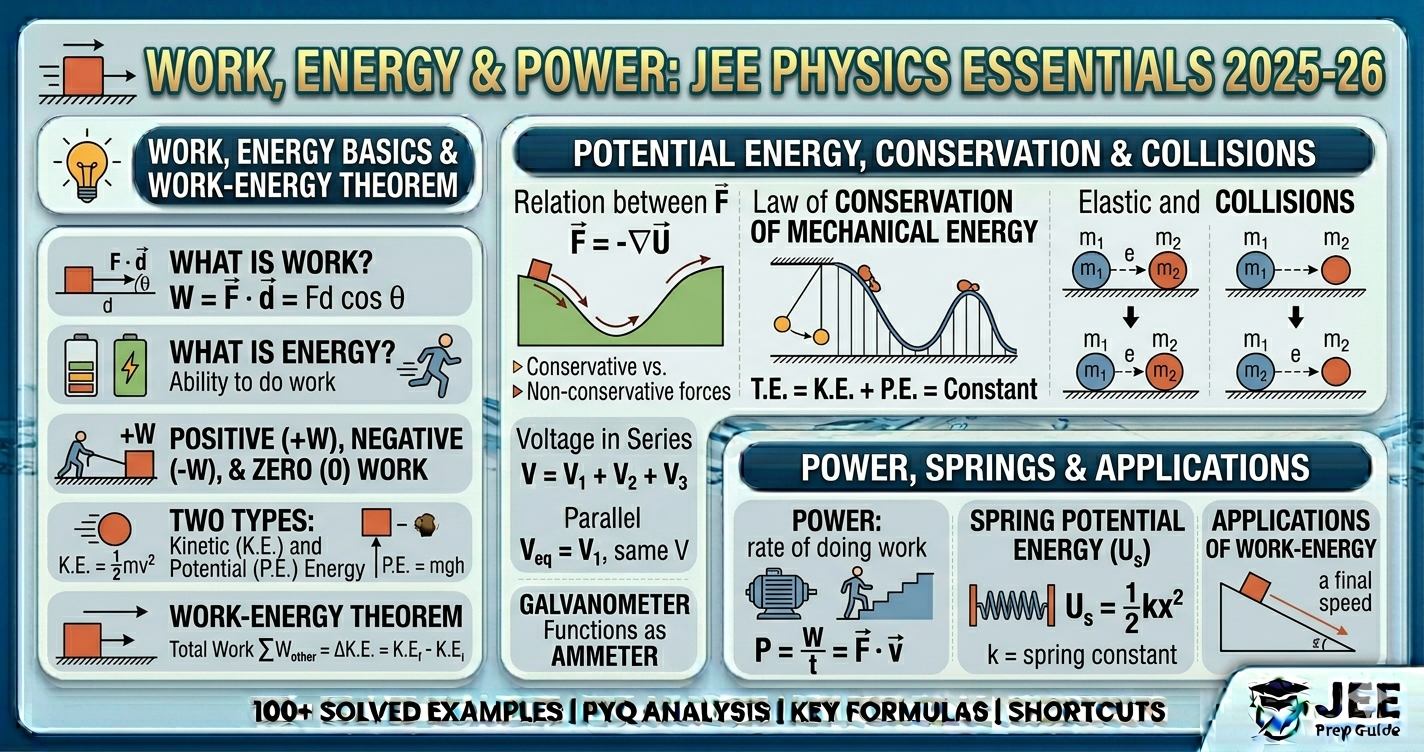
📖 Reading Time: 30 minutes ✅ Solved Examples: 100+ ⚡ Difficulty: Medium to Hard ⏰ Last Updated: 📊 Weightage: 12-16 marks (JEE Main)

📑 Quick Navigation - Work, Energy and Power

Work, Energy & Power JEE Main & Advanced 2025-26

Master the fundamental concepts of Work, Energy, and Power with comprehensive notes on Work-Energy Theorem, Conservation Laws, and Collisions. Includes 100+ solved problems and all JEE shortcuts.

📚 8 Complete Sections
✍️ 100+ Solved Examples
🎯 Quick Formulas
⭐⭐⭐⭐⭐ 4.9/5
320+ students rated this helpful
100+
Solved Examples
5 hrs
Study Time
Free
Always
Work Energy and Power JEE notes, Formulas, PYQs
Work Energy and Power JEE Notes, Formulas, PYQs
1

Work

In physics, work is done when a force causes displacement of an object. Unlike the everyday meaning, work in physics has a precise mathematical definition involving force, displacement, and the angle between them.

1.1 Definition of Work

Work Done by Constant Force

\[W = \vec{F} \cdot \vec{s} = Fs\cos\theta\]

F

Force applied

s

Displacement

θ

Angle between F and s

SI Unit

Joule (J)

1 J = 1 N·m = 1 kg·m²/s²

Dimensional Formula

[ML²T⁻²]

Same as Energy

1.2 Nature of Work (Sign Convention)

Condition Angle θ cos θ Work Example
Positive Work 0° ≤ θ < 90° Positive W > 0 Pushing a cart forward
Negative Work 90° < θ ≤ 180° Negative W < 0 Friction on moving block
Zero Work θ = 90° Zero W = 0 Carrying bag horizontally

💡 Quick Memory Trick

  • Positive Work: Force helps motion (same direction)
  • Negative Work: Force opposes motion (opposite direction)
  • Zero Work: Force ⊥ displacement OR no displacement

1.3 Work Done by Various Forces

Work by Gravity
\[W_g = mgh\]

Positive when falling down, negative when rising up

Work by Friction
\[W_f = -f \cdot s = -\mu N s\]

Always negative (opposes motion)

Work by Normal Force
\[W_N = 0 \text{ (usually)}\]

Zero when surface doesn't move in normal direction

Work by Spring Force
\[W_s = \frac{1}{2}kx_1^2 - \frac{1}{2}kx_2^2\]

From position x₁ to x₂

1.4 Work Done by Variable Force

\[W = \int_{x_1}^{x_2} F(x) \, dx = \text{Area under F-x curve}\]

⚠️ Important for JEE

Work is a scalar quantity (not vector). Even though it involves vectors (F and s), the dot product gives a scalar result. Work can be positive, negative, or zero.

📝 Solved Example 1 (JEE Main Pattern)

Question: A force F = (3î + 4ĵ) N acts on a body producing displacement s = (3î + 4ĵ) m. Find the work done.

Solution:

\[W = \vec{F} \cdot \vec{s} = (3\hat{i} + 4\hat{j}) \cdot (3\hat{i} + 4\hat{j})\]
\[W = 3 \times 3 + 4 \times 4 = 9 + 16 = 25 \text{ J}\]
\[\boxed{W = 25 \text{ J}}\]
2

Kinetic Energy

Kinetic Energy is the energy possessed by an object due to its motion. Any object that is moving has kinetic energy, and the faster it moves, the more kinetic energy it has.

2.1 Formula for Kinetic Energy

\[KE = \frac{1}{2}mv^2\]

where m = mass, v = velocity

Alternative Forms:

In terms of momentum

\[KE = \frac{p^2}{2m}\]

Relation with p

\[p = \sqrt{2mKE}\]

For rotation

\[KE = \frac{1}{2}I\omega^2\]

2.2 Properties of Kinetic Energy

✓ Always Positive or Zero

KE ≥ 0 (mass and v² are always positive)

✓ Scalar Quantity

No direction, only magnitude

✓ Frame Dependent

Different observers measure different KE

✓ Proportional to v²

Double speed → 4× kinetic energy

💡 JEE Trick: KE-Momentum Relations

If p is constant:

KE ∝ 1/m

Lighter object has more KE

If KE is constant:

p ∝ √m

Heavier object has more momentum

3

Potential Energy

Potential Energy is the energy stored in an object due to its position or configuration. It represents the capacity to do work when the object's position changes.

3.1 Gravitational Potential Energy

Near Earth's Surface
\[U = mgh\]

h = height above reference point

General Form (Large distances)
\[U = -\frac{GMm}{r}\]

r = distance from Earth's center

3.2 Elastic (Spring) Potential Energy

\[U = \frac{1}{2}kx^2\]

where k = spring constant, x = displacement from natural length

3.3 Conservative vs Non-Conservative Forces

Aspect Conservative Forces Non-Conservative Forces
Definition Work done is path independent Work done depends on path
Work in closed loop Zero Non-zero
PE exists? Yes, PE can be defined No PE can be defined
Examples Gravity, Spring, Electrostatic Friction, Air resistance, Viscous
Relation with PE W = -ΔU No relation

⚠️ Key Relation (Very Important!)

\[\vec{F} = -\frac{dU}{dx} \quad \text{or} \quad \vec{F} = -\nabla U\]

Force = negative gradient of potential energy. Force points from high PE to low PE.

📝 Solved Example 2

Question: If potential energy U = 3x² + 4, find the force at x = 2.

Solution:

\[F = -\frac{dU}{dx} = -\frac{d(3x^2 + 4)}{dx} = -6x\]

At x = 2:

\[F = -6(2) = -12 \text{ N}\]
4

Work-Energy Theorem

📜 Statement

"The net work done on an object equals the change in its kinetic energy."

\[W_{net} = \Delta KE = KE_f - KE_i = \frac{1}{2}mv^2 - \frac{1}{2}mu^2\]

4.1 Important Points

Wnet > 0

KE increases (object speeds up)

Wnet < 0

KE decreases (object slows down)

Wnet = 0

KE constant (constant speed)

Valid for ALL forces

Conservative + Non-conservative

4.2 Extended Form

\[W_{gravity} + W_{friction} + W_{applied} + W_{other} = \Delta KE\]

Sum of work by all individual forces = Change in KE

📝 Solved Example 3 (JEE Main 2023 Type)

Question: A 2 kg block is pushed by a 20 N force on a rough horizontal surface (μ = 0.3) for 5 m. If initial velocity is 4 m/s, find final velocity. (g = 10 m/s²)

Given: m = 2 kg, F = 20 N, μ = 0.3, s = 5 m, u = 4 m/s

Step 1: Calculate work by applied force

\[W_F = F \times s = 20 \times 5 = 100 \text{ J}\]

Step 2: Calculate work by friction

\[f = \mu mg = 0.3 \times 2 \times 10 = 6 \text{ N}\]
\[W_f = -f \times s = -6 \times 5 = -30 \text{ J}\]

Step 3: Apply Work-Energy Theorem

\[W_{net} = \Delta KE\]
\[100 - 30 = \frac{1}{2}(2)v^2 - \frac{1}{2}(2)(4)^2\]
\[70 = v^2 - 16\]
\[v^2 = 86\]
\[v = \sqrt{86} \approx 9.27 \text{ m/s}\]

💡 When to Use Work-Energy Theorem?

  • When asked to find velocity after displacement
  • When force varies with position
  • When path is complex but start/end points known
  • Problems involving friction and other forces together
5

Conservation of Mechanical Energy

📜 Law of Conservation of Energy

"In an isolated system where only conservative forces act, the total mechanical energy (KE + PE) remains constant."

Mathematical Form

\[KE_i + PE_i = KE_f + PE_f\]

or

\[E_{total} = KE + PE = \text{constant}\]

5.1 Conditions for Conservation

✓ Energy IS Conserved When:

  • • Only conservative forces act
  • • System is isolated
  • • No friction, air resistance

✗ Energy NOT Conserved When:

  • • Friction is present
  • • External forces do work
  • • Inelastic collisions occur

5.2 Modified Energy Conservation (With Non-Conservative Forces)

\[KE_i + PE_i + W_{nc} = KE_f + PE_f\]

Wnc = Work done by non-conservative forces (usually negative for friction)

📝 Solved Example 4 (JEE Advanced Pattern)

Question: A ball is dropped from height 10 m. It bounces back to 6 m. Find energy lost and coefficient of restitution. (g = 10 m/s²)

Solution:

Initial energy:

\[E_i = mgh_1 = m \times 10 \times 10 = 100m \text{ J}\]

Final energy:

\[E_f = mgh_2 = m \times 10 \times 6 = 60m \text{ J}\]

Energy lost:

\[\Delta E = 100m - 60m = 40m \text{ J}\]
\[\text{Fraction lost} = \frac{40m}{100m} = 40\%\]

Coefficient of restitution:

\[e = \sqrt{\frac{h_2}{h_1}} = \sqrt{\frac{6}{10}} = \sqrt{0.6}\]
\[e \approx 0.775\]

5.3 Energy Conservation in Springs

Spring-Mass System (Horizontal)

\[\frac{1}{2}mv_1^2 + \frac{1}{2}kx_1^2 = \frac{1}{2}mv_2^2 + \frac{1}{2}kx_2^2\]

At extreme position (x = A):

v = 0, PE = max, KE = 0

At mean position (x = 0):

v = max, PE = 0, KE = max

6

Power

Power is the rate at which work is done or energy is transferred. It tells us how quickly energy is being used or transferred.

6.1 Definition and Formulas

Average Power
\[P_{avg} = \frac{W}{t} = \frac{\Delta E}{t}\]
Instantaneous Power
\[P = \frac{dW}{dt} = \vec{F} \cdot \vec{v}\]
SI Unit

Watt (W)

1 W = 1 J/s = 1 kg·m²/s³

Other Units

1 HP (Horse Power) = 746 W

1 kW = 1000 W

1 MW = 10⁶ W

6.2 Power in Different Scenarios

Scenario Power Formula
Constant force, constant velocity P = Fv
Force at angle θ to velocity P = Fv cos θ
Lifting an object at constant speed P = mgv
Vehicle on incline at speed v P = (mg sin θ + f)v
Rotational motion P = τω

6.3 Vehicle Power Problems (JEE Favorite)

Vehicle Moving on Road

Maximum speed (constant P):

\[v_{max} = \frac{P}{F_{resistance}}\]

Acceleration at speed v:

\[a = \frac{P - fv}{mv}\]

💡 Important: Power & Energy Units

1 kWh (kilowatt-hour) is a unit of ENERGY, not power!

\[1 \text{ kWh} = 1000 \text{ W} \times 3600 \text{ s} = 3.6 \times 10^6 \text{ J}\]

📝 Solved Example 5

Question: A car of mass 1000 kg can develop maximum power of 50 kW. Find maximum speed on a road with friction coefficient 0.2. (g = 10 m/s²)

Solution:

At maximum speed, all power overcomes friction:

\[f = \mu mg = 0.2 \times 1000 \times 10 = 2000 \text{ N}\]
\[P = f \times v_{max}\]
\[50000 = 2000 \times v_{max}\]
\[v_{max} = 25 \text{ m/s} = 90 \text{ km/h}\]
7

Collisions

A collision is a short-duration interaction between two or more bodies where they exert forces on each other. Understanding collisions is crucial for JEE as 2-3 questions are asked every year.

7.1 Types of Collisions

Property Elastic Collision Inelastic Collision Perfectly Inelastic
Momentum Conserved ✓ Conserved ✓ Conserved ✓
Kinetic Energy Conserved ✓ NOT Conserved ✗ Maximum Loss ✗
Coefficient of Restitution (e) e = 1 0 < e < 1 e = 0
Bodies after collision Separate Separate Stick together
Example Ideal gas molecules Most real collisions Bullet in block

7.2 Coefficient of Restitution (e)

\[e = \frac{\text{Relative velocity of separation}}{\text{Relative velocity of approach}} = \frac{v_2 - v_1}{u_1 - u_2}\]

e = 1

Perfectly Elastic

0 < e < 1

Inelastic

e = 0

Perfectly Inelastic

7.3 Elastic Collision Formulas (1D)

For m₁ hitting stationary m₂ (u₂ = 0)

Velocity of m₁ after collision:

\[v_1 = \frac{(m_1 - m_2)}{m_1 + m_2}u_1\]

Velocity of m₂ after collision:

\[v_2 = \frac{2m_1}{m_1 + m_2}u_1\]

Special Cases (Elastic, u₂ = 0):

m₁ = m₂

v₁ = 0, v₂ = u₁

Complete transfer!

m₁ >> m₂

v₁ ≈ u₁, v₂ ≈ 2u₁

Heavy hits light

m₁ << m₂

v₁ ≈ -u₁, v₂ ≈ 0

Light bounces back

7.4 Perfectly Inelastic Collision

Bodies stick together (v₁ = v₂ = v)

\[m_1u_1 + m_2u_2 = (m_1 + m_2)v\]
\[v = \frac{m_1u_1 + m_2u_2}{m_1 + m_2}\]

Energy Lost:

\[\Delta KE = \frac{1}{2}\frac{m_1m_2}{m_1 + m_2}(u_1 - u_2)^2\]

7.5 2D Collisions (Oblique)

Conservation in 2D

x-direction:

\[m_1u_{1x} + m_2u_{2x} = m_1v_{1x} + m_2v_{2x}\]

y-direction:

\[m_1u_{1y} + m_2u_{2y} = m_1v_{1y} + m_2v_{2y}\]

📝 Solved Example 6 (JEE Main Pattern)

Question: A 2 kg ball moving at 4 m/s collides head-on with a 3 kg ball at rest. If collision is perfectly elastic, find velocities after collision.

Given: m₁ = 2 kg, m₂ = 3 kg, u₁ = 4 m/s, u₂ = 0

Using elastic collision formulas:

\[v_1 = \frac{(m_1 - m_2)u_1}{m_1 + m_2} = \frac{(2-3)(4)}{2+3} = \frac{-4}{5} = -0.8 \text{ m/s}\]
\[v_2 = \frac{2m_1u_1}{m_1 + m_2} = \frac{2(2)(4)}{5} = \frac{16}{5} = 3.2 \text{ m/s}\]
\[v_1 = -0.8 \text{ m/s (bounces back)}, \quad v_2 = 3.2 \text{ m/s}\]

⚠️ Height After Bouncing (Ball drop problems)

When a ball is dropped from height h and bounces:

\[h_n = e^{2n} \cdot h_0\]

where n = number of bounces, e = coefficient of restitution

8

Springs & Variable Force Problems

8.1 Spring Force (Hooke's Law)

\[F = -kx\]

k = spring constant (N/m), x = displacement from natural length

Negative sign indicates restoring nature

8.2 Work Done on/by Spring

Work done BY spring
\[W_s = \frac{1}{2}kx_1^2 - \frac{1}{2}kx_2^2\]

From position x₁ to x₂

Work done ON spring
\[W_{on} = \frac{1}{2}kx_2^2 - \frac{1}{2}kx_1^2\]

Stored as PE

8.3 Springs in Series and Parallel

Configuration Equivalent Spring Constant
Series \(\frac{1}{k_{eq}} = \frac{1}{k_1} + \frac{1}{k_2} + ...\)
Parallel \(k_{eq} = k_1 + k_2 + ...\)

💡 Memory Trick

Springs are opposite to resistors: Series springs add like parallel resistors, and parallel springs add like series resistors!

8.4 Block-Spring Problems (Energy Method)

📝 Solved Example 7

Question: A 2 kg block moving at 3 m/s hits a spring (k = 200 N/m). Find maximum compression.

Solution:

Using energy conservation (KE → Spring PE):

\[\frac{1}{2}mv^2 = \frac{1}{2}kx_{max}^2\]
\[\frac{1}{2}(2)(3)^2 = \frac{1}{2}(200)(x_{max})^2\]
\[9 = 100 \cdot x_{max}^2\]
\[x_{max}^2 = 0.09\]
\[x_{max} = 0.3 \text{ m} = 30 \text{ cm}\]

📋 Complete Formula Sheet - Work, Energy & Power

Work

W = F·s = Fs cos θ

W = ∫F dx (variable force)

Wgravity = mgh

Wfriction = -μNs

Wspring = ½kx₁² - ½kx₂²

Energy

KE = ½mv² = p²/2m

PE (gravity) = mgh

PE (spring) = ½kx²

PE (general) = -GMm/r

F = -dU/dx

Theorems

Wnet = ΔKE (Work-Energy)

KEi + PEi = KEf + PEf

Ei + Wnc = Ef

Power

P = W/t = dW/dt

P = F·v = Fv cos θ

P = τω (rotational)

1 HP = 746 W

1 kWh = 3.6 × 10⁶ J

Elastic Collision (u₂=0)

v₁ = (m₁-m₂)u₁/(m₁+m₂)

v₂ = 2m₁u₁/(m₁+m₂)

e = (v₂-v₁)/(u₁-u₂) = 1

Inelastic Collision

m₁u₁ + m₂u₂ = (m₁+m₂)v

ΔKE = ½[m₁m₂/(m₁+m₂)](u₁-u₂)²

e = 0 (perfectly inelastic)

hn = e²ⁿh₀ (bouncing)

📝 Previous Year Questions Analysis

JEE Main (Last 5 Years)

  • ✓ Work-Energy Problems: 30%
  • ✓ Collisions: 25%
  • ✓ Power & Vehicle Problems: 20%
  • ✓ Spring-Block Systems: 15%
  • ✓ Conservation of Energy: 10%

JEE Advanced (Last 5 Years)

  • ✓ Variable Force Integration: 25%
  • ✓ Multi-body Collisions: 25%
  • ✓ Energy + Momentum Combined: 20%
  • ✓ Chain/Rope Problems: 15%
  • ✓ Coefficient of Restitution: 15%

Top 10 Most Repeated Question Types

  1. Block hitting spring - find compression
  2. Bullet embedding in block (perfectly inelastic)
  3. Elastic collision between two balls
  4. Ball bouncing and finding height after n bounces
  5. Car climbing incline at constant speed - find power
  6. Work done by variable force (integration)
  7. Chain falling off table - energy method
  8. Two blocks connected by spring on smooth surface
  9. Work-energy theorem with friction
  10. Potential energy curves and equilibrium

Weightage Analysis

JEE Main: 12-16 marks (3-4 questions)
JEE Advanced: 15-20 marks (4-5 questions)
Difficulty Level: Medium to Hard
Study Time Required: 15-20 hours

🎯 Practice Problem Set

Level 1: Basic (JEE Main Standard)

  1. A force of 10 N acts on a 2 kg body at 60° to displacement of 4 m. Find work done.
  2. Find kinetic energy of a 5 kg body moving at 6 m/s.
  3. A spring of k = 100 N/m is compressed by 10 cm. Find stored potential energy.
  4. A 1000 W pump lifts water to height 10 m. How much water per second? (g = 10 m/s²)
  5. A 2 kg ball moving at 5 m/s stops after traveling 10 m. Find work by friction.
  6. A ball is dropped from 20 m. Find velocity just before hitting ground.
  7. Two balls of mass 2 kg and 4 kg undergo elastic collision. If 2 kg ball has 6 m/s and 4 kg is at rest, find final velocities.
  8. A 50 kg person climbs stairs of height 10 m in 20 s. Find power.

Level 2: Intermediate (JEE Main/Advanced)

  1. A force F = 2x + 3 acts on body. Find work done in moving from x = 0 to x = 5 m.
  2. A 2 kg block slides down a rough incline (30°, μ = 0.2) of length 5 m. Find velocity at bottom using energy method.
  3. A spring gun shoots a 50 g ball. If spring (k = 500 N/m) is compressed 10 cm, find muzzle velocity.
  4. A car of mass 2000 kg with engine power 100 kW starts from rest. Find time to reach 30 m/s (ignore resistance).
  5. A bullet of mass 20 g moving at 400 m/s embeds in a 2 kg wooden block. Find velocity of system and energy lost.
  6. A ball dropped from height h bounces back to h/2. Find coefficient of restitution.
  7. If U = 3x² - 6x + 5, find equilibrium position and nature of equilibrium.
  8. A 10 kg block on smooth surface is pushed by force F = 20 + 2t for 5 seconds. Find velocity.

Level 3: Advanced (JEE Advanced/Olympiad)

  1. A chain of mass m and length L on table starts sliding when L/4 hangs over. Find velocity when completely off.
  2. A ball moving with velocity v collides obliquely with identical ball at rest. Show that after elastic collision, velocities are perpendicular.
  3. Three identical balls are placed in a line. First ball hits second with velocity u. Find velocities after all collisions (elastic).
  4. A particle moves from origin under force F = (3x² + 2y)î + 2xĵ. Is force conservative? If yes, find PE function.
  5. Two blocks m₁ and m₂ connected by spring are placed on smooth surface. Find velocity of center of mass and oscillation amplitude when m₁ is pushed with velocity v₀.
  6. A ball falls from height H on inclined plane at angle θ. It bounces elastically. Find distance where it lands next.
  7. A particle slides from top of smooth hemisphere of radius R. At what angle does it leave surface?
  8. A sand car of mass M moving at v₀ starts collecting sand at rate dm/dt. Find velocity as function of time.

Related Physics Notes

Work, Energy and Power - Complete Guide for JEE 2025-26

Why This Chapter is Crucial for JEE?

Work, Energy and Power is one of the most important chapters carrying 10-12% weightage in JEE Physics. It provides alternative methods to solve mechanics problems and is essential for:

  • SHM - Energy oscillation concepts
  • Gravitation - Escape velocity, orbital energy
  • Rotational Motion - Rotational KE, rolling
  • Thermodynamics - Work-Heat equivalence

Key Topics & Their Weightage

High Priority Topics

  • • Work-Energy Theorem (Most Important)
  • • Collisions - Elastic & Inelastic
  • • Conservation of Energy
  • • Spring Block Systems

Medium Priority Topics

  • • Power calculations
  • • Variable force problems
  • • Potential energy curves

📚 How to Study Work, Energy & Power Effectively?

For JEE Main Students:

  1. Time Required: 5-6 days (3 hours/day)
  2. Master Work-Energy Theorem first
  3. Focus on collision formulas thoroughly
  4. Practice 80+ MCQs from previous years
  5. Understand when to use energy vs force method

For JEE Advanced Students:

  1. Time Required: 8-10 days (4 hours/day)
  2. Master integration for variable force
  3. Solve complex multi-step collision problems
  4. Practice chain/rope problems
  5. Understand potential energy curves deeply

⚠️ Common Mistakes to Avoid

  • Confusing Wnet with individual work: Work-Energy theorem uses NET work, not work by single force
  • Sign errors in collision: Remember velocity directions when applying e formula
  • Applying energy conservation with friction: Mechanical energy is NOT conserved when friction is present
  • Forgetting spring PE is ½kx²: Don't write kx² (missing ½ is very common)

Loved by 50,000+ JEE Aspirants

Join thousands of students who aced JEE using our notes

50K+
Students Helped
4.9/5
Average Rating
100+
Solved Problems
Free
Always Free
24/7
Available

📢 Share with your JEE friends: