
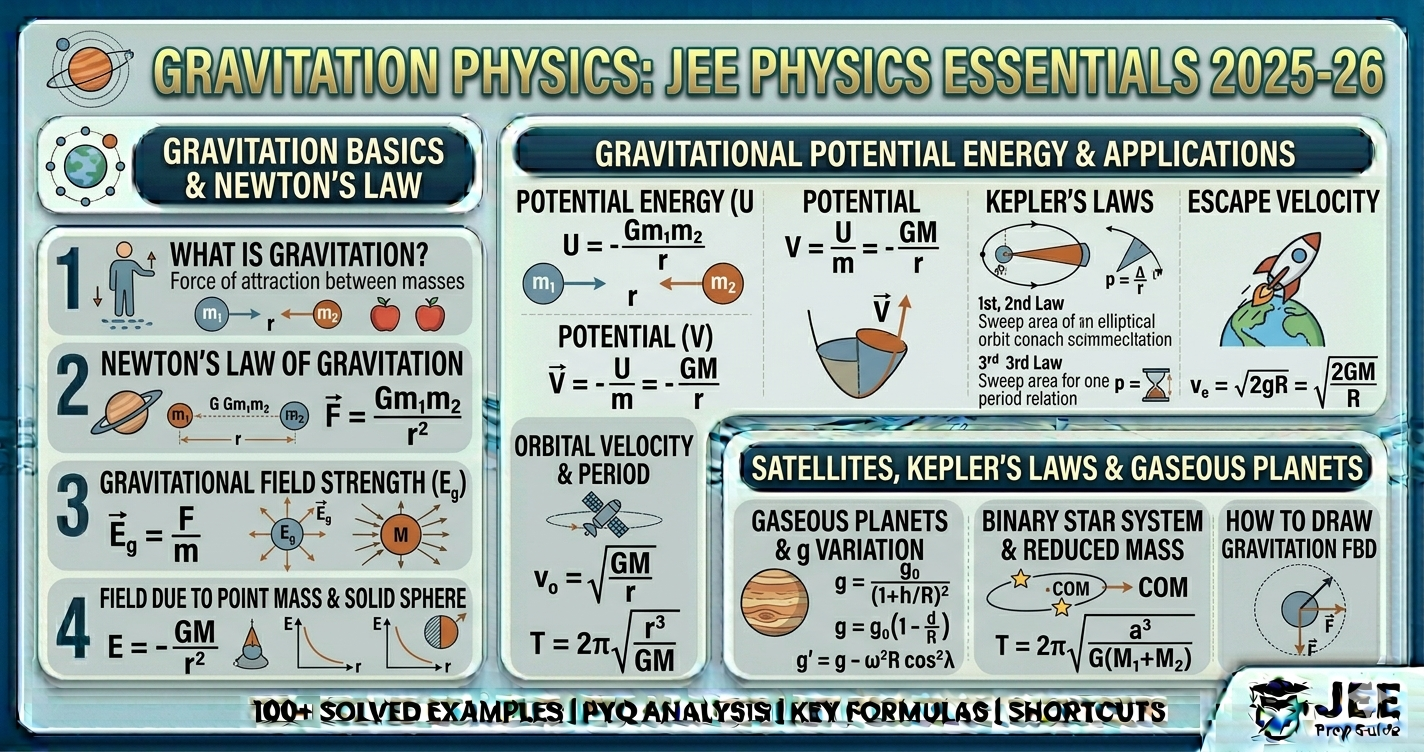
Newton's Law of Universal Gravitation
Newton's Law of Universal Gravitation is one of the most fundamental laws in physics. It describes the gravitational attraction between any two masses in the universe and forms the basis for understanding celestial mechanics.
1.1 Statement of the Law
Universal Law of Gravitation
Every particle in the universe attracts every other particle with a force that is:
- Directly proportional to the product of their masses
- Inversely proportional to the square of the distance between them
F
Gravitational force
G
Universal constant
m₁, m₂
Masses
r
Distance
1.2 Universal Gravitational Constant (G)
Value and Units of G
Dimensional Formula:
SI Units:
N·m²/kg² or m³/(kg·s²)
CGS: dyne·cm²/g² = 6.67 × 10⁻⁸
💡 Important Properties of Gravitational Force
- Always attractive: Unlike electrostatic force, gravity only attracts
- Central force: Acts along the line joining the two masses
- Conservative force: Work done is path independent
- Long range force: Has infinite range (though weakens with distance)
- Weakest fundamental force: G is extremely small
- Independent of medium: Not affected by intervening material
1.3 Vector Form of Newton's Law
Vector Notation
Force on mass m₁ due to m₂:
The negative sign indicates attractive force (opposite to position vector direction)
1.4 Principle of Superposition
Superposition of Gravitational Forces
The net gravitational force on a particle due to multiple particles is the vector sum of individual forces:
Each force is calculated independently using Newton's law, then added vectorially.
📝 Solved Example 1 (JEE Main 2023)
Question: Two spheres of masses 1 kg and 4 kg are separated by 10 cm. Find the position where gravitational field is zero.
Solution:
Let null point be at distance x from 1 kg mass.
At null point, gravitational fields due to both masses are equal and opposite:
Taking square root:
Note: Null point is always closer to the smaller mass. Between two masses, there's always exactly one null point.
📝 Solved Example 2 (JEE Advanced Pattern)
Question: Three identical masses m are placed at the vertices of an equilateral triangle of side a. Find the gravitational force on each mass.
Solution:
For mass at vertex A:
Force due to mass at B:
Force due to mass at C:
Angle between the two forces = 60°
Net force (using parallelogram law):
Direction: Towards the centroid of the triangle
Gravitational Field and Potential
The concepts of gravitational field and potential provide an elegant way to describe gravitational effects at any point in space without directly considering the masses involved.
2.1 Gravitational Field Intensity (E or g)
Definition
Gravitational field intensity at a point is the gravitational force experienced per unit mass placed at that point.
Unit: N/kg or m/s² | Dimension: [LT⁻²]
Note: At Earth's surface, E = g = 9.8 m/s²
2.2 Gravitational Field Due to Different Bodies
| Body | Location | Field Intensity (E) |
|---|---|---|
| Point Mass M | Distance r | E = GM/r² |
| Solid Sphere (uniform) | Outside (r > R) | E = GM/r² |
| Solid Sphere (uniform) | Inside (r < R) | E = GMr/R³ |
| Hollow Sphere (shell) | Outside (r > R) | E = GM/r² |
| Hollow Sphere (shell) | Inside (r < R) | E = 0 |
| Uniform Ring (M, R) | On axis at distance x | E = GMx/(R² + x²)^(3/2) |
| Uniform Disc | On axis at distance x | E = (2GMx/R²)[1 - x/√(R²+x²)] |
| Infinite Rod (λ) | Perpendicular distance r | E = 2Gλ/r |
💡 Important: Shell Theorem
- Theorem 1: A uniform spherical shell attracts a particle outside as if the entire mass were at the center
- Theorem 2: A uniform spherical shell exerts NO force on a particle inside it (E = 0 inside)
- Consequence: For solid sphere, only mass inside radius r contributes to field at r
2.3 Gravitational Potential (V)
Definition
Gravitational potential at a point is the work done per unit mass in bringing a mass from infinity to that point.
Unit: J/kg or m²/s² | Dimension: [L²T⁻²]
Key Properties:
- Gravitational potential is always negative (zero at infinity)
- Scalar quantity (no direction)
- Potential increases (becomes less negative) as we move away from mass
2.4 Relationship Between Field and Potential
Fundamental Relations
Field from Potential
(Field is negative gradient of potential)
Potential from Field
(Potential is work done per unit mass)
In Cartesian Coordinates:
2.5 Gravitational Potential Due to Different Bodies
| Body | Location | Potential (V) |
|---|---|---|
| Point Mass M | Distance r | V = -GM/r |
| Solid Sphere | Outside (r ≥ R) | V = -GM/r |
| Solid Sphere | Inside (r < R) | V = -GM(3R² - r²)/(2R³) |
| Solid Sphere | At center (r = 0) | V = -3GM/(2R) |
| Hollow Sphere | Outside (r ≥ R) | V = -GM/r |
| Hollow Sphere | Inside (r ≤ R) | V = -GM/R (constant) |
| Ring (M, R) | On axis at distance x | V = -GM/√(R² + x²) |
⚠️ Critical Difference: Shell vs Solid Sphere
Hollow Shell (Inside)
E = 0 (no force)
V = -GM/R (constant, non-zero)
Solid Sphere (Inside)
E = GMr/R³ (non-zero, ∝ r)
V varies with position
📝 Solved Example 3 (JEE Advanced 2022)
Question: Find the maximum gravitational field intensity on the axis of a uniform ring of mass M and radius R. At what distance from center does it occur?
Solution:
Field on axis at distance x:
For maximum, dE/dx = 0:
Using quotient rule:
Maximum field value:
Variation of Acceleration Due to Gravity
The acceleration due to gravity (g) is not constant throughout Earth. It varies with altitude, depth, latitude, and Earth's rotation. Understanding these variations is crucial for JEE.
3.1 Value of g at Earth's Surface
Fundamental Formula
For Earth: g ≈ 9.8 m/s² ≈ 10 m/s² (for calculations)
In terms of density (ρ):
This shows g depends on both density and radius
3.2 Variation with Height (h)
At Height h Above Surface
Exact Formula
Approximate (h << R)
Key Point: g decreases as we go higher. Use approximate formula only when h << R (e.g., h < R/10)
3.3 Variation with Depth (d)
At Depth d Below Surface
Or in terms of distance from center (r = R - d):
Special Cases:
- At surface (d = 0): gd = g
- At center (d = R): gd = 0
- g decreases linearly with depth inside Earth
💡 Comparison: Height vs Depth
For same change, which causes greater decrease in g?
For h = d: Δgh = 2 × Δgd
✓ Going up causes twice the decrease compared to going down (same distance)
3.4 Variation with Latitude (φ)
Effect of Earth's Rotation
Due to Earth's rotation, the effective g is reduced by centrifugal acceleration:
where φ is latitude and ω is Earth's angular velocity
At Poles (φ = 90°):
Maximum g (no centrifugal effect)
At Equator (φ = 0°):
Minimum g (maximum centrifugal effect)
Numerical Value:
gpole - gequator ≈ 0.034 m/s² (about 0.35% difference)
3.5 Effect of Earth's Shape (Oblateness)
Earth is Not a Perfect Sphere
Earth is flattened at poles (oblate spheroid):
- Equatorial radius Req ≈ 6378 km
- Polar radius Rpole ≈ 6357 km
- Difference ≈ 21 km
Combined effect (shape + rotation): g at poles is about 0.5% higher than at equator
📝 Solved Example 4 (JEE Main 2024)
Question: At what height above Earth's surface does g become half its surface value? (R = 6400 km)
Solution:
Using exact formula:
📝 Solved Example 5 (JEE Advanced Pattern)
Question: At what angular speed of Earth would objects at equator become weightless?
Solution:
For weightlessness at equator:
Substituting values:
Time period:
Note: Current Earth's period is 24 hours = 1440 min. Earth would need to rotate 17 times faster for equatorial weightlessness!
Gravitational Potential Energy
Gravitational potential energy is the energy stored in a system of masses due to their gravitational interaction. Understanding this concept is essential for solving problems involving escape velocity, satellites, and orbital mechanics.
4.1 Definition and Formula
Gravitational Potential Energy
The gravitational PE of a system of two masses is the work done by an external agent in assembling the system (bringing masses from infinity):
Key Points:
- Always negative: Because work is done ON the system to separate masses
- Zero at infinity: Reference point is infinite separation
- Relationship: U = mV (PE = mass × potential)
- More negative = more bound: Harder to separate
4.2 PE at Earth's Surface
For Object of Mass m
General Form
At Earth's Surface
4.3 Change in PE (Near Earth's Surface)
For Small Heights (h << R)
When h is small compared to R, we can use the simplified formula:
(This is the familiar formula used in basic mechanics)
Derivation:
4.4 Self-Energy of a System
PE of a System of n Particles
Sum over all pairs (n(n-1)/2 pairs for n particles)
Self-Energy of Uniform Sphere:
This is the work done to assemble the sphere from infinity
📝 Solved Example 6 (JEE Main 2023)
Question: Find the gravitational potential energy of a system of 4 identical particles of mass m at the corners of a square of side a.
Solution:
Count the pairs:
Total pairs = ⁴C₂ = 6
• 4 pairs along sides (distance = a)
• 2 pairs along diagonals (distance = a√2)
Calculate PE:
Escape Velocity
Escape velocity is the minimum velocity required for an object to escape from the gravitational influence of a celestial body. This concept is fundamental to understanding spacecraft launches and planetary atmospheres.
5.1 Definition and Derivation
Escape Velocity Formula
Minimum velocity needed to escape gravitational field (reach infinity with zero final velocity):
Derivation (using energy conservation):
5.2 Important Values
| Celestial Body | Escape Velocity | Notes |
|---|---|---|
| Earth | 11.2 km/s | Most commonly asked |
| Moon | 2.4 km/s | ≈ 1/5 of Earth's |
| Sun | 618 km/s | From surface |
| Jupiter | 59.5 km/s | Largest planet |
5.3 Key Relationships
Important Formulas
In Terms of g and R
In Terms of Density
Relation with Orbital Velocity
At Height h
💡 Critical Points About Escape Velocity
- Independent of mass: Same for all objects (feather or rocket)
- Independent of direction: Can be thrown at any angle
- Depends only on: Mass and radius of the celestial body
- ve = √2 × vo: Escape velocity is √2 times orbital velocity
- At infinity: Object has zero velocity (minimum case)
- v > ve: Object reaches infinity with some residual velocity
5.4 Velocity Greater Than Escape Velocity
Object Projected with v > ve
If initial velocity v > ve, the object will have some velocity at infinity:
📝 Solved Example 7 (JEE Main 2024)
Question: A rocket is launched from Earth's surface with velocity v = 1.5ve. Find its velocity at infinity.
Solution:
Using energy conservation:
📝 Solved Example 8 (JEE Advanced Pattern)
Question: If Earth's radius is doubled keeping mass constant, what happens to escape velocity?
Solution:
Escape velocity formula:
Original: ve1 = √(2GM/R)
New (R' = 2R): ve2 = √(2GM/2R) = √(GM/R)
Escape velocity decreases by factor of √2 (becomes 1/√2 times)
Satellites and Orbital Motion
Satellites are objects that orbit around a larger body under gravitational attraction. Understanding satellite motion is one of the most important and high-weightage topics in JEE gravitation.
6.1 Orbital Velocity
Velocity Required for Circular Orbit
For circular orbit, gravitational force provides centripetal force:
For orbit at height h above surface (r = R + h):
For near-surface orbit (h << R): vo ≈ √(gR) ≈ 7.9 km/s for Earth
6.2 Time Period of Revolution
Orbital Period
For near-surface orbit (h << R):
This is the minimum possible time period for any satellite
6.3 Energy of a Satellite
Energy Analysis
Kinetic Energy
Potential Energy
Total Energy
Important Relationships:
- KE = -E (KE is positive, same magnitude as total energy)
- PE = 2E (PE is negative, twice the total energy)
- KE = -PE/2 (KE is half the magnitude of PE)
- Total energy is always negative (satellite is bound)
💡 Binding Energy
Binding energy is the minimum energy required to remove satellite from orbit to infinity:
Energy needed to escape = KE of the satellite = Binding energy
6.4 Types of Satellites
| Type | Altitude | Period | Uses |
|---|---|---|---|
| Geostationary (GEO) | 36,000 km | 24 hours | Communication, TV, Weather |
| Polar | 700-800 km | ~100 min | Earth observation, Mapping |
| Medium Earth (MEO) | 2,000-36,000 km | 2-24 hours | GPS, Navigation |
| Low Earth (LEO) | 160-2,000 km | 88-127 min | ISS, Spy satellites |
6.5 Geostationary Satellite
Conditions and Calculations
Requirements:
- Period T = 24 hours
- Orbit in equatorial plane
- Direction: West to East (same as Earth)
- Circular orbit
Height Calculation:
For T = 24 hours: h ≈ 36,000 km
Orbital Parameters (for Earth):
- Height: h ≈ 35,800 km ≈ 6R
- Orbital velocity: v ≈ 3.07 km/s
- Orbital radius: r ≈ 42,200 km ≈ 7R
📝 Solved Example 9 (JEE Main 2023)
Question: A satellite is revolving in circular orbit of radius r. If its velocity is doubled, what happens?
Solution:
Original orbital velocity:
New velocity v' = 2vo
Compare with escape velocity from that orbit:
Since v' = 2vo > ve = 1.414vo
Velocity at infinity:
📝 Solved Example 10 (JEE Advanced 2022)
Question: Two satellites A and B are in circular orbits of radii r and 4r. Find the ratio of their (a) orbital velocities (b) time periods (c) total energies.
Solution:
(a) Orbital velocities:
(b) Time periods:
(c) Total energies:
(Satellite A is more tightly bound)
Kepler's Laws of Planetary Motion
Johannes Kepler formulated three empirical laws describing planetary motion around the Sun. These laws are derivable from Newton's law of gravitation and are essential for understanding orbital mechanics.
7.1 First Law (Law of Orbits)
Elliptical Orbits
Statement: All planets move in elliptical orbits with the Sun at one focus.
Key Terms:
- Semi-major axis (a): Half the longest diameter of ellipse
- Semi-minor axis (b): Half the shortest diameter of ellipse
- Eccentricity (e): e = c/a (where c = focus to center distance)
- Perihelion: Closest point to Sun (rmin = a(1-e))
- Aphelion: Farthest point from Sun (rmax = a(1+e))
7.2 Second Law (Law of Areas)
Equal Areas in Equal Times
Statement: The line joining the planet to the Sun sweeps out equal areas in equal intervals of time.
This is equivalent to:
- Conservation of angular momentum (L = constant)
- τ = 0 (central force produces no torque about Sun)
Relationship between velocities:
At perihelion: velocity is maximum | At aphelion: velocity is minimum
7.3 Third Law (Law of Periods)
T² ∝ a³
Statement: The square of the orbital period is proportional to the cube of the semi-major axis.
For two planets orbiting same star:
For circular orbit, a = r (orbital radius)
💡 Quick Memory Summary
| Law | Statement | Physics Principle |
|---|---|---|
| 1st (Orbits) | Elliptical orbits | Inverse square law |
| 2nd (Areas) | Equal areas in equal times | Conservation of angular momentum |
| 3rd (Periods) | T² ∝ a³ | Gravitational force = Centripetal force |
📝 Solved Example 11 (JEE Main 2024)
Question: A planet has orbital radius 4 times that of Earth. Find its orbital period in Earth years.
Solution:
Using Kepler's third law:
📝 Solved Example 12 (JEE Advanced Pattern)
Question: A comet moves in highly elliptical orbit with perihelion distance rP and aphelion distance rA = 4rP. Find ratio of velocities at these points.
Solution:
Using Kepler's second law (conservation of angular momentum):
Comet moves 4 times faster at perihelion than at aphelion
Binary Star Systems
Binary star systems consist of two stars orbiting around their common center of mass. This topic combines concepts of gravitation with center of mass motion.
8.1 Motion of Binary Stars
Key Relationships
Two stars of masses m₁ and m₂ separated by distance d orbit their common center of mass:
Distances from CM:
Angular Velocity:
Both stars have same ω
Time Period:
Energy of Binary System
Total Energy = KE₁ + KE₂ + PE
Note: Same form as single particle orbit, but with reduced mass μ = m₁m₂/(m₁+m₂)
📝 Solved Example 13 (JEE Advanced Pattern)
Question: Two stars of masses 2M and M are separated by distance d. Find the time period of their revolution around common CM.
Solution:
Using the binary star period formula:
Here m₁ = 2M, m₂ = M, so m₁ + m₂ = 3M
P Previous Year Questions (JEE Main & Advanced)
The variation of acceleration due to gravity (g) with distance (r) from the center of a solid sphere of radius R and uniform density is best represented by:
View Solution
Ans: (C)
Inside (r < R): g ∝ r (Linear)
Outside (r ≥ R): g ∝ 1/r² (Hyperbolic)
A satellite is orbiting Earth at a height of 2R (R = Earth's radius). Find its orbital velocity. (Take g = 10 m/s², R = 6400 km)
View Solution
Ans: 4.62 km/s
r = R + 2R = 3R
v = √(GM/r) = √(gR²/3R) = √(gR/3)
v = √(10 × 6.4×10⁶ / 3) = √(21.33×10⁶) ≈ 4618 m/s
Two planets P₁ and P₂ have masses M₁, M₂ and radii R₁, R₂. If escape velocities are equal, then:
View Solution
Ans: (A), (C)
v √(2GM/R). If v = vₑ₂, then M₁/R₁ = M₂/R₂
→ M₁/M₂ = R₁/R₂ (Option A correct)
g = GM/R². So g₁/g₂ = (M₁/M₂) × (R₂²/R₁²) = (R₁/R₂) × (R₂²/R₁²) = R₂/R₁ (Option C correct)
🎯 Practice Problems (For JEE 2025)
Answer
Answer
Answer
Answer
Answer
⚡ JEE Gravitation Cheatsheet
Force & Field
- F = GMm/r²
- E = GM/r² (Point mass)
- E = 0 (Inside Shell)
- E ∝ r (Inside Solid Sphere)
- Superposition: E⃗ = ΣE⃗ᵢ
Potential & Energy
- V = -GM/r
- U = -GMm/r
- U = mgh (h << R)
- Self Energy: -3GM²/5R
- E = -GMm/2r (Orbit)
Velocities
- v √(GM/r) (Orbital)
- vₑ = √(2GM/R) (Escape)
- vₑ = √2 vₒ
- v∞ = √(v² - v )
Kepler & Variation
- T² ∝ a³ (Kepler 3rd)
- dA/dt = L/2m = const
- gₕ = g(1 - 2h/R)
- gₔ = g(1 - d/R)
- Binary: T = 2π√(d³/GΣm)
🚀 Ready to Master Gravitation?
You've just completed the most comprehensive Gravitation notes for JEE!
Now practice 50+ questions from PYQs and move to the next chapter.