
📑 Quick Navigation - Rotational Motion

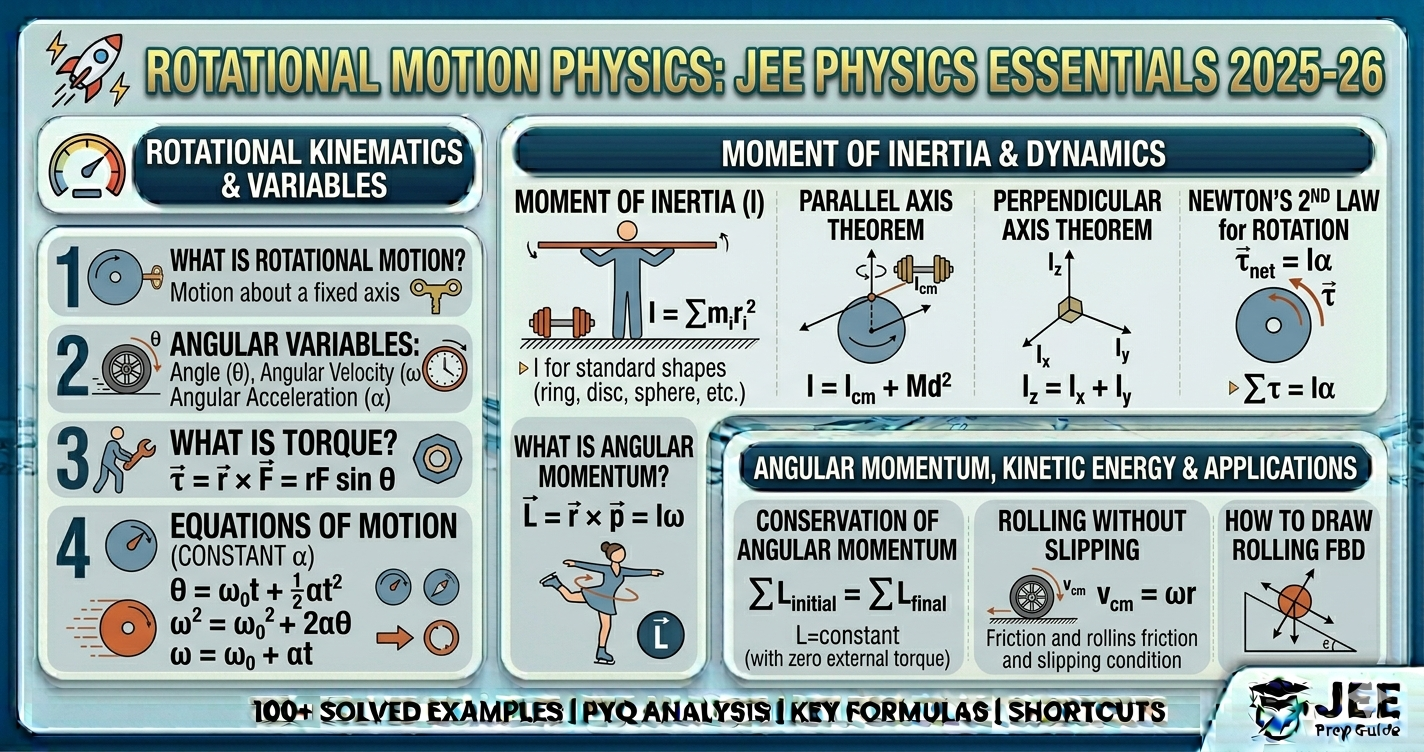
Rotational Motion JEE Main & Advanced 2025-26

Master the complete rotational mechanics with detailed notes on Moment of Inertia, Torque, Angular Momentum, and Rolling Motion. Includes 150+ solved problems, all theorems, and JEE shortcuts.

📚 8 Complete Sections
✍️ 150+ Solved Examples
🎯 All MI Formulas
⭐⭐⭐⭐⭐ 4.8/5
245+ students rated this helpful
150+
Solved Examples
4 hrs
Study Time
Free
Always
Rotational Motion JEE notes, Formulas, PYQs
Rotational Motion JEE Notes, Formulas, PYQs
1

Rotational Kinematics

Rotational kinematics describes the motion of rotating objects without considering the forces causing the rotation. It is the angular analogue of linear kinematics and forms the foundation for understanding all rotational phenomena.

1.1 Angular Quantities

Angular Displacement (θ)

Angle through which a body rotates about an axis

\[\theta = \frac{s}{r}\]

Unit: radian (dimensionless)

1 revolution = 2π rad = 360°

Angular Velocity (ω)

Rate of change of angular displacement

\[\omega = \frac{d\theta}{dt}\]

Unit: rad/s

Direction: Right hand rule

Angular Acceleration (α)

Rate of change of angular velocity

\[\alpha = \frac{d\omega}{dt}\]

Unit: rad/s²

Vector quantity

1.2 Relationship Between Linear and Angular Quantities

Important Relationships (Must Memorize!)

Displacement

\[s = r\theta\]

Velocity

\[v = r\omega\]

Acceleration

\[a_t = r\alpha\]

Centripetal Acceleration:

\[a_c = \frac{v^2}{r} = r\omega^2\]

1.3 Equations of Rotational Motion

Linear Motion Rotational Motion Condition
v = u + at ω = ω₀ + αt Constant α
s = ut + ½at² θ = ω₀t + ½αt² Constant α
v² = u² + 2as ω² = ω₀² + 2αθ Constant α
s = ½(u + v)t θ = ½(ω₀ + ω)t Constant α

💡 JEE Pro Tip

Every linear motion equation has an exact rotational analogue!
Just replace: s→θ, v→ω, a→α, m→I, F→τ, p→L
This makes solving rotational problems super easy if you know linear motion well!

📝 Solved Example 1 (JEE Main 2023)

Question: A wheel rotating at 900 rpm slows down uniformly to 300 rpm in 20 seconds. Find (a) angular acceleration, (b) number of revolutions in this time.

Solution:

Given:

Initial speed: n₀ = 900 rpm = 900/60 = 15 rps

Final speed: n = 300 rpm = 5 rps

Time: t = 20 s

Convert to angular velocity:

\[\omega_0 = 2\pi n_0 = 2\pi \times 15 = 30\pi \text{ rad/s}\]
\[\omega = 2\pi n = 2\pi \times 5 = 10\pi \text{ rad/s}\]

(a) Angular acceleration:

\[\omega = \omega_0 + \alpha t\]
\[10\pi = 30\pi + \alpha(20)\]
\[\alpha = -\pi \text{ rad/s}^2 = -3.14 \text{ rad/s}^2\]

(b) Number of revolutions:

\[\theta = \omega_0 t + \frac{1}{2}\alpha t^2\]
\[\theta = 30\pi(20) + \frac{1}{2}(-\pi)(20)^2\]
\[\theta = 600\pi - 200\pi = 400\pi \text{ rad}\]
\[\text{Number of revolutions} = \frac{400\pi}{2\pi} = 200\]
2

Moment of Inertia

Moment of Inertia (MI) is the rotational analogue of mass. It measures how difficult it is to change the rotational state of a body. This is one of the highest-scoring topics in JEE rotational motion.

2.1 Definition and Formula

Moment of Inertia (I)

For a system of particles:

\[I = \sum_{i=1}^{n} m_i r_i^2\]

where mi is mass of ith particle, ri is perpendicular distance from axis

For a continuous body:

\[I = \int r^2 \, dm\]

Unit: kg·m² | Dimension: [ML²]

⚠️ Key Points About MI

  • MI depends on axis of rotation - different axis → different MI
  • MI depends on mass distribution - not just total mass
  • MI is always positive (r² is always positive)
  • MI is a scalar quantity (though related to vector ω)
  • Higher MI = harder to rotate = more "rotational inertia"

2.2 Radius of Gyration (k)

Definition

Radius of gyration is the distance from the axis at which the entire mass can be assumed to be concentrated to give the same moment of inertia.

\[I = Mk^2\]
\[k = \sqrt{\frac{I}{M}}\]

where M is total mass, k has unit of length (meter)

2.3 MI of Standard Bodies (Must Memorize!)

Object Axis Moment of Inertia Radius of Gyration
Thin Rod Through center, ⊥ to length I = ML²/12 k = L/√12
Thin Rod Through end, ⊥ to length I = ML²/3 k = L/√3
Solid Cylinder About central axis I = MR²/2 k = R/√2
Hollow Cylinder About central axis I = MR² k = R
Solid Sphere About diameter I = 2MR²/5 k = R√(2/5)
Hollow Sphere About diameter I = 2MR²/3 k = R√(2/3)
Disc/Solid Cylinder About diameter I = MR²/4 k = R/2
Ring About central axis ⊥ to plane I = MR² k = R
Ring About diameter I = MR²/2 k = R/√2
Rectangular Plate About edge parallel to length I = Mb²/3 k = b/√3

💡 Memory Tricks for MI

  • Ring (hollow) always has highest MI: I = MR² (all mass at maximum distance)
  • Solid sphere has lowest MI: I = 2MR²/5 (mass distributed inside)
  • Rod through end = 4 × Rod through center: ML²/3 = 4(ML²/12)
  • Hollow = 2 × Solid (usually): Hollow sphere (2/3) vs Solid sphere (2/5)
  • Pattern for cylinders: Hollow (1) > Disc about diameter (1/4) > Solid about axis (1/2)

📝 Solved Example 2 (JEE Advanced 2022)

Question: Find the moment of inertia of a uniform rod of mass M and length L about an axis passing through a point at distance L/4 from one end and perpendicular to the rod.

Solution:

Method 1: Using Parallel Axis Theorem (Covered in next chapter)

MI about center: Icm = ML²/12

Distance from center to given point: d = L/4

\[I = I_{cm} + Md^2\]
\[I = \frac{ML^2}{12} + M\left(\frac{L}{4}\right)^2\]
\[I = \frac{ML^2}{12} + \frac{ML^2}{16}\]
\[I = \frac{4ML^2 + 3ML^2}{48} = \frac{7ML^2}{48}\]

Method 2: Direct Integration (Advanced)

Linear mass density: λ = M/L

Take origin at the given point, x varies from -L/4 to 3L/4

\[I = \int r^2 \, dm = \int_{-L/4}^{3L/4} x^2 \lambda \, dx\]
\[I = \lambda \left[\frac{x^3}{3}\right]_{-L/4}^{3L/4}\]
\[I = \frac{M}{L} \times \frac{1}{3}\left[\left(\frac{3L}{4}\right)^3 - \left(-\frac{L}{4}\right)^3\right]\]
\[I = \frac{7ML^2}{48}\]
3

Theorems of Moment of Inertia

Two fundamental theorems allow us to calculate MI about any axis if we know MI about certain standard axes. These theorems are extremely important for JEE and save enormous calculation time.

3.1 Parallel Axis Theorem

Statement

The moment of inertia about any axis is equal to the moment of inertia about a parallel axis through the center of mass plus the product of mass and square of distance between the two axes.

\[I = I_{cm} + Md^2\]

I

MI about given axis

Icm

MI about parallel axis through CM

d

Distance between axes

💡 Important Points

  • Parallel axis theorem is valid only when one axis passes through CM
  • I is always greater than Icm (since Md² > 0)
  • MI is minimum about axis through CM
  • Cannot apply theorem between two random parallel axes

📝 Proof of Parallel Axis Theorem

Consider a body rotating about axis AB at distance d from CM axis.

For any particle at position r from CM:

\[I_{AB} = \sum m_i r_i^2\]

where ri² = (r'i + d)² if we resolve perpendicular to axis

\[I_{AB} = \sum m_i (r'_i + d)^2\]
\[= \sum m_i r'^2_i + 2d\sum m_i r'_i + d^2\sum m_i\]

Note: Σmir'i = 0 (definition of center of mass)

\[I_{AB} = I_{cm} + Md^2\]

3.2 Perpendicular Axis Theorem

Statement

For a planar body (lamina), the moment of inertia about an axis perpendicular to the plane is equal to the sum of moments of inertia about two perpendicular axes in the plane that intersect at the point where the perpendicular axis passes.

\[I_z = I_x + I_y\]

(where x, y lie in the plane and z is perpendicular to plane, all three axes intersect at one point)

⚠️ Critical Points

  • Only valid for planar bodies (flat objects, laminas)
  • Cannot be applied to 3D objects like sphere, cylinder
  • All three axes must be mutually perpendicular
  • All three axes must intersect at same point
  • Used mainly for rings, discs, rectangular plates

📝 Application: MI of Ring about Diameter

For a ring of mass M and radius R:

Known: Iz (perpendicular to plane) = MR²

To find: I about diameter

By symmetry, Ix = Iy (any two diameters)

\[I_z = I_x + I_y\]
\[MR^2 = I_x + I_x = 2I_x\]
\[I_x = \frac{MR^2}{2}\]

This formula is frequently used in JEE problems!

📝 Solved Example 3 (JEE Main 2024 Type)

Question: A uniform square plate of side 'a' and mass M has moment of inertia I about an axis passing through center and perpendicular to plane. Find MI about a diagonal.

Solution:

Step 1: Find I about perpendicular axis

By perpendicular axis theorem for two edges parallel to sides:

\[I = I_x + I_y\]

where Ix and Iy are MI about two perpendicular edges through center

\[I_x = I_y = \frac{Ma^2}{12}\text{ (for rectangular plate)}\]
\[I = \frac{Ma^2}{12} + \frac{Ma^2}{12} = \frac{Ma^2}{6}\]

Step 2: Find MI about diagonal

By symmetry, MI about both diagonals are equal

Using perpendicular axis theorem with two diagonals:

\[I = I_{d1} + I_{d2}\]
\[\frac{Ma^2}{6} = I_d + I_d = 2I_d\]
\[I_d = \frac{Ma^2}{12}\]
4

Torque

Torque is the rotational analogue of force. Just as force causes linear acceleration, torque causes angular acceleration. Understanding torque is crucial for solving equilibrium and dynamics problems.

4.1 Definition of Torque

Mathematical Definition

Torque is the cross product of position vector and force:

\[\vec{\tau} = \vec{r} \times \vec{F}\]

Magnitude:

\[\tau = rF\sin\theta = r_{\perp}F = rF_{\perp}\]

r

Distance from axis

F

Applied force

θ

Angle between r and F

Unit: N·m | Dimension: [ML²T⁻²]

💡 Understanding Torque

  • Direction: Right hand rule (curl fingers from r to F, thumb gives τ direction)
  • Maximum torque: When θ = 90° (force perpendicular to r)
  • Zero torque: When θ = 0° or 180° (force parallel/antiparallel to r)
  • Lever arm: r = r sin θ is the perpendicular distance
  • Sign convention: Anticlockwise = positive, Clockwise = negative

4.2 Torque and Angular Acceleration

Newton's Second Law for Rotation

Linear Motion

\[F = ma\]

Rotational Motion

\[\tau = I\alpha\]

This is the most important equation in rotational dynamics!

📝 Solved Example 4 (JEE Main 2023)

Question: A force F = 10 N is applied tangentially to a disc of radius R = 0.5 m and mass M = 2 kg. Find the angular acceleration of the disc.

Solution:

Given:

F = 10 N (tangential force)

R = 0.5 m

M = 2 kg

Step 1: Calculate torque

Since force is tangential, θ = 90°

\[\tau = RF\sin(90°) = RF\]
\[\tau = 0.5 \times 10 = 5 \text{ N·m}\]

Step 2: Find moment of inertia

For disc about central axis:

\[I = \frac{MR^2}{2} = \frac{2 \times (0.5)^2}{2} = 0.25 \text{ kg·m}^2\]

Step 3: Apply τ = Iα

\[\alpha = \frac{\tau}{I} = \frac{5}{0.25}\]
\[\alpha = 20 \text{ rad/s}^2\]

4.3 Equilibrium Conditions

Conditions for Equilibrium

Translational Equilibrium
\[\sum \vec{F} = 0\]

Net force = 0

Rotational Equilibrium
\[\sum \vec{\tau} = 0\]

Net torque = 0

For complete equilibrium: Both conditions must be satisfied simultaneously!

📝 Solved Example 5 (JEE Advanced 2022)

Question: A uniform rod of length L and mass M is hinged at one end. A force F is applied at the free end making angle θ with the rod. Find the initial angular acceleration.

Solution:

Step 1: Identify forces and torques

Forces: Applied force F, Weight Mg, Hinge reaction

Hinge reaction passes through axis → zero torque

Step 2: Calculate torque due to F

Perpendicular component of F: F = F sin θ

\[\tau_F = L \times F\sin\theta = FL\sin\theta\]

Step 3: Calculate torque due to weight

Weight acts at center (L/2 from hinge)

Initially rod is horizontal, so weight is perpendicular

\[\tau_g = \frac{L}{2} \times Mg = \frac{MgL}{2}\]

Step 4: Net torque

\[\tau_{net} = FL\sin\theta - \frac{MgL}{2}\]

Step 5: Find angular acceleration

For rod about end: I = ML²/3

\[\alpha = \frac{\tau_{net}}{I} = \frac{FL\sin\theta - \frac{MgL}{2}}{\frac{ML^2}{3}}\]
\[\alpha = \frac{3}{ML}\left(F\sin\theta - \frac{Mg}{2}\right)\]
5

Angular Momentum

Angular momentum is the rotational analogue of linear momentum. Its conservation is one of the most powerful principles in physics and is extensively tested in JEE Advanced.

5.1 Definition and Formula

Angular Momentum (L)

For a particle:

\[\vec{L} = \vec{r} \times \vec{p} = \vec{r} \times m\vec{v}\]

Magnitude:

\[L = rp\sin\theta = mvr\sin\theta = mvr_{\perp}\]

For a rotating rigid body:

\[\vec{L} = I\vec{\omega}\]

Unit: kg·m²/s or J·s | Dimension: [ML²T⁻¹]

5.2 Relation Between Torque and Angular Momentum

Fundamental Relation

Linear

\[\vec{F} = \frac{d\vec{p}}{dt}\]

Rotational

\[\vec{\tau} = \frac{d\vec{L}}{dt}\]

Torque is the rate of change of angular momentum

5.3 Conservation of Angular Momentum

Law of Conservation

If the net external torque on a system is zero, the total angular momentum remains constant.

\[\text{If } \vec{\tau}_{ext} = 0 \text{, then } \vec{L} = \text{constant}\]
\[I_1\omega_1 = I_2\omega_2\]

💡 Applications of Angular Momentum Conservation

  • Ice skater spinning: Arms in → I decreases → ω increases
  • Diver tucking: Curled position → smaller I → faster rotation
  • Planetary motion: r decreases at perihelion → v increases (Kepler's 2nd law)
  • Helicopter blades: Main rotor torque balanced by tail rotor
  • Cat landing: Twisting body parts with different I to land on feet

📝 Solved Example 6 (JEE Advanced 2023)

Question: A person stands on a rotating platform holding two weights. Initially rotating at ω₁ = 2 rad/s with arms extended (I₁ = 6 kg·m²). When arms are brought close (I₂ = 2 kg·m²), find new angular velocity and change in kinetic energy.

Solution:

Part (a): Find ω₂

No external torque → Angular momentum conserved

\[L_1 = L_2\]
\[I_1\omega_1 = I_2\omega_2\]
\[6 \times 2 = 2 \times \omega_2\]
\[\omega_2 = 6 \text{ rad/s}\]

Part (b): Change in KE

Initial KE:

\[KE_1 = \frac{1}{2}I_1\omega_1^2 = \frac{1}{2}(6)(2)^2 = 12 \text{ J}\]

Final KE:

\[KE_2 = \frac{1}{2}I_2\omega_2^2 = \frac{1}{2}(2)(6)^2 = 36 \text{ J}\]

Change in KE:

\[\Delta KE = 36 - 12 = 24 \text{ J (increase)}\]

Note: KE increases even though L is conserved! The person does work by pulling arms in against centrifugal force. This extra work appears as increased rotational KE.

⚠️ Common Misconception

Conservation of L ≠ Conservation of KE

When moment of inertia changes, angular momentum is conserved (if τext = 0), but rotational kinetic energy is NOT conserved. Energy is added or removed by internal forces doing work.

In the example above: L conserved, but KE increased by 24 J (person's internal muscular work)

6

Rotational Dynamics

Rotational dynamics combines concepts of torque, angular momentum, and moment of inertia to solve complex problems involving rotating systems, pulleys, and coupled motions.

6.1 Equation of Motion for Rotation

Fundamental Equation

\[\sum \vec{\tau}_{ext} = I\vec{\alpha}\]

Sum of all external torques = Moment of inertia × Angular acceleration

For Fixed Axis Rotation

\[\tau = I\alpha\]

For Variable I

\[\tau = \frac{dL}{dt} = \frac{d(I\omega)}{dt}\]

6.2 Combined Translation and Rotation

💡 Problem Solving Strategy

  1. For translation of CM: Apply ΣF = Macm
  2. For rotation about CM: Apply Στ = Icmα
  3. Find constraint relations: Connect linear and angular quantities
  4. Solve simultaneously: Usually 2-3 equations with 2-3 unknowns

📝 Solved Example 7 (JEE Advanced Classic)

Question: A uniform disc of mass M and radius R is pulled horizontally by a force F applied at its center. A thread is wound on it. Find the acceleration of the disc and the angular acceleration if:
(a) Thread is pulled from top
(b) Thread is pulled from bottom

Solution:

Case (a): Thread pulled from top

For translation:

\[F - f = Ma \quad \text{...(1)}\]

(f is friction in forward direction)

For rotation about center:

Torque by F = FR (clockwise, promotes forward rolling)

Torque by f = fR (anticlockwise, opposes rotation)

\[FR - fR = I\alpha = \frac{MR^2}{2}\alpha \quad \text{...(2)}\]

Constraint (no slipping):

\[a = R\alpha \quad \text{...(3)}\]

Solving:

From (3): α = a/R

Substitute in (2):

\[FR - fR = \frac{MR^2}{2} \cdot \frac{a}{R}\]
\[F - f = \frac{Ma}{2} \quad \text{...(4)}\]

From (1) and (4):

\[Ma = F - f\]
\[\frac{Ma}{2} = F - f\]

Therefore: Ma = 2(F - f)

And from (4): F - f = Ma/2

So: Ma = 2(Ma/2) → This gives Ma = Ma (redundant)

Correct approach - Add equations (1) and (4):

\[F - f + (F - f) = Ma + \frac{Ma}{2}\]
\[2F - 2f = \frac{3Ma}{2}\]

From (1): f = F - Ma

Substitute:

\[2F - 2(F - Ma) = \frac{3Ma}{2}\]
\[2Ma = \frac{3Ma}{2}\]

Actually, let's solve properly:

From equation (2): F - f = Ma/2

From equation (1): F - f = Ma

Add both:

\[2(F - f) = Ma + \frac{Ma}{2} = \frac{3Ma}{2}\]
\[a = \frac{2F}{3M}, \quad \alpha = \frac{a}{R} = \frac{2F}{3MR}\]

Case (b): Thread pulled from bottom

Now F creates anticlockwise torque (opposes forward motion)

For rotation:

\[fR - FR = \frac{MR^2}{2}\alpha\]
\[f - F = \frac{Ma}{2}\]

For translation (same):

\[F - f = Ma\]

Solving:

\[F - f = Ma\]
\[f - F = \frac{Ma}{2}\]

Add: 0 = Ma + Ma/2 = 3Ma/2

\[a = 0 \text{ (disc doesn't move!)}\]

Physical Interpretation: When pulled from bottom, the force F tries to move disc forward but also rotates it backward. These effects exactly cancel out for pure rolling condition!

7

Rolling Motion

Rolling motion is a combination of translational and rotational motion. Understanding pure rolling is crucial as it appears in 40% of JEE rotational motion problems.

7.1 Condition for Pure Rolling

Pure Rolling Condition

For a body of radius R rolling without slipping:

\[v_{cm} = \omega R\]

Differentiating:

\[a_{cm} = \alpha R\]

Key Point: At the point of contact, velocity = 0 (no slipping condition)

7.2 Velocity Distribution in Rolling

Velocity at Different Points

Point of Contact

\[v = 0\]

Instantaneous rest

Center of Mass

\[v = v_{cm} = \omega R\]

Translation velocity

Topmost Point

\[v = 2v_{cm} = 2\omega R\]

Maximum velocity

General Point (angle θ from bottom)

\[v = v_{cm}\sqrt{2(1-\cos\theta)}\]

Vector sum of vcm and vrot

💡 Understanding Rolling Motion

Think of rolling as: Translation of CM + Rotation about CM

  • Every point has velocity = vcm (translation) + vrot (due to rotation)
  • At bottom: vcm forward + vrot backward = 0 (they cancel)
  • At top: vcm forward + vrot forward = 2vcm (they add)
  • At center: only vcm (no rotational component perpendicular)

7.3 Friction in Rolling Motion

Role of Friction

Rolling on Horizontal Surface

• Friction is static (no relative motion at contact)

• f ≤ μsN (can be less than maximum)

• Friction does no work (point of application has v = 0)

• Maintains vcm = ωR condition

Rolling Down Incline

• Friction acts upward along incline

• Opposes sliding, enables pure rolling

• Creates torque for rotation

• Still does no work (v = 0 at contact)

📝 Solved Example 8 (JEE Main 2024 Pattern)

Question: A solid sphere, hollow sphere, disc, and ring, all having same mass M and radius R, roll down an incline of height h. Find the ratio of their speeds at bottom.

Solution:

Using Energy Conservation:

Initial energy = Potential energy = Mgh

Final energy = Translational KE + Rotational KE

\[Mgh = \frac{1}{2}Mv^2 + \frac{1}{2}I\omega^2\]

For pure rolling: v = ωR, so ω = v/R

\[Mgh = \frac{1}{2}Mv^2 + \frac{1}{2}I\frac{v^2}{R^2}\]

Let I = kMR² (where k depends on shape)

\[Mgh = \frac{1}{2}Mv^2 + \frac{1}{2}kMR^2\frac{v^2}{R^2}\]
\[gh = \frac{v^2}{2}(1 + k)\]
\[v = \sqrt{\frac{2gh}{1+k}}\]

For different objects:

Object k value 1+k v
Solid Sphere 2/5 7/5 √(10gh/7)
Hollow Sphere 2/3 5/3 √(6gh/5)
Disc 1/2 3/2 √(4gh/3)
Ring 1 2 √(gh)
\[\text{Ratio } v_{\text{solid}} : v_{\text{hollow}} : v_{\text{disc}} : v_{\text{ring}}\] \[= \sqrt{\frac{10}{7}} : \sqrt{\frac{6}{5}} : \sqrt{\frac{4}{3}} : 1\] \[≈ 1.195 : 1.095 : 1.155 : 1\]

Order of speeds: Solid sphere (fastest) > Disc > Hollow sphere > Ring (slowest)
Reason: Objects with lower MI (mass closer to axis) convert more PE to translational KE

7.4 Acceleration of Rolling Objects on Incline

General Formula

For an object with I = kMR² rolling down an incline of angle θ:

\[a = \frac{g\sin\theta}{1 + k}\]

Friction force required:

\[f = \frac{kMg\sin\theta}{1 + k}\]
8

Rotational Kinetic Energy

Rotational kinetic energy is the energy possessed by a rotating body. For objects undergoing both translation and rotation, total KE is the sum of translational and rotational components.

8.1 Rotational KE Formula

Kinetic Energy Formulas

Pure Rotation

\[KE = \frac{1}{2}I\omega^2\]

Pure Translation

\[KE = \frac{1}{2}Mv_{cm}^2\]

Combined Motion (Rolling)

\[KE_{total} = \frac{1}{2}Mv_{cm}^2 + \frac{1}{2}I_{cm}\omega^2\]

For pure rolling (vcm = ωR):

\[KE = \frac{1}{2}Mv_{cm}^2\left(1 + k\right)\]

(where Icm = kMR²)

8.2 Energy Distribution in Rolling

Object k value KErot/KEtrans % Rotational
Ring/Hollow Cylinder 1 1:1 50%
Disc/Solid Cylinder 1/2 1:2 33.3%
Hollow Sphere 2/3 2:3 40%
Solid Sphere 2/5 2:5 28.6%

📝 Solved Example 9 (JEE Advanced 2021)

Question: A solid sphere of mass M and radius R is rolling with velocity v on a horizontal surface. It then rolls up an incline. Find the maximum height it can reach.

Solution:

Initial state: Rolling on horizontal surface

Total KE = Translational + Rotational

\[KE_i = \frac{1}{2}Mv^2 + \frac{1}{2}I\omega^2\]

For solid sphere: I = (2/5)MR²

For pure rolling: ω = v/R

\[KE_i = \frac{1}{2}Mv^2 + \frac{1}{2}\cdot\frac{2}{5}MR^2\cdot\frac{v^2}{R^2}\]
\[KE_i = \frac{1}{2}Mv^2 + \frac{1}{5}Mv^2 = \frac{7}{10}Mv^2\]

Final state: At maximum height h (momentarily at rest)

PEf = Mgh

KEf = 0

By conservation of energy:

\[KE_i = PE_f\]
\[\frac{7}{10}Mv^2 = Mgh\]
\[h = \frac{7v^2}{10g}\]

Note: Compare with sliding object (no rotation): h = v²/2g
Rolling object reaches 70% of height (7/10 vs 1/2) because some energy is in rotation

8.3 Work-Energy Theorem for Rotation

Work-Energy Relations

Linear Motion

\[W = \Delta KE_{trans}\]
\[W = \frac{1}{2}M(v_f^2 - v_i^2)\]

Rotational Motion

\[W = \Delta KE_{rot}\]
\[W = \frac{1}{2}I(\omega_f^2 - \omega_i^2)\]

Work done by torque:

\[W = \int \tau \, d\theta\]

For constant torque:

\[W = \tau \theta\]

📝 Previous Year Questions Analysis

JEE Main (Last 5 Years)

  • ✓ Rolling Motion: 35%
  • ✓ Moment of Inertia: 25%
  • ✓ Angular Momentum Conservation: 20%
  • ✓ Torque & Equilibrium: 15%
  • ✓ MI Theorems: 5%

JEE Advanced (Last 5 Years)

  • ✓ Combined motion problems: 30%
  • ✓ Angular momentum conservation: 25%
  • ✓ Energy analysis: 20%
  • ✓ Variable MI systems: 15%
  • ✓ Complex rolling: 10%

Top 15 Most Repeated Question Types

  1. Solid sphere/cylinder/ring rolling down incline - find acceleration/velocity
  2. Object rolling with initial velocity - find height reached on incline
  3. MI calculation using parallel/perpendicular axis theorem
  4. Angular momentum conservation when moment of inertia changes
  5. Pulley problems with rotating disc/cylinder
  6. Rod rotating about hinge - find angular acceleration/velocity
  7. Collision with rotating objects - angular momentum conservation
  8. Energy distribution in rolling motion (KErot/KEtrans)
  9. Finding friction force in rolling without slipping
  10. Toppling vs sliding conditions for objects on incline
  11. MI about arbitrary axis using theorems
  12. Work done by torque in rotational motion
  13. Combined rotation-translation in connected systems
  14. Angular velocity after inelastic collision with rotating disc
  15. Calculating radius of gyration from moment of inertia

Weightage Analysis

JEE Main: 12-16 marks (3-4 questions)
JEE Advanced: 18-24 marks (4-6 questions)
Difficulty Level: Medium to Hard
Study Time Required: 1-1.5 weeks

Year-wise Trend Analysis

Year JEE Main JEE Advanced Hot Topics
2024 4 questions 5 questions Rolling, L conservation
2023 3 questions 6 questions MI theorems, Energy
2022 4 questions 4 questions Torque, Rolling down incline
2021 3 questions 5 questions Combined motion, Collision

🎯 Practice Problem Set

Level 1: Basic (JEE Main Standard)

  1. Calculate moment of inertia of: (a) Thin rod about center (b) Disc about diameter (c) Ring about tangent
  2. A wheel of radius 0.5 m rotates at 300 rpm. Find linear velocity of a point on rim.
  3. Find MI of a system of 4 particles of mass m at corners of square of side a, about diagonal.
  4. A solid sphere and hollow sphere of same mass roll down from same height. Which reaches first?
  5. Calculate angular momentum of disc (M=2kg, R=0.5m) rotating at 10 rad/s about center.
  6. A torque of 20 N·m acts on a wheel (I = 4 kg·m²). Find angular acceleration.
  7. Find velocity of topmost point of a disc rolling with vcm = 5 m/s.
  8. Calculate rotational KE of solid cylinder (M=3kg, R=0.2m, ω=10 rad/s).

Level 2: Intermediate (JEE Main/Advanced)

  1. A rod of length L, mass M rotates about one end. Find MI using parallel axis theorem.
  2. A disc (M, R) rolls without slipping. If vcm = 10 m/s, find total KE.
  3. Two discs (I₁, I₂) rotating at (ω₁, ω₂) are coupled. Find final ω using L conservation.
  4. A solid sphere rolls down 30° incline of length 10m. Find acceleration and time taken.
  5. Ring and disc start from rest on incline (h=5m). Find their velocity ratio at bottom.
  6. A force F is applied tangentially to rim of disc. Find angular acceleration and friction.
  7. Person on rotating platform pulls weights inward. If I changes from 6 to 2 kg·m², find ΔKE.
  8. Calculate minimum friction coefficient for sphere to roll without slipping on 30° incline.
  9. Thin rod falls from vertical position. Find angular velocity when it becomes horizontal.
  10. Disc rotating at ω has another disc dropped on it. Find final angular velocity.

Level 3: Advanced (JEE Advanced/Olympiad)

  1. Derive formula for acceleration of cylinder rolling down incline using τ = Iα.
  2. A sphere rolls with velocity v. It encounters a step of height h = R/4. Will it climb?
  3. Find MI of semicircular disc about diameter using integration.
  4. A rod hinged at one end has a bullet embedded at free end. Find angular velocity using L conservation.
  5. Two spheres connected by rod rotate about perpendicular axis. Find total MI and KE.
  6. Disc on incline connected to hanging mass via pulley. Find acceleration of system.
  7. A ring and disc of same mass roll on horizontal surface with same KE. Find their velocity ratio.
  8. Particle collides with rotating disc at distance r from center. Find final angular velocity.
  9. Variable force F = kt acts tangentially on disc. Find ω as function of time.
  10. A sphere rolls inside a hemispherical bowl. Find height where it leaves surface.
  11. Derive condition for an object to topple vs slide on an incline.
  12. A yo-yo rolls down unwinding its string. Find acceleration using energy method.

Related Physics Notes

Rotational Motion - Complete Guide for JEE 2025-26

Why Rotational Motion is Crucial for JEE?

Rotational Motion is one of the highest-weightage chapters in JEE Physics, accounting for 12-16 marks in JEE Main and 18-24 marks in JEE Advanced. Key reasons for importance:

  • High Scoring: Concepts are formula-based and predictable
  • Connects Multiple Topics: Links with mechanics, energy, momentum
  • Application-Based: Real-world problems (wheels, pulleys, satellites)
  • Builds Foundation: Essential for advanced physics and engineering

In JEE Advanced, rotational motion is often combined with collision, energy conservation, and gravitation, making it a multi-concept problem type.

Key Topics & Must-Remember Formulas

1. Rotational Kinematics

ω = dθ/dt, α = dω/dt, v = rω, at = rα, ac = rω²

2. Moment of Inertia (MI)

  • • Ring: I = MR²
  • • Disc: I = MR²/2
  • • Solid Sphere: I = 2MR²/5
  • • Hollow Sphere: I = 2MR²/3
  • • Rod (center): I = ML²/12
  • • Rod (end): I = ML²/3

3. Important Theorems

Parallel: I = Icm + Md² | Perpendicular: Iz = Ix + Iy

4. Dynamics

τ = Iα, L = Iω, τ = dL/dt, KE = ½Iω²

5. Rolling Motion

vcm = ωR, KEtotal = ½Mv² + ½Iω², a = gsinθ/(1+k)

📚 How to Master Rotational Motion for JEE?

For JEE Main Students:

  1. Time Required: 1 week (3-4 hours/day)
  2. Memorize all MI formulas with derivations
  3. Master parallel and perpendicular axis theorems
  4. Practice 100+ rolling motion problems
  5. Focus on angular momentum conservation
  6. Solve all PYQs from last 10 years

For JEE Advanced Students:

  1. Time Required: 10-12 days (4-5 hours/day)
  2. Deep understanding of all theorems with proofs
  3. Practice variable MI and complex rolling problems
  4. Master combined rotation-translation dynamics
  5. Study collision with rotating objects
  6. Solve multi-concept integration problems

⚠️ Top 10 Common Mistakes in Rotational Motion

  1. 1.
    Using wrong MI formula: Always check if axis is through center, end, or arbitrary point
  2. 2.
    Forgetting pure rolling condition: vcm = ωR must be verified/used
  3. 3.
    Confusing k values: Ring (1), Disc (1/2), Solid sphere (2/5), Hollow sphere (2/3)
  4. 4.
    Wrong torque calculation: Remember τ = r × F (cross product), not rF always
  5. 5.
    Ignoring rotational KE: Total KE = ½Mv² + ½Iω² for rolling objects
  6. 6.
    Misapplying parallel axis theorem: Can only be used when one axis passes through CM
  7. 7.
    Direction of friction in rolling: On incline, friction acts upward (opposes sliding down)
  8. 8.
    Assuming KE is conserved: Only L is conserved when τext = 0, not KE
  9. 9.
    Wrong velocity at different points: Bottom = 0, Center = vcm, Top = 2vcm
  10. 10.
    Unit confusion: Angular quantities (θ in radians, ω in rad/s) vs linear (v in m/s)

📊 Topic-wise Weightage Breakdown

Topic JEE Main % JEE Advanced % Difficulty Priority
Rolling Motion 35% 30% Medium-High VERY HIGH
Moment of Inertia 25% 20% Medium VERY HIGH
Angular Momentum 20% 25% Medium-High HIGH
Torque & Dynamics 15% 15% Medium HIGH
MI Theorems 5% 10% Easy-Medium MEDIUM

⚡ Quick Revision Formula Sheet

Analogy Table

Linear Rotational
sθ
vω
aα
mI
Fτ
pL
F = maτ = Iα
KE = ½mv²KE = ½Iω²

Quick Facts

  • Hollow objects have higher MI than solid
  • Friction in pure rolling does zero work
  • vtop = 2vcm in rolling
  • L conserved when τext = 0
  • Perpendicular axis theorem only for planar bodies
  • Fastest roller: Solid sphere (lowest k)
  • MI minimum about axis through CM
  • Angular momentum is a vector (right hand rule)