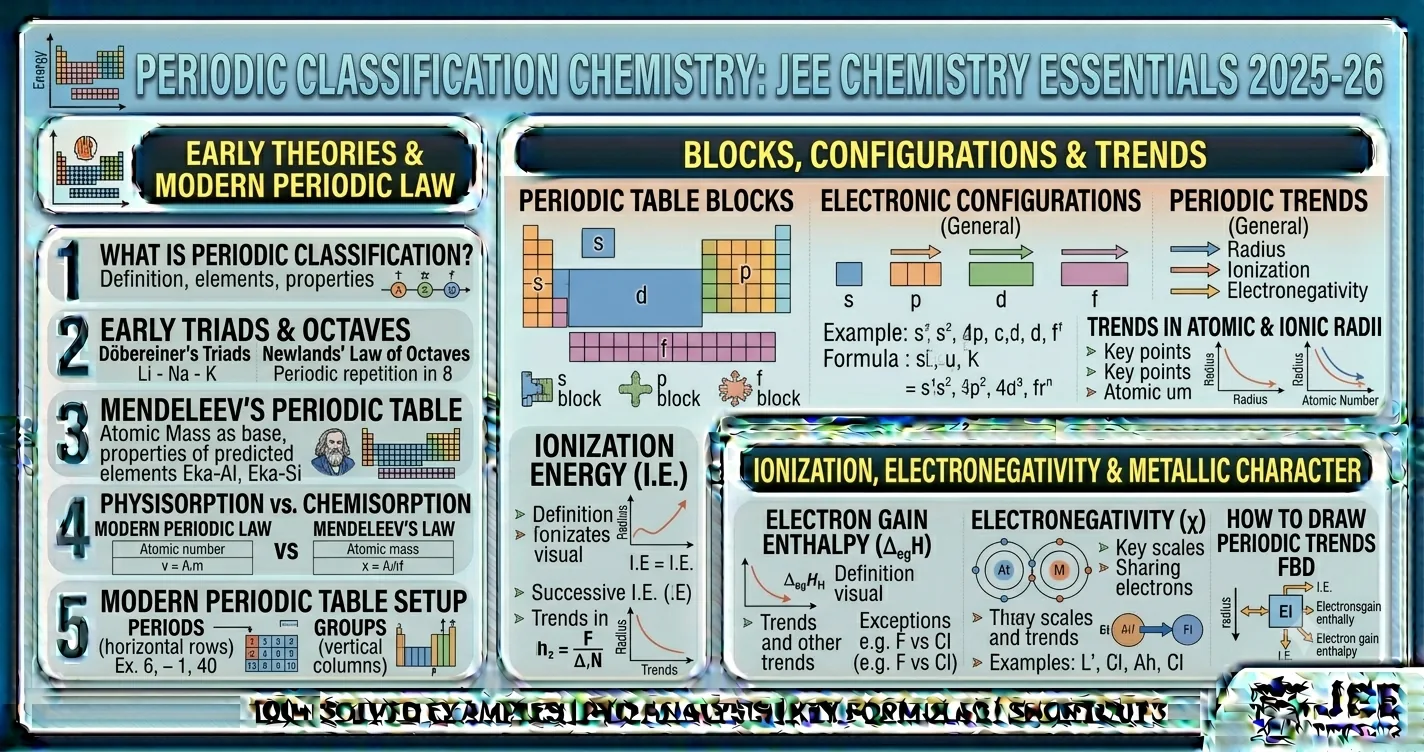
Complete Periodic Classification Mastery Guide for JEE 2026
Why Periodic Classification is Important
Periodic Classification is the backbone of inorganic chemistry. Here's why it's crucial:
- Foundation for 8+ chapters: Chemical bonding, p-block, d-block, f-block, coordination compounds all use periodic trends
- Scoring Chapter: 2-3 direct questions in JEE Main every session
- Conceptual Clarity: Understanding trends helps predict unknown element properties
- Rank Booster: Quick-scoring chapter with predictable question patterns
Topic-wise Weightage Analysis
Must-Remember Trends & Formulas
Effective Nuclear Charge
Z_eff = Z − σ
Screening: s > p > d > f
Ionization Enthalpy Exceptions
Be > B (fully filled 2s²)
N > O (half filled 2p³)
Mg > Al (fully filled 3s²)
P > S (half filled 3p³)
EGE Exception
Cl > F (small size of F)
S > O (small size of O)
Noble gases: positive EGE
Diagonal Relationships
Li ~ Mg
Be ~ Al
B ~ Si
5-Step Exam Strategy
-
1
Check electronic configuration first — identifies block, group, period instantly
-
2
For IE questions: Always check for half-filled/fully-filled exceptions
-
3
For EGE: Remember Cl > F and noble gases have positive EGE
-
4
For isoelectronic species: Higher Z = smaller size
-
5
For successive IE: Large jump = new shell = identifies valence electrons
7-Day Periodic Classification Mastery Roadmap
History
- • Dobereiner triads
- • Newlands octaves
- • Mendeleev table
Modern Table
- • Moseley's law
- • 7 periods, 18 groups
- • IUPAC naming
Blocks & Config
- • s, p, d, f blocks
- • Group/period ID
- • Element types
Atomic Radius
- • Types of radius
- • Z_eff formula
- • Isoelectronic species
IE & EGE
- • Trends & exceptions
- • Successive IE
- • Cl > F exception
EN & Anomalies
- • Electronegativity scales
- • Diagonal relationship
- • Inert pair effect
PYQ Marathon
- • 50+ PYQs
- • Revise exceptions
- • Formula sheet
Periodic Classification of Elements — Complete JEE Study Guide
The Classification of Elements and Periodicity in Properties is Chapter 3 of NCERT Class 11 Chemistry and forms the foundation of inorganic chemistry for JEE Main and Advanced. This chapter covers the historical development of the periodic table from Dobereiner's triads to Moseley's modern periodic law, the structure of the modern periodic table with 7 periods and 18 groups, and the periodic trends in atomic and ionic properties.
The most important topics for JEE from this chapter are ionization enthalpy trends and exceptions, electron gain enthalpy (especially the Cl > F exception), atomic and ionic radius trends, isoelectronic species comparison, diagonal relationship (Li-Mg, Be-Al, B-Si), and inert pair effect. These topics account for over 80% of all PYQs from this chapter in the last 10 years.
Students should focus on memorizing the four key IE exceptions (Be > B, N > O, Mg > Al, P > S), understanding why Cl has more negative EGE than F, and practicing successive ionization enthalpy problems to identify group numbers. The formula Z_eff = Z − σ for effective nuclear charge and the screening effect order (s > p > d > f) are essential for explaining all periodic trends.
For JEE Advanced, additional focus should be on anomalous properties of second-period elements, diagonal relationships, and the inert pair effect in heavier p-block elements. Combining periodic trends with chemical bonding concepts (like predicting bond character from electronegativity difference) is a common Advanced question pattern.