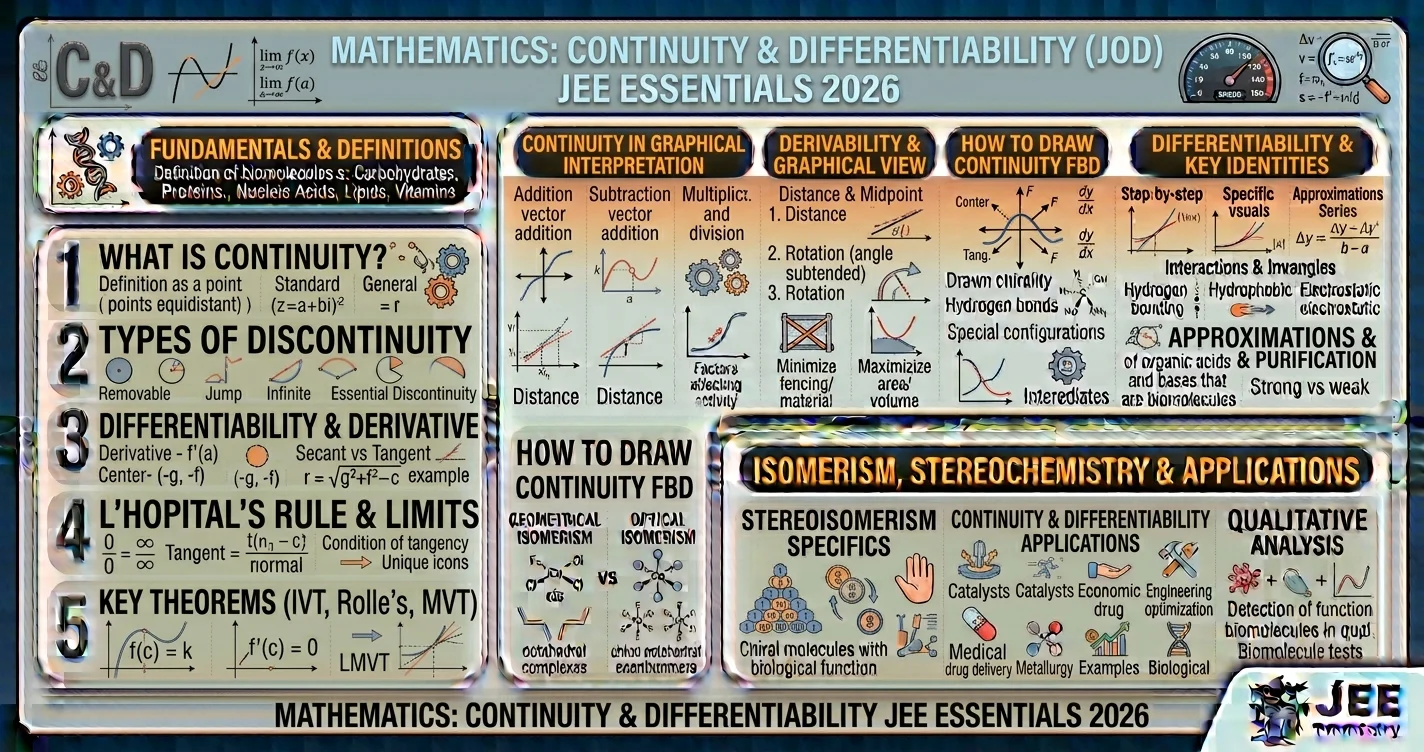
Complete Continuity and Differentiability Mastery Guide for JEE 2026
Why This Chapter is Important
Continuity and Differentiability is a high-scoring chapter in JEE Mathematics:
- 2-3 questions in almost every JEE Main session (8-12 marks)
- Conceptual + computational — easy if you know the formulas
- Foundation for Application of Derivatives and Integrals
- Piecewise function continuity appears almost every year
- Logarithmic differentiation is highly scoring
Topic-wise Weightage Analysis
Must-Remember Formulas & Values
Continuity & Differentiability
Continuous at c: LHL = RHL = f(c)
Differentiable at c: LHD = RHD (finite)
Differentiable ⟹ Continuous (not vice versa)
LHD = lim h→0 [f(c)−f(c−h)]/h
RHD = lim h→0 [f(c+h)−f(c)]/h
Inverse Trig Derivatives
d/dx(sin⁻¹x) = 1/√(1−x²)
d/dx(tan⁻¹x) = 1/(1+x²)
d/dx(sec⁻¹x) = 1/(|x|√(x²−1))
d/dx(cos⁻¹x) = −1/√(1−x²)
d/dx(cot⁻¹x) = −1/(1+x²)
Methods & Mean Value Theorems
Log diff: y = f^g ⟹ dy/dx = y[g'ln f + gf'/f]
Parametric: dy/dx = (dy/dt)/(dx/dt)
Leibniz: (uv)⁽ⁿ⁾ = Σ C(n,r) u⁽ⁿ⁻ʳ⁾ v⁽ʳ⁾
Rolle: f'(c) = 0, c ∈ (a,b) if f(a)=f(b)
LMVT: f'(c) = [f(b)−f(a)]/(b−a)
Cauchy: [f(b)−f(a)]/[g(b)−g(a)] = f'(c)/g'(c)
Series Expansions
eˣ = 1 + x + x²/2! + x³/3! + ...
sin x = x − x³/3! + x⁵/5! − ...
cos x = 1 − x²/2! + x⁴/4! − ...
ln(1+x) = x − x²/2 + x³/3 − ...
(1+x)ⁿ = 1 + nx + n(n−1)x²/2! + ...
5-Step Exam Strategy
-
1
For piecewise continuity: Compute LHL, RHL, f(c) separately and set all equal
-
2
For differentiability: Compute LHD and RHD using the appropriate piece formulas
-
3
For f(x)^g(x): Always use logarithmic differentiation
-
4
For Rolle's/LMVT: Verify all conditions, then solve f'(c) = value
-
5
For n-th derivative: Use Leibniz theorem for products, standard formulas for single functions
7-Day Mastery Roadmap
Continuity
- • Definition
- • LHL/RHL
- • Piecewise check
Discontinuity Types
- • Removable
- • Jump
- • Infinite/Oscillating
Differentiability
- • LHD/RHD
- • Relation w/ continuity
- • Non-diff points
Methods of Diff
- • Implicit
- • Logarithmic
- • Parametric
Inverse Trig + Higher
- • 6 derivatives
- • Leibniz theorem
- • n-th derivative
MVTs
- • Rolle's
- • LMVT
- • Cauchy's
PYQ Marathon
- • 60+ PYQs
- • Taylor/Maclaurin
- • Revision
Continuity and Differentiability — Complete JEE Study Guide
Continuity and Differentiability is one of the most scoring chapters in JEE Calculus, forming the bridge between Limits and Applications of Derivatives. The chapter typically contributes 2-3 questions (8-12 marks) in nearly every JEE Main session, and 2-4 questions in JEE Advanced.
The most important topics for JEE from this chapter are continuity of piecewise functions (where you find unknown constants using LHL = RHL = f(c)), differentiability at a point (using LHD = RHD test), number of points of non-differentiability (especially for functions like |x-a| + |x-b| + ...), logarithmic differentiation (for functions of the form f(x)^g(x)), derivatives of inverse trigonometric functions (especially tan⁻¹ forms), and Rolle's/LMVT applications.
Students should focus on mastering the LHD = RHD test: \(\lim_{h \to 0^-} \frac{f(c+h)-f(c)}{h} = \lim_{h \to 0^+} \frac{f(c+h)-f(c)}{h}\). The golden rule — every differentiable function is continuous, but a continuous function need not be differentiable — is the foundation. Classic counterexamples: f(x) = |x| (continuous but not differentiable at x=0), f(x) = x^(1/3) (vertical tangent at x=0), f(x) = x sin(1/x) with f(0)=0 (oscillating derivative).
For methods of differentiation, logarithmic differentiation is the most asked: for y = f(x)^g(x), take log to get ln y = g(x) ln f(x), then differentiate to obtain dy/dx = y[g'(x) ln f(x) + g(x) f'(x)/f(x)]. For parametric form (x = f(t), y = g(t)), use dy/dx = (dy/dt)/(dx/dt), and for the second derivative always remember d²y/dx² = [d/dt(dy/dx)] / (dx/dt), NOT (d²y/dt²)/(d²x/dt²).
The six inverse trigonometric derivatives must be memorized: d/dx(sin⁻¹x) = 1/√(1-x²), d/dx(cos⁻¹x) = -1/√(1-x²), d/dx(tan⁻¹x) = 1/(1+x²), d/dx(cot⁻¹x) = -1/(1+x²), d/dx(sec⁻¹x) = 1/(|x|√(x²-1)), d/dx(cosec⁻¹x) = -1/(|x|√(x²-1)). Note the absolute value |x| in the last two formulas — JEE often tests this detail.
For mean value theorems, remember the hierarchy: Cauchy's MVT (most general) → LMVT (special case with g(x) = x) → Rolle's theorem (special case of LMVT with f(a) = f(b)). The procedure to find 'c' is the same: differentiate, set f'(c) equal to the required value, solve for c, and verify c ∈ (a, b). Always check that all conditions (continuity on [a,b], differentiability on (a,b), and additionally f(a) = f(b) for Rolle's, g'(x) ≠ 0 for Cauchy's) are satisfied.
Taylor's series expansion of f(x) about x = a is \(\sum \frac{(x-a)^n}{n!} f^{(n)}(a)\), and Maclaurin's series (at a = 0) gives standard expansions: e^x = 1 + x + x²/2! + ..., sin x = x - x³/3! + ..., cos x = 1 - x²/2! + ..., ln(1+x) = x - x²/2 + x³/3 - ..., (1+x)^n = 1 + nx + n(n-1)x²/2! + .... These are useful for limit evaluation and approximation problems.