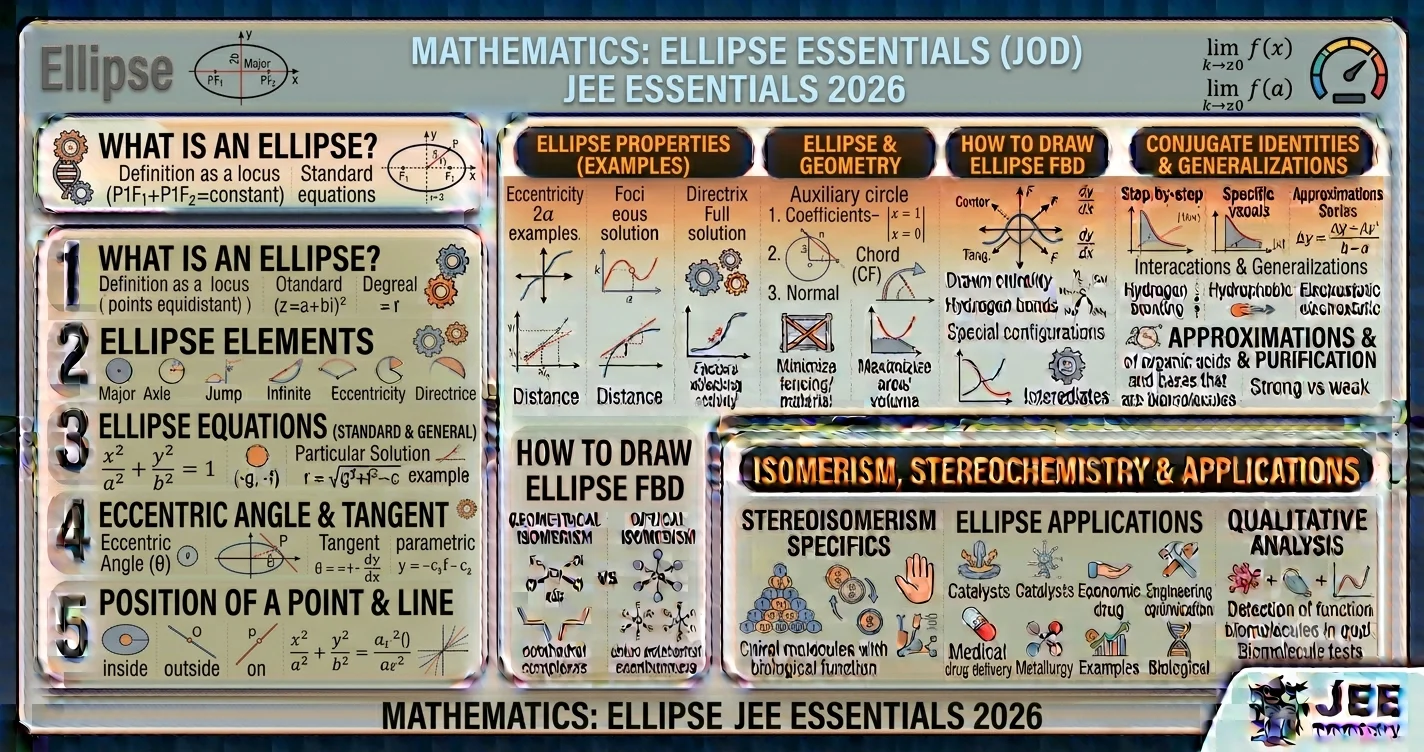
Complete Ellipse Mastery Guide for JEE 2026
Why This Chapter is Important
Ellipse is a high-yield chapter in JEE Coordinate Geometry:
- 1 question in almost every JEE Main session (4 marks)
- Formula-based — very scoring if formulas memorized
- Foundation for hyperbola and planetary motion problems
- Eccentricity problems appear almost every year
- Tangent problems are the second most frequent
Topic-wise Weightage Analysis
Must-Remember Formulas & Values
Equation & Elements
Standard: x²/a² + y²/b² = 1 (a > b)
Eccentricity: e = √(1 − b²/a²)
Foci: (±ae, 0); Directrices: x = ±a/e
Latus rectum: 2b²/a
SP + S'P = 2a (sum of focal distances)
Tangent & Normal
Tangent (slope): y = mx ± √(a²m² + b²)
Tangent (point): xx₁/a² + yy₁/b² = 1
Tangent (param): x cosθ/a + y sinθ/b = 1
Condition: c² = a²m² + b²
Normal (point): a²x/x₁ − b²y/y₁ = a² − b²
Normal (param): ax secθ − by cscθ = a² − b²
Circles & Chords
Auxiliary circle: x² + y² = a²
Director circle: x² + y² = a² + b²
Pair of tan: SS₁ = T²
Chord of contact: T = 0
Chord midpoint: T = S₁
Polar of (x₁, y₁): T = 0
Special Properties
Conjugate: m₁m₂ = −b²/a²
Ecc. angle diff (conj): π/2
CP² + CQ² = a² + b² (conjugate ends)
Area of parallelogram (conj. dia. tangents): 4ab
Area of ellipse: πab
Reflection: ray from one focus → other focus
5-Step Exam Strategy
-
1
For eccentricity: Use \(e = \sqrt{1 - b^2/a^2}\) — identify whether major axis is x or y first
-
2
For tangent: Pick the form based on given data — slope form, point form, or parametric form
-
3
For chord problems: Use T = 0 (contact) or T = S₁ (midpoint) — don't confuse the two!
-
4
For director circle: Remember x² + y² = a² + b² (real only if a > b)
-
5
For conjugate diameters: m₁m₂ = −b²/a², eccentric angle difference = π/2
7-Day Mastery Roadmap
Definition & Equation
- • Standard equation
- • Major/minor axis
- • Centre, vertices
Eccentricity & Foci
- • Eccentricity formula
- • Foci coordinates
- • Directrices
Latus Rectum & Focal Dist
- • Latus rectum: 2b²/a
- • SP + S'P = 2a
- • Auxiliary circle
Tangent (3 Forms)
- • Slope, point, parametric
- • Condition of tangency
- • Director circle
Normal & Pair
- • Normal (3 forms)
- • SS₁ = T²
- • Number of normals
Chord & Conjugate
- • T = 0, T = S₁
- • Pole & polar
- • Conjugate diameters
PYQ Marathon
- • 60+ PYQs
- • Reflection property
- • Mixed problems
Ellipse — Complete JEE Study Guide
Ellipse is one of the most scoring chapters in JEE Coordinate Geometry, alongside circles and parabola. The chapter typically contributes 1 question (4 marks) in nearly every JEE Main session, and 1-2 questions in JEE Advanced.
The most important topics for JEE from this chapter are eccentricity (formula \(e = \sqrt{1 - b^2/a^2}\)), tangent to ellipse (three forms — slope, point, parametric — very high frequency), condition of tangency (\(c^2 = a^2 m^2 + b^2\)), latus rectum (length \(2b^2/a\)), focal distance sum (\(SP + S'P = 2a\)), director circle (\(x^2 + y^2 = a^2 + b^2\)), auxiliary circle (\(x^2 + y^2 = a^2\)), chord of contact (T = 0), chord with given midpoint (T = S₁), pair of tangents (SS₁ = T²), normal to ellipse, conjugate diameters (\(m_1 m_2 = -b^2/a^2\)), and reflection property.
Students should focus on mastering the three tangent forms: slope form \(y = mx \pm \sqrt{a^2 m^2 + b^2}\), point form \(xx_1/a^2 + yy_1/b^2 = 1\), and parametric form \(x\cos\theta/a + y\sin\theta/b = 1\). The condition of tangency \(c^2 = a^2 m^2 + b^2\) is one of the most frequently tested formulas. The normal at \((a\cos\theta, b\sin\theta)\) is \(ax\sec\theta - by\csc\theta = a^2 - b^2\).
The "T-formula" is key to many problems. For ellipse \(S = x^2/a^2 + y^2/b^2 - 1 = 0\) and point \((x_1, y_1)\): \(T = xx_1/a^2 + yy_1/b^2 - 1\). Then: T = 0 gives tangent (if point on ellipse) or chord of contact (if external point); T = S₁ gives chord with midpoint \((x_1, y_1)\); SS₁ = T² gives pair of tangents from external point.
The director circle of ellipse \(x^2/a^2 + y^2/b^2 = 1\) is \(x^2 + y^2 = a^2 + b^2\), which is the locus of intersection of perpendicular tangents. The auxiliary circle is \(x^2 + y^2 = a^2\), drawn on the major axis as diameter. The foot of perpendicular from either focus to any tangent lies on the auxiliary circle.
For conjugate diameters, the product of slopes is \(-b^2/a^2\). The eccentric angles of the endpoints of conjugate diameters differ by \(\pi/2\). If \(P\) and \(Q\) are endpoints of conjugate diameters, then \(CP^2 + CQ^2 = a^2 + b^2\) (constant), and the parallelogram formed by tangents at the four endpoints has constant area \(= 4ab\).
The reflection property is a beautiful geometric property: a ray from one focus reflects off the ellipse to pass through the other focus. This is because the normal at any point on the ellipse bisects the angle between the focal radii (lines joining the point to the two foci). Applications include whispering galleries, lithotripsy, and elliptical mirrors.
For eccentricity problems: when \(a > b\), major axis is along x-axis, \(e = \sqrt{1 - b^2/a^2}\), foci at \((\pm ae, 0)\), directrices \(x = \pm a/e\). When \(b > a\), major axis is along y-axis, \(e = \sqrt{1 - a^2/b^2}\), foci at \((0, \pm be)\),directrices y=±b/e . The length of latus rectum is 2b 2 /a (if a>b ) or 2a 2 /b (if b>a ). The sum of focal distances is always the length of the major axis ( 2a or 2b ).
For area and perimeter: the area of ellipse is πab . The exact perimeter involves an elliptic integral, but approximations like Ramanujan's are sometimes used. The largest rectangle inscribed in an ellipse has area 2ab , and the largest inscribed triangle has area 4 3 3 ab .