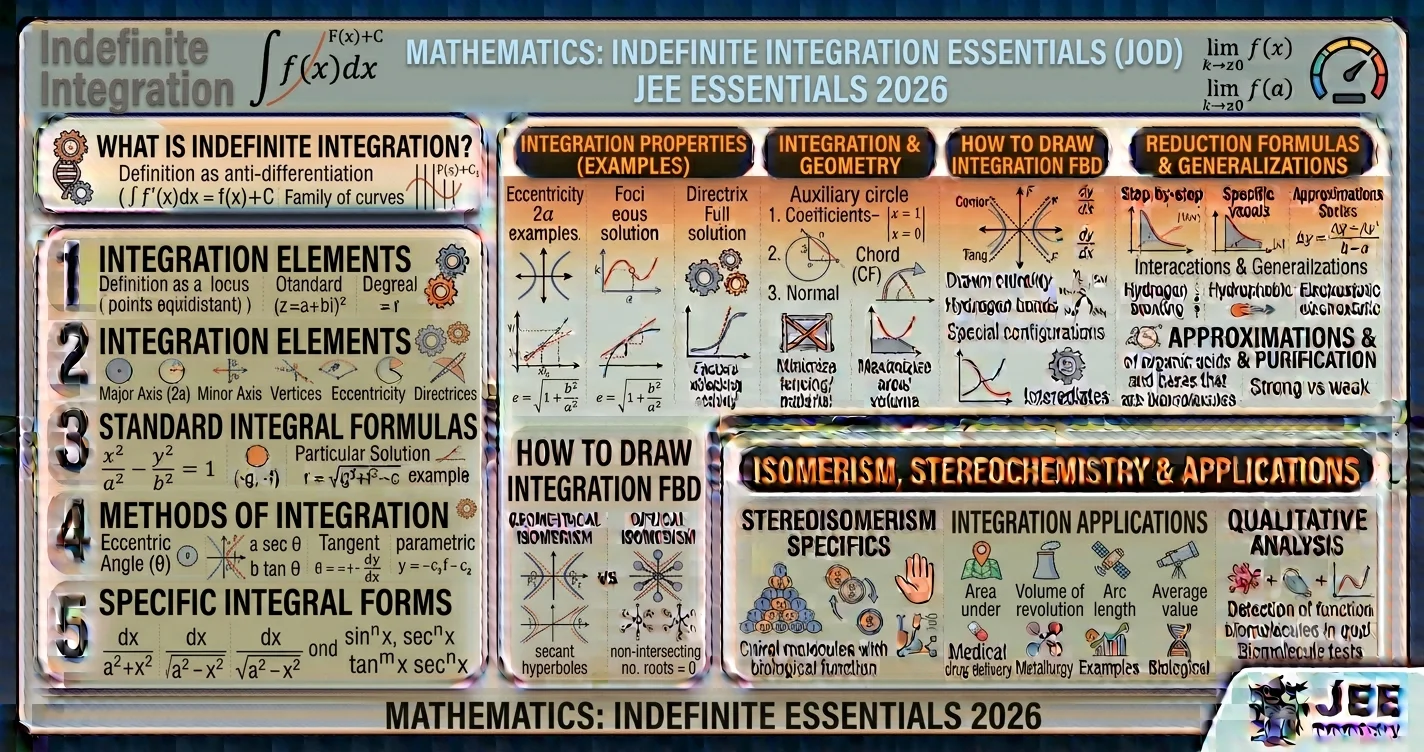
Complete Indefinite Integration Mastery Guide for JEE 2026
Why This Chapter is Important
Indefinite Integration is one of the highest-weightage calculus chapters in JEE:
- 1-2 questions in almost every JEE Main session
- Foundation for Definite Integration and Differential Equations
- Formula-heavy — scoring if methods mastered
- Integration by parts is the single most tested method
- eˣ[f+f'] pattern appears in almost every paper
Topic-wise Weightage Analysis
Must-Remember Formulas
Basic Forms
∫xⁿ dx = xⁿ⁺¹/(n+1) + C (n ≠ -1)
∫(1/x) dx = ln|x| + C
∫eˣ dx = eˣ + C; ∫aˣ dx = aˣ/ln a + C
∫sin x = -cos x; ∫cos x = sin x
∫sec²x = tan x; ∫csc²x = -cot x
∫sec x = ln|sec x + tan x| + C
∫tan x = ln|sec x| + C
By Parts & Special
∫u dv = uv - ∫v du (ILATE rule)
∫eˣ[f+f'] dx = eˣf + C
∫eᵃˣsin bx = eᵃˣ(a sin bx - b cos bx)/(a²+b²)
∫eᵃˣcos bx = eᵃˣ(a cos bx + b sin bx)/(a²+b²)
∫ln x dx = x ln x - x + C
Quadratic Forms
∫dx/(x²+a²) = (1/a)tan⁻¹(x/a) + C
∫dx/(x²-a²) = (1/2a)ln|(x-a)/(x+a)| + C
∫dx/√(a²-x²) = sin⁻¹(x/a) + C
∫dx/√(x²+a²) = ln|x+√(x²+a²)| + C
∫dx/√(x²-a²) = ln|x+√(x²-a²)| + C
Substitutions
√(a²-x²): x = a sinθ
√(a²+x²): x = a tanθ
√(x²-a²): x = a secθ
Weierstrass: t = tan(x/2)
sin x = 2t/(1+t²), cos x = (1-t²)/(1+t²)
5-Step Exam Strategy
-
1
Identify the form: Check if it's a product (by parts), rational (partial fractions), or has √ (trig substitution).
-
2
Check for eˣ[f+f']: If the integrand is eˣ times something, try to express it as f + f'.
-
3
For quadratics: Always complete the square first — it reveals the standard form.
-
4
For rational trig: Try identities first, then Weierstrass as last resort.
-
5
Verify: Differentiate your answer to check if you get back the integrand.
7-Day Mastery Roadmap
Basics & Formulae
- • Definition, properties
- • Standard formulae
- • Linearity
Substitution
- • Basic substitution
- • Standard substitutions
- • 50+ problems
Trig Integrals
- • Powers of sin/cos
- • Products
- • Identities
By Parts
- • ILATE rule
- • eˣ[f+f'] pattern
- • Cyclic integrals
Partial Fractions
- • All 4 cases
- • Cover-up method
- • Rational functions
Special Forms
- • 1/(ax²+bx+c)
- • Surd forms
- • Trig substitution
PYQ Marathon
- • 80+ PYQs
- • Weierstrass/Euler
- • Reduction formulae
Indefinite Integration — Complete JEE Study Guide
Indefinite Integration is one of the most important and scoring chapters in JEE Calculus. It typically contributes 1-2 questions in JEE Main and 1-3 questions in JEE Advanced every year. The chapter is the foundation for Definite Integration, Area Under Curves, and Differential Equations.
The most important topics for JEE from this chapter are integration by parts (using ILATE rule — Inverse trig, Logarithmic, Algebraic, Trigonometric, Exponential), the eˣ[f(x)+f'(x)] pattern (golden formula: \(\int e^x[f(x)+f'(x)]dx = e^x f(x) + C\)), partial fractions (four cases: distinct linear, repeated linear, irreducible quadratic, repeated quadratic), integration of 1/(ax²+bx+c) (complete the square method), integration of (px+q)/(ax²+bx+c) (split numerator), trigonometric substitutions (\(x = a\sin\theta\) for \(\sqrt{a^2-x^2}\), \(x = a\tan\theta\) for \(\sqrt{a^2+x^2}\), \(x = a\sec\theta\) for \(\sqrt{x^2-a^2}\)), and the Weierstrass substitution (\(t = \tan(x/2)\)) for rational functions of sin and cos.
Students should master the standard formulae first: \(\int x^n dx = x^{n+1}/(n+1) + C\), \(\int (1/x)dx = \ln|x| + C\), \(\int e^x dx = e^x + C\), \(\int \sin x\, dx = -\cos x + C\), \(\int \sec x\, dx = \ln|\sec x + \tan x| + C\), \(\int dx/(x^2+a^2) = (1/a)\tan^{-1}(x/a) + C\), \(\int dx/\sqrt{a^2-x^2} = \sin^{-1}(x/a) + C\), and \(\int dx/\sqrt{x^2+a^2} = \ln|x+\sqrt{x^2+a^2}| + C\).
The integration by parts formula \(\int u\, dv = uv - \int v\, du\) with the ILATE rule is the single most tested technique. For the special form \(\int e^x[f(x) + f'(x)]dx\), the answer is simply \(e^x f(x) + C\) — this pattern appears in nearly every JEE paper. Students should practice identifying this form by checking if the coefficient of \(e^x\) can be written as a function plus its derivative.
For partial fractions, the four cases must be mastered: (1) distinct linear factors \(\frac{A}{x-a} + \frac{B}{x-b}\), (2) repeated linear factors with powers, (3) irreducible quadratic \(\frac{Bx+C}{ax^2+bx+c}\), and (4) repeated quadratic. The Heaviside cover-up method is a useful shortcut for Case 1: \(A = P(a)/[(a-b)(a-c)]\).
For quadratic forms, the key technique is completing the square: \(ax^2+bx+c = a[(x+b/2a)^2 + (4ac-b^2)/(4a^2)]\). If the discriminant \(b^2-4ac < 0\), the result is an arctangent; if \(b^2-4ac > 0\), it's a logarithm; if \(b^2-4ac = 0\), it's a simple power. For \(\int (px+q)/(ax^2+bx+c)\, dx\), split the numerator as \(A(2ax+b) + B\) — the first part gives a logarithm, the second gives arctan or log.
The Weierstrass substitution \(t = \tan(x/2)\) converts \(\sin x = 2t/(1+t^2)\), \(\cos x = (1-t^2)/(1+t^2)\), \(dx = 2dt/(1+t^2)\). This transforms any rational function of sin x and cos x into a rational function of t, which can be integrated using partial fractions. While powerful, it often leads to lengthy algebra, so try simpler methods first.
Reduction formulae relate \(\int \sin^n x\, dx\) to \(\int \sin^{n-2} x\, dx\), reducing the power by 2 each time. The formula \(\int \sin^n x\, dx = -\frac{\sin^{n-1}x \cos x}{n} + \frac{n-1}{n}\int \sin^{n-2} x\, dx\) is derived using integration by parts. Similar formulae exist for \(\cos^n x\), \(\tan^n x\), \(\sec^n x\).
Euler's substitutions (three types) are used for integrals involving \(\sqrt{ax^2+bx+c}\): first when \(a > 0\) (\(\sqrt{ax^2+bx+c} = t - x\sqrt{a}\)), second when \(c > 0\) (\(\sqrt{ax^2+bx+c} = xt - \sqrt{c}\)), and third when \(b^2-4ac > 0\) (using real roots). In JEE, standard trig substitutions usually suffice, but Euler's method is useful for advanced problems.
Verification tip: After solving any indefinite integral, always differentiate your answer to verify you get back the original integrand. This catches algebraic errors and missing constants. Remember that the constant of integration \(C\) is essential — omitting it loses marks in JEE.