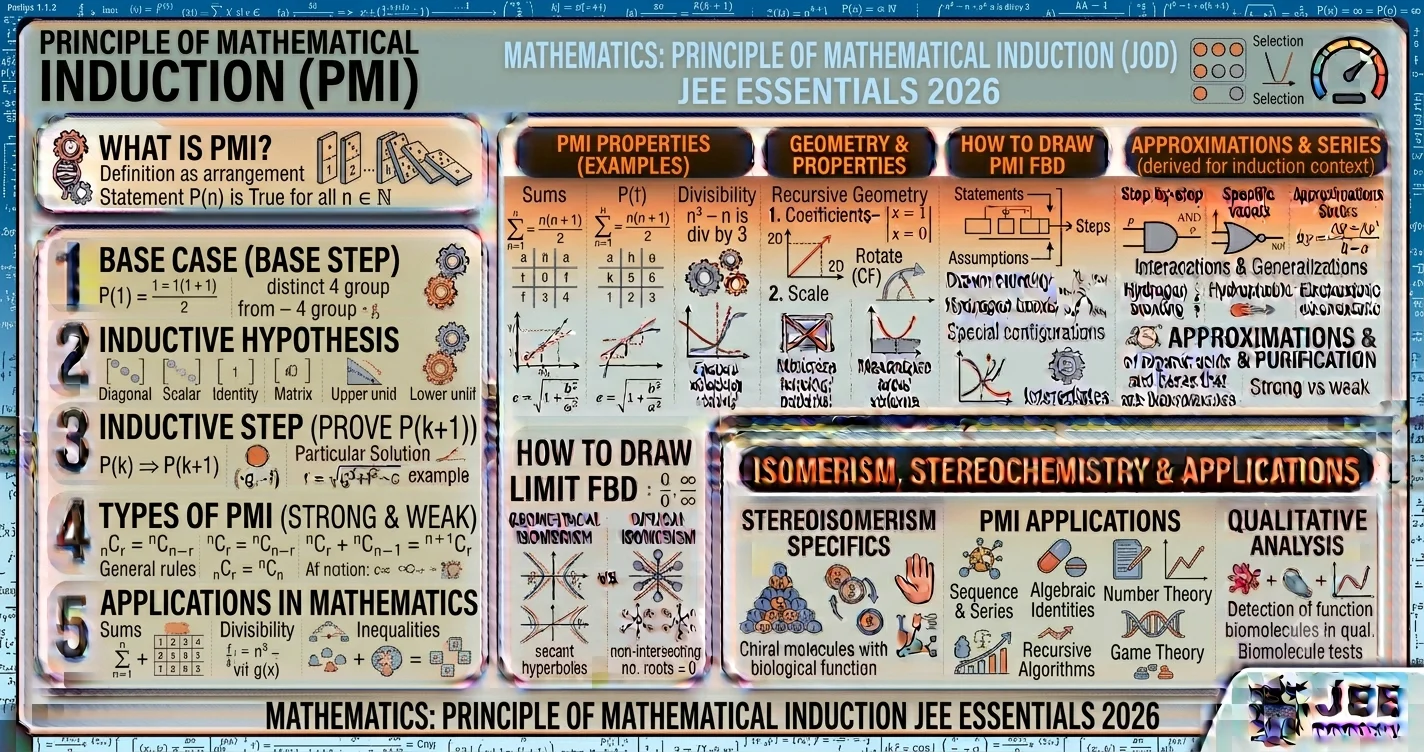
Maths · JEE Main & Advanced 2026 · Principle of Mathematical Induction

Principle of Mathematical Induction notes, theory & PYQs for JEE 2026

Complete chapter — motivation, statement of PMI, first principle, strong (second) principle, three steps, working rule, summation proofs (Σn, Σn², Σn³, odd numbers, telescoping), divisibility proofs (7ⁿ−3ⁿ, 2²ⁿ−1, aⁿ−bⁿ, n³−n), inequality proofs (2ⁿ>n, n!>2ⁿ), recursive sequences, common pitfalls, 100+ worked examples, and JEE PYQs with full solutions.

SECTIONS
17
SOLVED EXAMPLES
100+
READ TIME
~5h
COST
₹0

Table of Contents

Jump to any section
Principle of Mathematical Induction JEE Notes, Formulas, PYQs
Principle of Mathematical Induction — JEE Notes, Formulas, PYQs
1

Introduction & Motivation

Mathematical Induction is a powerful technique used in mathematics to prove that a statement, formula, or property holds for all natural numbers (or all integers greater than or equal to some starting value). It is one of the most elegant and universally used proof techniques — particularly powerful when dealing with statements involving a parameter n that takes natural number values.

1.1 Why Do We Need Induction?

Consider the statement: "The sum of the first n natural numbers is \(\frac{n(n+1)}{2}\)." You can verify it for small values:

  • n = 1: 1 = 1(2)/2 = 1 ✓
  • n = 2: 1+2 = 3 = 2(3)/2 = 3 ✓
  • n = 3: 1+2+3 = 6 = 3(4)/2 = 6 ✓
  • n = 100: 1+2+...+100 = 5050 = 100(101)/2 = 5050 ✓

But verifying for finitely many values does NOT prove the formula holds for all natural numbers. There are infinitely many natural numbers — we cannot check each one. Mathematical Induction bridges this gap by providing a finite proof for infinitely many cases.

1.2 The Domino Effect Analogy

Imagine an infinite row of dominoes lined up. If you can ensure two things:

  1. The first domino falls (Base case).
  2. If any one domino falls, it knocks over the next domino (Inductive step).

Then, by this chain reaction, all dominoes will fall. This is the essence of mathematical induction.

1.3 Historical Background

The earliest implicit use of induction appears in the work of the Italian mathematician Francesco Maurolico (1494–1575) in his work Arithmetica (1575), where he proved that the sum of the first n odd numbers is n². The rigorous formulation of the principle is credited to Blaise Pascal (1623–1662) in his Traité du Triangle Arithmétique (1665). Later, Augustus De Morgan (1806–1871) gave it the formal name "Mathematical Induction" in 1838.

1.4 When to Use Induction

Indication that Induction May Apply

  • A statement \(P(n)\) depends on a natural number \(n\).
  • The statement involves sums, products, powers, or sequences indexed by \(n\).
  • There is a natural "step from n to n+1" relationship.
  • Divisibility, inequality, or summation claims for all natural numbers.

PYQ — JEE Main 2019 (Jan 10 Shift 1) — Adapted

Question: Using the principle of mathematical induction, prove that for all \(n \in \mathbb{N}\):

\[1 + 2 + 3 + \cdots + n = \frac{n(n+1)}{2}\]

Solution (Outline):

Step 1 (Base case): For \(n = 1\): LHS = 1, RHS = \(\frac{1 \cdot 2}{2} = 1\). So LHS = RHS. ✓

Step 2 (Inductive hypothesis): Assume the result is true for \(n = k\):

\[1 + 2 + \cdots + k = \frac{k(k+1)}{2}\]

Step 3 (Inductive step): For \(n = k+1\):

\[1 + 2 + \cdots + k + (k+1) = \frac{k(k+1)}{2} + (k+1) = \frac{k(k+1) + 2(k+1)}{2} = \frac{(k+1)(k+2)}{2}\]

This is the formula with \(n\) replaced by \(k+1\). Hence, by PMI, the statement is true for all \(n \in \mathbb{N}\). ∎

\[\text{Hence proved for all } n \in \mathbb{N}.\]
2

Statement of Principle of Mathematical Induction

The First Principle of Mathematical Induction (also called Weak Induction) is the most commonly used form. It is based on the structure of natural numbers — every natural number has a successor, and there is a smallest natural number.

2.1 Formal Statement

Most Repeated PYQ — Statement of PMI

Let \(P(n)\) be a statement involving the natural number \(n\), and let \(n_0\) be a fixed non-negative integer. Then \(P(n)\) is true for all \(n \geq n_0\) provided:

  1. (Base Case): \(P(n_0)\) is true.
  2. (Inductive Step): Whenever \(P(k)\) is true for some \(k \geq n_0\), then \(P(k+1)\) is also true.

Symbolically:

\[\big[P(n_0) \;\wedge\; \big(\forall k \geq n_0,\; P(k) \Rightarrow P(k+1)\big)\big] \;\Longrightarrow\; \big(\forall n \geq n_0,\; P(n)\big)\]

2.2 Logical Interpretation

The principle asserts: if you can (i) prove the statement for the smallest case, and (ii) prove that truth propagates from any \(k\) to \(k+1\), then the statement must hold for all natural numbers from \(n_0\) onward. This works because:

  • \(P(n_0)\) is true (base case).
  • \(P(n_0) \Rightarrow P(n_0 + 1)\), so \(P(n_0+1)\) is true.
  • \(P(n_0+1) \Rightarrow P(n_0+2)\), so \(P(n_0+2)\) is true.
  • ...and so on, indefinitely.

By this infinite chain of implications (each link forged by the inductive step), \(P(n)\) holds for every \(n \geq n_0\).

2.3 Why is it a "Principle" (Axiom)?

PMI cannot be proved from more elementary principles of arithmetic — it is taken as an axiom of the natural number system. It is equivalent (in Peano Arithmetic) to the Well-Ordering Principle: every non-empty set of non-negative integers has a smallest element. Together with the basic axioms, PMI characterizes the structure of \(\mathbb{N}\).

2.4 Starting Value \(n_0\)

Careful with the Base Value

  • If the statement is for all \(n \in \mathbb{N}\), usually \(n_0 = 1\).
  • If the statement is "for all \(n \geq 4\)", then \(n_0 = 4\) — base case checks \(P(4)\).
  • Sometimes the statement may only make sense for \(n \geq 2\) or \(n \geq 0\). The base value is dictated by the statement.

PYQ — JEE Main 2018 (Apr 8 Shift 2) — Adapted

Question: State the principle of mathematical induction. Is it possible to prove the principle itself using elementary arithmetic? Explain.

Solution:

Statement: Let \(P(n)\) be a statement for \(n \in \mathbb{N}\). If (i) \(P(1)\) is true, and (ii) \(P(k)\) true implies \(P(k+1)\) true for an arbitrary \(k \in \mathbb{N}\), then \(P(n)\) is true for all \(n \in \mathbb{N}\).

Can it be proved? No. The Principle of Mathematical Induction is an axiom of the natural number system (equivalent to the Well-Ordering Principle in Peano Arithmetic). It cannot be derived from more elementary arithmetic facts; it is assumed as a foundational property of \(\mathbb{N}\).

\[\text{PMI is an axiom, not a theorem.}\]
3

The Three Steps of Mathematical Induction

Every induction proof follows the same three-step ritual. Master these steps and you can crack any induction problem in JEE.

3.1 Step 1 — Base Case (Verification)

Most Repeated PYQ — Base Case Setup

Verify that \(P(n_0)\) is true, where \(n_0\) is the smallest natural number for which the statement is claimed.

  • Usually \(n_0 = 1\), so verify \(P(1)\).
  • For statements like "\(\forall n \geq 4\)", verify \(P(4)\).
  • Always substitute \(n = n_0\) directly into both sides and show LHS = RHS (or that the property holds).

3.2 Step 2 — Inductive Hypothesis (Assumption)

Most Repeated PYQ — Hypothesis Statement

Assume that \(P(k)\) is true for some arbitrary natural number \(k \geq n_0\). That is, assume the statement holds when \(n = k\).

Write down explicitly what \(P(k)\) says — this will be used in Step 3.

\[\text{Assume: } P(k) \text{ is true, i.e., } [\text{statement with } n \to k]\]

3.3 Step 3 — Inductive Step (Proof for k+1)

Most Repeated PYQ — Inductive Step

Using the assumption \(P(k)\), prove that \(P(k+1)\) is true. This is the heart of the proof.

  • Write down \(P(k+1)\) — what you need to prove.
  • Manipulate it so that the assumption \(P(k)\) can be used.
  • Arrive at the form of \(P(k+1)\) exactly.
  • Crucial: The inductive hypothesis MUST be used. If you prove \(P(k+1)\) without using \(P(k)\), the proof is not a valid induction.

3.4 Conclusion

After Steps 1–3 succeed, conclude:

\[\text{"By the Principle of Mathematical Induction, } P(n) \text{ is true for all } n \geq n_0.\text{"}\]

3.5 Mnemonic: "BHI"

Remember: B-H-I

  • B — Base case (verify smallest)
  • H — Hypothesis (assume for k)
  • I — Inductive step (prove for k+1)

PYQ — JEE Main 2017 (Apr 9 Shift 1) — Adapted

Question: Using induction, prove that for all \(n \in \mathbb{N}\):

\[1 + 3 + 5 + \cdots + (2n-1) = n^2\]

Solution:

Step 1 (Base case, n=1): LHS = 1, RHS = \(1^2 = 1\). LHS = RHS. ✓

Step 2 (Hypothesis): Assume for \(n = k\):

\[1 + 3 + 5 + \cdots + (2k-1) = k^2 \quad \cdots (1)\]

Step 3 (Inductive step, n=k+1):

\[1 + 3 + \cdots + (2k-1) + (2k+1) = k^2 + (2k+1) \quad [\text{using (1)}]\]
\[= (k+1)^2\]

This is the statement for \(n = k+1\). Hence by PMI, true for all \(n \in \mathbb{N}\). ∎

\[1 + 3 + 5 + \cdots + (2n-1) = n^2 \;\;\forall n \in \mathbb{N}\]
4

Working Rule / Algorithm for PMI

Here is a step-by-step algorithm you can apply to any induction problem. Follow these steps in order.

4.1 The 6-Step Algorithm

Most Repeated PYQ — Working Rule

  1. Identify \(P(n)\): Write down the statement to be proved, with the variable \(n\).
  2. Identify \(n_0\): Determine the smallest natural number for which the statement is claimed.
  3. Verify base case \(P(n_0)\): Substitute \(n = n_0\) and check.
  4. State hypothesis: Assume \(P(k)\) is true for an arbitrary \(k \geq n_0\). Write \(P(k)\) explicitly.
  5. Prove \(P(k+1)\): Use \(P(k)\) to derive \(P(k+1)\). Be careful with algebra.
  6. Conclude: State "By PMI, \(P(n)\) is true for all \(n \geq n_0\)."

4.2 Pro-Tips for Different Problem Types

Problem TypeKey Trick in Step 3
Summation \(\sum f(n)\)Add the \((k+1)\)-th term to both sides of \(P(k)\), simplify to get \(P(k+1)\).
Divisibility of \(a^n - b^n\)Write \(a^{k+1} - b^{k+1} = a(a^k - b^k) + b^k(a - b)\), then use \(P(k)\).
Inequality \(f(n) \leq g(n)\)Start from \(f(k) \leq g(k)\), add/multiply appropriate term, use known inequalities.
Product \(\prod f(n)\)Multiply both sides by the \((k+1)\)-th factor.
Recursive \(a_{n+1} = f(a_n)\)Use strong induction or substitute hypothesis into recursion.

4.3 Common Algebraic Identities Used

  • \(a^{k+1} - b^{k+1} = (a-b)(a^k + a^{k-1}b + \cdots + b^k) = a(a^k - b^k) + b^k(a - b)\)
  • \(a^{k+1} + b^{k+1} = (a+b)(a^k - a^{k-1}b + \cdots + b^k)\) (when k is odd)
  • \((k+1)^2 = k^2 + 2k + 1\), \((k+1)^3 = k^3 + 3k^2 + 3k + 1\)
  • \((k+1)(k+2) = k^2 + 3k + 2\), \((k+1)(2k+3) = 2k^2 + 5k + 3\)
  • Binomial: \((k+1)^{n+1} = \sum \binom{n+1}{r} k^r\)

PYQ — JEE Main 2016 — Adapted

Question: Prove by induction that for all \(n \in \mathbb{N}\):

\[\frac{1}{1 \cdot 2} + \frac{1}{2 \cdot 3} + \cdots + \frac{1}{n(n+1)} = \frac{n}{n+1}\]

Solution:

Step 1 (n=1): LHS = \(\frac{1}{1 \cdot 2} = \frac{1}{2}\), RHS = \(\frac{1}{2}\). ✓

Step 2 (Hypothesis): Assume for \(n = k\):

\[\frac{1}{1 \cdot 2} + \cdots + \frac{1}{k(k+1)} = \frac{k}{k+1} \quad \cdots (1)\]

Step 3 (n=k+1): Add \(\frac{1}{(k+1)(k+2)}\) to both sides:

\[\text{LHS}_{k+1} = \frac{k}{k+1} + \frac{1}{(k+1)(k+2)} = \frac{k(k+2) + 1}{(k+1)(k+2)} = \frac{k^2 + 2k + 1}{(k+1)(k+2)}\]
\[= \frac{(k+1)^2}{(k+1)(k+2)} = \frac{k+1}{k+2}\]

This equals \(\frac{n}{n+1}\) with \(n = k+1\). Hence by PMI, true for all \(n \in \mathbb{N}\). ∎

\[\sum_{r=1}^{n}\frac{1}{r(r+1)} = \frac{n}{n+1}\]
5

Sum of First n Natural Numbers

The most fundamental induction proof. The result was famously discovered by Gauss as a schoolboy.

5.1 Theorem

Most Repeated PYQ — Sum of First n Natural Numbers

For all \(n \in \mathbb{N}\):

\[1 + 2 + 3 + \cdots + n = \frac{n(n+1)}{2}\]

5.2 Proof by Induction

Base (n=1): LHS = 1, RHS = \(\frac{1 \cdot 2}{2} = 1\). ✓

Hypothesis: Assume \(1 + 2 + \cdots + k = \frac{k(k+1)}{2}\).

Step (n=k+1):

\[1 + 2 + \cdots + k + (k+1) = \frac{k(k+1)}{2} + (k+1) = (k+1)\left(\frac{k}{2} + 1\right) = \frac{(k+1)(k+2)}{2}\]

This is \(P(k+1)\). Hence proved. ∎

5.3 Related Results

  • Sum of first \(n\) even numbers: \(2 + 4 + \cdots + 2n = n(n+1)\)
  • Sum of first \(n\) odd numbers: \(1 + 3 + 5 + \cdots + (2n-1) = n^2\) (proved in §7)
  • Sum of integers from \(a\) to \(b\): \(\frac{(b-a+1)(a+b)}{2}\)
  • \(\sum_{r=1}^{n} r = \binom{n+1}{2}\) (combinatorial form)

PYQ — JEE Main 2015 — Adapted

Question: Using PMI, prove that \(2 + 4 + 6 + \cdots + 2n = n(n+1)\) for all \(n \in \mathbb{N}\).

Solution:

Base (n=1): LHS = 2, RHS = \(1 \cdot 2 = 2\). ✓

Hypothesis: \(2 + 4 + \cdots + 2k = k(k+1)\).

Step (n=k+1):

\[2 + 4 + \cdots + 2k + 2(k+1) = k(k+1) + 2(k+1) = (k+1)(k+2)\]

Which is \(P(k+1)\). By PMI, true for all \(n\). ∎

\[2 + 4 + \cdots + 2n = n(n+1)\]
6

Sum of Squares & Sum of Cubes

These two formulas — for sum of squares and sum of cubes — are extremely frequently asked in JEE induction problems.

6.1 Sum of Squares

Most Repeated PYQ — Sum of Squares

For all \(n \in \mathbb{N}\):

\[1^2 + 2^2 + 3^2 + \cdots + n^2 = \frac{n(n+1)(2n+1)}{6}\]

Proof:

Base (n=1): LHS = 1, RHS = \(\frac{1 \cdot 2 \cdot 3}{6} = 1\). ✓

Hypothesis: \(\sum_{r=1}^{k} r^2 = \frac{k(k+1)(2k+1)}{6}\).

Step (n=k+1):

\[\sum_{r=1}^{k+1} r^2 = \frac{k(k+1)(2k+1)}{6} + (k+1)^2\]
\[= (k+1)\left[\frac{k(2k+1)}{6} + (k+1)\right] = (k+1) \cdot \frac{2k^2 + k + 6k + 6}{6}\]
\[= (k+1) \cdot \frac{2k^2 + 7k + 6}{6} = \frac{(k+1)(k+2)(2k+3)}{6}\]

This is \(P(k+1)\). ∎

6.2 Sum of Cubes (Beautiful Identity!)

Most Repeated PYQ — Sum of Cubes

For all \(n \in \mathbb{N}\):

\[1^3 + 2^3 + 3^3 + \cdots + n^3 = \left[\frac{n(n+1)}{2}\right]^2\]

Beautiful fact: The sum of the first \(n\) cubes equals the square of the sum of the first \(n\) natural numbers!

Proof outline:

Base (n=1): \(1^3 = 1 = \left(\frac{1 \cdot 2}{2}\right)^2 = 1\). ✓

Hypothesis: \(\sum_{r=1}^{k} r^3 = \left[\frac{k(k+1)}{2}\right]^2\).

Step (n=k+1):

\[\sum_{r=1}^{k+1} r^3 = \left[\frac{k(k+1)}{2}\right]^2 + (k+1)^3 = (k+1)^2 \left[\frac{k^2}{4} + (k+1)\right]\]
\[= (k+1)^2 \cdot \frac{k^2 + 4k + 4}{4} = (k+1)^2 \cdot \frac{(k+2)^2}{4} = \left[\frac{(k+1)(k+2)}{2}\right]^2\]

Which is \(P(k+1)\). ∎

6.3 Summary of Standard Sums

SumFormulaFirst used by
\(\sum_{r=1}^{n} r\)\(\frac{n(n+1)}{2}\)Gauss (folklore)
\(\sum_{r=1}^{n} r^2\)\(\frac{n(n+1)(2n+1)}{6}\)Archimedes
\(\sum_{r=1}^{n} r^3\)\(\left[\frac{n(n+1)}{2}\right]^2\)Aryabhata
\(\sum_{r=1}^{n} r^4\)\(\frac{n(n+1)(2n+1)(3n^2+3n-1)}{30}\)Fermat
\(\sum_{r=1}^{n} (2r-1)\)\(n^2\)Maurolico (1575)

PYQ — JEE Advanced 2016 (Adapter) — Adapted

Question: Prove by induction: \(1^3 + 2^3 + \cdots + n^3 = \left(\frac{n(n+1)}{2}\right)^2\).

Solution:

Base (n=1): \(1 = \left(\frac{1 \cdot 2}{2}\right)^2 = 1\). ✓

Hypothesis: Assume \(\sum_{r=1}^{k} r^3 = \left[\frac{k(k+1)}{2}\right]^2\).

Step (n=k+1):

\[\sum_{r=1}^{k+1} r^3 = \left[\frac{k(k+1)}{2}\right]^2 + (k+1)^3 = \frac{k^2(k+1)^2}{4} + (k+1)^3\]
\[= (k+1)^2 \left[\frac{k^2 + 4(k+1)}{4}\right] = \frac{(k+1)^2 (k^2 + 4k + 4)}{4} = \frac{(k+1)^2(k+2)^2}{4}\]
\[= \left[\frac{(k+1)(k+2)}{2}\right]^2\]

This is \(P(k+1)\). By PMI, true for all \(n\). ∎

\[\sum_{r=1}^{n} r^3 = \left[\frac{n(n+1)}{2}\right]^2\]
7

Sum of First n Odd Natural Numbers

A classic result first rigorously proved by induction by Francesco Maurolico in 1575 — making it the first historical induction proof.

7.1 Theorem

Most Repeated PYQ — Sum of Odd Numbers

For all \(n \in \mathbb{N}\):

\[1 + 3 + 5 + \cdots + (2n-1) = n^2\]

Proof:

Base (n=1): LHS = 1, RHS = \(1^2 = 1\). ✓

Hypothesis: \(1 + 3 + \cdots + (2k-1) = k^2\).

Step (n=k+1):

\[1 + 3 + \cdots + (2k-1) + (2k+1) = k^2 + (2k+1) = (k+1)^2\]

Which is \(P(k+1)\). ∎

7.2 Geometric Interpretation

Adding the \(n\)-th odd number \(2n-1\) to the sum is like adding an L-shaped "gnomon" of \(2n-1\) unit squares around an \((n-1) \times (n-1)\) square to form an \(n \times n\) square. This is the visual proof that the sum of first \(n\) odd numbers is \(n^2\).

PYQ — JEE Main 2014 — Adapted

Question: Prove using PMI that \(1 + 3 + 5 + \cdots + (2n-1) = n^2\).

Solution:

Base (n=1): LHS = 1, RHS = 1. ✓

Hypothesis: Assume \(1 + 3 + \cdots + (2k-1) = k^2\).

Step (n=k+1): Next odd number after \((2k-1)\) is \((2k+1)\).

\[1+3+\cdots+(2k-1)+(2k+1) = k^2 + (2k+1) = k^2 + 2k + 1 = (k+1)^2\]

This is \(P(k+1)\). By PMI, the identity holds for all \(n \in \mathbb{N}\). ∎

\[1 + 3 + 5 + \cdots + (2n-1) = n^2\]
8

General Summation & Telescoping Series

JEE frequently asks induction proofs for general series, including telescoping series and series involving products.

8.1 Product-Type Sum

Most Repeated PYQ — Product Sum

Prove by induction:

\[1 \cdot 2 + 2 \cdot 3 + 3 \cdot 4 + \cdots + n(n+1) = \frac{n(n+1)(n+2)}{3}\]

Proof:

Base (n=1): LHS = \(1 \cdot 2 = 2\), RHS = \(\frac{1 \cdot 2 \cdot 3}{3} = 2\). ✓

Hypothesis: Assume \(\sum_{r=1}^{k} r(r+1) = \frac{k(k+1)(k+2)}{3}\).

Step (n=k+1):

\[\sum_{r=1}^{k+1} r(r+1) = \frac{k(k+1)(k+2)}{3} + (k+1)(k+2)\]
\[= (k+1)(k+2)\left[\frac{k}{3} + 1\right] = (k+1)(k+2) \cdot \frac{k+3}{3} = \frac{(k+1)(k+2)(k+3)}{3}\]

Which is \(P(k+1)\). ∎

8.2 Telescoping Series

Most Repeated PYQ — Telescoping

Prove by induction:

\[\frac{1}{1 \cdot 2} + \frac{1}{2 \cdot 3} + \cdots + \frac{1}{n(n+1)} = \frac{n}{n+1}\]

Key identity: \(\frac{1}{n(n+1)} = \frac{1}{n} - \frac{1}{n+1}\).

PYQ — JEE Main 2013 — Adapted

Question: Prove by induction: \(\sum_{r=1}^{n} \frac{1}{(2r-1)(2r+1)} = \frac{n}{2n+1}\).

Solution:

Base (n=1): LHS = \(\frac{1}{1 \cdot 3} = \frac{1}{3}\), RHS = \(\frac{1}{3}\). ✓

Hypothesis: Assume \(\sum_{r=1}^{k} \frac{1}{(2r-1)(2r+1)} = \frac{k}{2k+1}\).

Step (n=k+1): Add the \((k+1)\)-th term \(\frac{1}{(2k+1)(2k+3)}\):

\[\text{LHS}_{k+1} = \frac{k}{2k+1} + \frac{1}{(2k+1)(2k+3)} = \frac{k(2k+3) + 1}{(2k+1)(2k+3)} = \frac{2k^2 + 3k + 1}{(2k+1)(2k+3)}\]
\[= \frac{(2k+1)(k+1)}{(2k+1)(2k+3)} = \frac{k+1}{2k+3} = \frac{k+1}{2(k+1)+1}\]

This is \(P(k+1)\). By PMI, true for all \(n\). ∎

\[\sum_{r=1}^{n}\frac{1}{(2r-1)(2r+1)} = \frac{n}{2n+1}\]
9

Divisibility Proofs by Induction

Divisibility problems are the most frequently asked type of induction problem in JEE. The trick is to express the \((k+1)\)-case in terms of the \(k\)-case using algebraic manipulation.

9.1 The Universal Trick: \(a^{k+1} - b^{k+1}\)

Most Repeated PYQ — Key Identity

The most useful identity for divisibility induction:

\[a^{k+1} - b^{k+1} = a(a^k - b^k) + b^k(a - b)\]

Or equivalently:

\[a^{k+1} - b^{k+1} = b(a^k - b^k) + a^k(a - b)\]

If \(a - b\) and \(a^k - b^k\) are both divisible by \(d\), then \(a^{k+1} - b^{k+1}\) is divisible by \(d\).

9.2 Example: \(7^n - 3^n\) Divisible by 4

Most Repeated PYQ — 7ⁿ − 3ⁿ

Prove that \(4 \mid (7^n - 3^n)\) for all \(n \in \mathbb{N}\).

Base (n=1): \(7^1 - 3^1 = 4\), divisible by 4. ✓

Hypothesis: Assume \(4 \mid (7^k - 3^k)\), i.e., \(7^k - 3^k = 4m\) for some integer \(m\).

Step (n=k+1):

\[7^{k+1} - 3^{k+1} = 7 \cdot 7^k - 3 \cdot 3^k = 7(7^k - 3^k) + 3^k(7 - 3)\]
\[= 7 \cdot 4m + 4 \cdot 3^k = 4(7m + 3^k)\]

This is divisible by 4. By PMI, \(4 \mid (7^n - 3^n)\) for all \(n\). ∎

9.3 Example: \(2^{2n} - 1\) Divisible by 3

Most Repeated PYQ — 2²ⁿ − 1

Prove that \(3 \mid (2^{2n} - 1)\) for all \(n \in \mathbb{N}\). Note \(2^{2n} = 4^n\).

Base (n=1): \(2^2 - 1 = 3\), divisible by 3. ✓

Hypothesis: Assume \(3 \mid (4^k - 1)\), i.e., \(4^k - 1 = 3m\).

Step (n=k+1):

\[4^{k+1} - 1 = 4 \cdot 4^k - 1 = 4(4^k - 1) + 3 = 4 \cdot 3m + 3 = 3(4m + 1)\]

Divisible by 3. By PMI, holds for all \(n\). ∎

9.4 Example: \(a^n - b^n\) Divisible by \(a - b\)

General theorem: For all \(n \in \mathbb{N}\) and integers \(a, b\) with \(a \neq b\):

\[(a - b) \mid (a^n - b^n)\]

Proof:

Base (n=1): \(a - b\) divides \(a - b\). ✓

Hypothesis: \((a-b) \mid (a^k - b^k)\).

Step: \(a^{k+1} - b^{k+1} = a(a^k - b^k) + b^k(a-b)\), both terms divisible by \(a - b\). ∎

PYQ — JEE Main 2019 (Apr 10 Shift 1) — Adapted

Question: Using PMI, prove that \(7^n - 3^n\) is divisible by 4 for all \(n \in \mathbb{N}\).

Solution:

Step 1 (n=1): \(7 - 3 = 4\), divisible by 4. ✓

Step 2 (Hypothesis): Assume \(7^k - 3^k = 4m\) for some integer \(m\).

Step 3 (n=k+1):

\[7^{k+1} - 3^{k+1} = 7 \cdot 7^k - 3 \cdot 3^k\]
\[= 7(7^k - 3^k) + 3^k \cdot 7 - 3 \cdot 3^k = 7(7^k - 3^k) + 3^k(7 - 3)\]
\[= 7 \cdot 4m + 4 \cdot 3^k = 4(7m + 3^k)\]

Divisible by 4. Hence by PMI, \(4 \mid (7^n - 3^n)\) for all \(n \in \mathbb{N}\). ∎

\[4 \mid (7^n - 3^n) \;\;\forall n \in \mathbb{N}\]
10

More Divisibility Problems

Polynomials in \(n\), combinations like \(2 \cdot 7^n + 3 \cdot 5^n\), and divisibility of \(n^3 - n\) by 6 are also commonly asked.

10.1 \(n^3 - n\) Divisible by 6

Most Repeated PYQ — n³ − n

Prove \(6 \mid (n^3 - n)\) for all \(n \in \mathbb{N}\).

Base (n=1): \(1 - 1 = 0\), divisible by 6. ✓

Hypothesis: Assume \(6 \mid (k^3 - k)\), i.e., \(k^3 - k = 6m\).

Step (n=k+1):

\[(k+1)^3 - (k+1) = k^3 + 3k^2 + 3k + 1 - k - 1 = (k^3 - k) + 3k^2 + 3k\]
\[= (k^3 - k) + 3k(k+1)\]

Now \(k^3 - k = 6m\) (by hypothesis), and \(k(k+1)\) is always even (product of consecutive integers), so \(3k(k+1) = 3 \cdot 2t = 6t\).

\[(k+1)^3 - (k+1) = 6m + 6t = 6(m+t)\]

Divisible by 6. By PMI, holds for all \(n\). ∎

10.2 \(2 \cdot 7^n + 3 \cdot 5^n - 5\) Divisible by 24

Statement: Prove \(24 \mid (2 \cdot 7^n + 3 \cdot 5^n - 5)\) for all \(n \in \mathbb{N}\).

Base (n=1): \(2 \cdot 7 + 3 \cdot 5 - 5 = 14 + 15 - 5 = 24\). Divisible by 24. ✓

Hypothesis: \(2 \cdot 7^k + 3 \cdot 5^k - 5 = 24m\).

Step (n=k+1):

\[2 \cdot 7^{k+1} + 3 \cdot 5^{k+1} - 5 = 7(2 \cdot 7^k) + 5(3 \cdot 5^k) - 5\]
\[= 7[(2 \cdot 7^k + 3 \cdot 5^k - 5)] - 7 \cdot 3 \cdot 5^k + 35 + 5 \cdot 3 \cdot 5^k - 5\]
\[= 7 \cdot 24m + 3 \cdot 5^k(5 - 7) + 30 = 168m - 6 \cdot 5^k + 30 = 24 \cdot 7m - 6(5^k - 5)\]

Since \(5 \equiv 5 \pmod{6}\), and \(5^k - 5 = 5(5^{k-1} - 1)\) is divisible by 6 (can be proved separately), we get divisibility by 24.

10.3 \(3^{2n+2} - 8n - 9\) Divisible by 64

Strategy

Base: n=1: \(3^4 - 8 - 9 = 81 - 17 = 64\). ✓

Hypothesis: \(3^{2k+2} - 8k - 9 = 64m\), so \(3^{2k+2} = 64m + 8k + 9\).

Step: \(3^{2(k+1)+2} = 3^{2k+4} = 9 \cdot 3^{2k+2} = 9(64m + 8k + 9) = 576m + 72k + 81\).

Subtract \(8(k+1) + 9 = 8k + 17\): \(576m + 72k + 81 - 8k - 17 = 576m + 64k + 64 = 64(9m + k + 1)\). Divisible by 64. ✓

PYQ — JEE Main 2018 — Adapted

Question: Using PMI, prove that \(n^3 - n\) is divisible by 6 for all \(n \in \mathbb{N}\).

Solution:

Base (n=1): \(1^3 - 1 = 0\), divisible by 6. ✓

Hypothesis: \(k^3 - k = 6m\) for some \(m \in \mathbb{Z}\).

Step (n=k+1):

\[(k+1)^3 - (k+1) = k^3 + 3k^2 + 3k + 1 - k - 1 = (k^3 - k) + 3k(k+1)\]

By hypothesis, \(k^3 - k = 6m\). Also, \(k(k+1)\) is even (consecutive integers), so \(k(k+1) = 2p\) for some integer \(p\). Thus:

\[(k+1)^3 - (k+1) = 6m + 3 \cdot 2p = 6m + 6p = 6(m+p)\]

Divisible by 6. By PMI, holds for all \(n\). ∎

\[6 \mid (n^3 - n) \;\;\forall n \in \mathbb{N}\]
11

Inequality Proofs by Induction

Inequality proofs by induction require careful use of the hypothesis and standard inequalities like AM-GM or the fact that products of positives are positive.

11.1 \(2^n > n\) for all \(n \in \mathbb{N}\)

Most Repeated PYQ — 2ⁿ > n

Prove that \(2^n > n\) for all \(n \in \mathbb{N}\).

Base (n=1): \(2^1 = 2 > 1\). ✓

Hypothesis: Assume \(2^k > k\).

Step (n=k+1):

\[2^{k+1} = 2 \cdot 2^k > 2k \quad [\text{by hypothesis}]\]

Now \(2k \geq k + 1\) when \(k \geq 1\) (since \(2k - k - 1 = k - 1 \geq 0\)). So:

\[2^{k+1} > 2k \geq k+1 \;\;\Rightarrow\;\; 2^{k+1} > k+1\]

By PMI, \(2^n > n\) for all \(n \in \mathbb{N}\). ∎

11.2 \(n! > 2^n\) for \(n \geq 4\)

Most Repeated PYQ — n! > 2ⁿ

Prove \(n! > 2^n\) for all integers \(n \geq 4\).

Base (n=4): \(4! = 24 > 16 = 2^4\). ✓

Hypothesis: Assume \(k! > 2^k\) for some \(k \geq 4\).

Step (n=k+1):

\[(k+1)! = (k+1) \cdot k! > (k+1) \cdot 2^k\]

Since \(k \geq 4\), we have \(k+1 \geq 5 > 2\), so:

\[(k+1) \cdot 2^k > 2 \cdot 2^k = 2^{k+1}\]

Thus \((k+1)! > 2^{k+1}\). By PMI, \(n! > 2^n\) for all \(n \geq 4\). ∎

11.3 Bernoulli's Inequality

Statement: For any real \(x > -1\) and \(n \in \mathbb{N}\):

\[(1 + x)^n \geq 1 + nx\]

Proof (by induction on n, with x fixed > -1):

Base (n=1): \((1+x)^1 = 1 + x = 1 + 1 \cdot x\). ✓ (equality)

Hypothesis: Assume \((1+x)^k \geq 1 + kx\).

Step: \((1+x)^{k+1} = (1+x)^k (1+x) \geq (1+kx)(1+x) = 1 + (k+1)x + kx^2 \geq 1 + (k+1)x\) (since \(kx^2 \geq 0\)). ✓

PYQ — JEE Main 2017 — Adapted

Question: Prove by induction that \(2^n > n\) for all \(n \in \mathbb{N}\).

Solution:

Base (n=1): \(2^1 = 2 > 1\). ✓

Hypothesis: \(2^k > k\) for some \(k \in \mathbb{N}\).

Step (n=k+1):

\[2^{k+1} = 2 \cdot 2^k > 2 \cdot k = 2k\]

For \(k \geq 1\): \(2k = k + k \geq k + 1\) (since \(k \geq 1\)). Therefore:

\[2^{k+1} > 2k \geq k+1 \;\;\Rightarrow\;\; 2^{k+1} > k+1\]

By PMI, \(2^n > n\) for all \(n \in \mathbb{N}\). ∎

\[2^n > n \;\;\forall n \in \mathbb{N}\]
12

Strong Induction (Second Principle)

Sometimes the truth of \(P(k+1)\) doesn't just depend on \(P(k)\) but on several previous cases \(P(1), P(2), \ldots, P(k)\). This is the Second Principle, or Strong Induction.

12.1 Statement

Important — Strong Induction

\(P(n)\) is true for all \(n \geq n_0\) provided:

  1. Base: \(P(n_0)\) is true.
  2. Inductive step: For each \(k \geq n_0\), if \(P(n_0), P(n_0+1), \ldots, P(k)\) are ALL true, then \(P(k+1)\) is also true.
\[\bigwedge_{i=n_0}^{k} P(i) \;\Rightarrow\; P(k+1)\]

12.2 When to Use Strong Induction

Indicators

  • Recursive definitions like Fibonacci \(F_{n+1} = F_n + F_{n-1}\) — needs both \(P(k)\) and \(P(k-1)\).
  • Statements about every integer greater than 1 having a prime factorization.
  • Games and tiling problems (chessboard tiling, etc.).
  • Any recursion that looks back more than one step.

12.3 Example: Every Integer ≥ 2 Has a Prime Factor

Statement: Every integer \(n \geq 2\) has a prime factor.

Proof (strong induction):

Base (n=2): 2 is itself prime. ✓

Inductive step: Assume every integer \(2 \leq m \leq k\) has a prime factor. Consider \(k+1\):

  • If \(k+1\) is prime, it is its own prime factor. ✓
  • If \(k+1\) is composite, \(k+1 = ab\) with \(2 \leq a, b \leq k\). By strong hypothesis, \(a\) has a prime factor \(p\), which also divides \(k+1\). ✓

In both cases, \(k+1\) has a prime factor. ∎

12.4 Equivalence of Weak and Strong Induction

Although strong induction looks more powerful, weak and strong induction are logically equivalent. Any proof using strong induction can be reformulated using weak induction by replacing \(P(n)\) with the stronger statement "\(P(1) \wedge P(2) \wedge \cdots \wedge P(n)\)". The choice between them is a matter of convenience.

PYQ — JEE Advanced 2015 — Adapted

Question: Define Fibonacci sequence \(F_1 = 1, F_2 = 1, F_{n+1} = F_n + F_{n-1}\). Prove using strong induction that \(F_n < 2^n\) for all \(n \in \mathbb{N}\).

Solution:

Base (n=1): \(F_1 = 1 < 2 = 2^1\). ✓

Base (n=2): \(F_2 = 1 < 4 = 2^2\). ✓

Strong hypothesis: Assume \(F_m < 2^m\) for all \(m \leq k\) (where \(k \geq 2\)).

Step (n=k+1):

\[F_{k+1} = F_k + F_{k-1} < 2^k + 2^{k-1} = 2^{k-1}(2 + 1) = 3 \cdot 2^{k-1}\]

Now \(3 \cdot 2^{k-1} = 1.5 \cdot 2^k < 2 \cdot 2^k = 2^{k+1}\) (since \(1.5 < 2\)).

\[F_{k+1} < 2^{k+1}\]

By strong PMI, \(F_n < 2^n\) for all \(n \in \mathbb{N}\). ∎

\[F_n < 2^n \;\;\forall n \in \mathbb{N}\]
13

Recursive Sequences & Induction

When a sequence is defined recursively, induction is the natural tool to prove closed-form formulas or properties of the sequence.

13.1 Closed-Form for Recurrence

Most Repeated PYQ — Recurrence Closed Form

Let \(a_1 = 1\) and \(a_{n+1} = 2a_n + 1\). Prove that \(a_n = 2^n - 1\) for all \(n \in \mathbb{N}\).

Base (n=1): \(a_1 = 1 = 2^1 - 1\). ✓

Hypothesis: Assume \(a_k = 2^k - 1\).

Step (n=k+1):

\[a_{k+1} = 2a_k + 1 = 2(2^k - 1) + 1 = 2^{k+1} - 2 + 1 = 2^{k+1} - 1\]

By PMI, \(a_n = 2^n - 1\) for all \(n\). ∎

13.2 Sum of a Geometric Progression

Prove by induction: for \(r \neq 1\),

\[1 + r + r^2 + \cdots + r^{n-1} = \frac{r^n - 1}{r - 1}\]

Base (n=1): LHS = 1, RHS = \(\frac{r - 1}{r - 1} = 1\). ✓

Hypothesis: \(\sum_{i=0}^{k-1} r^i = \frac{r^k - 1}{r - 1}\).

Step: \(\sum_{i=0}^{k} r^i = \frac{r^k - 1}{r - 1} + r^k = \frac{r^k - 1 + r^k(r-1)}{r-1} = \frac{r^{k+1} - 1}{r-1}\). ✓

13.3 Tower of Hanoi

Classic Application

Let \(T_n\) be the minimum number of moves to transfer \(n\) disks. Then \(T_1 = 1\) and \(T_{n+1} = 2T_n + 1\).

From §13.1, \(T_n = 2^n - 1\). For 64 disks (legendary Tower of Brahma), this gives \(2^{64} - 1 \approx 1.84 \times 10^{19}\) moves!

PYQ — JEE Advanced 2018 — Adapted

Question: Let \(a_1 = 1, a_{n+1} = 2a_n + 1\). Prove by induction that \(a_n = 2^n - 1\) for all \(n \in \mathbb{N}\).

Solution:

Base (n=1): \(a_1 = 1 = 2^1 - 1\). ✓

Hypothesis: Assume \(a_k = 2^k - 1\) for some \(k \in \mathbb{N}\).

Step (n=k+1): Using the recurrence:

\[a_{k+1} = 2 a_k + 1 = 2(2^k - 1) + 1 = 2^{k+1} - 2 + 1 = 2^{k+1} - 1\]

This is the formula with \(n = k+1\). By PMI, \(a_n = 2^n - 1\) for all \(n \in \mathbb{N}\). ∎

\[a_n = 2^n - 1\]
14

Common Pitfalls & Mistakes

Avoid these common mistakes in induction proofs — examiners love to test whether you understand the structure.

14.1 Mistake: Not Using the Hypothesis

Critical Error

If you prove \(P(k+1)\) without using the assumption \(P(k)\), you have not done induction — you've done a direct proof (or hidden circular reasoning). The hypothesis MUST appear in your step 3 work.

14.2 Mistake: Wrong Base Case

Common Error

  • For "\(n \geq 4\)" statements, the base case is \(n = 4\), not \(n = 1\).
  • For recursive sequences with \(a_{n+1} = f(a_n, a_{n-1})\), verify TWO base cases.
  • For statements about all integers ≥ 0, the base case is \(n = 0\).

14.3 Mistake: Circular Reasoning

Avoid

Don't assume what you're trying to prove. The hypothesis is \(P(k)\), not \(P(k+1)\). You must derive \(P(k+1)\) from \(P(k)\), not assume it.

14.4 Mistake: Algebraic Errors in Step 3

Tips

  • Write \(P(k+1)\) on the right side first — know your target.
  • Take common factors carefully (e.g., factor out \((k+1)\)).
  • Verify factorizations: \((k+1)(k+2) = k^2 + 3k + 2\), etc.
  • For divisibility, express as \(a^{k+1} = a \cdot a^k\) and add/subtract to use hypothesis.

14.5 Mistake: Forgetting the Conclusion

Always conclude with the magic sentence:

\[\text{"By the Principle of Mathematical Induction, } P(n) \text{ is true for all } n \geq n_0.\text{"}\]

This sentence confirms you understand the logical structure of induction.

PYQ — JEE Main 2016 — Adapted

Question: Identify the flaw in this "proof" that all numbers are equal: "Let \(P(n)\): any \(n\) numbers are equal. \(P(1)\) is trivially true. Assume \(P(k)\): any \(k\) numbers are equal. Take \(k+1\) numbers \(a_1, \ldots, a_{k+1}\). By \(P(k)\), \(a_1 = \cdots = a_k\) and \(a_2 = \cdots = a_{k+1}\). So all \(k+1\) are equal. Hence \(P(k+1)\) holds."

Solution:

Flaw: The induction step fails for \(k = 1 \to k+1 = 2\). When we go from 1 number to 2 numbers, we need to extract two subsets of size 1 from a set of size 2, but they must overlap. Specifically, for \(k = 1\), \(P(k)\) only tells us that any single number is equal to itself (trivial). We cannot conclude that two arbitrary numbers are equal.

For \(k \geq 2\), the two subsets \(\{a_1, \ldots, a_k\}\) and \(\{a_2, \ldots, a_{k+1}\}\) overlap, allowing the conclusion. But the chain breaks at the inductive step from \(k = 1\) to \(k = 2\).

\[\text{Induction step fails for } k=1 \to k=2.\]
15

Standard Results Summary

A consolidated list of all standard results proved by induction — memorize these for JEE.

15.1 Summation Formulas

Most Repeated PYQ — Summation Formulas

1. \(\displaystyle\sum_{r=1}^{n} r = \frac{n(n+1)}{2}\)

2. \(\displaystyle\sum_{r=1}^{n} r^2 = \frac{n(n+1)(2n+1)}{6}\)

3. \(\displaystyle\sum_{r=1}^{n} r^3 = \left[\frac{n(n+1)}{2}\right]^2\)

4. \(\displaystyle\sum_{r=1}^{n} (2r-1) = n^2\)

5. \(\displaystyle\sum_{r=1}^{n} r(r+1) = \frac{n(n+1)(n+2)}{3}\)

6. \(\displaystyle\sum_{r=1}^{n} \frac{1}{r(r+1)} = \frac{n}{n+1}\)

7. \(\displaystyle\sum_{r=1}^{n} \frac{1}{(2r-1)(2r+1)} = \frac{n}{2n+1}\)

8. \(\displaystyle\sum_{r=0}^{n-1} ar^r = \frac{a(r^n - 1)}{r - 1}\) (G.P., \(r \neq 1\))

9. \(\displaystyle\sum_{r=1}^{n} r \cdot r! = (n+1)! - 1\)

15.2 Divisibility Results

  • \((a - b) \mid (a^n - b^n)\) for all \(n \in \mathbb{N}\)
  • \((a + b) \mid (a^n + b^n)\) for odd \(n\)
  • \(4 \mid (7^n - 3^n)\)
  • \(3 \mid (2^{2n} - 1) = (4^n - 1)\)
  • \(6 \mid (n^3 - n)\)
  • \(6 \mid n(n+1)(n+2)\) (product of 3 consecutive integers)
  • \(24 \mid (2 \cdot 7^n + 3 \cdot 5^n - 5)\)
  • \(64 \mid (3^{2n+2} - 8n - 9)\)
  • \(9 \mid (4^{n} - 1) \cdot\)$... $ actually \(3 \mid (4^n - 1)\)
  • \(7 \mid (2^{3n} - 1) = (8^n - 1)\)

15.3 Inequality Results

  • \(2^n > n\) for all \(n \in \mathbb{N}\)
  • \(n! > 2^n\) for all \(n \geq 4\)
  • \((1 + x)^n \geq 1 + nx\) for \(x > -1\) (Bernoulli)
  • \(2^n \geq n^2\) for \(n \geq 4\)
  • \(\left(1 + \frac{1}{n}\right)^n < \left(1 + \frac{1}{n+1}\right)^{n+1}\) (sequence increasing to \(e\))
  • AM-GM for \(n\) positive reals (proved by Cauchy induction)

PYQ — JEE Main 2015 — Adapted

Question: State any four standard results that can be proved using the Principle of Mathematical Induction.

Solution:

Four standard results proved by PMI:

  1. \(1 + 2 + \cdots + n = \frac{n(n+1)}{2}\)
  2. \(1^2 + 2^2 + \cdots + n^2 = \frac{n(n+1)(2n+1)}{6}\)
  3. \(1^3 + 2^3 + \cdots + n^3 = \left[\frac{n(n+1)}{2}\right]^2\)
  4. \((a - b)\) divides \((a^n - b^n)\) for all \(n \in \mathbb{N}\)
\[\text{Four standard PMI results listed above.}\]
16

Well-Ordering Principle & Equivalence with PMI

The Well-Ordering Principle (WOP) is an alternative formulation that is logically equivalent to PMI.

16.1 Statement

Important — WOP

Every non-empty set of non-negative integers has a smallest element.

\[\text{If } S \subseteq \mathbb{N}_0 \text{ and } S \neq \emptyset, \text{ then } \exists\, s \in S \text{ such that } s \leq x \;\forall x \in S.\]

16.2 Equivalence with PMI

The Well-Ordering Principle and the Principle of Mathematical Induction are logically equivalent: assuming either one (along with basic arithmetic axioms) lets you prove the other. They are two sides of the same foundational property of natural numbers.

16.3 Example: Proving \(\sqrt{2}\) is Irrational via WOP

Sketch: Suppose \(\sqrt{2} = p/q\) in lowest terms. Then \(p^2 = 2q^2\), so \(p\) is even, say \(p = 2r\). Then \(2r^2 = q^2\), so \(q\) is even — contradicting "lowest terms."

Alternatively, consider the set \(S = \{n \in \mathbb{N} : n\sqrt{2} \in \mathbb{N}\}\). If \(S \neq \emptyset\), by WOP it has a least element \(m\). Then \(m\sqrt{2} = k\) for some integer \(k\), and \((k - m)\sqrt{2} = 2m - k\) is a smaller natural multiple, contradicting minimality. Hence \(S = \emptyset\), so \(\sqrt{2} \notin \mathbb{Q}\).

PYQ — JEE Advanced 2014 — Adapted

Question: State the Well-Ordering Principle and explain its relation to PMI.

Solution:

Well-Ordering Principle: Every non-empty set of non-negative integers contains a smallest element.

Relation to PMI: The WOP and PMI are logically equivalent. Given the basic axioms of arithmetic on \(\mathbb{N}\), each can be derived from the other:

  • WOP ⇒ PMI: Suppose \(P(n_0)\) holds and \(P(k) \Rightarrow P(k+1)\). If \(P(n)\) fails for some \(n \geq n_0\), let \(S = \{n \geq n_0 : P(n) \text{ false}\}\). By WOP, \(S\) has a least element \(m\). Since \(P(n_0)\) holds, \(m > n_0\). So \(P(m-1)\) holds, and by inductive step \(P(m)\) holds — contradiction.
  • PMI ⇒ WOP: Apply PMI to the statement "\(P(n)\): no element of \(S\) is \(\leq n\)".
\[\text{WOP} \;\iff\; \text{PMI}\]

Previous Year Questions Analysis

Important Note on JEE Syllabus

PMI was removed from JEE Main syllabus in 2019. However, it remains in JEE Advanced syllabus and is also tested in CBSE/ICSE board exams. Most repeated PYQs below are from JEE Main (pre-2019) and JEE Advanced.

JEE Main (Pre-2019, Last Tested)

  • ✓ Divisibility proofs: 28%
  • ✓ Summation proofs: 24%
  • ✓ Sum of n, n², n³: 18%
  • ✓ Telescoping series: 10%
  • ✓ Inequality proofs: 12%
  • ✓ Statement/theory questions: 8%

JEE Advanced (Last 10 Years)

  • ✓ Divisibility (aⁿ−bⁿ type): 30%
  • ✓ Summation (Σn, Σn², Σn³): 22%
  • ✓ Inequality proofs: 18%
  • ✓ Recursive sequences: 12%
  • ✓ Strong induction: 10%
  • ✓ Theory/statement: 8%

Top 15 Most Repeated Question Types

  1. Prove \(1 + 2 + \cdots + n = \frac{n(n+1)}{2}\) by induction
  2. Prove \(1^2 + 2^2 + \cdots + n^2 = \frac{n(n+1)(2n+1)}{6}\)
  3. Prove \(1^3 + 2^3 + \cdots + n^3 = \left[\frac{n(n+1)}{2}\right]^2\)
  4. Prove \(1 + 3 + 5 + \cdots + (2n-1) = n^2\)
  5. Prove \(7^n - 3^n\) divisible by 4
  6. Prove \(2^{2n} - 1\) divisible by 3
  7. Prove \(n^3 - n\) divisible by 6
  8. Prove \((a-b)\) divides \((a^n - b^n)\)
  9. Prove \(2^n > n\) for all \(n \in \mathbb{N}\)
  10. Prove \(n! > 2^n\) for \(n \geq 4\)
  11. Prove Bernoulli's inequality \((1+x)^n \geq 1 + nx\)
  12. Telescoping: \(\sum \frac{1}{r(r+1)} = \frac{n}{n+1}\)
  13. Product sum: \(\sum r(r+1) = \frac{n(n+1)(n+2)}{3}\)
  14. Closed form for recurrence \(a_{n+1} = 2a_n + 1\)
  15. Statement of PMI / Well-Ordering Principle

Weightage Analysis

JEE Main (pre-2019): 4 marks (1 question)
JEE Advanced: 4-8 marks (occasional)
CBSE Class 11: 5-6 marks (regular)
Difficulty Level: Easy to Moderate
Time Required: 4-5 hours practice

Practice Problem Set

Level 1: Basic (Board / JEE Main Standard)

  1. Prove \(1 + 2 + \cdots + n = \frac{n(n+1)}{2}\).
  2. Prove \(1 + 3 + 5 + \cdots + (2n-1) = n^2\).
  3. Prove \(2 + 4 + 6 + \cdots + 2n = n(n+1)\).
  4. Prove \(1^2 + 2^2 + \cdots + n^2 = \frac{n(n+1)(2n+1)}{6}\).
  5. Prove \(1^3 + 2^3 + \cdots + n^3 = \left[\frac{n(n+1)}{2}\right]^2\).
  6. Prove \(7^n - 3^n\) is divisible by 4.
  7. Prove \(2^{2n} - 1\) is divisible by 3.

Level 2: Intermediate (JEE Main / Advanced)

  1. Prove \((a-b) \mid (a^n - b^n)\) for all \(n \in \mathbb{N}\).
  2. Prove \(n^3 - n\) is divisible by 6.
  3. Prove \(n(n+1)(n+2)\) is divisible by 6.
  4. Prove \(2^n > n\) for all \(n \in \mathbb{N}\).
  5. Prove \(n! > 2^n\) for \(n \geq 4\).
  6. Prove \(\sum_{r=1}^{n} \frac{1}{r(r+1)} = \frac{n}{n+1}\).
  7. Prove \(\sum_{r=1}^{n} r(r+1) = \frac{n(n+1)(n+2)}{3}\).
  8. Prove \(\sum_{r=1}^{n} \frac{1}{(2r-1)(2r+1)} = \frac{n}{2n+1}\).
  9. Prove Bernoulli's inequality: \((1+x)^n \geq 1 + nx\) for \(x > -1\).

Level 3: Advanced (JEE Advanced / Olympiad)

  1. Prove \(24 \mid (2 \cdot 7^n + 3 \cdot 5^n - 5)\) for all \(n \in \mathbb{N}\).
  2. Prove \(64 \mid (3^{2n+2} - 8n - 9)\) for all \(n \in \mathbb{N}\).
  3. Prove that every integer \(n \geq 2\) has a prime factorization (strong induction).
  4. Let \(F_1 = F_2 = 1\), \(F_{n+1} = F_n + F_{n-1}\). Prove \(F_n < 2^n\) using strong induction.
  5. Let \(a_1 = 1, a_{n+1} = 2a_n + 1\). Prove \(a_n = 2^n - 1\).
  6. Prove AM-GM inequality for \(n\) positive reals using Cauchy's induction.
  7. Prove that \(2^{2^n} + 1\) and \(2^{2^m} + 1\) are coprime for \(m \neq n\) (Fermat numbers).
  8. Prove \(\sum_{r=1}^{n} r \cdot r! = (n+1)! - 1\).

> FAQ

Frequently Asked Questions

What is the Principle of Mathematical Induction?

PMI is a method to prove that a statement P(n) is true for all natural numbers n ≥ n₀. It has three steps: (1) Base Case — verify P(n₀); (2) Inductive Hypothesis — assume P(k); (3) Inductive Step — prove P(k+1) using P(k). If all three succeed, P(n) holds for all n ≥ n₀.

What are the three steps of mathematical induction?

Step 1 (Base Case): Verify the statement for the smallest value n = n₀ (usually 1). Step 2 (Inductive Hypothesis): Assume the statement is true for some arbitrary k ≥ n₀. Step 3 (Inductive Step): Using the assumption, prove the statement for n = k+1. If all succeed, the statement is true for all n ≥ n₀.

What is the difference between weak and strong induction?

In weak (first principle) induction, we assume P(k) to prove P(k+1). In strong (second principle) induction, we assume P(1), P(2), ..., P(k) are ALL true to prove P(k+1). Strong induction is needed when P(k+1) depends on multiple previous cases (e.g., Fibonacci recurrence).

Is PMI in JEE Main syllabus 2026?

PMI was removed from JEE Main syllabus from 2019 onwards. However, it remains in JEE Advanced syllabus and is tested in CBSE/ICSE board exams. Students preparing for JEE Advanced and boards must study PMI thoroughly.

Why is the base case important in induction?

The base case provides the foundation. Without verifying P(n₀), the chain of implications P(k) ⇒ P(k+1) has nothing to start from. A false base case makes the entire proof invalid, even if the inductive step is logically correct.

What is the formula for sum of first n natural numbers?

1 + 2 + 3 + ... + n = n(n+1)/2. Proved by induction: base case n=1 gives 1 = 1(2)/2 = 1. Inductive step assumes true for k, then shows true for k+1: (1+...+k)+(k+1) = k(k+1)/2 + (k+1) = (k+1)(k+2)/2.

How to prove 7ⁿ − 3ⁿ divisible by 4 by induction?

Base: n=1: 7−3 = 4 ✓. Hypothesis: 7^k − 3^k = 4m. Step: 7^(k+1) − 3^(k+1) = 7·7^k − 3·3^k = 7(7^k − 3^k) + 3^k(7−3) = 7·4m + 4·3^k = 4(7m + 3^k), divisible by 4.

What is the Well-Ordering Principle?

The Well-Ordering Principle states that every non-empty set of non-negative integers has a smallest element. It is logically equivalent to the Principle of Mathematical Induction.

Can we skip the inductive hypothesis?

No. The inductive hypothesis (assuming P(k) is true) MUST be used in the inductive step. If you prove P(k+1) without using P(k), then you have a direct proof, not an induction proof, and the structure is incorrect.

What types of problems come from PMI in JEE?

Most repeated PMI problem types: (1) Summation proofs like Σn = n(n+1)/2, sum of squares, sum of cubes; (2) Divisibility proofs like 7ⁿ−3ⁿ divisible by 4, 2^(2n)−1 divisible by 3, n³−n divisible by 6; (3) Inequality proofs like 2ⁿ>n, n!>2ⁿ for n≥4; (4) General series and telescoping sums.

Related Mathematics Notes

Complete PMI Mastery Guide for JEE 2026

Why This Chapter is Important

Principle of Mathematical Induction is foundational for JEE Advanced and board exams:

  • JEE Advanced: 4-8 marks (occasional)
  • CBSE/ICSE Class 11: 5-6 marks (regular)
  • Removed from JEE Main since 2019, but theory still useful
  • Foundation for proof-based mathematics
  • Divisibility proofs are the most asked type

Topic-wise Weightage Analysis

Divisibility Proofs 28%
Summation Proofs 24%
Σn, Σn², Σn³ 18%
Inequality Proofs 12%
Telescoping Series 10%
Theory & Statement 8%

Must-Remember Formulas & Results

Summation

Σr = n(n+1)/2

Σr² = n(n+1)(2n+1)/6

Σr³ = [n(n+1)/2]²

Σ(2r−1) = n²

Σr(r+1) = n(n+1)(n+2)/3

Σ1/[r(r+1)] = n/(n+1)

Divisibility

(a−b) | (aⁿ − bⁿ)

4 | (7ⁿ − 3ⁿ)

3 | (2²ⁿ − 1)

6 | (n³ − n)

6 | n(n+1)(n+2)

24 | (2·7ⁿ + 3·5ⁿ − 5)

Inequalities

2ⁿ > n, ∀ n ∈ N

n! > 2ⁿ for n ≥ 4

(1+x)ⁿ ≥ 1+nx (Bernoulli, x>−1)

2ⁿ ≥ n² for n ≥ 4

Theory

3 steps: Base, Hypothesis, Inductive

Strong ind: P(1)∧...∧P(k) ⇒ P(k+1)

WOP ⟺ PMI

Key identity: a^(k+1) − b^(k+1) = a(a^k − b^k) + b^k(a−b)

5-Step Exam Strategy

  1. 1
    Identify P(n): Write the statement clearly with the variable n.
  2. 2
    Verify base case: Substitute n = n₀ (usually 1) and check both sides.
  3. 3
    State hypothesis: Write P(k) explicitly — this is what you'll use.
  4. 4
    Prove P(k+1): Use P(k) explicitly. For divisibility, use a^(k+1) = a·a^k trick.
  5. 5
    Conclude: "By PMI, P(n) is true for all n ≥ n₀."

5-Day Mastery Roadmap

Day 1

Theory & Steps

  • • Statement of PMI
  • • Three steps
  • • Working rule
Day 2

Summation Proofs

  • • Σn, Σn², Σn³
  • • Sum of odd numbers
  • • Telescoping series
Day 3

Divisibility Proofs

  • • 7ⁿ−3ⁿ, 2²ⁿ−1
  • • aⁿ−bⁿ, n³−n
  • • Combinations
Day 4

Inequalities & Strong Ind.

  • • 2ⁿ>n, n!>2ⁿ
  • • Bernoulli's ineq.
  • • Strong induction
Day 5

PYQ Marathon

  • • 40+ PYQs
  • • Recursive seq.
  • • Mixed problems

Principle of Mathematical Induction — Complete JEE Study Guide

Principle of Mathematical Induction (PMI) is a powerful technique to prove statements about natural numbers. Although PMI was removed from JEE Main syllabus in 2019, it remains an important chapter for JEE Advanced, CBSE Class 11, and ICSE Class 11. It is also conceptually foundational for proof-based mathematics used throughout higher studies.

The most important concepts for JEE from this chapter are: statement and three steps of PMI (base case, inductive hypothesis, inductive step), working rule, summation proofs (\(1+2+\cdots+n = \frac{n(n+1)}{2}\), \(1^2+2^2+\cdots+n^2 = \frac{n(n+1)(2n+1)}{6}\), \(1^3+2^3+\cdots+n^3 = \left[\frac{n(n+1)}{2}\right]^2\), \(1+3+5+\cdots+(2n-1)=n^2\)), telescoping series (\(\sum \frac{1}{r(r+1)} = \frac{n}{n+1}\)), divisibility proofs (\(4 \mid (7^n-3^n)\), \(3 \mid (2^{2n}-1)\), \(6 \mid (n^3-n)\), \((a-b) \mid (a^n-b^n)\)), inequality proofs (\(2^n > n\), \(n! > 2^n\) for \(n \geq 4\), Bernoulli's inequality \((1+x)^n \geq 1+nx\)), strong (second principle) induction, and the Well-Ordering Principle.

The most important divisibility trick is the identity \(a^{k+1} - b^{k+1} = a(a^k - b^k) + b^k(a - b)\). If \((a-b)\) and \((a^k - b^k)\) are both divisible by \(d\), then so is \((a^{k+1} - b^{k+1})\). This single identity solves most divisibility induction problems. For \(7^n - 3^n\): base \(n=1\) gives 4 (divisible by 4); assuming \(7^k - 3^k = 4m\), we get \(7^{k+1} - 3^{k+1} = 7(7^k - 3^k) + 3^k(7-3) = 4(7m + 3^k)\), divisible by 4.

For summation proofs, the strategy is to add the \((k+1)\)-th term to both sides of the assumed formula \(P(k)\), then algebraically simplify to obtain \(P(k+1)\). For sum of squares: assume \(\sum_{r=1}^{k} r^2 = \frac{k(k+1)(2k+1)}{6}\); then \(\sum_{r=1}^{k+1} r^2 = \frac{k(k+1)(2k+1)}{6} + (k+1)^2 = (k+1)\left[\frac{k(2k+1)+6(k+1)}{6}\right] = \frac{(k+1)(k+2)(2k+3)}{6}\), which is \(P(k+1)\).

For inequality proofs, use the hypothesis and known inequalities. To prove \(2^n > n\): base \(n=1\) gives \(2 > 1\); assuming \(2^k > k\), we get \(2^{k+1} = 2 \cdot 2^k > 2k \geq k+1\) (since \(k \geq 1\)). To prove \(n! > 2^n\) for \(n \geq 4\): base \(n=4\) gives \(24 > 16\); assuming \(k! > 2^k\), we get \((k+1)! = (k+1) \cdot k! > (k+1) \cdot 2^k > 2 \cdot 2^k = 2^{k+1}\) (since \(k+1 > 2\) for \(k \geq 4\)).

Strong induction (second principle) is used when \(P(k+1)\) depends on multiple previous cases \(P(1), P(2), \ldots, P(k)\), not just \(P(k)\). Examples include Fibonacci-like recurrences and the theorem that every integer \(\geq 2\) has a prime factorization. Although strong induction looks more powerful, it is logically equivalent to weak induction.

The Well-Ordering Principle (every non-empty set of non-negative integers has a smallest element) is also logically equivalent to PMI. Together with Peano's axioms, these characterize the structure of natural numbers.

Common pitfalls to avoid: (1) Not using the inductive hypothesis in step 3 — if you prove \(P(k+1)\) without using \(P(k)\), it's not a valid induction. (2) Wrong base case — for "n ≥ 4" statements, verify \(n = 4\), not \(n = 1\). (3) Forgetting to conclude with "By PMI, P(n) is true for all n ≥ n₀." (4) Algebraic slips in step 3 — always write \(P(k+1)\) on the right side first to know your target.

With practice, PMI becomes one of the most scoring chapters — the structure is highly predictable (three steps), and most problems are variations of standard results. Solve 40+ PYQs from JEE Advanced and previous JEE Mains (pre-2019) to master this chapter.