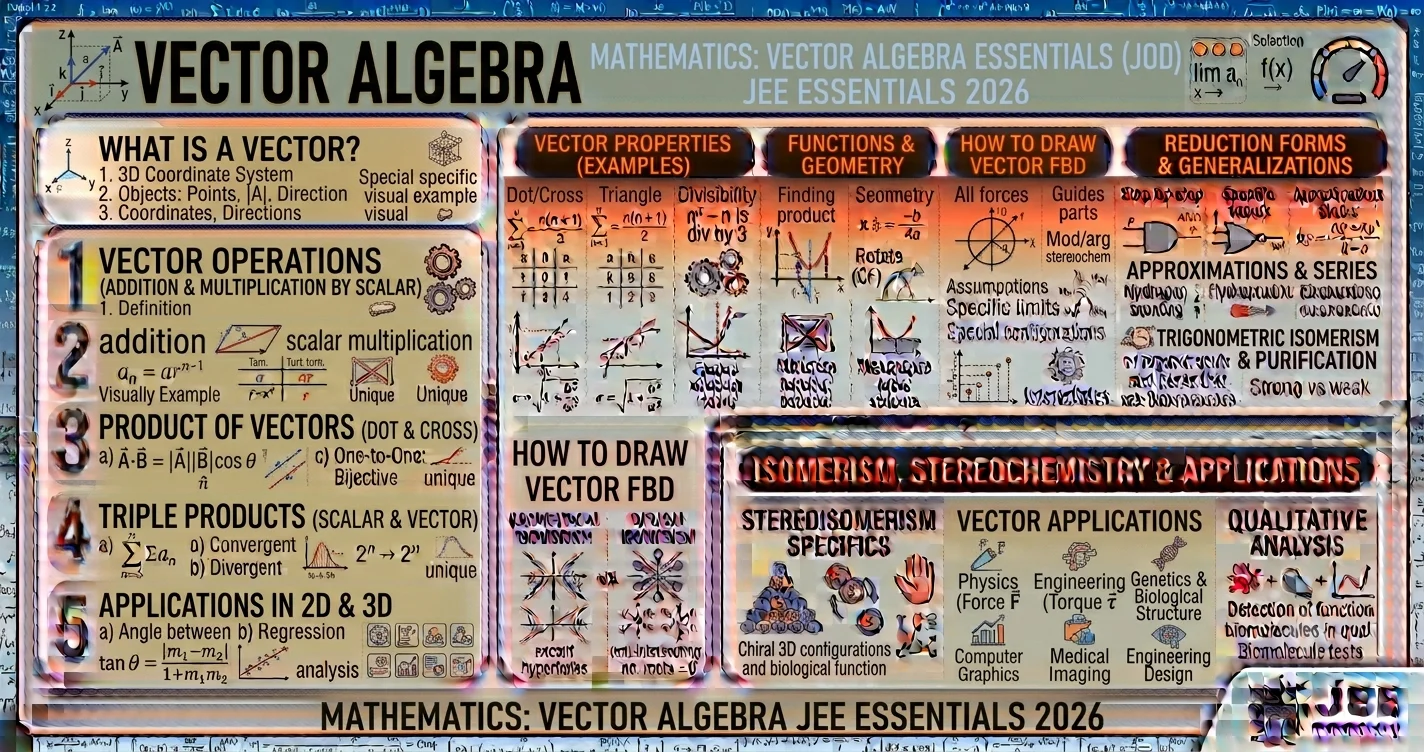
Basics & Types of Vectors
A vector is a quantity that has both magnitude and direction, while a scalar has only magnitude. Vectors are typically represented by directed line segments, denoted as \(\vec{a}\) or \(\vec{AB}\) (from point A to point B). The magnitude (or length) is denoted by \(|\vec{a}|\) or \(|\vec{AB}|\).
1.1 Position Vector
Important Concept — Position Vector
The position vector of a point \(P(x, y, z)\) in 3D space relative to the origin \(O(0, 0, 0)\) is given by:
Its magnitude is \(|\vec{OP}| = \sqrt{x^2 + y^2 + z^2}\).
1.2 Types of Vectors
- Zero Vector (Null Vector): A vector with zero magnitude and undefined direction. Denoted as \(\vec{0}\). Example: \(\vec{AA}\).
- Unit Vector: A vector of unit magnitude. Denoted by \(\hat{a}\) (read as 'a hat').
- Equal Vectors: Two vectors are equal if they have the same magnitude and direction, regardless of their initial points.
- Negative Vector: A vector having the same magnitude as the original vector but opposite direction.
- Collinear Vectors: Two or more vectors parallel to the same line, irrespective of their magnitude and direction.
- Co-initial Vectors: Vectors having the same starting point.
- Co-planar Vectors: Vectors lying in the same plane.
1.3 Unit Vector Formula
Most Repeated PYQ — Unit Vector
The unit vector in the direction of a given vector \(\vec{a}\) is obtained by dividing the vector by its own magnitude:
PYQ — JEE Main 2024 (Jan 31 Shift 1)
Question: Let \(\vec{a} = 2\hat{i} + \hat{j} - \hat{k}\) and \(\vec{b} = \hat{i} - \hat{j} + 2\hat{k}\). Find a unit vector parallel to \(\vec{a} + \vec{b}\).
Solution:
First, find \(\vec{a} + \vec{b}\):
Calculate magnitude:
Now, the unit vector is:
Answer: \(\frac{1}{\sqrt{10}}(3\hat{i} + \hat{k})\)
Addition & Section Formula
Vector addition follows the triangle law or parallelogram law. The section formula is vital for finding a point that divides a line segment in a specific ratio.
2.1 Triangle Law of Addition
If two vectors are represented as two sides of a triangle in sequence, then their resultant is represented by the third side drawn from the tail of the first to the head of the second: \(\vec{AB} + \vec{BC} = \vec{AC}\).
2.2 Parallelogram Law of Addition
If two vectors acting at the same point are represented by the adjacent sides of a parallelogram, then the resultant is represented by the diagonal passing through that common point: \[|\vec{R}| = \sqrt{a^2 + b^2 + 2ab\cos\theta}\] where \(a = |\vec{a}|\), \(b = |\vec{b}|\), and \(\theta\) is the angle between them.
2.3 Section Formula (Internal & External)
Most Repeated PYQ — Section Formula
The position vector \(\vec{r}\) of a point \(P\) dividing the line segment joining \(A(\vec{a})\) and \(B(\vec{b})\) in the ratio \(m:n\) is:
Internally:
Externally:
2.4 Midpoint Formula
If \(P\) is the midpoint of \(AB\), it divides \(AB\) in ratio \(1:1\):
PYQ — JEE Main 2023 (Apr 8 Shift 1)
Question: If the position vectors of points \(A\) and \(B\) are \(\hat{i} + 2\hat{j} - 3\hat{k}\) and \(2\hat{i} - \hat{j} + 4\hat{k}\) respectively, find the position vector of a point \(C\) that divides \(AB\) externally in the ratio \(2:1\).
Solution:
Using external section formula \(\vec{c} = \frac{m\vec{b} - n\vec{a}}{m - n}\) with \(m=2, n=1\):
Answer: \(3\hat{i} - 4\hat{j} + 11\hat{k}\)
Dot Product (Scalar Product)
The dot product (or scalar product) of two vectors results in a scalar quantity. It is highly tested in JEE Mains and Advanced.
3.1 Definition & Formula
Most Repeated PYQ — Dot Product
The dot product of two vectors \(\vec{a}\) and \(\vec{b}\) is defined as the product of their magnitudes and the cosine of the angle \(\theta\) between them:
In component form, for \(\vec{a} = a_1\hat{i} + a_2\hat{j} + a_3\hat{k}\) and \(\vec{b} = b_1\hat{i} + b_2\hat{j} + b_3\hat{k}\):
3.2 Properties of Dot Product
- Commutative: \(\vec{a} \cdot \vec{b} = \vec{b} \cdot \vec{a}\)
- Distributive over addition: \(\vec{a} \cdot (\vec{b} + \vec{c}) = \vec{a} \cdot \vec{b} + \vec{a} \cdot \vec{c}\)
- \(\vec{a} \cdot \vec{a} = |\vec{a}|^2\)
- \(\hat{i} \cdot \hat{i} = \hat{j} \cdot \hat{j} = \hat{k} \cdot \hat{k} = 1\)
- \(\hat{i} \cdot \hat{j} = \hat{j} \cdot \hat{k} = \hat{k} \cdot \hat{i} = 0\)
- Perpendicularity: Two non-zero vectors are perpendicular if and only if \(\vec{a} \cdot \vec{b} = 0\).
- Cauchy-Schwartz Inequality: \(|\vec{a} \cdot \vec{b}| \leq |\vec{a}| |\vec{b}|\)
3.3 Angle Between Two Vectors
Important — Angle Formula
The angle \(\theta\) between vectors \(\vec{a}\) and \(\vec{b}\) is given by:
PYQ — JEE Main 2024 (Apr 4 Shift 2)
Question: If \(\vec{a} = 2\hat{i} + \hat{j} + 2\hat{k}\) and \(\vec{b} = \hat{i} - 2\hat{j} + 2\hat{k}\), find the angle between \(\vec{a}\) and \(\vec{b}\).
Solution:
Find dot product: \(\vec{a} \cdot \vec{b} = (2)(1) + (1)(-2) + (2)(2) = 2 - 2 + 4 = 4\)
Find magnitudes:
Calculate cosine of angle:
Answer: \(\cos^{-1}\left(\frac{4}{9}\right)\)
Cross Product (Vector Product)
The cross product of two vectors results in a vector quantity. It is perpendicular to both vectors and represents the area of the parallelogram formed by them.
4.1 Definition & Formula
Most Repeated PYQ — Cross Product
The cross product of \(\vec{a}\) and \(\vec{b}\) is a vector defined as:
where \(\hat{n}\) is the unit vector perpendicular to both \(\vec{a}\) and \(\vec{b}\) (determined by the right-hand rule).
In determinant form:
4.2 Properties of Cross Product
- Anti-commutative: \(\vec{a} \times \vec{b} = -(\vec{b} \times \vec{a})\)
- Distributive: \(\vec{a} \times (\vec{b} + \vec{c}) = \vec{a} \times \vec{b} + \vec{a} \times \vec{c}\)
- Not associative: \(\vec{a} \times (\vec{b} \times \vec{c}) \neq (\vec{a} \times \vec{b}) \times \vec{c}\)
- \(\vec{a} \times \vec{a} = \vec{0}\)
- \(\hat{i} \times \hat{j} = \hat{k}, \hat{j} \times \hat{k} = \hat{i}, \hat{k} \times \hat{i} = \hat{j}\)
- Parallel vectors: Two non-zero vectors are parallel iff \(\vec{a} \times \vec{b} = \vec{0}\).
- Lagrange's Identity: \(|\vec{a} \times \vec{b}|^2 = |\vec{a}|^2|\vec{b}|^2 - (\vec{a} \cdot \vec{b})^2\)
4.3 Geometrical Interpretation (Area)
Most Repeated PYQ — Area of Triangle/Parallelogram
The magnitude of the cross product gives the area of the parallelogram formed by \(\vec{a}\) and \(\vec{b}\) as adjacent sides:
The area of the triangle formed by \(\vec{a}\) and \(\vec{b}\) as adjacent sides is:
PYQ — JEE Main 2023 (Jan 25 Shift 2)
Question: Find the area of the triangle with vertices \(A(1, 1, 1)\), \(B(1, 2, 3)\), and \(C(2, 1, 2)\).
Solution:
Find vectors \(\vec{AB}\) and \(\vec{AC}\):
Find \(\vec{AB} \times \vec{AC}\):
Magnitude:
Area of triangle = \(\frac{1}{2} |\vec{AB} \times \vec{AC}|\)
Answer: \(\frac{\sqrt{6}}{2}\)
Scalar Triple Product
The scalar triple product of three vectors \(\vec{a}\), \(\vec{b}\), and \(\vec{c}\) is a scalar quantity, denoted by \([\vec{a} \, \vec{b} \, \vec{c}]\). It represents the volume of a parallelepiped.
5.1 Definition & Formula
Most Repeated PYQ — STP
The scalar triple product is defined as \(\vec{a} \cdot (\vec{b} \times \vec{c})\), evaluated as a determinant:
5.2 Geometrical Meaning (Volume)
Most Repeated PYQ — Volume of Parallelepiped
The absolute value of the scalar triple product gives the volume of the parallelepiped formed by the three vectors as adjacent edges:
Volume of a tetrahedron formed by \(\vec{a}, \vec{b}, \vec{c}\) is:
5.3 Properties of Scalar Triple Product
- Cyclic permutation: \([\vec{a} \, \vec{b} \, \vec{c}] = [\vec{b} \, \vec{c} \, \vec{a}] = [\vec{c} \, \vec{a} \, \vec{b}]\)
- Swapping adjacent vectors changes sign: \([\vec{a} \, \vec{b} \, \vec{c}] = -[\vec{b} \, \vec{a} \, \vec{c}]\)
- If any two vectors are equal, \([\vec{a} \, \vec{a} \, \vec{c}] = 0\).
- Coplanar vectors: Three vectors are coplanar if and only if their scalar triple product is zero: \([\vec{a} \, \vec{b} \, \vec{c}] = 0\).
PYQ — JEE Main 2022 (July 27 Shift 1)
Question: Find the volume of the parallelepiped whose adjacent edges are represented by the vectors \(\vec{a} = 2\hat{i} - 3\hat{j} + \hat{k}\), \(\vec{b} = \hat{i} + \hat{j} - \hat{k}\), and \(\vec{c} = 3\hat{i} + 2\hat{j} - 2\hat{k}\).
Solution:
Evaluate the determinant \([\vec{a} \, \vec{b} \, \vec{c}]\):
Expand along first row:
Volume = \(|[\vec{a} \, \vec{b} \, \vec{c}]|\)
Answer: 2
Vector Triple Product (VTP)
The vector triple product of three vectors \(\vec{a}, \vec{b}, \vec{c}\) is defined as \(\vec{a} \times (\vec{b} \times \vec{c})\). The result is a vector lying in the plane of \(\vec{b}\) and \(\vec{c}\).
6.1 Formula (BAC-CAB Rule)
Most Repeated PYQ — VTP Formula
The vector triple product is evaluated using the famous BAC-CAB rule:
Similarly, for \((\vec{a} \times \vec{b}) \times \vec{c}\) (note the different bracket position!):
6.2 Properties & Coplanarity
- The vector \(\vec{a} \times (\vec{b} \times \vec{c})\) is perpendicular to \(\vec{b} \times \vec{c}\), and hence lies in the plane of \(\vec{b}\) and \(\vec{c}\).
- VTP is not associative: \(\vec{a} \times (\vec{b} \times \vec{c}) \neq (\vec{a} \times \vec{b}) \times \vec{c}\)
- Jacobi Identity: \(\vec{a} \times (\vec{b} \times \vec{c}) + \vec{b} \times (\vec{c} \times \vec{a}) + \vec{c} \times (\vec{a} \times \vec{b}) = \vec{0}\)
PYQ — JEE Advanced 2023 (Paper 1)
Question: Let \(\vec{a} = \hat{i} + \hat{j} - \hat{k}\), \(\vec{b} = \hat{i} - \hat{j} + \hat{k}\), and \(\vec{c} = -\hat{i} + \hat{j} + \hat{k}\). Evaluate \(\vec{a} \times (\vec{b} \times \vec{c})\).
Solution:
Using formula \(\vec{a} \times (\vec{b} \times \vec{c}) = (\vec{a} \cdot \vec{c})\vec{b} - (\vec{a} \cdot \vec{b})\vec{c}\)
Calculate dot products:
Substitute into the formula:
Answer: \(-2\hat{i} + 2\hat{j}\)
Projection of Vectors
The projection of a vector onto another gives the component of the first vector in the direction of the second. This is a vital concept frequently asked in JEE Mains.
7.1 Scalar Projection (Component)
Most Repeated PYQ — Projection Formula
The scalar projection (or component) of vector \(\vec{a}\) in the direction of vector \(\vec{b}\) is:
7.2 Vector Projection
The vector projection of \(\vec{a}\) on \(\vec{b}\) is the scalar projection multiplied by the unit vector in the direction of \(\vec{b}\):
PYQ — JEE Main 2021 (Sep 1 Shift 1)
Question: Find the projection of the vector \(\vec{a} = 2\hat{i} + 3\hat{j} + 2\hat{k}\) on the vector \(\vec{b} = \hat{i} + 2\hat{j} + \hat{k}\).
Solution:
Find dot product: \(\vec{a} \cdot \vec{b} = (2)(1) + (3)(2) + (2)(1) = 2 + 6 + 2 = 10\)
Find magnitude of \(\vec{b}\): \(|\vec{b}| = \sqrt{1^2 + 2^2 + 1^2} = \sqrt{6}\)
Calculate projection:
Answer: \(\frac{10}{\sqrt{6}}\)
Direction Cosines & Direction Ratios
The direction cosines of a vector are the cosines of the angles that the vector makes with the positive x, y, and z axes. Direction ratios are any three numbers proportional to the direction cosines.
8.1 Direction Cosines
Important — Direction Cosines
If a vector \(\vec{OP}\) makes angles \(\alpha, \beta, \gamma\) with the x, y, and z axes respectively, then its direction cosines (DCs) are:
The fundamental relation between direction cosines is:
8.2 Direction Ratios
If \(a, b, c\) are direction ratios (DRs) of a vector, then its direction cosines are:
For a position vector \(x\hat{i} + y\hat{j} + z\hat{k}\), the direction ratios are simply \(x, y, z\).
PYQ — JEE Main 2020 (Sep 4 Shift 1)
Question: A vector \(\vec{r}\) makes angles \(\frac{\pi}{3}\) with \(\hat{i}\) and \(\frac{\pi}{4}\) with \(\hat{j}\). Find the angle made by \(\vec{r}\) with \(\hat{k}\).
Solution:
Let the angle with \(\hat{k}\) be \(\gamma\). The direction cosines are:
Using \(l^2 + m^2 + n^2 = 1\):
Answer: \(\frac{\pi}{3}\) or \(\frac{2\pi}{3}\)
Coplanar & Linearly Independent Vectors
Three vectors are coplanar if they lie in the same plane. A set of vectors is linearly independent if no vector in the set can be expressed as a linear combination of the others.
9.1 Condition for Coplanarity
Most Repeated PYQ — Coplanarity Condition
Three vectors \(\vec{a}, \vec{b}, \vec{c}\) are coplanar if and only if their scalar triple product is zero:
Alternatively, three vectors are coplanar if one can be expressed as a linear combination of the other two: \(\vec{c} = x\vec{a} + y\vec{b}\).
9.2 Linear Independence
A set of vectors \(\vec{a}_1, \vec{a}_2, \dots, \vec{a}_n\) is said to be linearly independent if the equation:
holds only when \(x_1 = x_2 = \dots = x_n = 0\). Otherwise, they are linearly dependent.
For three 3D vectors, linear independence is equivalent to non-coplanarity, i.e., \([\vec{a} \, \vec{b} \, \vec{c}] \neq 0\).
PYQ — JEE Main 2019 (Apr 10 Shift 2)
Question: Find the value of \(\lambda\) for which the four points with position vectors \(6\hat{i} - 7\hat{j}\), \(16\hat{i} - 19\hat{j} - 4\hat{k}\), \(\lambda\hat{i} - 3\hat{j} + 6\hat{k}\), and \(2\hat{i} - 5\hat{j} + 10\hat{k}\) are coplanar.
Solution:
Let the points be \(A, B, C, D\). Find vectors \(\vec{AB}, \vec{AC}, \vec{AD}\):
For the points to be coplanar, \([\vec{AB} \, \vec{AC} \, \vec{AD}] = 0\):
Expand the determinant:
Answer: \(\lambda = 1.5\)
Key Results & Identities
A quick summary of the most important formulas and identities that frequently appear in competitive exams.
Most Repeated PYQ — Formulas
1. Dot Product: \(\vec{a} \cdot \vec{b} = |\vec{a}||\vec{b}|\cos\theta = a_1b_1 + a_2b_2 + a_3b_3\)
2. Cross Product: \(|\vec{a} \times \vec{b}| = |\vec{a}||\vec{b}|\sin\theta\)
3. Projection of \(\vec{a}\) on \(\vec{b}\): \(\frac{\vec{a} \cdot \vec{b}}{|\vec{b}|}\)
4. Vector Triple Product: \(\vec{a} \times (\vec{b} \times \vec{c}) = (\vec{a} \cdot \vec{c})\vec{b} - (\vec{a} \cdot \vec{b})\vec{c}\)
5. Volume of Parallelepiped: \(|[\vec{a} \, \vec{b} \, \vec{c}]|\)
6. Area of Parallelogram: \(|\vec{a} \times \vec{b}|\)
7. Area of Triangle: \(\frac{1}{2}|\vec{a} \times \vec{b}|\)
8. Lagrange's Identity: \(|\vec{a} \times \vec{b}|^2 = |\vec{a}|^2|\vec{b}|^2 - (\vec{a} \cdot \vec{b})^2\)
9. Direction Cosines: \(l^2 + m^2 + n^2 = 1\)
10. Angle between vectors: \(\cos\theta = \frac{\vec{a} \cdot \vec{b}}{|\vec{a}||\vec{b}|}\)
PYQ — JEE Main 2024 (Apr 6 Shift 1)
Question: If \(|\vec{a}| = 3, |\vec{b}| = 4\) and \(\vec{a} \cdot \vec{b} = 6\), find \(|\vec{a} \times \vec{b}|\).
Solution:
Using Lagrange's Identity: \(|\vec{a} \times \vec{b}|^2 = |\vec{a}|^2|\vec{b}|^2 - (\vec{a} \cdot \vec{b})^2\)
Answer: \(6\sqrt{3}\)
Previous Year Questions Analysis
JEE Main (Last 10 Years)
- ✓ Dot Product & Angle: 22%
- ✓ Projection of Vectors: 15%
- ✓ Cross Product (Area): 15%
- ✓ Scalar Triple Product (Volume): 12%
- ✓ Vector Triple Product: 10%
- ✓ Section Formula / Position Vector: 8%
- ✓ Unit Vector / Perpendicular Vector: 10%
- ✓ Direction Cosines: 8%
JEE Advanced (Last 10 Years)
- ✓ Vector Triple Product (BAC-CAB): 25%
- ✓ Coplanarity / Linear Independence: 20%
- ✓ Mixed problems (Lines + Vectors): 20%
- ✓ Scalar Triple Product properties: 15%
- ✓ Geometrical Applications: 20%
Top 15 Most Repeated Question Types
- Find angle between two vectors using \(\vec{a} \cdot \vec{b}\).
- Projection of \(\vec{a}\) on \(\vec{b}\) and vice versa.
- Area of triangle/parallelogram using cross product.
- Volume of parallelepiped/tetrahedron using STP.
- Evaluate Vector Triple Product using BAC-CAB rule.
- Find unit vector perpendicular to both \(\vec{a}\) and \(\vec{b}\) (\(\vec{a} \times \vec{b}\)).
- Position vector dividing line segment internally/externally.
- Find \(\lambda\) for which points are coplanar (\([\vec{a} \, \vec{b} \, \vec{c}] = 0\)).
- Given \(|\vec{a}|, |\vec{b}|\), and \(\vec{a} \cdot \vec{b}\), find \(|\vec{a} \times \vec{b}|\) (Lagrange's identity).
- Verify linear independence of vectors.
- Find direction cosines given angles with axes.
- Compute dot/cross product from given components.
- Find a vector of given magnitude perpendicular to two vectors.
- Vector equation of a line passing through two points.
- Shortest distance between two skew lines (uses cross product).
Weightage Analysis
Practice Problem Set
Level 1: Basic (JEE Main Standard)
- Find the unit vector in the direction of \(2\hat{i} - 3\hat{j} + 6\hat{k}\).
- Find the dot product of \(\hat{i} + 2\hat{j} - 3\hat{k}\) and \(2\hat{i} - \hat{j} + \hat{k}\).
- Find the projection of \(\hat{i} + \hat{j}\) on \(\hat{i} - \hat{j}\).
- Find the area of the parallelogram formed by \(\hat{i} + \hat{j}\) and \(\hat{i} + 2\hat{j}\).
- If \([\vec{a} \, \vec{b} \, \vec{c}] = 5\), find \([\vec{b} \, \vec{a} \, \vec{c}]\).
Level 2: Intermediate (JEE Main/Advanced)
- Show that the vectors \(\hat{i} - 2\hat{j} + 3\hat{k}\), \(-2\hat{i} + 3\hat{j} - 4\hat{k}\), and \(\hat{i} - 3\hat{j} + 5\hat{k}\) are coplanar.
- Find the angle between the vectors \(2\hat{i} - \hat{j} + 2\hat{k}\) and \(3\hat{i} + 2\hat{j} - 6\hat{k}\).
- Find the volume of the parallelepiped formed by \(\hat{i} - \hat{j} + \hat{k}\), \(2\hat{i} + \hat{j} - \hat{k}\), and \(-\hat{i} + 2\hat{j} + 3\hat{k}\).
- Evaluate \(\vec{a} \times (\vec{b} \times \vec{c})\) if \(\vec{a} = \hat{i} + \hat{j}\), \(\vec{b} = \hat{j} + \hat{k}\), \(\vec{c} = \hat{k} + \hat{i}\).
- If \(|\vec{a}| = 5, |\vec{b}| = 3, |\vec{a} \times \vec{b}| = 12\), find \(\vec{a} \cdot \vec{b}\).
Level 3: Advanced (JEE Advanced/Olympiad)
- Prove that \(\vec{a} \times (\vec{b} \times \vec{c}) + \vec{b} \times (\vec{c} \times \vec{a}) + \vec{c} \times (\vec{a} \times \vec{b}) = \vec{0}\) (Jacobi Identity).
- If \(\vec{a}, \vec{b}, \vec{c}\) are unit vectors such that \(\vec{a} + \vec{b} + \vec{c} = \vec{0}\), find the value of \(\vec{a} \cdot \vec{b} + \vec{b} \cdot \vec{c} + \vec{c} \cdot \vec{a}\).
- Find the value of \(\lambda\) such that the vectors \(\vec{a} = \hat{i} + \lambda\hat{j} + \hat{k}\), \(\vec{b} = \lambda\hat{i} + \hat{j} + \lambda\hat{k}\), and \(\vec{c} = \hat{i} + \hat{j} + \lambda\hat{k}\) are coplanar.
- Prove Lagrange's identity: \(|\vec{a} \times \vec{b}|^2 + (\vec{a} \cdot \vec{b})^2 = |\vec{a}|^2|\vec{b}|^2\).
> FAQ
Frequently Asked Questions
What is a unit vector?
A unit vector is a vector of unit magnitude (length 1). It is obtained by dividing a vector by its own magnitude. If a is a vector, its unit vector is â = a / |a|.
What is the formula for the dot product of two vectors?
The dot product (or scalar product) of two vectors a and b is given by a · b = |a| |b| cos θ, where θ is the angle between them. In component form, if a = a₁î + a₂ĵ + a₃k̂ and b = b₁î + b₂ĵ + b₃k̂, then a · b = a₁b₁ + a₂b₂ + a₃b₃.
What is the vector triple product?
The vector triple product of three vectors a, b, c is defined as a × (b × c). It is a vector quantity and is evaluated using the formula a × (b × c) = (a · c)b - (a · b)c.
What is the geometrical meaning of the scalar triple product?
The absolute value of the scalar triple product [a b c] = a · (b × c) represents the volume of the parallelepiped formed by the three vectors a, b, and c as adjacent edges. If it is zero, the vectors are coplanar.
How do you find the projection of vector a on vector b?
The scalar projection (or component) of vector a in the direction of vector b is given by (a · b) / |b|. The vector projection is ((a · b) / |b|²) b.
How many questions come from Vector Algebra in JEE Mains?
On average, 2 questions (8 marks) appear from Vector Algebra in every JEE Main session. Most repeated topics are dot product, cross product, projection of vectors, scalar triple product, and finding unit vectors.