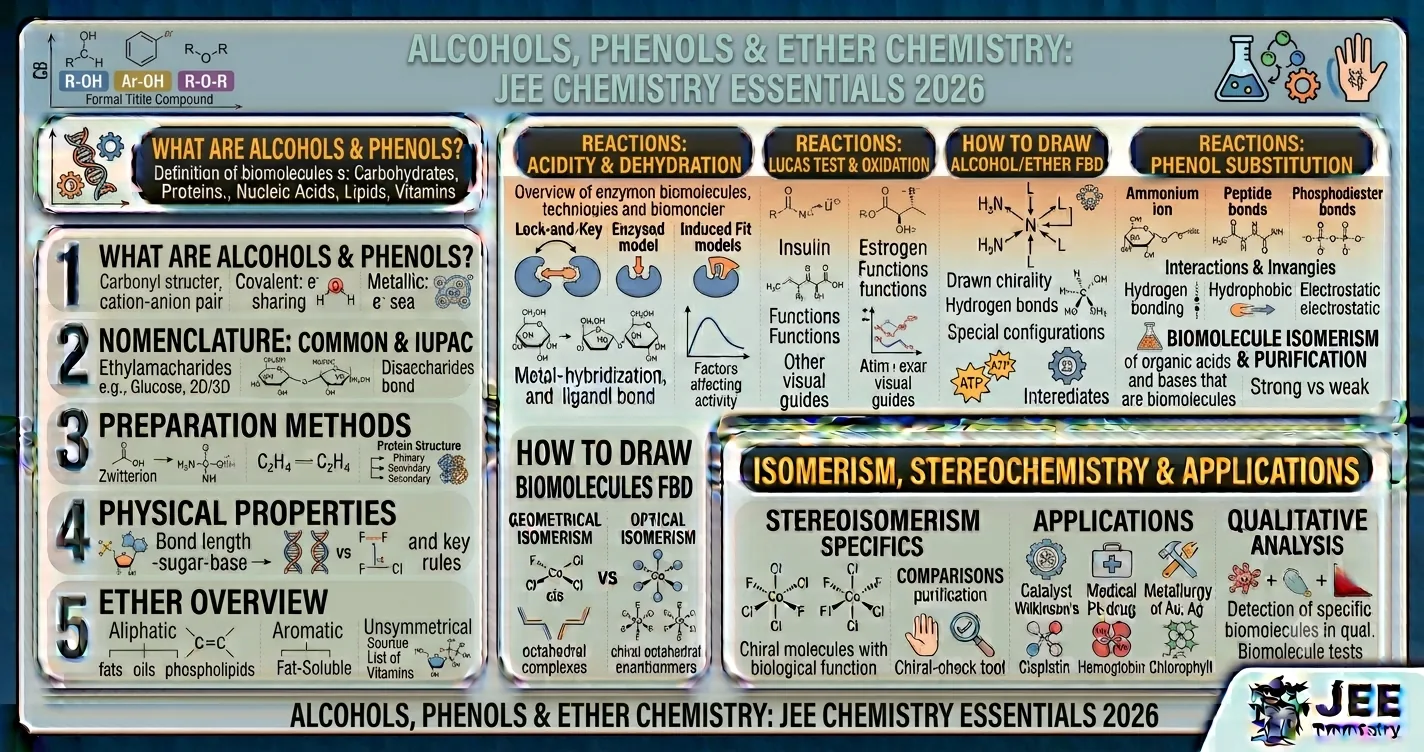
Complete Alcohols, Phenols & Ethers Mastery Guide for JEE 2026
Why This Chapter is Important
Alcohols, Phenols and Ethers is one of the most scoring chapters in JEE Organic Chemistry:
- High Weightage: 1-2 questions every session in JEE Main
- Foundation for next chapter: Aldehydes, Ketones & Acids build on alcohol oxidation
- Predictable Pattern: Same named reactions (Reimer-Tiemann, Kolbe, Williamson) asked repeatedly
- Tests & Identification: Lucas test, Victor Meyer, FeCl₃ — direct concept-based questions
- Connections: Links to GOC, hydrocarbons, carbonyl compounds
Topic-wise Weightage Analysis
Must-Remember Reactions & Reagents
Oxidation Reagents
PCC: 1° → Aldehyde (stops)
K₂Cr₂O₇/H⁺: 1° → Acid, 2° → Ketone
KMnO₄/H⁺: Same as K₂Cr₂O₇
Na₂Cr₂O₇: Phenol → p-Benzoquinone
Named Reactions
Reimer-Tiemann: Phenol + CHCl₃/NaOH → Salicylaldehyde
Kolbe: Phenol + NaOH + CO₂ → Salicylic acid
Williamson: R-X + R'O⁻Na⁺ → R-O-R' (SN2)
Pinacol-Pinacolone: 1,2-diol → ketone (H⁺)
Acidity Order
Picric acid > p-NO₂-phenol > Phenol > p-cresol
Phenol > Water > Ethanol
CH₃OH > 1° > 2° > 3° alcohol
Identification Tests
Lucas: 3° immediate, 2° 5-10 min, 1° no reaction
Victor Meyer: 1° Red, 2° Blue, 3° Colorless
FeCl₃: Phenol → Violet
Br₂ water: Phenol → White ppt (2,4,6-tribromo)
5-Step Exam Strategy
-
1
Acidity questions: Check for EWG/EDG on phenol. EWG increases acidity, EDG decreases. Picric acid is most acidic.
-
2
Oxidation questions: 1° + PCC → aldehyde; 1° + K₂Cr₂O₇ → acid; 2° → ketone (both); 3° → no reaction
-
3
Williamson synthesis: Use primary alkyl halide (SN2). Tertiary halide → elimination.
-
4
Hydroboration: Anti-Markovnikov + syn addition. Product = alcohol with OH on less substituted C.
-
5
Lucas test: Turbidity time identifies alcohol class. 3° fast, 2° medium, 1° slow.
7-Day Alcohols Phenols Ethers Mastery Roadmap
Classification
- • 1°, 2°, 3° alcohols
- • Allylic, benzylic
- • IUPAC naming
Structure & Properties
- • H-bonding
- • BP & solubility
- • Resonance in phenol
Alcohol Prep
- • Acid hydration
- • Hydroboration
- • Grignard
Alcohol Reactions
- • Oxidation
- • Dehydration
- • Pinacol rearrangement
Phenol Reactions
- • Acidity order
- • Reimer-Tiemann
- • Kolbe reaction
Ethers & Tests
- • Williamson
- • Ether cleavage (HI)
- • Lucas & Victor Meyer
PYQ Marathon
- • 50+ PYQs
- • Revise named rxns
- • Cheat sheet
Alcohols, Phenols & Ethers — Complete JEE Study Guide
Alcohols, Phenols and Ethers is a vital chapter in JEE Organic Chemistry (Class 12, Chapter 7 of NCERT). It covers the structure, preparation, properties, and reactions of three important classes of oxygen-containing organic compounds. The chapter connects previous concepts like GOC, hydrocarbons, and haloalkanes with the upcoming chapter on aldehydes, ketones, and carboxylic acids.
The most important topics for JEE from this chapter are acidity of phenol and substituent effects (especially the order: picric acid > p-nitrophenol > phenol > p-cresol), Reimer-Tiemann reaction (phenol + CHCl₃/NaOH → salicylaldehyde), Kolbe's reaction (phenol + NaOH + CO₂ → salicylic acid), Williamson ether synthesis (SN2 mechanism with primary alkyl halide), Lucas test for distinguishing 1°/2°/3° alcohols, hydroboration-oxidation (anti-Markovnikov syn addition), oxidation of alcohols (PCC stops at aldehyde, K₂Cr₂O₇/H⁺ goes to carboxylic acid), pinacol-pinacolone rearrangement (1,2-methyl shift), and cumene process for industrial phenol preparation (co-produces acetone).
Students should focus on memorizing all named reactions with their products and reagents, understanding the resonance stabilization of phenoxide ion (which explains phenol's acidity), and mastering the SN2 vs E2 mechanism in Williamson synthesis (primary halides give substitution, tertiary give elimination). The distinction between PCC (mild oxidant, stops at aldehyde) and K₂Cr₂O₇/H⁺ (strong oxidant, gives carboxylic acid) is among the most tested concepts.
For JEE Advanced, additional focus should be on the mechanism of pinacol-pinacolone rearrangement (migratory aptitude: H > aryl > 3° alkyl > 2° > 1° > methyl), stereochemistry of hydroboration (syn addition with retention in oxidation step), and predicting products of ether cleavage (SN2 for primary group with I⁻ attacking smaller alkyl; SN1 for tertiary group via carbocation). Identification tests like Lucas (timing of turbidity), Victor Meyer (color: red for 1°, blue for 2°, colorless for 3°), FeCl₃ (violet with phenol), and bromine water (white ppt of 2,4,6-tribromophenol) are routinely asked.
Common mistakes to avoid: confusing Markovnikov (acid hydration) with anti-Markovnikov (hydroboration) addition; using tertiary alkyl halides in Williamson synthesis (gives elimination not ether); forgetting that phenol doesn't react with NaHCO₃ (weaker acid than carbonic acid); and mixing up the Lucas test order (3° fastest, not 1°). Mastery of these concepts will guarantee 4-8 marks in JEE Main and help with related questions in JEE Advanced.