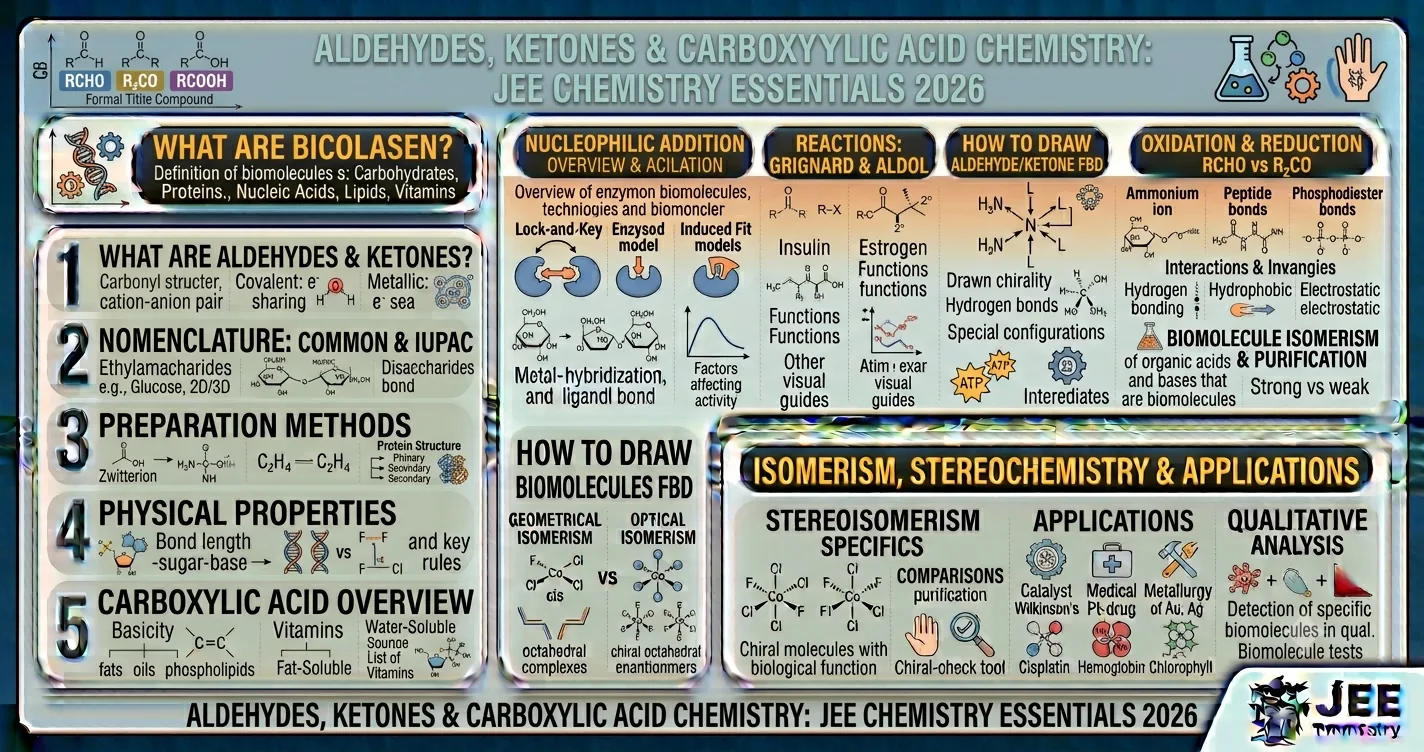
Complete Aldehydes, Ketones & Carboxylic Acids Mastery Guide for JEE 2026
Why This Chapter is Important
Aldehydes, Ketones and Carboxylic Acids is one of the highest-weightage chapters in JEE Organic Chemistry:
- 2-3 questions in almost every JEE Main session
- Highest name reaction density — 15+ named reactions
- Connects with alcohols, amines, and biomolecules chapters
- Tests and identification — frequently asked in assertion-reason
- Acidic strength — concept used in multiple chapters
Topic-wise Weightage Analysis
Must-Remember Formulas & Values
Aldol vs Cannizzaro
Aldol: α-H present + dil. NaOH
Cannizzaro: NO α-H + conc. NaOH
No α-H: HCHO, C₆H₅CHO, (CH₃)₃CCHO
Iodoform Test
CH₃CHO + NaOH/I₂ → CHI₃↓
CH₃COR + NaOH/I₂ → CHI₃↓
CH₃CH(OH)R + NaOH/I₂ → CHI₃↓
CH₃CH₂OH + NaOH/I₂ → CHI₃↓
Reduction Reagents
C=O → CH-OH: NaBH₄, LiAlH₄, H₂/Ni
C=O → CH₂: Zn-Hg/HCl (Clemmensen)
C=O → CH₂: NH₂NH₂/KOH (W-K)
RCOCl → RCHO: H₂/Pd-BaSO₄
RCOOH → RCH₂OH: LiAlH₄, B₂H₆
Acidic Strength Order
FCH₂COOH > ClCH₂COOH > HCOOH
HCOOH > C₆H₅COOH > CH₃COOH
Cl₃CCOOH > Cl₂CHCOOH > ClCH₂COOH
o-Cl-C₆H₄COOH > m- > p- > C₆H₅COOH
5-Step Exam Strategy
-
1
For aldol/cannizzaro: Check for α-H first. If present → aldol; if absent → Cannizzaro
-
2
For iodoform test: Look for CH₃CO– or CH₃CH(OH)– group in the structure
-
3
For acidic strength: Check for electron-withdrawing groups (–I stabilizes anion → stronger acid)
-
4
For identification: Tollens' (all aldehydes), Fehling's (aliphatic aldehydes only), iodoform (CH₃CO–)
-
5
For reduction: C=O→CH-OH uses NaBH₄; C=O→CH₂ uses Clemmensen or Wolff-Kishner
7-Day Mastery Roadmap
Structure & Prep
- • Carbonyl structure
- • Preparation methods
- • Rosenmund, Stephen
Nuc. Addition
- • Mechanism
- • Reactivity order
- • Ammonia derivatives
Aldol
- • Mechanism
- • Crossed aldol
- • Practice 30+ Qs
Cannizzaro
- • Crossed Cannizzaro
- • Identify no α-H
- • Practice 30+ Qs
Haloform & Tests
- • Iodoform test
- • Tollens, Fehling
- • All identification tests
Acids & Strength
- • HVZ reaction
- • Acidic strength
- • Substituent effects
PYQ Marathon
- • 60+ PYQs
- • Name reactions
- • Formula sheet
Aldehydes, Ketones & Carboxylic Acids — Complete JEE Study Guide
Aldehydes, Ketones and Carboxylic Acids is one of the most important chapters in JEE Organic Chemistry, covering the structure, preparation, properties, and reactions of carbonyl compounds and carboxylic acids. The chapter includes 15+ named reactions, making it the highest name-reaction density chapter in the syllabus.
The most important topics for JEE from this chapter are aldol condensation (requires α-hydrogen, uses dilute base), Cannizzaro reaction (requires NO α-hydrogen, uses concentrated base), iodoform/haloform test (compounds with CH₃CO– or CH₃CH(OH)– group), nucleophilic addition reactivity order (HCHO > CH₃CHO > CH₃COCH₃), acidic strength comparison (based on inductive, resonance, and hybridization effects), and identification tests (Tollens' test for all aldehydes, Fehling's test for aliphatic aldehydes only).
Students should focus on mastering the distinction between aldol and Cannizzaro reactions (based on presence/absence of α-H), the Clemmensen vs Wolff-Kishner reduction (acidic vs basic medium), and the Rosenmund reduction (acid chloride to aldehyde using Pd/BaSO₄). The HVZ reaction (α-halogenation of carboxylic acids with X₂/red phosphorus) and the side-chain oxidation of alkyl benzenes to benzoic acids (using hot KMnO₄/KOH) are also frequently tested.
For JEE Advanced, additional focus should be on crossed aldol condensation (when one reactant has no α-H), Baeyer-Villiger oxidation (ketone to ester using peracids), Kolbe-Schmitt reaction (phenol to salicylic acid), Reimer-Tiemann reaction (phenol to salicylaldehyde), and multi-step synthesis problems combining multiple reactions. The acidic strength of substituted benzoic acids requires understanding of ortho effect, inductive effect at meta position, and resonance effects at ortho/para positions.
The key formulas to memorize include: equivalent weight concepts (rarely tested here but useful for titration problems), the order of acidic strength (FCH₂COOH > ClCH₂COOH > HCOOH > C₆H₅COOH > CH₃COOH), the reactivity order for nucleophilic addition (HCHO > RCHO > RCOR'), and the distinction between various reducing agents (NaBH₄ reduces only aldehydes/ketones, LiAlH₄ reduces all carbonyls including acids and esters, Clemmensen/Wolff-Kishner reduce C=O to CH₂).