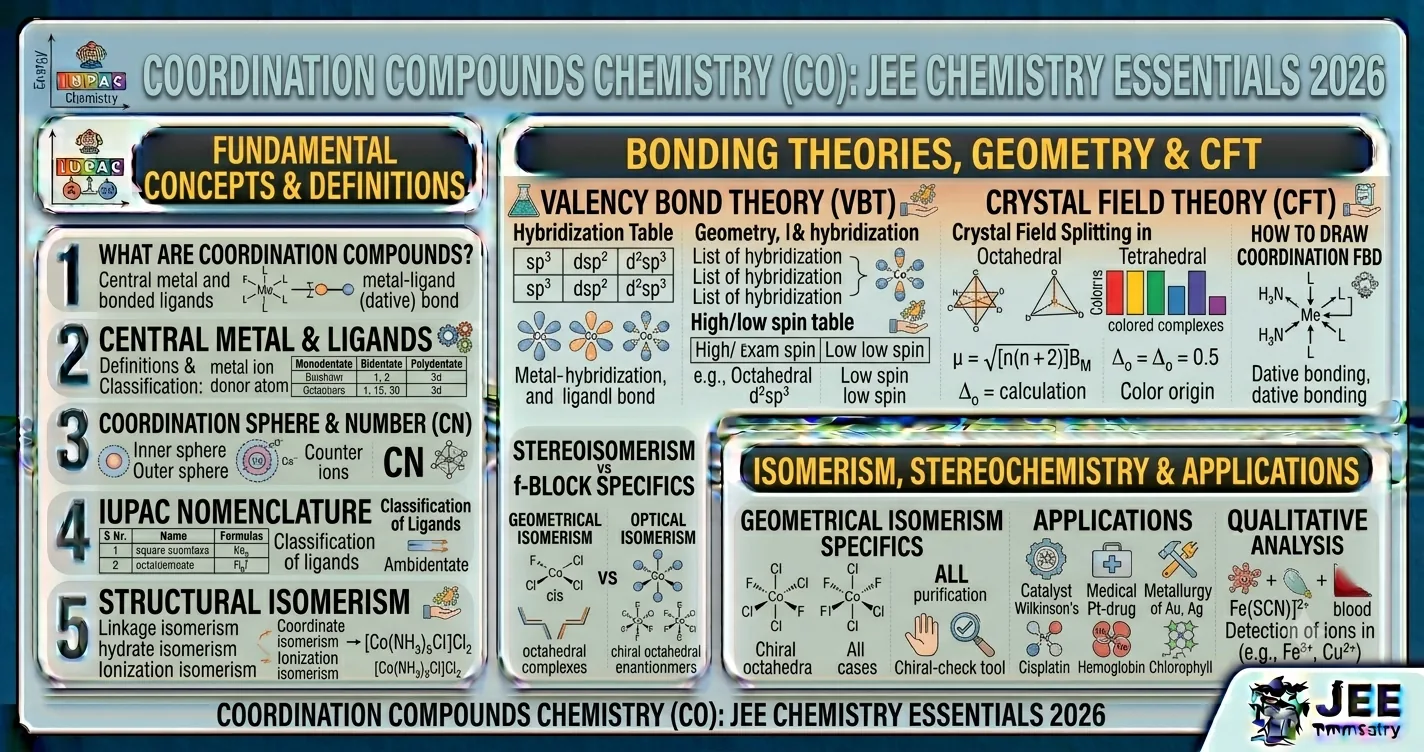
Complete Coordination Compounds Mastery Guide for JEE 2026
Why Coordination Compounds is Important
Coordination Compounds is one of the highest-scoring chapters of inorganic chemistry. Here's why it's crucial:
- Direct & Predictable Questions: 1-2 questions in JEE Main every session
- Rote-Friendly Formulas: CFSE, magnetic moment, EAN rule are mechanical to apply
- Application-Focused: Links to d & f-block, bonding, isomerism
- Rank Booster: Nomenclature & isomerism are guaranteed-easy marks
Topic-wise Weightage Analysis
Must-Remember Formulas
Magnetic Moment
μ = √[n(n+2)] BM
n = 1→1.73, 2→2.83, 3→3.87, 4→4.90, 5→5.92
CFSE (Octahedral)
CFSE = (–0.4n₍t₂g₎ + 0.6n₍eg₎)Δ₀ + P·n_pairs
Δ_t = (4/9) Δ₀
EAN Rule
EAN = Z – OS + 2 × (no. of ligands)
Target = noble gas Z (e.g., Kr = 36)
Stability
K_f = [MLₙ] / ([M][L]ⁿ)
Chelate effect → entropy-driven
5-Step Exam Strategy
-
1
Find oxidation state of metal first — everything (name, EAN, electron count) follows from it
-
2
Identify ligand type — ambidentate (NO₂/ONO, SCN/NCS), chelating, π-acceptor
-
3
For geometry: weak field → high spin; strong field → low spin (memorize spectrochemical series)
-
4
Count unpaired electrons → compute μ, decide paramagnetic/diamagnetic
-
5
For colour: energy of absorbed light = Δ₀; observed colour = complementary colour
Coordination Compounds — Complete JEE Study Guide
Coordination Compounds is Chapter 5 of NCERT Class 12 Chemistry and one of the most important inorganic chemistry chapters for JEE Main and Advanced. It covers Werner's coordination theory, IUPAC nomenclature of complexes, structural and stereo isomerism, valence bond theory (VBT), crystal field theory (CFT), CFSE calculations, magnetic properties, the spectrochemical series, EAN rule, metal carbonyls and applications like cisplatin in cancer treatment.
The most important topics for JEE are IUPAC nomenclature (appears every year), hybridisation & magnetic behaviour of complexes like [Ni(CN)₄]²⁻ vs [NiCl₄]²⁻, isomerism (geometrical, optical, linkage, ionisation, coordination), CFSE calculations for dⁿ configurations, and the spectrochemical series. These account for over 80% of PYQs from this chapter.
Students should memorise the spectrochemical series order (I⁻ < Br⁻ < Cl⁻ < F⁻ < OH⁻ < H₂O < NH₃ < en < CN⁻ < CO), practise naming complexes in both cationic and anionic forms, and master the CFSE formula CFSE = (–0.4nₜ₂ₘ + 0.6nₑₘ)Δ₀ + P·n_pairs. The EAN rule (EAN = Z – OS + 2 × ligands) is a favourite direct question in both JEE Main and Advanced.
For JEE Advanced, focus on magnetic moment calculations, low vs high spin determination, isomer counting, and applications of complexes such as cis-[Pt(NH₃)₂Cl₂] (cisplatin). Practical applications of coordination compounds — from biological oxygen transport (haemoglobin) to industrial catalysis (Ziegler-Natta) — frequently appear in assertion-reasoning questions.