Chemistry · JEE Main & Advanced 2026 · General Organic Chemistry

General Organic Chemistry notes, mechanisms & PYQs for JEE 2026

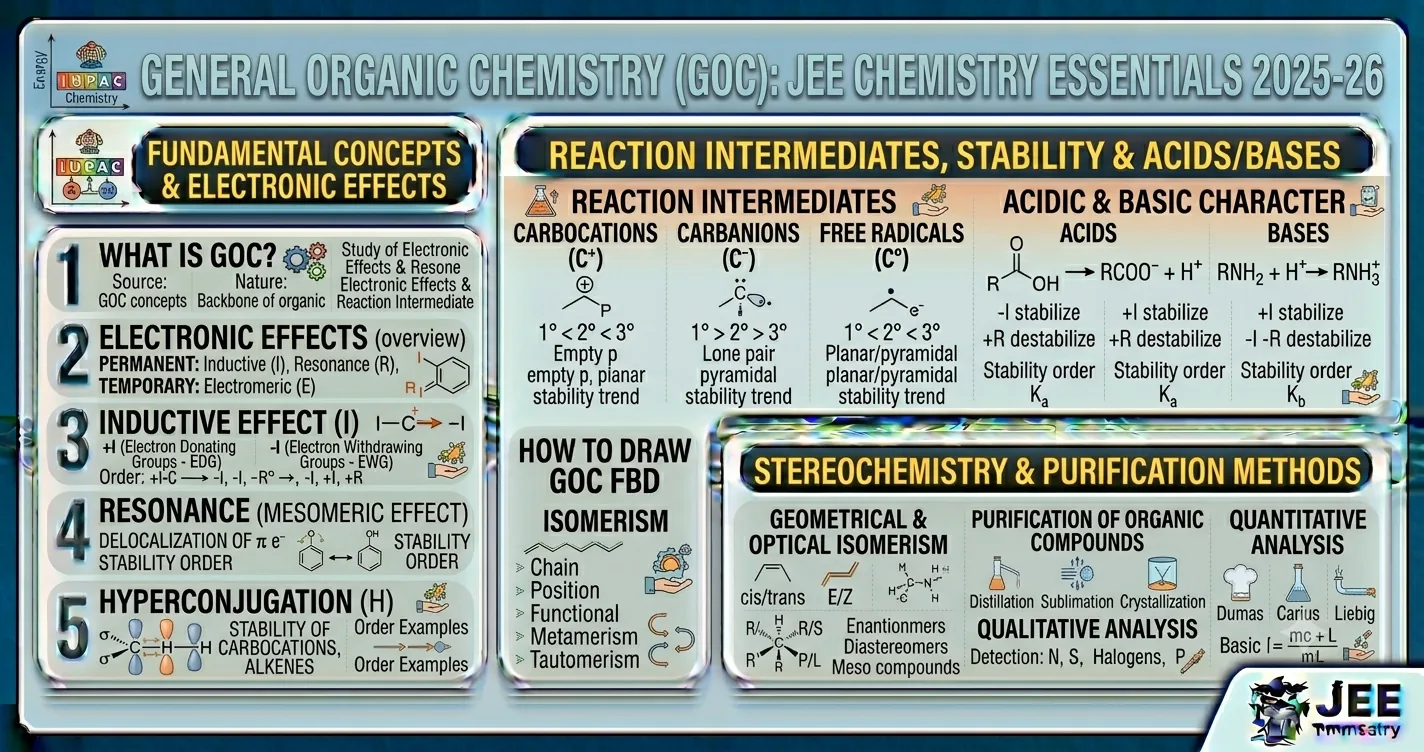
Complete GOC chapter — electronic effects (Inductive, Resonance, Hyperconjugation, Electromeric), fission of covalent bonds, reaction intermediates (carbocations, carbanions, free radicals, carbenes), and detailed analysis of Acidic & Basic strength. Includes JEE shortcuts, 150+ worked examples, and most repeated PYQs.

SECTIONS
8
SOLVED EXAMPLES
150+
READ TIME
~4h
COST
₹0

Table of Contents

Jump to any section
General Organic Chemistry JEE Notes, Formulas, PYQs
1

Cleavage of Covalent Bond & Reaction Intermediates

General Organic Chemistry (GOC) starts with understanding how covalent bonds break to form reactive intermediates. The mode of bond cleavage determines the type of intermediate formed, which in turn dictates the reaction mechanism. This is the absolute foundation for JEE Organic Chemistry.

1.1 Types of Bond Cleavage

Important for JEE — Foundation of Mechanisms

Homolytic Cleavage (Symmetrical)

  • Bond breaks symmetrically.
  • Each atom takes one electron.
  • Forms Free Radicals.
  • Occurs in non-polar bonds (C-C, C-H, Cl-Cl) in presence of heat/UV/peroxides.
A:B → A• + B•

Heterolytic Cleavage (Unsymmetrical)

  • Bond breaks asymmetrically.
  • Both electrons go to more electronegative atom.
  • Forms Ions (Carbocation or Carbanion).
  • Occurs in polar bonds in presence of polar solvent.
A:B → A⁺ + :B⁻

1.2 Reaction Intermediates

Intermediates are short-lived, highly reactive species formed during a reaction. Their stability dictates the rate and pathway of the reaction.

Most Repeated PYQ — Carbocation Stability

Carbocation (Carbonium ion): Positively charged carbon, $sp^2$ hybridized, 6 valence electrons (empty p-orbital).

\[\text{Stability: } 3^\circ > 2^\circ > 1^\circ > \text{CH}_3^+\]

Stabilized by +I effect, Hyperconjugation, and Resonance.

\[\text{Resonance Stabilized: Benzyl > Allyl} > 3^\circ > 2^\circ > 1^\circ > \text{CH}_3^+ > \text{Vinyl} > \text{Aryl}\]

Most Repeated PYQ — Carbanion Stability

Carbanion: Negatively charged carbon, $sp^3$ hybridized, 8 valence electrons (lone pair).

\[\text{Stability: } \text{CH}_3^- > 1^\circ > 2^\circ > 3^\circ\]

Stabilized by -I effect and Resonance. (Reverse of carbocation because +I of alkyl groups destabilizes negative charge).

Free Radicals

Free Radical: Neutral carbon with unpaired electron, $sp^2$ hybridized.

\[\text{Stability: } 3^\circ > 2^\circ > 1^\circ > \text{CH}_3^\bullet\]

Stabilized by Hyperconjugation and Resonance (same trend as carbocations, but less stable than carbocations).

PYQ — JEE Main 2024

Question: Which of the following is the most stable carbocation?

(a) $CH_3^+$

(b) $(CH_3)_3C^+$ (tert-butyl)

(c) $C_6H_5^+$ (phenyl)

(d) $C_6H_5CH_2^+$ (benzyl)

Solution:

- $CH_3^+$ has no hyperconjugation or resonance → Least stable.

- Phenyl cation ($C_6H_5^+$) has positive charge on $sp^2$ carbon with no resonance stabilization → Very unstable.

- tert-butyl has 9 α-hydrogens for hyperconjugation → Stable.

- Benzyl carbocation ($C_6H_5CH_2^+$) is stabilized by resonance with the benzene ring → Most stable.

\[\text{Order: } C_6H_5CH_2^+ > (CH_3)_3C^+ > C_6H_5^+ > CH_3^+\]

Answer: (d) $C_6H_5CH_2^+$

2

Inductive Effect (I-Effect)

The Inductive Effect is the permanent polarization of a sigma bond due to the difference in electronegativity of the bonded atoms. It is transmitted through sigma bonds and decreases rapidly with distance (negligible after 3-4 carbon atoms).

2.1 Definition and Types

Core Concept — Inductive Effect

When an electronegative atom is attached to a carbon chain, it pulls the shared pair of electrons towards itself, creating a permanent dipole.

-I Effect (Electron Withdrawing)

Groups that pull electrons away from carbon chain.

Order: $-NO_2 > -CN > -COOH > -F > -Cl > -Br > -I > -OH > -OCH_3 > -C\equiv CH > -C_6H_5$

+I Effect (Electron Donating)

Groups that push electrons towards the carbon chain.

Order: $-C(CH_3)_3 > -CH(CH_3)_2 > -CH_2CH_3 > -CH_3 > -D > -H$

Memory Trick

"No Corrupt Commissioner Forced Inspector By Introducing Our Highly Corrupt Handlers" — Helps remember the -I order! (NO2, CN, COOH, F, Cl, Br, I, OH, OCH3).

2.2 Applications of Inductive Effect

High PYQ Frequency — Acidity & Basicity

  1. Polarization of Bonds: Higher -I effect of halogens increases the polarity of C-X bond, making it more reactive towards nucleophilic substitution.
  2. Acidic Strength: Electron Withdrawing Groups (-I) stabilize the conjugate base by dispersing the negative charge, increasing acidity.
  3. Basic Strength: Electron Donating Groups (+I) stabilize the conjugate acid by dispersing the positive charge, increasing basicity.

Acidic Strength of Carboxylic Acids

Consider acetic acid vs. chloroacetic acid:

\[Cl-CH_2-COOH > CH_3-COOH\]

Cl is -I group, pulls electron density, stabilizes $Cl-CH_2-COO^-$ more than $CH_3-COO^-$. Thus, Cl-CH2-COOH is stronger acid.

\[CCl_3-COOH > CHCl_2-COOH > CH_2Cl-COOH > CH_3-COOH\]

More -I groups = Stronger acid!

PYQ — JEE Main 2023

Question: The correct decreasing order of acidic strength is:

(a) $FCH_2COOH > ClCH_2COOH > BrCH_2COOH > ICH_2COOH$

(b) $ICH_2COOH > BrCH_2COOH > ClCH_2COOH > FCH_2COOH$

(c) $ClCH_2COOH > FCH_2COOH > BrCH_2COOH > ICH_2COOH$

(d) $FCH_2COOH > BrCH_2COOH > ClCH_2COOH > ICH_2COOH$

Solution:

Acidic strength depends on the stability of the conjugate base. The halogens exert a -I effect.

The order of -I effect is: $F > Cl > Br > I$ (based on electronegativity).

Since F is the most electronegative, it stabilizes the carbanion most effectively.

\[\text{Acidic strength: } FCH_2COOH > ClCH_2COOH > BrCH_2COOH > ICH_2COOH\]

Answer: (a)

3

Resonance & Mesomeric Effect

Resonance is the phenomenon where a single Lewis structure cannot describe a molecule, and it is represented as a hybrid of multiple canonical structures. It involves the delocalization of $\pi$ electrons or lone pairs.

3.1 Rules of Resonance

Important Rules for JEE

  • Nucleus positions must remain unchanged; only $\pi$ electrons and lone pairs move.
  • All canonical forms must have the same number of unpaired electrons.
  • More stable structures contribute more to the resonance hybrid.
  • Structures with complete octets are more stable than those without.
  • Structures with no charge separation are more stable.
  • If charges exist, negative charge should be on the more electronegative atom.

3.2 Mesomeric Effect (M-Effect or R-Effect)

+M Effect (Electron Donating)

Groups that donate $\pi$ electrons to the conjugated system.

Groups: $-OH, -OR, -NH_2, -NHR, -NR_2, -Cl, -Br, -I$ (halogens have +M and -I)

Order (+M): $-NH_2 > -OH > -OR > -X$

-M Effect (Electron Withdrawing)

Groups that withdraw $\pi$ electrons from the conjugated system.

Groups: $-NO_2, -CN, -CHO, -COR, -COOH, -COOR, -SO_3H$

Order (-M): $-NO_2 > -CN > -CHO > -COR$

Exception Alert!

Halogens (-F, -Cl, -Br, -I) show -I effect (withdraws sigma electrons) but +M effect (donates $\pi$ electrons via lone pairs). Overall, halogens are deactivating but ortho/para directing.

PYQ — JEE Main 2022

Question: Which of the following is NOT a resonance structure of phenol?

(a) Structure with negative charge on ortho carbon and positive on O.

(b) Structure with negative charge on para carbon and positive on O.

(c) Structure with negative charge on oxygen and positive on ortho carbon.

(d) Structure with positive charge on oxygen and negative on meta carbon.

Solution:

In phenol ($C_6H_5OH$), the +M effect of -OH donates electron density into the ring.

This creates negative charge at ortho and para positions, while oxygen acquires a positive charge.

The meta position never gets a negative charge in the resonance hybrid of phenol.

\[\text{Negative charge develops only at o- and p- positions}\]

Answer: (d)

4

Hyperconjugation (No-Bond Resonance)

Hyperconjugation is the delocalization of $\sigma$ electrons of a C-H bond (or C-C bond) into an adjacent empty p-orbital, $\pi$ bond, or half-filled p-orbital. It is also called $\sigma-\pi$ conjugation or no-bond resonance.

High PYQ Frequency — Stability Comparison

Requirements for Hyperconjugation:

  • At least one $\alpha$-hydrogen (H attached to $sp^3$ hybridized carbon adjacent to $sp^2/sp$ carbon).
  • An empty p-orbital, half-filled p-orbital, or a $\pi$ bond on the adjacent carbon.

Number of hyperconjugative structures = Number of $\alpha$-hydrogens.

4.1 Applications of Hyperconjugation

1. Stability of Alkenes

More substituted alkenes are more stable due to more hyperconjugation.

\[(CH_3)_2C=C(CH_3)_2 > (CH_3)_2C=CHCH_3 > (CH_3)_2C=CH_2 > CH_3CH=CH_2 > CH_2=CH_2\]

Stability $\propto$ Number of $\alpha$-hydrogens.

2. Stability of Carbocations & Free Radicals

More $\alpha$-hydrogens = More hyperconjugation = More stability.

\[3^\circ (9 \alpha-H) > 2^\circ (6 \alpha-H) > 1^\circ (3 \alpha-H) > CH_3^+ (0 \alpha-H)\]

Baker-Nathan Effect

In some cases (like electrophilic addition to alkenes), the observed stability order reverses due to the dominance of steric hindrance over hyperconjugation. This is the Baker-Nathan effect.

PYQ — JEE Main 2024

Question: The correct order of stability for the following alkenes is:
$I: CH_2=CH_2$
$II: CH_3-CH=CH-CH_3$ (trans)
$III: (CH_3)_2C=C(CH_3)_2$
$IV: CH_3-CH=CH_2$

(a) III > II > IV > I

(b) I > IV > II > III

(c) III > IV > II > I

(d) II > III > IV > I

Solution:

Stability of alkenes depends on the number of $\alpha$-hydrogens (hyperconjugation).

$I: CH_2=CH_2$ (0 $\alpha$-H)

$II: CH_3-CH=CH-CH_3$ (6 $\alpha$-H)

$III: (CH_3)_2C=C(CH_3)_2$ (12 $\alpha$-H)

$IV: CH_3-CH=CH_2$ (3 $\alpha$-H)

More $\alpha$-H $\Rightarrow$ greater hyperconjugation $\Rightarrow$ greater stability.

\[\text{Stability: } III > II > IV > I\]

Answer: (a)

5

Electromeric Effect (E-Effect)

The Electromeric Effect is a temporary effect that operates in compounds containing multiple bonds (C=O, C=N, C=C) in the presence of an attacking reagent. It involves the complete transfer of $\pi$ electrons to one of the atoms in the multiple bond.

+E Effect

$\pi$ electrons transfer to the atom to which the reagent gets attached. Seen when the reagent is an electrophile.

Example: $H^+$ adding to alkene. $\pi$ electrons go to the other C, creating a carbocation.

-E Effect

$\pi$ electrons transfer away from the atom to which the reagent gets attached. Seen when reagent is a nucleophile attacking a polar bond.

Example: $CN^-$ attacking carbonyl carbon. Electrons shift completely to oxygen.

Key Difference

Inductive Effect operates on $\sigma$ bonds and is permanent.
Electromeric Effect operates on $\pi$ bonds and is temporary (exists only during reaction).

6

Acidic Strength in Organic Compounds

Acidic strength in organic compounds is determined by the stability of the conjugate base formed after losing a proton ($H^+$). More stable the conjugate base, stronger is the acid. This is the most critical topic in GOC for JEE.

Most Repeated PYQ Type — Acidity

Factors stabilizing conjugate base (increasing acidity):

  • -I and -M effect: Disperses negative charge. (e.g., $NO_2$ group increases acidity).
  • Resonance: Phenol is more acidic than alcohol because phenoxide is resonance stabilized.
  • Aromaticity: Cyclopentadiene is highly acidic ($pK_a \approx 16$) because its conjugate base is aromatic (obeys Hückel's rule).
  • Hybridization: $sp \ > sp^2 \ > sp^3$ (More s-character = more acidic). $HC\equiv CH > H_2C=CH_2 > CH_3-CH_3$.

Master Order of Acidic Strength

Carboxylic Acids vs Phenols vs Alcohols:

RCOOH > ArOH > H_2O > ROH > HC\equiv CH

Substituted Benzoic Acids:

Ortho-substituted benzoic acids are generally stronger acids than para/meta, regardless of whether the group is EDG or EWG, due to the "Ortho effect" (steric inhibition of resonance).

PYQ — JEE Main 2024

Question: The correct decreasing order of acidic strength is:
$I: p-Nitrophenol$
$II: Phenol$
$III: p-Cresol$
$IV: p-Methoxyphenol$

(a) I > II > III > IV

(b) IV > III > II > I

(c) I > III > II > IV

(d) II > I > IV > III

Solution:

Acidity depends on the stability of phenoxide ion.

- $-NO_2$ is -I and -M group $\rightarrow$ stabilizes phenoxide $\rightarrow$ increases acidity (I is strongest).

- $-CH_3$ is +I group $\rightarrow$ destabilizes phenoxide $\rightarrow$ decreases acidity (III weaker than II).

- $-OCH_3$ is +M group (stronger than -I) $\rightarrow$ destabilizes phenoxide $\rightarrow$ decreases acidity drastically (IV is weakest).

\[\text{Order: } p\text{-}NO_2C_6H_4OH > C_6H_5OH > p\text{-}CH_3C_6H_4OH > p\text{-}CH_3OC_6H_4OH\]

Answer: (a)

7

Basic Strength in Organic Compounds

Basicity is the tendency to donate a lone pair of electrons. The stability of the base determines its strength: a less stable base is more reactive (stronger base). In amines, basicity depends on the availability of the lone pair on nitrogen.

High PYQ Frequency — Amine Basicity

Basicity of Amines in Gaseous Phase: Stability of base $\propto$ +I effect.

\[3^\circ > 2^\circ > 1^\circ > NH_3\]

Basicity of Amines in Aqueous Phase: Depends on +I effect, steric hindrance, and solvation.

\[2^\circ > 1^\circ > 3^\circ > NH_3\] (e.g., $(CH_3)_2NH > CH_3NH_2 > (CH_3)_3N > NH_3$)

Why is 3° Amine less basic than 1° and 2° in water?

  • +I Effect: Increases basicity order: $3^\circ > 2^\circ > 1^\circ$.
  • Solvation Effect: More $H$ atoms on $N$ = better $H$-bonding with water = better stabilization of conjugate acid. Favors $1^\circ > 2^\circ > 3^\circ$.
  • Steric Hindrance: Bulky groups on $3^\circ$ amine hinder proton approach. Decreases basicity.
  • Net Result: Combined effect makes $2^\circ$ amine the strongest base in water.

Aromatic Amines Basicity

Aniline is far less basic than ammonia/aliphatic amines because the lone pair on $N$ is delocalized into the benzene ring (resonance), making it less available.

\[\text{Basicity: } R-NH_2 > NH_3 > Ar-NH_2\]

Substituted Anilines:

\[\text{p-}OCH_3C_6H_4NH_2 > \text{p-}CH_3C_6H_4NH_2 > C_6H_5NH_2 > \text{p-}NO_2C_6H_4NH_2\]

EDG (+M) increases basicity of aniline; EWG (-M) decreases it.

PYQ — JEE Main 2023

Question: The correct order of basicity in aqueous solution is:

(a) $NH_3 > CH_3NH_2 > (CH_3)_2NH > (CH_3)_3N$

(b) $(CH_3)_2NH > CH_3NH_2 > (CH_3)_3N > NH_3$

(c) $(CH_3)_3N > (CH_3)_2NH > CH_3NH_2 > NH_3$

(d) $CH_3NH_2 > (CH_3)_2NH > (CH_3)_3N > NH_3$

Solution:

In aqueous phase, three factors compete:

1. +I effect favors $3^\circ > 2^\circ > 1^\circ$.

2. Steric hindrance opposes $3^\circ$ amine.

3. Solvation of conjugate acid strongly favors $1^\circ$ and $2^\circ$ (more H-bonds).

The combined effect yields the order: $2^\circ > 1^\circ > 3^\circ > NH_3$.

\[(CH_3)_2NH > CH_3NH_2 > (CH_3)_3N > NH_3\]

Answer: (b)

8

Types of Organic Reactions

Organic reactions are broadly classified into Substitution, Addition, Elimination, and Rearrangement reactions based on the mechanism.

1. Substitution Reaction

One atom/group is replaced by another.

Nucleophilic (SN): $OH^-$ replaces $Cl$ (e.g., $CH_3Cl + KOH \rightarrow CH_3OH + KCl$).

Electrophilic (SE): $NO_2^+$ replaces $H$ in benzene.

Free Radical (SR): Halogenation of alkanes.

2. Addition Reaction

Unsaturated molecule adds atoms/groups across a double/triple bond.

Electrophilic (AE): Addition of $Br_2$ to ethene.

Nucleophilic (AN): Addition of $HCN$ to carbonyls.

3. Elimination Reaction

Loss of two groups from adjacent carbons to form a double bond.

E1: Two-step, forms carbocation, favored by polar protic solvent.

E2: One-step, concerted, favored by strong base.

4. Rearrangement Reaction

Atoms rearrange within the molecule to form an isomer.

Example: Conversion of phenylhydroxylamine to p-aminophenol.

Nucleophile vs Electrophile

  • Nucleophile: Electron rich, attacks at positive center (Lewis base). e.g., $H_2O, NH_3, OH^-, CN^-$.
  • Electrophile: Electron deficient, attacks at negative center (Lewis acid). e.g., $H^+, NO_2^+, Br^+, R^+$.
  • Ambident Nucleophile: Can attack via two different sites. e.g., $CN^-$ (C and N), $NO_2^-$ (N and O).

Previous Year Questions Analysis

JEE Main (Last 10 Years)

  • ✓ Acidic/Basic Strength Order: 35%
  • ✓ Carbocation/Intermediate Stability: 25%
  • ✓ Resonance Structures: 15%
  • ✓ Hyperconjugation (Alkene stability): 15%
  • ✓ Inductive Effect Application: 10%

JEE Advanced (Last 10 Years)

  • ✓ Amine Basicity (Gaseous vs Aqueous): 30%
  • ✓ Resonance & Ortho/Para Directing Nature: 25%
  • ✓ Identification of Reaction Intermediates: 20%
  • ✓ Ambidentate Nucleophiles & Electrophiles: 15%
  • ✓ Aromaticity & Stability: 10%

Top 10 Most Repeated Question Types

  1. Arrange substituted phenols/carboxylic acids in order of acidity.
  2. Arrange substituted amines/anilines in order of basicity.
  3. Find the most stable carbocation/carbanion/free radical.
  4. Determine stability of alkenes based on hyperconjugation.
  5. Identify the number of resonance structures / canonical forms.
  6. Find the basicity center of an ambident nucleophile (e.g., $CN^-$ vs $NO_2^-$).
  7. Identify electrophile/nucleophile from a given set of reagents.
  8. Predict the acidic hydrogen based on hybridization / aromaticity.
  9. Identify valid vs invalid resonance structures.
  10. Effect of substituents (EDG/EWG) on electrophilic aromatic substitution rate.

Weightage Analysis

JEE Main: 4-8 marks (1-2 questions)
JEE Advanced: 6-12 marks (mechanism based)
Difficulty Level: Easy to Moderate
Time Required: 3-4 hours practice

Practice Problem Set

Level 1: Basic (JEE Main Standard)

  1. Arrange in increasing order of acidic strength: $CH_3COOH, ClCH_2COOH, FCH_2COOH, (CH_3)_3CCOOH$.
  2. Which is more stable: Allyl carbocation or propyl carbocation? Explain.
  3. Predict the order of basicity: $NH_3, CH_3NH_2, (CH_3)_2NH, C_6H_5NH_2$ (in gas phase).
  4. Draw all resonance structures of the carbonate ion ($CO_3^{2-}$).
  5. Identify the electrophile and nucleophile in: $CH_3Br + OH^- \rightarrow CH_3OH + Br^-$.

Level 2: Intermediate (JEE Main/Advanced)

  1. Arrange: p-nitrophenol, p-cresol, phenol, p-methoxyphenol in decreasing order of acidity.
  2. Why is cyclopentadiene ($pK_a = 16$) much more acidic than cycloheptatriene ($pK_a = 36$)?
  3. Compare the basicity of aniline, p-methylaniline, and p-nitroaniline.
  4. Which is more acidic: $H_2O$ or $HC \equiv CH$? Why?
  5. Draw the resonance structures of benzyl carbocation and count the number of canonical forms.

Level 3: Advanced (JEE Advanced/Olympiad)

  1. Why does 2,6-dimethylbenzoic acid not undergo bromination easily? Explain using steric inhibition of resonance.
  2. Compare the basicity of the three nitrogen atoms in histamine.
  3. Why is p-hydroxybenzoic acid less acidic than o-hydroxybenzoic acid (salicylic acid)?
  4. Predict the order of basicity: pyrrole, pyridine, piperidine.
  5. Explain the Baker-Nathan effect and give an example where it overrides normal hyperconjugation.

> FAQ

Frequently Asked Questions

What is General Organic Chemistry (GOC)?

General Organic Chemistry (GOC) is the foundational chapter of organic chemistry that deals with the basic principles governing the structure, reactivity, and properties of organic compounds. It covers electronic effects (inductive, resonance, hyperconjugation), reaction intermediates (carbocations, carbanions, free radicals), and acid-base concepts.

What are the types of electronic displacement in organic molecules?

The four main types of electronic displacement in organic molecules are Inductive Effect (permanent, sigma bond), Resonance/Mesomeric Effect (permanent, pi bond/lone pair), Hyperconjugation (permanent, sigma-pi), and Electromeric Effect (temporary, pi bond in presence of attacking reagent).

What is the correct order of stability for carbocations?

The stability order of carbocations is: Benzyl > Allyl > 3° > 2° > 1° > Methyl > Vinyl > Aryl. This is because alkyl groups stabilize carbocations via hyperconjugation and +I effect, while resonance stabilizes allyl and benzyl carbocations.

How does the inductive effect affect acidic strength?

Electron Withdrawing Groups (EWG) with -I effect stabilize the conjugate base by dispersing the negative charge, thereby increasing acidic strength. Electron Donating Groups (EDG) with +I effect destabilize the conjugate base, decreasing acidic strength.

What is hyperconjugation?

Hyperconjugation is the delocalization of sigma electrons of a C-H or C-C bond with an adjacent empty p-orbital, pi bond, or half-filled p-orbital. It is also known as 'no-bond resonance' and stabilizes carbocations, free radicals, and alkenes.

Is GOC important for JEE Mains?

Yes, GOC is extremely important for JEE Main and Advanced. Direct questions (1-2 per shift) are asked on stability of intermediates, acidity/basicity order, and identifying reaction mechanisms. Moreover, GOC is the backbone for understanding all other chapters in organic chemistry.

What is the difference between Resonance and Hyperconjugation?

Resonance involves the delocalization of pi (π) electrons or lone pairs, while hyperconjugation involves the delocalization of sigma (σ) electrons (usually C-H). Both stabilize the molecule, but resonance is generally a much stronger stabilizing effect than hyperconjugation.

Why is phenol more acidic than alcohol?

Phenol is more acidic than alcohol because the phenoxide ion formed after losing a proton is stabilized by resonance (delocalization of negative charge into the benzene ring). In alcohol, the alkoxide ion is not stabilized by resonance and the +I effect of the alkyl group further destabilizes it.

Related Chemistry Notes

Complete General Organic Chemistry (GOC) Mastery Guide for JEE 2026

Why GOC is the Most Important Chapter

General Organic Chemistry (GOC) is the absolute backbone of organic chemistry for JEE Main & Advanced:

  • Direct Questions: 1-2 guaranteed questions on acidity/basicity or stability in every JEE Main shift.
  • Foundation for Reactions: You cannot understand reaction mechanisms (SN1, SN2, E1, E2) without GOC.
  • Score Booster: Highly logical chapter, requires minimal memorization if concepts are clear.
  • Bridges Chapters: Connects Hydrocarbons, Haloalkanes, Alcohols, Phenols, and Amines seamlessly.

Topic-wise Weightage Analysis

Acidic & Basic Strength 35%
Intermediates Stability 25%
Resonance & Hyperconjugation 30%
Inductive/Electromeric 10%

Must-Remember Stability Orders

Carbocations & Free Radicals

Benzyl > Allyl > 3° > 2° > 1° > CH₃⁺

Carbanions

CH₃⁻ > 1° > 2° > 3° (opposite to carbocation)

Acidic Strength

RCOOH > ArOH > H₂O > ROH

RCOOH: -I/-M groups increase acidity

Basic Strength (Amines)

Gas: 3° > 2° > 1° > NH₃

Aqueous: 2° > 1° > 3° > NH₃

5-Step Exam Strategy

  1. 1
    For Acidity: First check the functional group (COOH > Phenol > Alcohol). Then look for EWG/EDG.
  2. 2
    For Basicity: Check lone pair availability. Resonance delocalization reduces basicity drastically (e.g., aniline).
  3. 3
    For Intermediates: Count α-hydrogens for hyperconjugation. Remember +I destabilizes negative charge.
  4. 4
    For Resonance: Ensure nuclei positions don't shift. Negative charge prefers more electronegative atom.
  5. 5
    Hybridization: More s-character = more acidic C-H, less basic lone pair.

General Organic Chemistry — Complete JEE Study Guide

General Organic Chemistry (GOC) forms the fundamental framework for understanding the vast syllabus of organic chemistry for JEE Main & Advanced. This chapter primarily deals with the electronic displacements occurring in covalent bonds—specifically the Inductive Effect, Resonance (Mesomeric) Effect, Hyperconjugation, and Electromeric Effect. Mastering these electronic effects is non-negotiable, as they dictate the stability of reaction intermediates and the reactivity of organic molecules.

Reaction intermediates such as carbocations, carbanions, free radicals, carbenes, and nitrenes are generated via homolytic or heterolytic bond cleavage. For JEE, the most crucial skill is determining the stability order of these intermediates. For example, a $3^\circ$ carbocation is more stable than a $2^\circ$ or $1^\circ$ carbocation due to the combined electron-donating effects (+I effect) of alkyl groups and hyperconjugation by α-hydrogens. Conversely, the stability order for carbanions is the exact opposite ($1^\circ > 2^\circ > 3^\circ$) because the electron-donating groups destabilize a negative charge.

Another high-weightage area is the comparison of acidic and basic strength. To solve these questions, students must rely on the stability of the conjugate base or conjugate acid. Electron Withdrawing Groups (EWG) like $-NO_2$ and $-CN$ stabilize negative charges via -I and -M effects, thereby increasing the acidity of carboxylic acids and phenols. In contrast, Electron Donating Groups (EDG) like $-CH_3$ and $-OCH_3$ increase basicity by pushing electron density towards the nitrogen in amines. A classic JEE trap involves the basicity of amines in aqueous vs. gaseous phases, where steric hindrance and hydrogen-bonding solvation effects overturn the expected +I effect order, making $2^\circ$ amines more basic than $1^\circ$ and $3^\circ$ amines in water.

At JEE Advanced level, questions often combine multiple effects, such as comparing the acidity of substituted benzoic acids (Ortho effect) or the basicity of aromatic amines where resonance reduces the availability of the nitrogen lone pair. Aspirants must practice drawing valid resonance structures and identifying the major contributor to the resonance hybrid. A solid grasp of GOC not only helps in solving direct questions but is essential for predicting products in complex reaction mechanisms across chapters like Hydrocarbons, Haloalkanes, Alcohols, and Biomolecules.