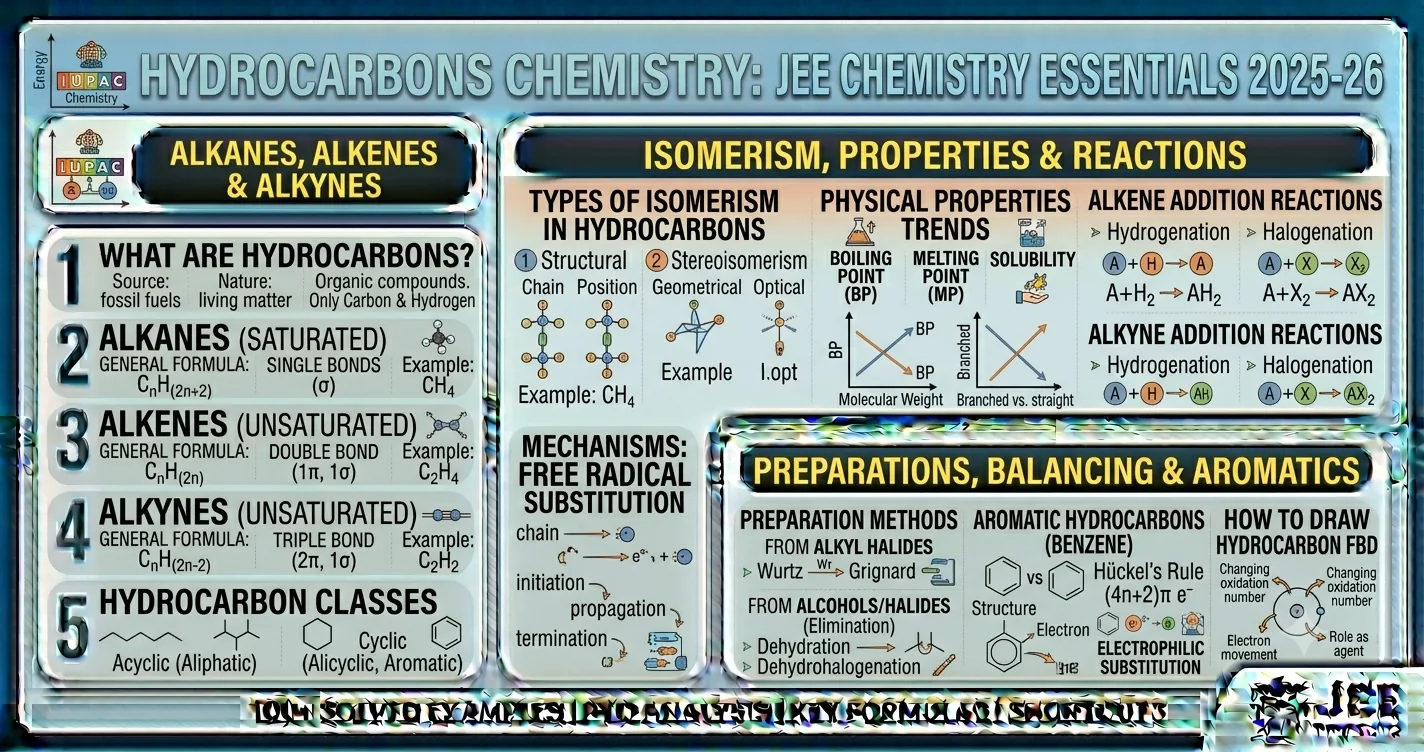
Complete Hydrocarbons Mastery Guide for JEE 2026
Why Hydrocarbons is Important
Hydrocarbons is a highly scoring and foundational chapter in Organic Chemistry for JEE:
- Foundation for GOC: Introduces core mechanisms (free radicals, carbocations) that apply to all of Class 12 organic chemistry.
- High Weightage: 2-3 questions in JEE Main and 3-5 questions in JEE Advanced every year.
- Conceptually Intensive: Tests logic (directing effects, Saytzeff vs Hofmann) rather than rote memorization.
- Direct Applications: Essential for understanding downstream chapters like Aldehydes, Ketones, and Amines.
Topic-wise Weightage Analysis
Must-Remember Concepts & Values
Addition Rules
Markovnikov: Negative part to less H-rich C
Anti-Mark: Negative part to more H-rich C (Peroxide, only HBr)
Saytzeff: More substituted alkene (E2)
Hofmann: Less substituted alkene (Bulky base)
Acidity & Hybridization
sp (50%) > sp2 (33%) > sp3 (25%)
Ethyne > Ethene > Ethane
Terminal alkyne H is acidic (pKa ~25)
Aromatic Directives
o,p-directing: -OH, -NH2, -X, -R
m-directing: -NO2, -CN, -CHO, -COOH
Halogens: Deactivating but o,p-directing
5-Step Exam Strategy
-
1
For Addition reactions: Always check if the reagent contains peroxide. If yes, apply Anti-Markovnikov (only for HBr).
-
2
For Elimination: Check the base. Bulkier base (t-BuOK) = Hofmann product. Normal base (alc. KOH) = Saytzeff product.
-
3
For Aromatic Substitution: Map the existing group to o/p or m. Draw all positions and check for steric hindrance (para preferred if bulky).
-
4
For Ozonolysis: Count the fragments. If an aldehyde is formed, the original carbon had one H. If a ketone, it had none. If CO2, it was a terminal =CH2.
-
5
For Conversions: Remember that alkynes can be selectively reduced to cis (Lindlar) or trans (Na/liq NH3) alkenes.
7-Day Hydrocarbons Mastery Roadmap
Alkanes Prep
- • Wurtz reaction
- • Decarboxylation
- • Core-House synthesis
Alkanes Rxns
- • Free radical mech
- • Order of reactivity
- • Conformations
Alkenes
- • Saytzeff rule
- • Markovnikov
- • Peroxide effect
Ozonolysis
- • Reductive vs Oxidative
- • Deduce structures
- • KMnO4 cleavage
Alkynes
- • Acidity & tests
- • Hydration
- • Reduction (Lindlar)
Aromatic
- • Benzene structure
- • EAS mechanisms
- • Friedel-Crafts
Directive & PYQ
- • o/p/m directing
- • 50+ PYQs
- • Reaction mapping
Hydrocarbons — Complete JEE Study Guide
Hydrocarbons is a critical chapter in JEE Chemistry that covers the structure, preparation, properties, and reactions of organic compounds containing only carbon and hydrogen. It is divided into Alkanes, Alkenes, Alkynes, and Aromatic Hydrocarbons. This chapter forms the bedrock of organic chemistry mechanisms tested in JEE Main and Advanced.
The most important topics for JEE from this chapter are Markovnikov and Anti-Markovnikov additions (specifically the peroxide effect limited to HBr), Saytzeff and Hofmann elimination rules, ozonolysis mapping (deducing the original alkene structure from carbonyl products), acidity of terminal alkynes based on sp hybridization, and the directive influence of substituents in Electrophilic Aromatic Substitution (EAS).
Students should focus on understanding the "why" behind the rules. For instance, bromine is more selective than chlorine in free radical halogenation because the H-abstraction step by Br• is endothermic (highly sensitive to bond dissociation energy and radical stability), whereas Cl• abstraction is exothermic (less selective, driven by statistical probability). Similarly, halogens are deactivating yet ortho/para-directing because their strong -I effect withdraws electrons, but their +R effect donates lone pairs to stabilize the arenium ion intermediate.
For JEE Advanced, focus heavily on multi-step synthesis, identifying compounds based on chemical tests (like terminal alkynes with Tollens' reagent), and predicting carbocation rearrangements during hydration and Friedel-Crafts reactions. Mastering the reaction mechanisms—rather than rote memorizing products—is the key to solving complex organic chemistry problems in JEE.