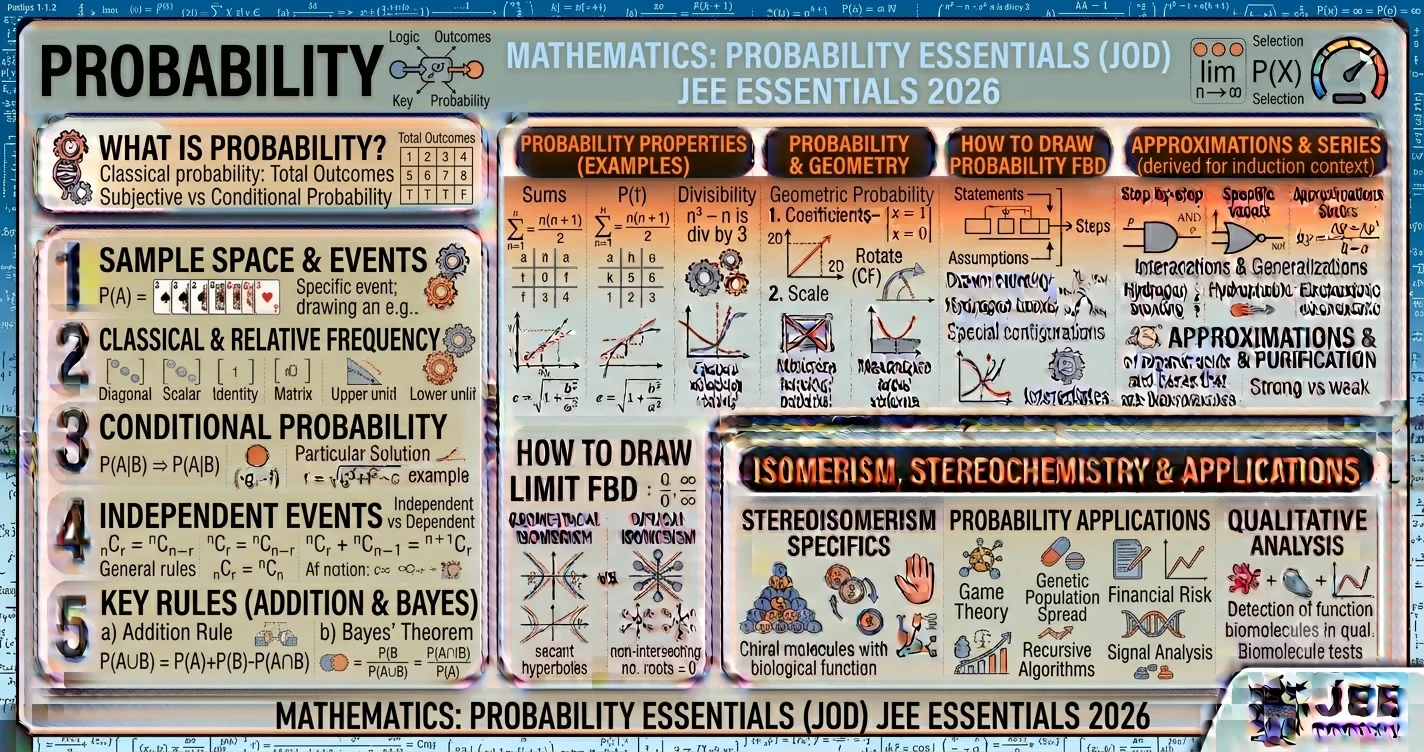
Maths · JEE Main & Advanced 2026 · Probability

Probability notes, formulas & PYQs for JEE 2026

Complete chapter — random experiments, sample space, types of events, classical & axiomatic probability, addition theorem, conditional probability, multiplication theorem, independent events, total probability theorem, Bayes' theorem, random variables, Bernoulli trials, binomial distribution, mean & variance, 150+ worked examples, and JEE PYQs with solutions.

SECTIONS
11
SOLVED EXAMPLES
150+
READ TIME
~6h
COST
₹0

Table of Contents

Jump to any section
Probability JEE Notes, Formulas, PYQs, Bayes Theorem
Probability — JEE Notes, Formulas, PYQs, Bayes' Theorem
1

Random Experiments, Sample Space & Events

Probability is the mathematical study of randomness and uncertainty. It quantifies how likely an event is to occur. The theory of probability forms the foundation for statistics, machine learning, and risk analysis. In JEE, this chapter typically contributes 2-3 questions in every Main session and is heavily tested in Advanced as well.

1.1 Random Experiment

An experiment is called a random experiment if it satisfies the following conditions:

  1. All possible outcomes of the experiment are known in advance.
  2. The exact result of the experiment cannot be predicted with certainty before performing it.
  3. The experiment can be repeated under identical conditions.

Examples: Tossing a coin, rolling a die, drawing a card from a deck, picking a ball from an urn.

1.2 Sample Space (S)

The set of all possible outcomes of a random experiment is called the sample space, denoted by \(S\) or \(\Omega\). Each element of the sample space is called a sample point.

Examples:

  • Tossing a coin: \(S = \{H, T\}\), \(n(S) = 2\)
  • Tossing two coins: \(S = \{HH, HT, TH, TT\}\), \(n(S) = 4\)
  • Rolling a die: \(S = \{1, 2, 3, 4, 5, 6\}\), \(n(S) = 6\)
  • Rolling two dice: \(n(S) = 36\)
  • Drawing a card from a deck: \(n(S) = 52\)

1.3 Event

Important — Definition of Event

Every subset of a sample space \(S\) is called an event. In other words, an event is a collection of sample points (outcomes) of the random experiment. The empty set \(\emptyset\) and \(S\) itself are also events.

Example: When rolling a die, \(S = \{1,2,3,4,5,6\}\). The event "getting an even number" is \(E = \{2, 4, 6\}\).

1.4 Occurrence of an Event

An event \(E\) is said to have occurred if the outcome \(\omega\) of the experiment is such that \(\omega \in E\). If \(\omega \notin E\), we say event \(E\) has not occurred.

For example, if we roll a 4 and \(E = \{2,4,6\}\) (even number), then \(E\) has occurred. If we roll a 3, \(E\) has not occurred.

1.5 Number of Sample Points in Common Experiments

Experimentn(S)
Tossing 1 coin2
Tossing \(n\) coins\(2^n\)
Rolling 1 die6
Rolling \(n\) dice\(6^n\)
Drawing 1 card from 5252
Drawing \(r\) cards from 52\(\binom{52}{r}\)
Choosing \(r\) from \(n\) (without order)\(\binom{n}{r}\)
Permutations of \(r\) from \(n\)\({}^nP_r = \dfrac{n!}{(n-r)!}\)

Important Tip

When counting sample points, always ask: is the selection ordered (permutations) or unordered (combinations)? Drawing cards is typically unordered; arranging people in a row is ordered. This distinction affects \(n(S)\).

PYQ — JEE Main 2024 (Jan 30 Shift 1)

Question: Three coins are tossed once. Find the probability of getting at least two heads.

Solution:

When 3 coins are tossed: \(S = \{HHH, HHT, HTH, THH, HTT, THT, TTH, TTT\}\), so \(n(S) = 8\).

Event \(E\): at least two heads \(= \{HHH, HHT, HTH, THH\}\), so \(n(E) = 4\).

\[P(E) = \frac{n(E)}{n(S)} = \frac{4}{8} = \frac{1}{2}\]
\[P(E) = \frac{1}{2}\]

Answer: \(\dfrac{1}{2}\)

2

Types of Events & Algebra of Events

Understanding the classification of events and their algebraic operations is fundamental to solving JEE probability problems. Most problems involve combining events using union, intersection, and complement — so mastering these operations is essential.

2.1 Types of Events

Most Repeated PYQ Concept — Types of Events

  1. Impossible Event: The empty set \(\emptyset\) is called an impossible event. Its probability is 0.
  2. Sure/Certain Event: The sample space \(S\) itself is called a sure event. Its probability is 1.
  3. Simple/Elementary Event: An event with only one sample point. Example: getting 3 when rolling a die.
  4. Compound Event: An event with more than one sample point. Example: getting an even number when rolling a die.
  5. Mutually Exclusive Events: Two events \(A\) and \(B\) are mutually exclusive (disjoint) if \(A \cap B = \emptyset\), i.e., they cannot occur simultaneously. Example: getting an even number and getting an odd number when rolling a die.
  6. Exhaustive Events: Events \(A_1, A_2, \ldots, A_n\) are exhaustive if \(A_1 \cup A_2 \cup \cdots \cup A_n = S\). At least one of them must occur.
  7. Mutually Exclusive & Exhaustive: Events that are both — they partition the sample space. Example: \(\{1\}, \{2\}, \ldots, \{6\}\) for a die.
  8. Equally Likely Events: Events with equal probability of occurrence. Example: getting heads or tails on a fair coin.

2.2 Algebra of Events

For events \(A, B\) defined on a sample space \(S\):

  • Complement: \(A'\) or \(\bar{A}\) or \(A^c = S - A\) (event "not A")
  • Union: \(A \cup B\) (event "A or B or both")
  • Intersection: \(A \cap B\) (event "A and B both")
  • Difference: \(A - B = A \cap B'\) (event "A but not B")
  • Symmetric Difference: \(A \Delta B = (A - B) \cup (B - A)\) (event "exactly one of A, B")

2.3 Important Set Theory Results for Events

Most Repeated PYQ — Set Operations on Events

  • De Morgan's Laws: \((A \cup B)' = A' \cap B'\) and \((A \cap B)' = A' \cup B'\)
  • \((A - B) \cup (B - A) = (A \cup B) - (A \cap B)\)
  • \(A \cup B = A \cup (B - A) = B \cup (A - B)\)
  • \(A = (A \cap B) \cup (A \cap B')\) — partition of A
  • \(A \cup B \cup C = (A - (B \cup C)) \cup (B - (A \cup C)) \cup (C - (A \cup B)) \cup (A \cap B \cap C') \cup \ldots\)
  • "Exactly one of A, B, C" \(= (A \cap B' \cap C') \cup (A' \cap B \cap C') \cup (A' \cap B' \cap C)\)
  • "Exactly two of A, B, C" \(= (A \cap B \cap C') \cup (A \cap B' \cap C) \cup (A' \cap B \cap C)\)
  • "At least two of A, B, C" \(= (A \cap B) \cup (B \cap C) \cup (A \cap C)\)
  • "At most two of A, B, C" \(= (A \cap B \cap C)'\)

2.4 Odds in Favour and Against

If \(P(A)\) is the probability of event \(A\):

  • Odds in favour of A: \(P(A) : P(A') = P(A) : (1 - P(A))\)
  • Odds against A: \(P(A') : P(A) = (1 - P(A)) : P(A)\)

Example: If odds in favour of A are 3:5, then \(P(A) = \dfrac{3}{3+5} = \dfrac{3}{8}\) and \(P(A') = \dfrac{5}{8}\).

Critical — Common Mistakes

  • Confusing "mutually exclusive" with "independent" — they are very different!
  • Writing \(P(A - B) = P(A) - P(B)\) — WRONG. Correct: \(P(A - B) = P(A) - P(A \cap B)\)
  • Forgetting that "exactly one of A, B" is \((A - B) \cup (B - A)\), not just \(A \cup B\)
  • For exhaustive events, forgetting that union must equal sample space exactly

PYQ — JEE Main 2023 (Apr 10 Shift 1)

Question: If \(A\) and \(B\) are two events such that \(P(A \cup B) = \dfrac{5}{6}\), \(P(A \cap B) = \dfrac{1}{4}\) and \(P(B') = \dfrac{1}{3}\), then find \(P(A)\).

Solution:

Given: \(P(B') = \dfrac{1}{3} \Rightarrow P(B) = 1 - \dfrac{1}{3} = \dfrac{2}{3}\)

Using addition theorem:

\[P(A \cup B) = P(A) + P(B) - P(A \cap B)\]
\[\frac{5}{6} = P(A) + \frac{2}{3} - \frac{1}{4}\]
\[\frac{5}{6} = P(A) + \frac{8}{12} - \frac{3}{12} = P(A) + \frac{5}{12}\]
\[P(A) = \frac{5}{6} - \frac{5}{12} = \frac{10}{12} - \frac{5}{12} = \frac{5}{12}\]
\[P(A) = \frac{5}{12}\]

Answer: \(\dfrac{5}{12}\)

3

Classical & Axiomatic Definition of Probability

Probability can be defined in multiple ways. The classical definition works for equally likely outcomes, while the axiomatic definition (due to Kolmogorov) is the most general and rigorous — it forms the basis of modern probability theory.

3.1 Classical Definition of Probability

Most Repeated PYQ Formula

If a random experiment has \(n\) mutually exclusive, exhaustive, and equally likely outcomes, and \(m\) of them are favourable to event \(E\), then:

\[P(E) = \frac{\text{Number of favourable outcomes}}{\text{Total number of outcomes}} = \frac{n(E)}{n(S)} = \frac{m}{n}\]

Limitations:

  • All outcomes must be equally likely.
  • \(n(S)\) must be finite.
  • Cannot handle continuous sample spaces (e.g., selecting a real number in [0,1]).

3.2 Axiomatic Definition (Kolmogorov's Axioms)

Important — Three Axioms

For any event \(A\) in sample space \(S\), the probability \(P(A)\) is a real number satisfying:

  1. Axiom 1 (Non-negativity): \(P(A) \geq 0\)
  2. Axiom 2 (Normalization): \(P(S) = 1\)
  3. Axiom 3 (Countable Additivity): For mutually exclusive events \(A_1, A_2, \ldots\): \(P(A_1 \cup A_2 \cup \cdots) = P(A_1) + P(A_2) + \cdots\)

3.3 Properties of Probability

  • \(P(\emptyset) = 0\) (probability of impossible event)
  • \(P(S) = 1\) (probability of sure event)
  • \(0 \leq P(A) \leq 1\) for any event \(A\)
  • \(P(A') = 1 - P(A)\)
  • \(P(A \cup B) \leq P(A) + P(B)\) (Boole's inequality generalizes this)
  • \(P(A \cap B) \leq \min(P(A), P(B))\)
  • If \(A \subseteq B\), then \(P(A) \leq P(B)\)
  • \(P(A - B) = P(A) - P(A \cap B) = P(A \cap B')\)
  • \(P(A \Delta B) = P(A) + P(B) - 2P(A \cap B)\)
  • \(P(A \cup B) \geq \max(P(A), P(B))\)
  • \(P(A \cup B) \leq 1\)

3.4 Statistical (Empirical) Probability

If an experiment is repeated \(n\) times and an event \(A\) occurs \(m\) times, the empirical probability is:

\[P(A) = \lim_{n \to \infty} \frac{m}{n}\]

This is the "frequency" definition, useful when outcomes are not equally likely.

3.5 Probability of Complementary and Other Combined Events

  • \(P(\text{at least one of } A, B) = P(A \cup B)\)
  • \(P(\text{none of } A, B) = P(A' \cap B') = 1 - P(A \cup B)\)
  • \(P(\text{exactly one of } A, B) = P(A) + P(B) - 2P(A \cap B)\)
  • \(P(\text{at least one of } A_1, \ldots, A_n) = 1 - P(A_1' \cap A_2' \cap \cdots \cap A_n')\)
  • If \(A_1, \ldots, A_n\) are mutually exclusive and exhaustive: \(\sum P(A_i) = 1\)

Useful Strategy

When asked for "at least one", always use the complement: \(P(\text{at least one}) = 1 - P(\text{none})\). This often dramatically simplifies the calculation.

PYQ — JEE Main 2024 (Apr 4 Shift 2)

Question: A bag contains 8 red and 5 white balls. Three balls are drawn at random. Find the probability that (i) all 3 are white, (ii) all 3 are red, (iii) at least one is white.

Solution:

Total balls = 13. Total ways to draw 3 balls = \(\binom{13}{3} = 286\).

(i) All 3 white: Favourable = \(\binom{5}{3} = 10\)

\[P = \frac{10}{286} = \frac{5}{143}\]

(ii) All 3 red: Favourable = \(\binom{8}{3} = 56\)

\[P = \frac{56}{286} = \frac{28}{143}\]

(iii) At least one white: Use complement (none white = all red)

\[P(\text{at least 1 white}) = 1 - P(\text{all red}) = 1 - \frac{28}{143} = \frac{115}{143}\]
\[(i)\;\frac{5}{143}\;\;\;(ii)\;\frac{28}{143}\;\;\;(iii)\;\frac{115}{143}\]
4

Addition Theorem of Probability

The addition theorem gives the probability of the union of events. It is essentially the inclusion-exclusion principle applied to probability, and is one of the most frequently used formulas in JEE probability problems.

4.1 Addition Theorem for Two Events

Most Repeated PYQ — Addition Theorem

For any two events \(A\) and \(B\) defined on a sample space \(S\):

\[P(A \cup B) = P(A) + P(B) - P(A \cap B)\]

Proof: \(A \cup B = A \cup (B - A)\) where \(A\) and \(B - A\) are disjoint. So \(P(A \cup B) = P(A) + P(B - A)\). Also \(B = (A \cap B) \cup (B - A)\), so \(P(B) = P(A \cap B) + P(B - A)\). Subtracting gives the theorem.

4.2 Special Cases

  • If A, B are mutually exclusive: \(A \cap B = \emptyset \Rightarrow P(A \cap B) = 0\), so \(P(A \cup B) = P(A) + P(B)\).
  • If A ⊆ B: \(P(A \cup B) = P(B)\) (since A is contained in B).
  • Maximum value of P(A ∪ B): \(\min(1, P(A) + P(B))\)
  • Minimum value of P(A ∪ B): \(\max(P(A), P(B))\)

4.3 Addition Theorem for Three Events

Most Repeated PYQ — Three Event Formula

For three events \(A, B, C\):

\[P(A \cup B \cup C) = P(A) + P(B) + P(C) - P(A \cap B) - P(B \cap C) - P(A \cap C) + P(A \cap B \cap C)\]

If mutually exclusive: \(P(A \cup B \cup C) = P(A) + P(B) + P(C)\).

4.4 Boole's Inequality

For any events \(A_1, A_2, \ldots, A_n\) (not necessarily mutually exclusive):

\[P\left(\bigcup_{i=1}^{n} A_i\right) \leq \sum_{i=1}^{n} P(A_i)\]

Equality holds iff the events are mutually exclusive.

4.5 Range of P(A ∩ B)

Important — Bounds on Intersection

For any two events \(A\) and \(B\):

\[\max\{0,\; P(A) + P(B) - 1\} \leq P(A \cap B) \leq \min\{P(A),\; P(B)\}\]

Upper bound: achieved when one event contains the other.

Lower bound: achieved when \(A \cup B = S\) (covers whole sample space).

4.6 Probability of "Exactly One" and "Exactly Two"

For three events \(A, B, C\):

  • Exactly one: \(P(A) + P(B) + P(C) - 2[P(A \cap B) + P(B \cap C) + P(A \cap C)] + 3P(A \cap B \cap C)\)
  • Exactly two: \(P(A \cap B) + P(B \cap C) + P(A \cap C) - 3P(A \cap B \cap C)\)
  • At least two: \(P(A \cap B) + P(B \cap C) + P(A \cap C) - 2P(A \cap B \cap C)\)
  • None: \(1 - P(A \cup B \cup C)\)
  • At least one: \(P(A \cup B \cup C)\)

PYQ — JEE Main 2024 (Apr 6 Shift 2)

Question: Let \(A\) and \(B\) be two events such that \(P(A) = 0.5\), \(P(B) = 0.4\), and \(P(A \cap B) = 0.2\). Find \(P(A' \cap B')\), \(P(A \cap B')\), and \(P(A' \cup B')\).

Solution:

(i) \(P(A' \cap B') = P((A \cup B)') = 1 - P(A \cup B)\):

\[P(A \cup B) = 0.5 + 0.4 - 0.2 = 0.7\]
\[P(A' \cap B') = 1 - 0.7 = 0.3\]

(ii) \(P(A \cap B') = P(A) - P(A \cap B) = 0.5 - 0.2 = 0.3\)

(iii) \(P(A' \cup B') = P((A \cap B)') = 1 - P(A \cap B) = 1 - 0.2 = 0.8\) (De Morgan's)

\[P(A' \cap B') = 0.3,\;\; P(A \cap B') = 0.3,\;\; P(A' \cup B') = 0.8\]
5

Conditional Probability

Conditional probability is the probability of an event given that another event has already occurred. It is the backbone of advanced probability — Bayes' theorem, total probability, and independence all build on this concept. JEE tests conditional probability extensively.

5.1 Definition of Conditional Probability

Most Repeated PYQ — Conditional Probability

The conditional probability of event \(A\) given that event \(B\) has occurred (with \(P(B) \neq 0\)) is defined as:

\[P(A | B) = \frac{P(A \cap B)}{P(B)}\]

Similarly: \(P(B | A) = \dfrac{P(A \cap B)}{P(A)}\) for \(P(A) \neq 0\).

Interpretation: Once we know \(B\) has occurred, our sample space "shrinks" to \(B\). Within this reduced sample space, \(P(A|B)\) is the proportion where \(A\) also occurs.

5.2 Classical Approach to Conditional Probability

When outcomes are equally likely:

\[P(A | B) = \frac{n(A \cap B)}{n(B)}\]

This is because once \(B\) has occurred, the new sample space is \(B\), and the favourable outcomes are \(A \cap B\).

5.3 Properties of Conditional Probability

Important — Properties to Remember

  • \(P(S | B) = 1\) for \(P(B) \neq 0\) (since \(S \cap B = B\), so \(P(S|B) = P(B)/P(B) = 1\))
  • \(P(\emptyset | B) = 0\)
  • \(P(A' | B) = 1 - P(A | B)\)
  • If \(A\) and \(B\) are mutually exclusive (and \(P(B) \neq 0\)): \(P(A | B) = 0\)
  • If \(A \subseteq B\): \(P(A | B) = \dfrac{P(A)}{P(B)}\)
  • If \(B \subseteq A\): \(P(A | B) = 1\)
  • For any three events: \(P(A \cup B | C) = P(A | C) + P(B | C) - P(A \cap B | C)\)
  • \(0 \leq P(A | B) \leq 1\)

5.4 Chain Rule of Probability

For events \(A_1, A_2, \ldots, A_n\):

\[P(A_1 \cap A_2 \cap \cdots \cap A_n) = P(A_1) \cdot P(A_2 | A_1) \cdot P(A_3 | A_1 \cap A_2) \cdots P(A_n | A_1 \cap \cdots \cap A_{n-1})\]

For 3 events: \(P(A \cap B \cap C) = P(A) \cdot P(B|A) \cdot P(C | A \cap B)\)

5.5 Important Result (Extended Multiplication)

Useful Identity

From the definition:

\[P(A \cap B) = P(A) \cdot P(B | A) = P(B) \cdot P(A | B)\]

This gives a useful relation: \(\dfrac{P(A|B)}{P(B|A)} = \dfrac{P(A)}{P(B)}\)

PYQ — JEE Main 2024 (Jan 31 Shift 2)

Question: A box contains 4 red and 5 white balls. Two balls are drawn one by one without replacement. Find the probability that both are red. Also find the probability that the second ball is red.

Solution:

Part (i): Both red

Let \(R_1\) = first is red, \(R_2\) = second is red.

\[P(R_1 \cap R_2) = P(R_1) \cdot P(R_2 | R_1) = \frac{4}{9} \times \frac{3}{8} = \frac{12}{72} = \frac{1}{6}\]

Part (ii): Second ball red

Second is red means: (first red AND second red) OR (first white AND second red)

\[P(R_2) = P(R_1) \cdot P(R_2 | R_1) + P(R_1') \cdot P(R_2 | R_1')\]
\[= \frac{4}{9} \times \frac{3}{8} + \frac{5}{9} \times \frac{4}{8} = \frac{12}{72} + \frac{20}{72} = \frac{32}{72} = \frac{4}{9}\]
\[P(\text{both red}) = \frac{1}{6}, \;\;\; P(\text{2nd red}) = \frac{4}{9}\]

Note: P(second ball red) = P(first ball red) = 4/9. This is a general result when drawing without replacement — by symmetry!

6

Multiplication Theorem of Probability

The multiplication theorem computes the probability of the simultaneous occurrence of two or more events. It is essentially a rearrangement of the conditional probability definition, but it deserves its own treatment due to its immense utility.

6.1 Multiplication Theorem for Two Events

Most Repeated PYQ — Multiplication Rule

For any two events \(A\) and \(B\):

\[P(A \cap B) = P(A) \cdot P(B | A) \quad \text{if } P(A) \neq 0\] \[P(A \cap B) = P(B) \cdot P(A | B) \quad \text{if } P(B) \neq 0\]

6.2 Multiplication Theorem for Three Events

\[P(A \cap B \cap C) = P(A) \cdot P(B | A) \cdot P(C | A \cap B)\]

Example: Three cards are drawn without replacement from a deck of 52. Probability all are aces:

\[P = \frac{4}{52} \times \frac{3}{51} \times \frac{2}{50} = \frac{24}{132600} = \frac{1}{5525}\]

6.3 General Multiplication Theorem

Important — General Formula

For \(n\) events \(A_1, A_2, \ldots, A_n\):

\[P\left(\bigcap_{i=1}^{n} A_i\right) = P(A_1) \cdot P(A_2 | A_1) \cdot P(A_3 | A_1 \cap A_2) \cdots P(A_n | A_1 \cap \cdots \cap A_{n-1})\]

6.4 When Events Are Independent

If \(A_1, A_2, \ldots, A_n\) are independent events, the multiplication theorem simplifies to:

\[P(A_1 \cap A_2 \cap \cdots \cap A_n) = P(A_1) \cdot P(A_2) \cdots P(A_n)\]

Example: Tossing 3 coins. Probability of 3 heads = \(\dfrac{1}{2} \times \dfrac{1}{2} \times \dfrac{1}{2} = \dfrac{1}{8}\).

6.5 With and Without Replacement

Most Repeated PYQ Concept

With Replacement: Each draw is independent. Sample space remains same on each draw. Use multiplication of independent probabilities.

Without Replacement: Each draw depends on previous draws. Use conditional probabilities.

Example: Drawing 2 balls from a bag with 3 red and 5 white:

  • With replacement: \(P(\text{both red}) = \dfrac{3}{8} \times \dfrac{3}{8} = \dfrac{9}{64}\)
  • Without replacement: \(P(\text{both red}) = \dfrac{3}{8} \times \dfrac{2}{7} = \dfrac{6}{56} = \dfrac{3}{28}\)

PYQ — JEE Main 2023 (Apr 8 Shift 1)

Question: A problem in mathematics is given to three students \(A\), \(B\), \(C\). Their chances of solving it are \(\dfrac{1}{2}\), \(\dfrac{1}{3}\), \(\dfrac{1}{4}\) respectively. Find the probability that the problem is solved.

Solution:

Use complement: \(P(\text{problem solved}) = 1 - P(\text{none solves})\)

Assuming independence: \(P(\text{none}) = P(A') \cdot P(B') \cdot P(C') = \dfrac{1}{2} \cdot \dfrac{2}{3} \cdot \dfrac{3}{4} = \dfrac{6}{24} = \dfrac{1}{4}\)

\[P(\text{problem solved}) = 1 - \frac{1}{4} = \frac{3}{4}\]
\[P(\text{solved}) = \frac{3}{4}\]

Answer: \(\dfrac{3}{4}\)

7

Independent Events

Two events are independent if the occurrence of one does not affect the probability of the other. Independence is a crucial concept — it simplifies calculations enormously. Distinguishing independence from mutual exclusivity is critical for JEE.

7.1 Definition of Independent Events

Most Repeated PYQ — Independence

Two events \(A\) and \(B\) are said to be independent if and only if:

\[P(A \cap B) = P(A) \cdot P(B)\]

Equivalently, \(P(A | B) = P(A)\) (knowing \(B\) doesn't change probability of \(A\)), or \(P(B | A) = P(B)\).

7.2 Important Results on Independence

Important — Must Know Properties

  • If \(A\) and \(B\) are independent, then so are: (a) \(A'\) and \(B\), (b) \(A\) and \(B'\), (c) \(A'\) and \(B'\).
  • If \(A\) and \(B\) are independent, then \(P(A \cup B) = P(A) + P(B) - P(A)P(B) = 1 - P(A')P(B')\).
  • If \(A\) and \(B\) are mutually exclusive and \(P(A) > 0, P(B) > 0\), then they are NOT independent (since \(P(A \cap B) = 0 \neq P(A) \cdot P(B)\)).
  • If \(A\) and \(B\) are independent and \(P(A) > 0, P(B) > 0\), then they are NOT mutually exclusive (since \(P(A \cap B) > 0\)).
  • Two impossible events are independent (trivially). An impossible event is independent of any event.
  • A sure event \(S\) is independent of any event \(A\) (since \(P(S \cap A) = P(A) = P(S) \cdot P(A)\)).

7.3 Pairwise vs Mutual Independence

Most Repeated PYQ — Pairwise vs Mutual

Pairwise Independent: Three events \(A, B, C\) are pairwise independent if:

\[P(A \cap B) = P(A) \cdot P(B), \quad P(B \cap C) = P(B) \cdot P(C), \quad P(A \cap C) = P(A) \cdot P(C)\]

Mutually Independent: Three events are mutually independent if they are pairwise independent AND:

\[P(A \cap B \cap C) = P(A) \cdot P(B) \cdot P(C)\]

Key insight: Pairwise independence does NOT imply mutual independence.

7.4 Classic Example: Pairwise but Not Mutually Independent

Toss two coins. Define:

  • \(A\): First coin shows head
  • \(B\): Second coin shows head
  • \(C\): Both coins show same face

Then \(P(A) = P(B) = P(C) = \dfrac{1}{2}\), and \(P(A \cap B) = P(A \cap C) = P(B \cap C) = \dfrac{1}{4} = P(A)P(B)\) etc. So pairwise independent.

But \(P(A \cap B \cap C) = \dfrac{1}{4} \neq \dfrac{1}{8} = P(A)P(B)P(C)\). So NOT mutually independent.

7.5 Important Warning

Critical — Common Confusions

  • Independent ≠ Mutually Exclusive (in fact they are nearly opposites for non-trivial events)
  • Don't assume independence unless explicitly stated or clearly implied (e.g., separate experiments)
  • For "with replacement" problems, events are independent; for "without replacement", they are dependent
  • If \(A\) and \(B\) are independent and \(B\) and \(C\) are independent, it does NOT follow that \(A\) and \(C\) are independent

PYQ — JEE Main 2024 (Apr 8 Shift 1)

Question: Let \(A\) and \(B\) be two independent events such that \(P(A) = \dfrac{1}{3}\) and \(P(B) = \dfrac{1}{4}\). Find \(P(A \cup B)\) and \(P(A | A \cup B)\).

Solution:

Since A and B are independent: \(P(A \cap B) = P(A) \cdot P(B) = \dfrac{1}{3} \times \dfrac{1}{4} = \dfrac{1}{12}\)

(i) P(A ∪ B):

\[P(A \cup B) = P(A) + P(B) - P(A \cap B) = \frac{1}{3} + \frac{1}{4} - \frac{1}{12} = \frac{4+3-1}{12} = \frac{6}{12} = \frac{1}{2}\]

(ii) P(A | A ∪ B):

\[P(A | A \cup B) = \frac{P(A \cap (A \cup B))}{P(A \cup B)} = \frac{P(A)}{P(A \cup B)} = \frac{1/3}{1/2} = \frac{2}{3}\]
\[P(A \cup B) = \frac{1}{2},\;\; P(A | A \cup B) = \frac{2}{3}\]
8

Law of Total Probability

The law of total probability is a powerful tool that breaks down the probability of an event into a weighted sum over a "partition" of the sample space. It is the stepping stone to Bayes' theorem and is heavily tested in JEE.

8.1 Partition of Sample Space

Important — Definition

Events \(A_1, A_2, \ldots, A_n\) are said to form a partition of the sample space \(S\) if:

  1. \(A_i \cap A_j = \emptyset\) for \(i \neq j\) (mutually exclusive)
  2. \(A_1 \cup A_2 \cup \cdots \cup A_n = S\) (exhaustive)
  3. \(P(A_i) > 0\) for all \(i\) (non-empty)

8.2 Law of Total Probability

Most Repeated PYQ — Total Probability

If \(A_1, A_2, \ldots, A_n\) form a partition of \(S\), then for any event \(B\):

\[P(B) = \sum_{i=1}^{n} P(A_i) \cdot P(B | A_i) = P(A_1)P(B|A_1) + P(A_2)P(B|A_2) + \cdots + P(A_n)P(B|A_n)\]

8.3 Intuition Behind the Theorem

Since the \(A_i\)'s partition \(S\), every outcome in \(B\) must fall in exactly one of the \(A_i\)'s. So:

\[B = (B \cap A_1) \cup (B \cap A_2) \cup \cdots \cup (B \cap A_n)\]

These pieces are mutually exclusive, so:

\[P(B) = \sum P(B \cap A_i) = \sum P(A_i) \cdot P(B | A_i)\]

8.4 Common Partition Examples

  • Urn/Bag problems: \(A_1\) = bag 1 selected, \(A_2\) = bag 2 selected, ...
  • Dice problems: \(A_i\) = die shows \(i\), for \(i = 1, 2, \ldots, 6\)
  • Person selection: \(A_1\) = person 1 chosen, \(A_2\) = person 2 chosen, ...
  • Machine problems: \(A_i\) = product from machine \(i\)
  • Two-state problems: \(A\) and \(A'\) form a partition (just 2 events)

8.5 Strategy for Solving Total Probability Problems

  1. Identify the "partition" — usually different sources/bags/people/machines.
  2. Find \(P(A_i)\) for each — usually equal if randomly chosen.
  3. Find \(P(B | A_i)\) for each — the probability of the event given each source.
  4. Apply the formula \(P(B) = \sum P(A_i) \cdot P(B | A_i)\).

PYQ — JEE Main 2024 (Apr 5 Shift 2)

Question: Bag I contains 3 red and 4 black balls, while Bag II contains 5 red and 3 black balls. One ball is transferred from Bag I to Bag II, and then a ball is drawn from Bag II. The ball so drawn is found to be red. Find the probability that the transferred ball is black.

Solution:

Let \(A_1\): red ball transferred, \(A_2\): black ball transferred. \(P(A_1) = \dfrac{3}{7}\), \(P(A_2) = \dfrac{4}{7}\).

After transferring red: Bag II has 6 red, 3 black. \(P(B | A_1) = \dfrac{6}{9} = \dfrac{2}{3}\)

After transferring black: Bag II has 5 red, 4 black. \(P(B | A_2) = \dfrac{5}{9}\)

Probability ball drawn is red (total probability):

\[P(B) = P(A_1) \cdot P(B|A_1) + P(A_2) \cdot P(B|A_2) = \frac{3}{7} \cdot \frac{2}{3} + \frac{4}{7} \cdot \frac{5}{9} = \frac{2}{7} + \frac{20}{63} = \frac{18+20}{63} = \frac{38}{63}\]

This is a Bayes' theorem problem! Find \(P(A_2 | B)\):

\[P(A_2 | B) = \frac{P(A_2) \cdot P(B|A_2)}{P(B)} = \frac{(4/7)(5/9)}{38/63} = \frac{20/63}{38/63} = \frac{20}{38} = \frac{10}{19}\]
\[P(\text{transferred ball is black}) = \frac{10}{19}\]
9

Bayes' Theorem

Bayes' theorem is the most important topic in JEE probability — virtually every JEE Main session has a Bayes' theorem question. It allows us to "reverse" conditional probabilities: given an observed effect, find the probability of each possible cause. Master this chapter thoroughly!

9.1 Statement of Bayes' Theorem

Most Repeated PYQ — Bayes' Theorem

If \(A_1, A_2, \ldots, A_n\) form a partition of \(S\) and \(B\) is an event with \(P(B) > 0\), then for each \(i\):

\[P(A_i | B) = \frac{P(A_i) \cdot P(B | A_i)}{\sum_{k=1}^{n} P(A_k) \cdot P(B | A_k)} = \frac{P(A_i) \cdot P(B | A_i)}{P(B)}\]

Interpretation:

  • \(P(A_i)\) is the prior probability (before observing B)
  • \(P(B | A_i)\) is the likelihood
  • \(P(A_i | B)\) is the posterior probability (after observing B)
  • The denominator \(P(B)\) is a normalizing constant (by total probability theorem)

9.2 Bayes' Theorem for Two Events

For two events \(A\) and \(B\) (with \(A, A'\) forming a partition):

\[P(A | B) = \frac{P(A) \cdot P(B | A)}{P(A) \cdot P(B | A) + P(A') \cdot P(B | A')}\]

9.3 Proof of Bayes' Theorem

By definition of conditional probability:

\[P(A_i | B) = \frac{P(A_i \cap B)}{P(B)} = \frac{P(A_i) \cdot P(B | A_i)}{P(B)}\]

Apply total probability to denominator: \(P(B) = \sum P(A_k) \cdot P(B | A_k)\). Substituting gives Bayes' theorem.

9.4 Step-by-Step Procedure for Bayes' Problems

Most Repeated PYQ Strategy

  1. Identify the partition — these are the "causes" (e.g., which bag, which machine, which person).
  2. Find prior probabilities \(P(A_i)\) — usually equal if selection is random.
  3. Find likelihoods \(P(B | A_i)\) — probability of observed event given each cause.
  4. Compute denominator using total probability: \(P(B) = \sum P(A_i) \cdot P(B | A_i)\).
  5. Apply Bayes' formula to find the desired posterior probability.

9.5 Common Bayes' Theorem Problem Types

  • Bag/Urn problems: Bags contain different colored balls; one bag is selected and a ball drawn.
  • Disease/Test problems: A test gives positive result; find probability person actually has disease.
  • Manufacturing problems: Products from different machines with different defect rates.
  • Person-speaking problems: A speaks truth with probability \(p\), B with \(q\); both report same event.
  • Card problems: Cards drawn from different decks under various conditions.

Pro Tip

Always write the answer as a fraction (not decimal). JEE answers are typically fractions. Make a tree diagram in your rough work to visualize the partition and conditional probabilities — this prevents careless errors.

PYQ — JEE Main 2024 (Apr 9 Shift 1)

Question: Three urns \(A\), \(B\), \(C\) contain 6 red & 4 white, 2 red & 6 white, 1 red & 5 white balls respectively. An urn is chosen at random and a ball is drawn. If the ball drawn is red, find the probability that it was drawn from urn \(A\).

Solution:

Let \(E_A, E_B, E_C\) = choosing urn A, B, C. \(P(E_A) = P(E_B) = P(E_C) = \dfrac{1}{3}\).

Let \(R\) = ball drawn is red.

\[P(R | E_A) = \frac{6}{10} = \frac{3}{5}, \quad P(R | E_B) = \frac{2}{8} = \frac{1}{4}, \quad P(R | E_C) = \frac{1}{6}\]

By total probability:

\[P(R) = \frac{1}{3} \cdot \frac{3}{5} + \frac{1}{3} \cdot \frac{1}{4} + \frac{1}{3} \cdot \frac{1}{6} = \frac{1}{3}\left(\frac{3}{5} + \frac{1}{4} + \frac{1}{6}\right)\]
\[= \frac{1}{3} \cdot \frac{36 + 15 + 10}{60} = \frac{1}{3} \cdot \frac{61}{60} = \frac{61}{180}\]

By Bayes' theorem:

\[P(E_A | R) = \frac{P(E_A) \cdot P(R|E_A)}{P(R)} = \frac{(1/3)(3/5)}{61/180} = \frac{1/5}{61/180} = \frac{180}{305} = \frac{36}{61}\]
\[P(\text{urn A} | \text{red ball}) = \frac{36}{61}\]

Answer: \(\dfrac{36}{61}\)

10

Random Variables & Probability Distributions

A random variable is a numerical-valued function defined on a sample space. It allows us to apply numerical techniques to random phenomena. Probability distributions describe how probabilities are distributed over the values of a random variable.

10.1 Definition of Random Variable

Important — Definition

A random variable (r.v.) \(X\) is a function from the sample space \(S\) to the real numbers \(\mathbb{R}\):

\[X : S \to \mathbb{R}\]

Example: Toss two coins. Let \(X\) = number of heads. Then \(X\) can be 0, 1, or 2.

10.2 Types of Random Variables

  • Discrete Random Variable: Takes at most countably many values (usually a finite set or a sequence). Example: number of heads in \(n\) tosses.
  • Continuous Random Variable: Takes values in an interval (uncountably many). Example: height, weight, time.

In JEE, we primarily deal with discrete random variables.

10.3 Probability Distribution

Most Repeated PYQ Concept

The probability distribution of a discrete r.v. \(X\) is a table (or function) giving \(P(X = x_i) = p_i\) for each value \(x_i\). It must satisfy:

  1. \(p_i \geq 0\) for all \(i\)
  2. \(\sum p_i = 1\) (sum of all probabilities equals 1)
\(X\)\(x_1\)\(x_2\)\(\cdots\)\(x_n\)
\(P(X)\)\(p_1\)\(p_2\)\(\cdots\)\(p_n\)

10.4 Mean (Expected Value)

Most Repeated PYQ — Mean Formula

The mean or expected value of \(X\) is:

\[\mu = E(X) = \sum_{i} x_i \cdot p_i\]

10.5 Variance and Standard Deviation

Most Repeated PYQ — Variance Formulas

Variance:

\[\text{Var}(X) = \sigma^2 = E[(X - \mu)^2] = \sum_{i} (x_i - \mu)^2 p_i = E(X^2) - [E(X)]^2\]

Standard Deviation:

\[\sigma = \sqrt{\text{Var}(X)} = \sqrt{E(X^2) - \mu^2}\]

where \(E(X^2) = \sum x_i^2 \cdot p_i\).

10.6 Properties of Expectation and Variance

  • \(E(c) = c\) for any constant \(c\)
  • \(E(aX + b) = a \cdot E(X) + b\) (linearity)
  • \(E(X + Y) = E(X) + E(Y)\) (always true)
  • \(E(XY) = E(X) \cdot E(Y)\) if \(X, Y\) are independent
  • \(\text{Var}(c) = 0\) for any constant
  • \(\text{Var}(aX + b) = a^2 \cdot \text{Var}(X)\)
  • \(\text{Var}(X + Y) = \text{Var}(X) + \text{Var}(Y)\) if \(X, Y\) are independent
  • \(\text{Var}(X - Y) = \text{Var}(X) + \text{Var}(Y)\) if \(X, Y\) are independent (note the + sign!)

10.7 Cumulative Distribution Function (CDF)

The CDF of a random variable \(X\) is defined as:

\[F(x) = P(X \leq x)\]

Properties: \(F\) is non-decreasing, \(\lim_{x \to -\infty} F(x) = 0\), \(\lim_{x \to \infty} F(x) = 1\). For discrete r.v., \(P(a < X \leq b) = F(b) - F(a)\).

PYQ — JEE Main 2024 (Apr 1 Shift 2)

Question: A random variable \(X\) has the following probability distribution:

\(X\)01234
\(P(X)\)\(k\)\(2k\)\(3k\)\(2k\)\(k\)

Find \(k\), mean, and variance.

Solution:

(i) Find k: Sum of probabilities = 1

\[k + 2k + 3k + 2k + k = 1 \Rightarrow 9k = 1 \Rightarrow k = \frac{1}{9}\]

(ii) Mean:

\[\mu = \sum x_i p_i = 0 \cdot \frac{1}{9} + 1 \cdot \frac{2}{9} + 2 \cdot \frac{3}{9} + 3 \cdot \frac{2}{9} + 4 \cdot \frac{1}{9} = \frac{0+2+6+6+4}{9} = \frac{18}{9} = 2\]

(iii) Variance:

\[E(X^2) = 0 + 1 \cdot \frac{2}{9} + 4 \cdot \frac{3}{9} + 9 \cdot \frac{2}{9} + 16 \cdot \frac{1}{9} = \frac{2+12+18+16}{9} = \frac{48}{9} = \frac{16}{3}\]
\[\text{Var}(X) = E(X^2) - \mu^2 = \frac{16}{3} - 4 = \frac{16-12}{3} = \frac{4}{3}\]
\[k = \frac{1}{9},\;\; \mu = 2,\;\; \text{Var}(X) = \frac{4}{3}\]
11

Bernoulli Trials & Binomial Distribution

The binomial distribution is the most important discrete probability distribution for JEE. It models the number of successes in a fixed number of independent Bernoulli trials. This is a high-yield topic with at least one question almost every year in JEE Main.

11.1 Bernoulli Trials

Most Repeated PYQ Concept

Trials of a random experiment are called Bernoulli trials if they satisfy:

  1. There are only two possible outcomes: success (S) and failure (F).
  2. The probability of success \(p\) is the same on each trial (and \(q = 1 - p\) is probability of failure).
  3. Trials are independent.

Examples: Tossing a coin (H/T), hitting a target (hit/miss), defective item (defective/good).

11.2 Binomial Distribution Definition

Most Repeated PYQ — Binomial Formula

If \(X\) denotes the number of successes in \(n\) independent Bernoulli trials with probability of success \(p\), then:

\[P(X = r) = \binom{n}{r} p^r q^{n-r}, \quad r = 0, 1, 2, \ldots, n\]

where \(q = 1 - p\). We write \(X \sim B(n, p)\).

11.3 Mean, Variance and Standard Deviation

Most Repeated PYQ — Mean & Variance

  • Mean: \(E(X) = \mu = np\)
  • Variance: \(\text{Var}(X) = \sigma^2 = npq\)
  • Standard Deviation: \(\sigma = \sqrt{npq}\)

Important: For binomial distribution, \(\text{Var} < \text{Mean}\) always (since \(q < 1\) implies \(npq < np\)).

11.4 Key Properties of Binomial Distribution

  • \(\sum_{r=0}^{n} P(X=r) = \sum_{r=0}^{n} \binom{n}{r} p^r q^{n-r} = (q+p)^n = 1^n = 1\)
  • It is symmetric when \(p = q = \dfrac{1}{2}\).
  • It is skewed right when \(p < 0.5\), skewed left when \(p > 0.5\).
  • Mode of binomial distribution: \(\lfloor (n+1)p \rfloor\) if \((n+1)p\) is not an integer; if \((n+1)p\) is integer, mode is \((n+1)p\) and \((n+1)p - 1\).
  • If \(X_1 \sim B(n_1, p)\) and \(X_2 \sim B(n_2, p)\) independently, then \(X_1 + X_2 \sim B(n_1 + n_2, p)\).

11.5 Recurrence Relation

For binomial probabilities:

\[P(X = r+1) = \frac{n-r}{r+1} \cdot \frac{p}{q} \cdot P(X = r)\]

Useful for computing successive probabilities given one value.

11.6 Probability of "At Least" and "At Most"

Important

  • \(P(X \geq r) = \sum_{k=r}^{n} \binom{n}{k} p^k q^{n-k}\)
  • \(P(X \leq r) = \sum_{k=0}^{r} \binom{n}{k} p^k q^{n-k}\)
  • \(P(X \geq 1) = 1 - P(X = 0) = 1 - q^n\) (often used shortcut)
  • \(P(X \geq r) = 1 - P(X \leq r-1)\)

11.7 Complete Formula Sheet

ConceptFormula
Classical Probability\(P(E) = n(E)/n(S)\)
Addition (2 events)\(P(A \cup B) = P(A) + P(B) - P(A \cap B)\)
Addition (3 events)\(P(A \cup B \cup C) = P(A)+P(B)+P(C) - P(A \cap B) - P(B \cap C) - P(A \cap C) + P(A \cap B \cap C)\)
Conditional\(P(A|B) = P(A \cap B)/P(B)\)
Multiplication\(P(A \cap B) = P(A) \cdot P(B|A)\)
Independent\(P(A \cap B) = P(A) \cdot P(B)\)
Total Probability\(P(B) = \sum P(A_i) P(B|A_i)\)
Bayes' Theorem\(P(A_i|B) = P(A_i) P(B|A_i)/P(B)\)
Binomial PMF\(P(X=r) = \binom{n}{r} p^r q^{n-r}\)
Binomial Mean\(\mu = np\)
Binomial Variance\(\sigma^2 = npq\)
Binomial SD\(\sigma = \sqrt{npq}\)
At least 1\(P(X \geq 1) = 1 - q^n\)

Decision Flowchart

  • Single event probability? → Use \(P(E) = n(E)/n(S)\)
  • Probability of A or B? → Addition theorem
  • "Given that" / "if" in problem? → Conditional probability
  • Multiple causes / sources? → Total probability + Bayes'
  • "Find probability cause was..." → Bayes' theorem (posterior)
  • Repeated trials with same p? → Binomial distribution
  • At least one success? → \(1 - q^n\)
  • Distribution table given? → Verify \(\sum p_i = 1\), find mean & variance

PYQ — JEE Main 2024 (Apr 12 Shift 2)

Question: A fair die is thrown 6 times. Find the probability that the number 5 appears exactly 2 times. Also find the mean and variance.

Solution:

This is a binomial distribution with \(n = 6\), \(p = 1/6\) (prob of 5), \(q = 5/6\).

P(X = 2):

\[P(X = 2) = \binom{6}{2} \left(\frac{1}{6}\right)^2 \left(\frac{5}{6}\right)^4 = 15 \cdot \frac{1}{36} \cdot \frac{625}{1296} = \frac{9375}{46656} = \frac{3125}{15552}\]

Mean: \(\mu = np = 6 \times \dfrac{1}{6} = 1\)

Variance: \(\sigma^2 = npq = 6 \times \dfrac{1}{6} \times \dfrac{5}{6} = \dfrac{5}{6}\)

\[P(X=2) = \frac{3125}{15552},\;\; \mu = 1,\;\; \sigma^2 = \frac{5}{6}\]

Common Mistakes Summary

  • Confusing mutually exclusive with independent events
  • Forgetting to verify \(\sum p_i = 1\) before finding mean/variance
  • Using \(P(A \cap B) = P(A) \cdot P(B)\) when events are NOT independent
  • Forgetting the denominator in Bayes' theorem (total probability)
  • Confusing "without replacement" (hypergeometric, not binomial) with binomial
  • Writing variance as \(np^2\) instead of \(npq\)
  • Forgetting \(q = 1 - p\) when computing binomial probabilities
  • Not recognizing when total probability theorem applies
  • Saying \(P(A \cup B) = P(A) + P(B)\) without mutually exclusive condition

Previous Year Questions Analysis

JEE Main (Last 10 Years)

  • ✓ Bayes' Theorem: 24%
  • ✓ Conditional Probability: 18%
  • ✓ Binomial Distribution: 16%
  • ✓ Independent Events: 12%
  • ✓ Total Probability: 10%
  • ✓ Addition Theorem: 8%
  • ✓ Ball/Urn Problems: 7%
  • ✓ Probability Distribution Tables: 5%

JEE Advanced (Last 10 Years)

  • ✓ Multi-concept Bayes' Problems: 20%
  • ✓ Conditional Probability + Combinatorics: 18%
  • ✓ Independent vs Mutually Exclusive: 14%
  • ✓ Binomial with Recurrence: 12%
  • ✓ Random Variables (Mean/Var): 14%
  • ✓ Functional Equations + Probability: 10%
  • ✓ Total Probability + Bayes' Combined: 8%
  • ✓ Card/Geometric Problems: 4%

Top 12 Most Repeated Question Types

  1. Bayes' theorem — urn/bag problem with ball drawn, find which urn
  2. Conditional probability — given event B occurred, find P(A|B)
  3. Binomial distribution — find P(X = r), mean, or variance
  4. Independent events — verify independence or find P(A∩B)
  5. Probability problem solved using complement: 1 - P(none)
  6. "At least one" problems with coins/dice
  7. Without replacement drawing (cards, balls)
  8. With replacement drawing (independent events)
  9. Distribution table — find k, then mean & variance
  10. Find probability from given odds
  11. Three events — find P(exactly one), P(at least two), etc.
  12. Two persons speaking truth / lying problems

Weightage Analysis

JEE Main: 8-12 marks (2-3 questions)
JEE Advanced: 8-16 marks (2-4 questions)
Difficulty Level: Easy to Moderate
Time Required: 5-6 hours practice

Practice Problem Set

Level 1: Basic (JEE Main Standard)

  1. A coin is tossed 4 times. Find the probability of getting exactly 2 heads.
  2. Two dice are rolled. Find the probability that the sum is 7.
  3. A card is drawn from a standard deck. Find the probability it is a king or a heart.
  4. If \(P(A) = 0.4, P(B) = 0.3, P(A \cap B) = 0.2\), find \(P(A|B)\) and \(P(B|A)\).
  5. A bag has 5 red and 3 white balls. Two are drawn without replacement. Find \(P(\text{both red})\).
  6. For a binomial distribution \(B(n=10, p=0.4)\), find \(P(X = 3)\).

Level 2: Intermediate (JEE Main/Advanced)

  1. Three coins are tossed. Find the probability of getting at least one head and at least one tail.
  2. A and B independently hit a target with probabilities 1/3 and 1/4. Find probability target is hit.
  3. Bag 1 has 3R, 4B; Bag 2 has 5R, 2B. A bag is randomly chosen and a ball drawn. If red, find prob it came from Bag 1.
  4. A die is thrown 5 times. Find P(exactly 3 sixes).
  5. If \(P(A) = 1/3, P(B) = 1/4, P(A \cup B) = 1/2\), find \(P(A \cap B)\) and check independence.
  6. A random variable \(X\) has values 1, 2, 3 with probabilities \(k, 2k, 3k\). Find \(k\), mean, variance.

Level 3: Advanced (JEE Advanced/Olympiad)

  1. A speaks truth 3/4 times, B speaks truth 4/5 times. Both report same number. Find prob it is correct.
  2. Three urns: A has 1R,2W; B has 2R,1W; C has 3R. Choose urn, draw 2 balls without replacement. If both red, find prob urn was C.
  3. In a binomial distribution, mean = 8, variance = 4. Find \(n, p, q\).
  4. An unbiased die is rolled 7 times. Find P(sum is exactly 25).
  5. Two cards are drawn from a deck. Find P(both are aces | both are red).
  6. A factory has 3 machines producing 20%, 30%, 50% of items with defect rates 2%, 3%, 4%. Find prob a defective item came from machine 2.

> FAQ

Frequently Asked Questions

What is conditional probability?

Conditional probability of event A given that event B has occurred is defined as P(A|B) = P(A∩B)/P(B), provided P(B) ≠ 0. It represents the probability of A happening under the knowledge that B has already happened.

What is Bayes' Theorem?

Bayes' theorem states: P(A_i|B) = P(A_i)·P(B|A_i) / Σ P(A_k)·P(B|A_k). It is used to find the posterior probability of a cause given that an effect has occurred. It is one of the most frequently asked topics in JEE Main.

What is the difference between mutually exclusive and independent events?

Mutually exclusive events cannot occur simultaneously (A∩B = ∅, so P(A∩B) = 0). Independent events have no effect on each other's probability (P(A∩B) = P(A)·P(B)). Two mutually exclusive non-impossible events are NEVER independent, since P(A∩B)=0 ≠ P(A)·P(B).

What is the formula for binomial distribution?

For n independent Bernoulli trials with probability of success p, P(X = r) = C(n,r)·p^r·q^(n-r) where q = 1-p and r = 0,1,2,...,n. The mean is np, variance is npq, and standard deviation is √(npq).

What is the Law of Total Probability?

If A_1, A_2, ..., A_n form a partition of the sample space (mutually exclusive and exhaustive), then for any event B: P(B) = Σ P(A_i)·P(B|A_i). It is the foundation of Bayes' theorem.

What is the addition theorem of probability?

For any two events A and B: P(A∪B) = P(A) + P(B) − P(A∩B). For three events: P(A∪B∪C) = P(A)+P(B)+P(C) − P(A∩B) − P(B∩C) − P(C∩A) + P(A∩B∩C). For mutually exclusive events, P(A∪B) = P(A) + P(B).

How many questions come from Probability in JEE Mains?

On average 2-3 questions (8-12 marks) appear from Probability in every JEE Main session. Most repeated topics are: Bayes' theorem, conditional probability, binomial distribution, independent events, and problems involving balls/cards/dice.

What are Bernoulli trials?

Bernoulli trials are independent repeated trials of an experiment with exactly two possible outcomes: success (probability p) and failure (probability q = 1-p). Examples: tossing a coin, hitting/missing a target. The number of successes follows a binomial distribution.

What is the mean and variance of binomial distribution?

For a binomial distribution B(n, p): Mean = np, Variance = npq (where q = 1−p), Standard Deviation = √(npq). The variance is always less than the mean (since q < 1). Mean > Variance > 0.

How to identify a Bayes' theorem problem?

If the problem has multiple "sources" (urns, bags, machines, persons) and asks "given an effect was observed, find which source" — it's a Bayes' theorem problem. Examples: "given ball is red, find which bag was chosen" or "given product is defective, find which machine produced it".

Related Mathematics Notes

Complete Probability Mastery Guide for JEE 2026

Why This Chapter is Important

Probability is a high-scoring chapter in JEE Mathematics:

  • 2-3 questions in almost every JEE Main session (8-12 marks)
  • Bayes' theorem appears almost every year
  • Conditional probability is the most asked concept
  • Foundation for Statistics and Machine Learning
  • Binomial distribution is a sure-shot scoring topic

Topic-wise Weightage Analysis

Bayes' Theorem 24%
Conditional Probability 18%
Binomial Distribution 16%
Independent Events 12%
Total Probability 10%
Other (Addition, RV, etc.) 20%

Must-Remember Formulas & Values

Basic Probability

P(E) = n(E)/n(S)

P(A∪B) = P(A) + P(B) − P(A∩B)

P(A∩B) = P(A)·P(B|A) = P(B)·P(A|B)

0 ≤ P(A) ≤ 1, P(A') = 1 − P(A)

Conditional & Bayes'

P(A|B) = P(A∩B)/P(B)

P(B) = Σ P(Aᵢ)·P(B|Aᵢ)

P(Aᵢ|B) = P(Aᵢ)P(B|Aᵢ)/P(B)

Independent: P(A∩B) = P(A)·P(B)

Random Variable & Binomial

E(X) = Σ xᵢpᵢ, Var(X) = E(X²) − [E(X)]²

P(X=r) = C(n,r)·pʳ·qⁿ⁻ʳ

Mean = np, Variance = npq

SD = √(npq)

Special Results

P(at least 1) = 1 − P(none) = 1 − qⁿ

P(exactly 1 of A,B) = P(A)+P(B)−2P(A∩B)

P(A∪B∪C) = ΣP(A) − ΣP(A∩B) + P(A∩B∩C)

Var(aX+b) = a²·Var(X)

5-Step Exam Strategy

  1. 1
    Identify partition: Look for multiple "sources" — urns, bags, machines, persons
  2. 2
    For "given that": Use conditional probability P(A|B) = P(A∩B)/P(B)
  3. 3
    For "find the cause": Apply Bayes' theorem with total probability in denominator
  4. 4
    For "at least one": Use complement: 1 − P(none) = 1 − qⁿ
  5. 5
    For repeated trials: Use binomial: P(X=r) = C(n,r)pʳqⁿ⁻ʳ, mean=np, var=npq

7-Day Mastery Roadmap

Day 1

Basics

  • • Sample space
  • • Events
  • • Classical prob
Day 2

Addition Thm

  • • P(A∪B)
  • • P(A∪B∪C)
  • • Complement
Day 3

Conditional

  • • P(A|B)
  • • Chain rule
  • • Properties
Day 4

Independence

  • • Independent events
  • • Pairwise vs mutual
  • • With/without replace
Day 5

Total Prob

  • • Partition
  • • Total prob thm
  • • Practice urn problems
Day 6

Bayes' Thm

  • • Bayes' formula
  • • 50+ problems
  • • Disease/test type
Day 7

RV + Binomial

  • • Distribution table
  • • Mean/variance
  • • Binomial formula

Probability — Complete JEE Study Guide

Probability is one of the most scoring chapters in JEE Mathematics, typically contributing 2-3 questions (8-12 marks) in every JEE Main session and 2-4 questions in JEE Advanced. The chapter builds on Permutations & Combinations and forms the foundation for Statistics.

The most important topic for JEE is Bayes' theorem, which appears in almost every JEE Main session. The theorem allows us to compute the posterior probability of a "cause" given an observed "effect": \(P(A_i|B) = P(A_i)P(B|A_i)/\sum P(A_k)P(B|A_k)\). Typical problems involve multiple urns/bags with different colored balls, multiple machines with different defect rates, or multiple persons with different truth-telling probabilities.

Conditional probability is the second most tested topic. The key formula is \(P(A|B) = P(A \cap B)/P(B)\). Students must master the chain rule: \(P(A \cap B \cap C) = P(A) \cdot P(B|A) \cdot P(C|A \cap B)\), and the multiplication theorem for independent events: \(P(A \cap B) = P(A) \cdot P(B)\).

Independent events are a critical concept — two events A and B are independent iff \(P(A \cap B) = P(A) \cdot P(B)\). The key insight is that independent events are NOT the same as mutually exclusive events (in fact, for non-trivial events they are mutually exclusive OR independent, not both). For three events, distinguish pairwise independence from mutual independence.

Binomial distribution models the number of successes in \(n\) independent Bernoulli trials. The probability mass function is \(P(X=r) = \binom{n}{r}p^r q^{n-r}\) where \(q = 1-p\). The mean is \(np\), variance is \(npq\), and standard deviation is \(\sqrt{npq}\). Important: variance is always less than mean in binomial distribution (since \(q < 1\)).

For random variables, remember: the probability distribution must satisfy \(\sum p_i = 1\) and \(p_i \geq 0\). The mean is \(\mu = \sum x_i p_i\) and variance is \(\sigma^2 = E(X^2) - \mu^2 = \sum x_i^2 p_i - \mu^2\). Use linearity: \(E(aX + b) = aE(X) + b\) and \(\text{Var}(aX + b) = a^2 \text{Var}(X)\).

A common shortcut for "at least one" problems: \(P(\text{at least 1 success in } n \text{ trials}) = 1 - P(\text{no success}) = 1 - q^n\). For example, probability of at least one head in 4 tosses of a coin = \(1 - (1/2)^4 = 15/16\).

Always remember the addition theorem: \(P(A \cup B) = P(A) + P(B) - P(A \cap B)\) for any two events, simplified to \(P(A) + P(B)\) when A and B are mutually exclusive. For three events, the inclusion-exclusion formula applies: \(P(A \cup B \cup C) = P(A) + P(B) + P(C) - P(A \cap B) - P(B \cap C) - P(A \cap C) + P(A \cap B \cap C)\).