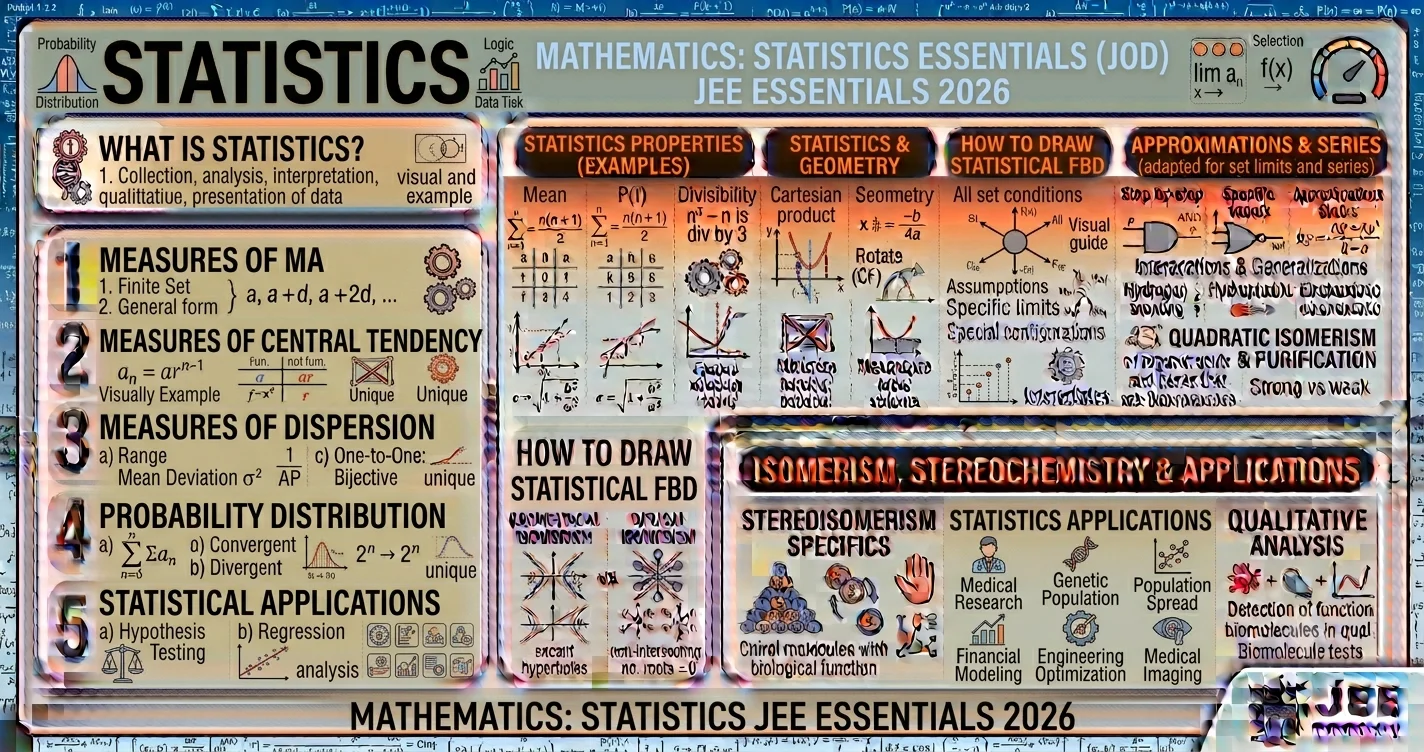
Complete Statistics Mastery Guide for JEE 2026
Why This Chapter is Important
Statistics is a highly scoring and straightforward chapter in JEE Mathematics:
- 1-2 questions in almost every JEE Main session (4-8 marks)
- Purely formula-based — no complex derivations needed
- Quick to solve if you remember the shortcuts
- Variance properties are conceptually simple but highly tested
- Combined Variance problems are standard and scoring
5-Step Exam Strategy
-
1
For Variance: Always use the shortcut \(\sigma^2 = \overline{x^2} - \bar{x}^2\) instead of \(\sum(x_i-\bar{x})^2/n\).
-
2
For Scaling: Remember "Variance scales by square". If \(y = ax+b\), \(\sigma_y^2 = a^2\sigma_x^2\).
-
3
For Combined Data: Calculate Combined Mean FIRST. Then find \(d_1, d_2\) to use the Combined Variance formula.
-
4
For Mean Deviation: Remember it is minimum about the Median.
-
5
For Wrong Observations: Correct the sums (\(\sum x_i\) and \(\sum x_i^2\)) first, then apply formulas.
Statistics — Complete JEE Study Guide
Statistics in JEE Main and Advanced focuses on numerical computations and properties of central tendency and dispersion. The most critical formula to memorize is the shortcut for variance: \(\sigma^2 = \frac{\sum x_i^2}{n} - \left(\frac{\sum x_i}{n}\right)^2\). This single formula can solve over 50% of the statistics questions in JEE, such as when given the sum of observations and sum of their squares, you are asked to find the variance.
Another highly tested concept is the scaling property of variance. If each observation is transformed as \(y_i = ax_i + b\), the mean transforms linearly (\(\bar{y} = a\bar{x} + b\)), but the variance scales by the square of the multiplier (\(\sigma_y^2 = a^2\sigma_x^2\)). This is because adding a constant 'b' shifts the data without changing its spread, while multiplying by 'a' scales the spread. The standard deviation scales by \(|a|\).
The combined mean and variance formula is another frequent visitor in JEE Main papers. When two groups with sizes \(n_1, n_2\), means \(\bar{x}_1, \bar{x}_2\), and variances \(\sigma_1^2, \sigma_2^2\) are merged, the combined mean is a simple weighted average. The combined variance, however, requires an extra term: \(\sigma_{12}^2 = \frac{n_1(\sigma_1^2 + d_1^2) + n_2(\sigma_2^2 + d_2^2)}{n_1 + n_2}\), where \(d_1 = \bar{x}_1 - \bar{x}_{12}\) and \(d_2 = \bar{x}_2 - \bar{x}_{12}\). Students must be careful to compute the combined mean accurately first, as any error there will propagate to the variance.
For Mean Deviation, remember the absolute value property: \(MD = \frac{\sum |x_i - A|}{n}\). The choice of 'A' matters; MD is minimized when \(A\) is the median. If the question asks for consistency between two players or teams, calculate the Coefficient of Variation (CV), given by \(CV = \frac{\sigma}{\bar{x}} \times 100\). The entity with the lower CV is more consistent.