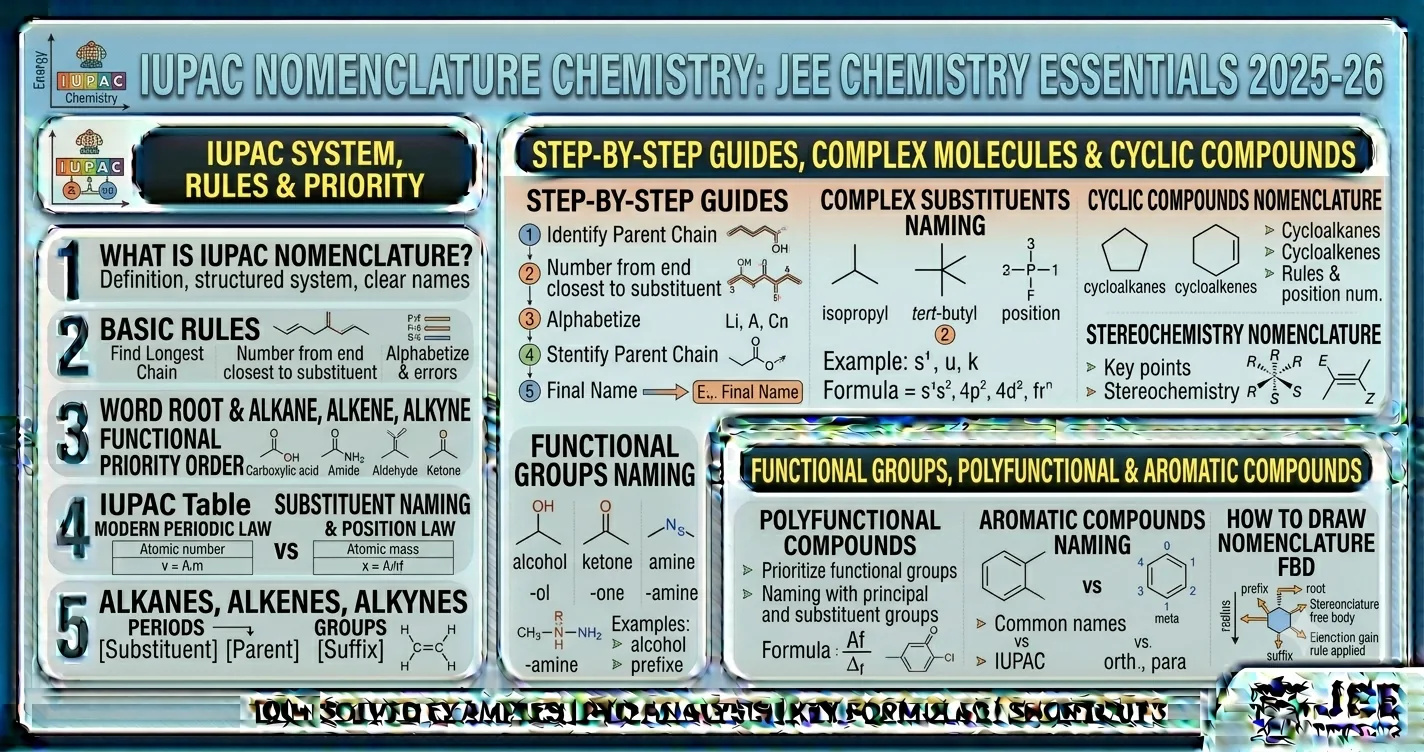
Complete IUPAC Nomenclature Mastery Guide for JEE 2026
Why IUPAC Nomenclature is Important
IUPAC Nomenclature forms the absolute foundation of organic chemistry for JEE:
- Direct Questions: 1 sure-shot question in JEE Main every session.
- Language of Organic Chemistry: You cannot understand reaction mechanisms or product identification without knowing nomenclature.
- Sets up Isomerism: Understanding complex substituents and parent chains directly translates to counting structural isomers.
- JEE Advanced Trap: Advanced often gives complex names and asks for the structure or stability, where a single locant error changes the molecule entirely.
Topic-wise Weightage Analysis
Must-Remember Formulas & Values
Functional Group Priority
-COOH > -SO₃H > -COOR > -COX
> -CONH₂ > -CN > -CHO > C=O
> -OH > -NH₂ > C=C / C≡C
Bicyclic Notation
Bicyclo[x.y.z]alkane
Total C = x + y + z + 2
Order: x > y > z
Locant Comparison
Rule: First Point of Difference
(2, 3, 5) beats (2, 4, 5)
DO NOT SUM!
Alphabetization
Ignore: di, tri, tetra
Include: iso, neo, cyclo
sec-, tert- are ignored
5-Step Exam Strategy
-
1
Identify Principal Group: Find the highest priority functional group; this dictates the suffix.
-
2
Find Parent Chain: Select the longest chain containing the principal group and max multiple bonds.
-
3
Number the Chain: Give lowest locant to the principal group, then multiple bonds, then substituents.
-
4
Apply First Point of Difference: Compare locant sets if numbering is ambiguous; do not sum.
-
5
Assemble & Alphabetize: Write prefixes alphabetically (ignoring di/tri), enclose complex substituents in parentheses.
7-Day IUPAC Nomenclature Mastery Roadmap
Basics
- • Word roots
- • Prefixes/suffixes
- • Simple alkanes
Locants
- • Lowest set rule
- • First point of diff
- • Practice sets
Priority
- • Priority order
- • Prefix vs suffix
- • Multi-functional
En-Yne
- • Double/triple bonds
- • Lowest locant rule
- • Practice
Bicyclic
- • Bridgehead carbons
- • [x.y.z] notation
- • Spiro compounds
Aromatic
- • Benzene rules
- • Retained names
- • o, m, p notation
PYQs
- • 50+ PYQs
- • Complex substituents
- • Revision
IUPAC Nomenclature — Complete JEE Study Guide
IUPAC Nomenclature is the systematic method of naming organic compounds as prescribed by the International Union of Pure and Applied Chemistry. It is a foundational chapter for JEE Main & Advanced Organic Chemistry. The chapter covers the identification of the longest carbon chain, assigning lowest locants, recognizing functional group priority, and naming complex structures like bicyclic and aromatic compounds.
The most critical topic for JEE is the functional group priority order. Students must memorize the sequence: Carboxylic acid > Sulphonic acid > Ester > Acid halide > Amide > Nitrile > Aldehyde > Ketone > Alcohol > Amine > Alkene/Alkyne. The highest priority group acts as the suffix, while others become prefixes (e.g., ketone becomes 'oxo', alcohol becomes 'hydroxy').
Another high-weightage area is the First Point of Difference rule for numbering. Instead of adding up the locants of substituents, JEE requires students to compare them as a sequence (e.g., 2,3,5 is lower than 2,4,5 because at the second position, 3 is less than 4). Furthermore, naming bicyclic compounds using the bicyclo[x.y.z]alkane format, where x, y, z represent the number of carbons in the three bridges between the two bridgehead carbons in decreasing order, is a frequent JEE Advanced concept.
For aromatic compounds, students should be familiar with both systematic and retained names (like toluene, phenol, aniline, benzoic acid). When multiple substituents are present, numbering must prioritize the principal functional group as C1, followed by alphabetical ordering of the remaining substituents to achieve the lowest locant set.