
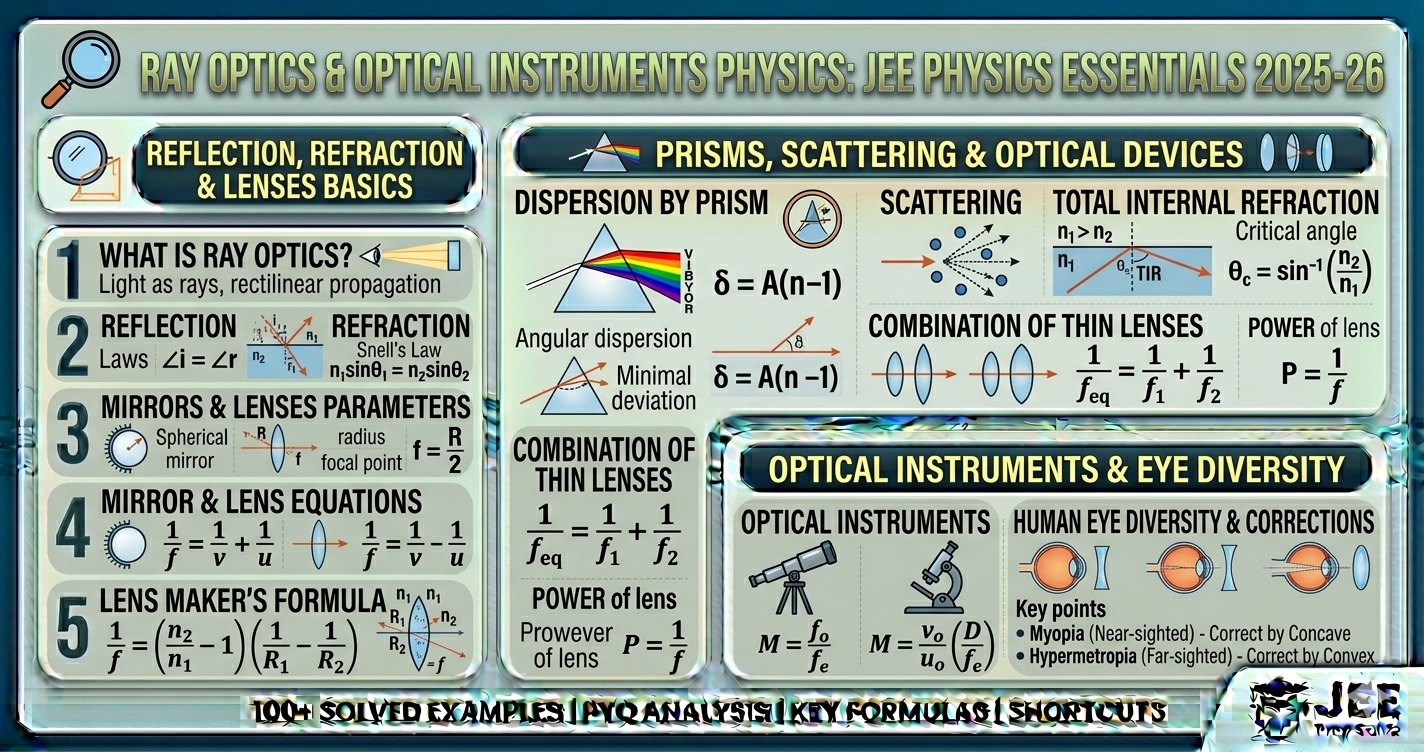
Ray Optics - Complete Guide for JEE 2025-26
Why Ray Optics is Important for JEE?
Ray Optics is one of the highest-scoring chapters in JEE Physics. It carries 5-6% weightage with formula-based questions that are easy to solve if concepts are clear:
- Mirror & Lens formulas - Direct numerical problems (most common)
- Total Internal Reflection - Concept-based MCQs
- Prism Problems - Minimum deviation calculations
- Optical Instruments - Magnifying power formulas
In JEE Advanced, ray optics questions often involve multi-concept problems combining mirrors, lenses, and refraction at surfaces.
Key Formulas to Remember
1. Must-Know Formulas
- • Mirror: 1/f = 1/v + 1/u, m = −v/u
- • Lens: 1/f = 1/v − 1/u, m = v/u
- • Snell's Law: n₁sinθ₁ = n₂sinθ₂
- • Lens Maker's: 1/f = (μ−1)(1/R₁ − 1/R₂)
- • Power: P = 1/f (in meters)
- • Prism: μ = sin[(A+δₘ)/2] / sin(A/2)
2. Quick Shortcuts
- • Thin prism: δ = (μ−1)A
- • Apparent depth = Real depth / n
- • Critical angle: sinC = 1/n
- • Telescope (normal): m = f₀/fₑ
📚 How to Study Ray Optics Effectively?
For JEE Main Students:
- Time Required: 4-5 days (2-3 hours/day)
- Master sign convention first — it's the foundation
- Practice 50+ numericals on mirror & lens formula
- Memorize image formation tables for mirrors & lenses
- Solve 20+ TIR and prism problems
- Learn magnifying power formulas for all instruments
For JEE Advanced Students:
- Time Required: 7-8 days (3 hours/day)
- Master refraction at curved surfaces formula
- Practice silvered lens and combination problems
- Solve multi-concept problems (mirror + lens + slab)
- Study image velocity in mirrors and lenses
- Practice deviation without dispersion problems
⚠️ Common Mistakes to Avoid in JEE Exam
-
❌
Wrong sign convention: Object distance u is ALWAYS negative (object on left). Most students forget this and get wrong answers.
-
❌
Confusing mirror and lens formulas: Mirror: 1/f = 1/v + 1/u (plus sign). Lens: 1/f = 1/v − 1/u (minus sign). Similarly, m = −v/u (mirror) vs m = v/u (lens).
-
❌
Unit conversion in Power: P = 1/f requires f in METERS, not centimeters. f = 20 cm → P = 1/0.2 = +5D, NOT 1/20.
-
❌
TIR conditions: TIR only happens from denser to rarer medium. Many students try to apply it from rarer to denser — not possible!
-
❌
Ignoring lateral inversion: Convex mirror always gives virtual erect diminished image. Don't confuse with concave mirror properties.
📊 JEE Previous Year Question Analysis (2015-2024)
| Year | JEE Main | JEE Advanced | Topic Focus |
|---|---|---|---|
| 2024 | 2 Questions (8 marks) | 2 Questions (8 marks) | Lens combination, TIR, Prism deviation |
| 2023 | 1 Question (4 marks) | 3 Questions (10 marks) | Mirror formula, Refraction at curved surface |
| 2022 | 2 Questions (8 marks) | 2 Questions (7 marks) | Silvered lens, Optical fiber, Telescope |
Trend: JEE Advanced increasingly asks multi-step problems combining reflection, refraction, and lens concepts. Pure formula-based questions are becoming rare in Advanced — expect application-based problems.