
📑 Quick Navigation - Electromagnetic Induction

Electromagnetic Induction JEE Main & Advanced 2025-26

Master the complete chapter with detailed notes on Faraday's Laws, Lenz's Law, Motional EMF, Self & Mutual Inductance, LC Oscillations, and AC Generator. Includes 200+ solved problems, important formulas, and all JEE shortcuts.

📚 10 Complete Sections
✍️ 200+ Solved Examples
🎯 Quick Formulas
⭐⭐⭐⭐⭐ 4.9/5
287+ students rated this helpful
200+
Solved Examples
4 hrs
Study Time
Free
Always
Electromagnetic Induction JEE notes, Formulas, PYQs
Electromagnetic Induction - JEE Notes, Formulas, PYQs
1

Magnetic Flux

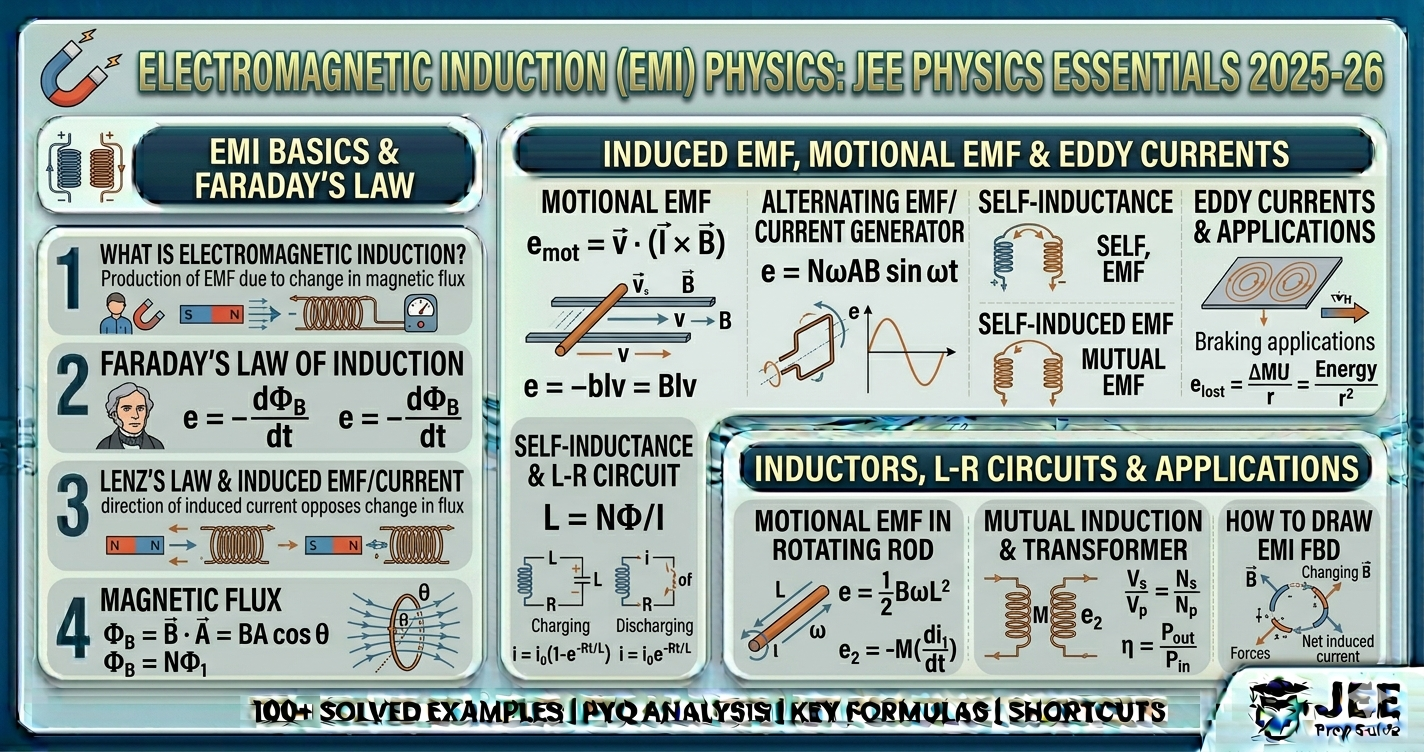
Magnetic flux is the measure of magnetic field passing through a given surface. It's the fundamental quantity in electromagnetic induction - changes in magnetic flux lead to induced EMF.

1.1 Definition of Magnetic Flux

Magnetic Flux (Φ)

\[\Phi = \vec{B} \cdot \vec{A} = BA\cos\theta\]

Where:

• Φ = Magnetic flux (Weber, Wb)

• B = Magnetic field (Tesla, T)

• A = Area of surface (m²)

• θ = Angle between B and area normal

For Non-uniform Field:

\[\Phi = \int \vec{B} \cdot d\vec{A}\]

Maximum Flux

(θ = 0°, B ⊥ surface)

\[\Phi_{max} = BA\]

Zero Flux

(θ = 90°, B ∥ surface)

\[\Phi = 0\]

SI Unit

Weber (Wb)

1 Wb = 1 T·m² = 1 V·s

1.2 Flux Linkage

Flux Linkage for Coil with N turns

\[\Phi_{total} = N\Phi = NBA\cos\theta\]

Total flux linkage = Number of turns × Flux through each turn

💡 Ways to Change Magnetic Flux

Flux can be changed by varying:

  1. Magnetic field (B): Moving magnet, changing current
  2. Area (A): Expanding/contracting loop, sliding wire
  3. Angle (θ): Rotating coil in magnetic field
  4. Number of turns (N): Rarely used practically

📝 Solved Example 1

Question: A circular coil of radius 10 cm and 50 turns is placed with its plane at 60° to a uniform magnetic field of 0.2 T. Calculate the magnetic flux through the coil.

Solution:

Given: r = 0.1 m, N = 50, B = 0.2 T

Plane at 60° to B means normal at θ = 90° - 60° = 30° to B

Area of coil:

\[A = \pi r^2 = \pi (0.1)^2 = 0.01\pi \text{ m}^2\]

Total flux linkage:

\[\Phi = NBA\cos\theta = 50 \times 0.2 \times 0.01\pi \times \cos 30°\]
\[\Phi = 50 \times 0.2 \times 0.01\pi \times \frac{\sqrt{3}}{2}\]
\[\Phi = 0.0866\pi = 0.272 \text{ Wb}\]
2

Faraday's Laws of Electromagnetic Induction

Michael Faraday discovered that changing magnetic flux through a circuit induces an electromotive force (EMF). This is the foundation of electric generators, transformers, and most modern electrical technology.

2.1 Faraday's First Law

First Law

"Whenever the magnetic flux linked with a circuit changes, an EMF is induced in the circuit. The induced EMF lasts as long as the change in flux continues."

Key Points:

  • EMF is induced only when flux changes
  • Constant flux → No induced EMF
  • Faster the change → Greater the induced EMF

2.2 Faraday's Second Law

Second Law (Quantitative)

"The magnitude of induced EMF is equal to the rate of change of magnetic flux linkage with the circuit."

\[\varepsilon = -\frac{d\Phi}{dt}\]

For a coil with N turns:

\[\varepsilon = -N\frac{d\Phi}{dt}\]

The negative sign represents Lenz's Law

💡 Average vs Instantaneous EMF

Average EMF:

\[\varepsilon_{avg} = -N\frac{\Delta\Phi}{\Delta t} = -N\frac{\Phi_2 - \Phi_1}{t_2 - t_1}\]

Instantaneous EMF:

\[\varepsilon = -N\frac{d\Phi}{dt}\]

2.3 Induced Current and Charge

Induced Current

\[I = \frac{\varepsilon}{R} = -\frac{N}{R}\frac{d\Phi}{dt}\]

Where R is the total resistance of the circuit

Total Charge Flowed:

\[Q = \int I \, dt = -\frac{N}{R}\int d\Phi = \frac{N\Delta\Phi}{R} = \frac{N(\Phi_1 - \Phi_2)}{R}\]

Note: Charge depends only on total change in flux, not on time taken!

⚠️ Important JEE Points

  • Induced EMF is independent of resistance of circuit
  • Induced current depends on resistance (I = ε/R)
  • Charge flowed is independent of time (depends only on ΔΦ)
  • EMF can exist even in open circuit (no current flows)
  • For EMF: consider rate of change; For charge: consider total change

📝 Solved Example 2

Question: A coil of 100 turns and resistance 20 Ω is placed in a magnetic field. The magnetic flux through the coil changes from 0.05 Wb to 0.02 Wb in 0.1 s. Calculate: (a) Average induced EMF (b) Average induced current (c) Total charge flowed.

Solution:

Given: N = 100, R = 20 Ω, Φ₁ = 0.05 Wb, Φ₂ = 0.02 Wb, Δt = 0.1 s

(a) Average EMF:

\[\varepsilon = -N\frac{\Delta\Phi}{\Delta t} = -100 \times \frac{(0.02 - 0.05)}{0.1}\]
\[\varepsilon = -100 \times \frac{-0.03}{0.1} = 100 \times 0.3\]
\[\varepsilon = 30 \text{ V}\]

(b) Average current:

\[I = \frac{\varepsilon}{R} = \frac{30}{20}\]
\[I = 1.5 \text{ A}\]

(c) Total charge:

\[Q = \frac{N|\Delta\Phi|}{R} = \frac{100 \times 0.03}{20}\]
\[Q = 0.15 \text{ C}\]

Verification: Q = I × t = 1.5 × 0.1 = 0.15 C ✓

3

Lenz's Law

Lenz's Law determines the direction of induced current. It's a consequence of conservation of energy and is represented by the negative sign in Faraday's law.

3.1 Statement of Lenz's Law

Lenz's Law

"The direction of induced EMF (or induced current) is always such as to oppose the cause that produces it."

In other words:

  • If flux is increasing → Induced current creates opposing flux (opposite direction)
  • If flux is decreasing → Induced current creates supporting flux (same direction)

3.2 Lenz's Law and Conservation of Energy

💡 Physical Significance

Lenz's Law is a direct consequence of Conservation of Energy:

  • If induced current aided the change, flux would increase further
  • This would induce more current → More flux → Infinite energy!
  • This violates conservation of energy
  • Hence, induced current must oppose the change

3.3 Applying Lenz's Law - Examples

Situation Flux Change Induced Current Direction
N-pole approaching coil Increasing (into coil) Anticlockwise (creates N-pole to repel)
N-pole receding from coil Decreasing (from coil) Clockwise (creates S-pole to attract)
S-pole approaching coil Increasing (from coil) Clockwise (creates S-pole to repel)
S-pole receding from coil Decreasing (into coil) Anticlockwise (creates N-pole to attract)
Current in nearby coil increasing Increasing Opposite to primary current
Current in nearby coil decreasing Decreasing Same direction as primary current

⚠️ Key Point: Opposition vs Current Direction

The induced current opposes the CHANGE in flux, not the flux itself!

  • If B is increasing upward → Induced B is downward
  • If B is decreasing upward → Induced B is upward
  • Induced current opposes change, not the original flux

📝 Solved Example 3

Question: A bar magnet is dropped through a vertical copper tube. Explain why it falls slower than in free fall and describe the nature of induced currents.

Solution:

Analysis using Lenz's Law:

1. As magnet approaches a section of tube:

  • Flux through that section increases
  • Induced current creates magnetic field opposing this increase
  • This field repels the approaching magnet

2. As magnet recedes from a section:

  • Flux through that section decreases
  • Induced current creates magnetic field opposing this decrease
  • This field attracts the receding magnet

3. Net Effect:

Both repulsion from below and attraction from above oppose the motion of the magnet.

This creates a retarding force → Magnet falls with acceleration < g

Eventually reaches terminal velocity when magnetic drag = weight

Note: Energy of magnet's gravitational PE is converted to heat in the tube due to induced eddy currents.

4

Motional EMF

When a conductor moves through a magnetic field, an EMF is induced due to the magnetic force on the free charges in the conductor. This is called motional EMF and is extremely important for JEE.

4.1 EMF in a Straight Conductor Moving in Magnetic Field

Motional EMF Formula

\[\varepsilon = BvL\]

Where:

• B = Magnetic field (T)

• v = Velocity of conductor (m/s)

• L = Length of conductor in the field (m)

General Vector Form:

\[\varepsilon = \int (\vec{v} \times \vec{B}) \cdot d\vec{l}\]

Conditions:

  • v, B, and L should be mutually perpendicular for maximum EMF
  • If v makes angle θ with B: ε = BvL sinθ
  • EMF = 0 if v is parallel to B or L

4.2 Understanding Motional EMF (Force Approach)

💡 Physical Explanation

  1. Free electrons in the moving conductor experience Lorentz force F = qvB
  2. Electrons accumulate at one end → Creates potential difference
  3. Equilibrium when electric force = magnetic force: qE = qvB
  4. This gives: E = vB
  5. EMF = E × L = BvL

4.3 Sliding Wire on Rails

Sliding Wire Problem

A wire of length L slides on two parallel rails connected by resistance R in a magnetic field B.

Induced EMF:

\[\varepsilon = BvL\]

Induced Current:

\[I = \frac{BvL}{R}\]

Magnetic Force on Wire:

\[F = BIL = \frac{B^2L^2v}{R}\]

(This opposes motion - Lenz's law)

Power Dissipated:

\[P = I^2R = \frac{B^2L^2v^2}{R}\]

4.4 Rotating Conductor in Magnetic Field

Rod Rotating About One End

A rod of length L rotates about one end with angular velocity ω in a perpendicular magnetic field B.

Induced EMF:

\[\varepsilon = \frac{1}{2}BL^2\omega = \frac{1}{2}BLv\]

where v = ωL is velocity of the free end

Derivation:

Consider element dx at distance x from pivot:

dε = B(ωx)dx

ε = ∫₀ᴸ Bωx dx = Bω[x²/2]₀ᴸ = ½BωL²

Rod Rotating About Center

Induced EMF:

\[\varepsilon = 0\]

EMF in two halves are equal and opposite, hence cancel out!

Rotating Disc (Faraday Disc)

A disc of radius R rotates with angular velocity ω in perpendicular magnetic field B.

EMF between center and rim:

\[\varepsilon = \frac{1}{2}BR^2\omega\]

📝 Solved Example 4 (JEE Advanced Pattern)

Question: A rod of length 1 m and mass 0.5 kg slides without friction on two horizontal parallel rails 1 m apart, connected by a resistance of 2 Ω. A uniform magnetic field of 0.5 T exists perpendicular to the rails. The rod is given an initial velocity of 4 m/s. Find: (a) Initial EMF (b) Initial current (c) Initial retardation (d) Distance traveled before stopping.

Solution:

Given: L = 1 m, m = 0.5 kg, R = 2 Ω, B = 0.5 T, v₀ = 4 m/s

(a) Initial EMF:

\[\varepsilon_0 = Bv_0L = 0.5 \times 4 \times 1 = 2 \text{ V}\]

(b) Initial current:

\[I_0 = \frac{\varepsilon_0}{R} = \frac{2}{2} = 1 \text{ A}\]

(c) Initial retardation:

\[F = BI_0L = 0.5 \times 1 \times 1 = 0.5 \text{ N}\]
\[a = \frac{F}{m} = \frac{0.5}{0.5} = 1 \text{ m/s}^2\]

(d) Distance before stopping:

Note: This is NOT constant deceleration! As v decreases, F decreases.

Using energy conservation:

\[\text{Initial KE} = \text{Heat dissipated in R}\]
\[\frac{1}{2}mv_0^2 = \int_0^t I^2R \, dt\]

Using impulse-momentum (simpler approach):

\[m\frac{dv}{dt} = -\frac{B^2L^2v}{R}\]
\[v = v_0 e^{-\frac{B^2L^2}{mR}t}\]

Distance = ∫v dt from 0 to ∞:

\[s = \frac{mRv_0}{B^2L^2} = \frac{0.5 \times 2 \times 4}{0.25 \times 1}\]
\[s = 16 \text{ m}\]
5

Eddy Currents

When a bulk conductor is exposed to changing magnetic flux, currents are induced throughout its volume. These circulating currents are called eddy currents (or Foucault currents).

5.1 Properties of Eddy Currents

Characteristics

  • Circulating currents in planes perpendicular to magnetic field
  • Follow Lenz's Law - oppose the change causing them
  • Produce heating effect (I²R losses)
  • Magnitude depends on conductivity and rate of flux change
  • Create magnetic braking effect (oppose relative motion)

5.2 Applications of Eddy Currents

Useful Applications ✓
  • Electromagnetic braking: Trains, roller coasters
  • Induction heating: Cooking, metal melting
  • Metal detectors: Security, archaeology
  • Damping in galvanometers: Dead-beat galvanometer
  • Speedometers: In vehicles
  • Energy meters: Watt-hour meters
Undesirable Effects ✗
  • Energy loss: In transformers, motors
  • Heating: Cores of electrical machines
  • Reduced efficiency: Due to eddy current losses

How to reduce eddy currents:

  • Use laminated cores (thin insulated sheets)
  • Use high resistivity materials

💡 Electromagnetic Braking

When a metal plate moves through a magnetic field:

  • Eddy currents are induced in the plate
  • These currents create their own magnetic field
  • Interaction with external field produces retarding force
  • Force is proportional to velocity: F ∝ v (like viscous drag)
  • Advantages: No wear, no overheating, smooth braking
6

Self Inductance

Self inductance is the property of a coil by which it opposes any change in current through it by inducing an EMF in itself. It's the electrical equivalent of inertia in mechanics.

6.1 Definition of Self Inductance

Self Inductance (L)

In terms of flux:

\[L = \frac{N\Phi}{I}\]

Flux linkage per unit current

In terms of EMF:

\[\varepsilon = -L\frac{dI}{dt}\]

Self-induced EMF (back EMF)

SI Unit: Henry (H) = V·s/A = Wb/A = Ω·s

Dimension: [ML²T⁻²A⁻²]

6.2 Self Inductance of Standard Configurations

Configuration Self Inductance (L) Notes
Solenoid L = μ₀n²Al = μ₀N²A/l n = N/l = turns per unit length
Toroid L = μ₀N²A/(2πr) r = mean radius of toroid
Coaxial Cable L = (μ₀l/2π)ln(b/a) a, b = inner, outer radii
Single Loop L ≈ μ₀R[ln(8R/a) - 2] R = loop radius, a = wire radius

Energy Stored in Inductor

\[U = \frac{1}{2}LI^2\]

This energy is stored in the magnetic field.

Energy Density in Magnetic Field:

\[u = \frac{B^2}{2\mu_0}\]

Energy per unit volume (J/m³)

💡 Analogy: Inductor vs Capacitor

Property Inductor Capacitor
Stores energy in Magnetic field Electric field
Energy formula U = ½LI² U = ½CV²
Opposes change in Current Voltage
Energy density B²/2μ₀ ½ε₀E²

📝 Solved Example 5

Question: A solenoid has 1000 turns, length 50 cm, and cross-sectional area 10 cm². Calculate: (a) Self inductance (b) Energy stored when current is 2 A (c) EMF induced when current changes at 100 A/s.

Solution:

Given: N = 1000, l = 0.5 m, A = 10×10⁻⁴ m² = 10⁻³ m²

(a) Self inductance:

\[L = \frac{\mu_0 N^2 A}{l} = \frac{4\pi \times 10^{-7} \times (1000)^2 \times 10^{-3}}{0.5}\]
\[L = \frac{4\pi \times 10^{-7} \times 10^6 \times 10^{-3}}{0.5} = \frac{4\pi \times 10^{-4}}{0.5}\]
\[L = 8\pi \times 10^{-4} = 2.51 \times 10^{-3} \text{ H} = 2.51 \text{ mH}\]

(b) Energy stored at I = 2 A:

\[U = \frac{1}{2}LI^2 = \frac{1}{2} \times 2.51 \times 10^{-3} \times (2)^2\]
\[U = 5.02 \times 10^{-3} \text{ J} = 5.02 \text{ mJ}\]

(c) Induced EMF at dI/dt = 100 A/s:

\[\varepsilon = L\frac{dI}{dt} = 2.51 \times 10^{-3} \times 100\]
\[\varepsilon = 0.251 \text{ V} = 251 \text{ mV}\]
7

Mutual Inductance

Mutual inductance is the property by which a change in current in one coil induces an EMF in a neighboring coil. This is the principle behind transformers.

7.1 Definition of Mutual Inductance

Mutual Inductance (M)

In terms of flux:

\[M = \frac{N_2\Phi_{21}}{I_1} = \frac{N_1\Phi_{12}}{I_2}\]

In terms of EMF:

\[\varepsilon_2 = -M\frac{dI_1}{dt}\]

Reciprocity:

M₁₂ = M₂₁ = M (Mutual inductance is symmetric)

7.2 Coefficient of Coupling

Coupling Coefficient (k)

\[M = k\sqrt{L_1 L_2}\]

Where: 0 ≤ k ≤ 1

• k = 1: Perfect coupling (all flux links both coils)

• k = 0: No coupling (coils are far apart/perpendicular)

• 0 < k < 1: Partial coupling (practical transformers)

7.3 Mutual Inductance of Standard Configurations

Configuration Mutual Inductance (M)
Two coaxial solenoids
(one inside other)
M = μ₀n₁n₂Al = μ₀N₁N₂A/l
Two coils wound on same core
(perfect coupling, k=1)
M = √(L₁L₂)
Coaxial loops
(distance d >> radii)
M = μ₀πR₁²R₂²/(2d³)

7.4 Combination of Inductors

Series Combination

With aiding (same direction):

\[L_{eq} = L_1 + L_2 + 2M\]

With opposing (opposite direction):

\[L_{eq} = L_1 + L_2 - 2M\]
Parallel Combination

With aiding:

\[\frac{1}{L_{eq}} = \frac{L_1 + L_2 + 2M}{L_1L_2 - M^2}\]

Without mutual inductance (M=0):

\[\frac{1}{L_{eq}} = \frac{1}{L_1} + \frac{1}{L_2}\]
8

LR Circuits (Growth & Decay)

When an inductor is connected to a circuit, the current doesn't change instantaneously due to self-induced EMF. This leads to exponential growth and decay of current.

8.1 Growth of Current in LR Circuit

Current Growth (Charging)

When switch is closed to connect battery:

Current:

\[I(t) = I_0(1 - e^{-t/\tau}) = \frac{E}{R}(1 - e^{-Rt/L})\]

Maximum/Steady Current:

\[I_0 = \frac{E}{R}\]

Time Constant:

\[\tau = \frac{L}{R}\]

At t = τ:

I = I₀(1 - e⁻¹) = I₀(1 - 0.368) = 0.632 I₀ ≈ 63.2%

8.2 Decay of Current in LR Circuit

Current Decay (Discharging)

When battery is disconnected (circuit closed through R):

Current:

\[I(t) = I_0 e^{-t/\tau} = I_0 e^{-Rt/L}\]

At t = τ:

I = I₀e⁻¹ = 0.368 I₀ ≈ 36.8%

💡 Analogy: LR vs RC Circuit

Property LR Circuit RC Circuit
Time constant τ = L/R τ = RC
Growth I = I₀(1-e^(-t/τ)) q = q₀(1-e^(-t/τ))
Decay I = I₀e^(-t/τ) q = q₀e^(-t/τ)
Initially Acts as open circuit Acts as short circuit
Finally (steady) Acts as short circuit Acts as open circuit
9

LC Oscillations

When a charged capacitor is connected to an inductor, energy oscillates between electric field (capacitor) and magnetic field (inductor). This is analogous to mechanical oscillations.

9.1 LC Oscillation Equations

LC Circuit Oscillation

Angular Frequency:

\[\omega = \frac{1}{\sqrt{LC}}\]

Frequency:

\[f = \frac{1}{2\pi\sqrt{LC}}\]

Time Period:

\[T = 2\pi\sqrt{LC}\]

Charge and Current

Charge:

\[q = q_0 \cos(\omega t)\]

Current:

\[I = -q_0\omega \sin(\omega t) = I_0\cos(\omega t + \frac{\pi}{2})\]

Maximum Current:

\[I_0 = q_0\omega = \frac{q_0}{\sqrt{LC}}\]

9.2 Energy in LC Oscillations

Energy Conservation

Energy in Capacitor:

\[U_C = \frac{q^2}{2C} = \frac{q_0^2}{2C}\cos^2(\omega t)\]

Energy in Inductor:

\[U_L = \frac{1}{2}LI^2 = \frac{q_0^2}{2C}\sin^2(\omega t)\]

Total Energy (Constant):

\[U_{total} = U_C + U_L = \frac{q_0^2}{2C} = \frac{1}{2}LI_0^2\]

💡 Analogy: LC Circuit vs Spring-Mass System

LC Circuit Spring-Mass
Charge q Displacement x
Current I Velocity v
Inductance L Mass m
1/C Spring constant k
ω = 1/√LC ω = √(k/m)
q²/2C (electric energy) ½kx² (potential energy)
½LI² (magnetic energy) ½mv² (kinetic energy)
10

AC Generator & Transformer

AC generators and transformers are practical applications of electromagnetic induction. They are fundamental to power generation and distribution.

10.1 AC Generator (Alternator)

Principle & Working

A coil rotates in a magnetic field, changing the flux through it continuously.

Magnetic Flux:

\[\Phi = NBA\cos(\omega t)\]

Induced EMF:

\[\varepsilon = -\frac{d\Phi}{dt} = NBA\omega\sin(\omega t) = \varepsilon_0\sin(\omega t)\]

Peak EMF:

\[\varepsilon_0 = NBA\omega = NBA \times 2\pi f\]

10.2 Transformer

Transformer Equations

Works on mutual induction - AC in primary induces AC in secondary.

Transformation Ratio:

\[\frac{V_s}{V_p} = \frac{N_s}{N_p} = \frac{I_p}{I_s} = k\]

Step-Up Transformer:

Ns > Np (k > 1)

Vs > Vp (voltage increases)

Is < Ip (current decreases)

Step-Down Transformer:

Ns < Np (k < 1)

Vs < Vp (voltage decreases)

Is > Ip (current increases)

For Ideal Transformer:

\[V_p I_p = V_s I_s \text{ (Power in = Power out)}\]

Efficiency:

\[\eta = \frac{P_{out}}{P_{in}} = \frac{V_s I_s}{V_p I_p}\]

Losses: Copper loss (I²R), Iron loss (eddy currents, hysteresis), Flux leakage

⚠️ Important Points for JEE

  • Transformers work only with AC (need changing flux)
  • DC cannot be transformed directly
  • In transmission lines: Step up → High V, Low I → Less I²R loss → Step down
  • Laminated core reduces eddy current losses
  • Soft iron core (high μ, low hysteresis) preferred

📝 Previous Year Questions Analysis

JEE Main (Last 5 Years)

  • ✓ Faraday's Law & Lenz's Law: 30%
  • ✓ Motional EMF: 25%
  • ✓ Self & Mutual Inductance: 20%
  • ✓ LR & LC Circuits: 15%
  • ✓ Transformer & Generator: 10%

JEE Advanced (Last 5 Years)

  • ✓ Complex Motional EMF: 35%
  • ✓ LR/LC Circuit Analysis: 25%
  • ✓ Inductance Calculations: 20%
  • ✓ Energy Considerations: 12%
  • ✓ Mixed Concepts: 8%

Top 12 Most Repeated Question Types

  1. Rod sliding on rails in magnetic field - current, force, terminal velocity
  2. Rotating rod/disc in magnetic field - induced EMF
  3. Coil in changing magnetic field - induced EMF and current
  4. Self inductance of solenoid - calculation and energy
  5. LR circuit - growth/decay of current, time constant
  6. LC oscillations - frequency, energy distribution
  7. Mutual inductance between coaxial solenoids
  8. Direction of induced current using Lenz's law
  9. Transformer - turns ratio, efficiency problems
  10. Charge flowed when flux changes
  11. Eddy current applications and effects
  12. AC generator - peak and RMS values

Weightage Analysis

JEE Main: 12-16 marks (3-4 questions)
JEE Advanced: 15-22 marks (4-6 questions)
Difficulty Level: Medium to Hard
Time Required: 6-8 hours practice

🎯 Practice Problem Set

Level 1: Basic (JEE Main Standard)

  1. A coil of 200 turns and area 100 cm² is placed perpendicular to magnetic field 0.1 T. Find flux through coil.
  2. Magnetic flux through a coil changes from 0.4 Wb to 0.1 Wb in 0.2 s. Find average induced EMF.
  3. A rod of length 50 cm moves at 5 m/s perpendicular to field 0.2 T. Find motional EMF.
  4. Find self inductance of solenoid with 500 turns, length 25 cm, area 10 cm².
  5. An inductor of 2 H carries current 3 A. Calculate energy stored.
  6. Calculate time constant for LR circuit with L = 5 H and R = 10 Ω.
  7. Find frequency of LC oscillations when L = 1 H and C = 1 μF.
  8. A transformer has 100 primary and 500 secondary turns. If V_p = 220 V, find V_s.

Level 2: Intermediate (JEE Main/Advanced)

  1. A rectangular loop (20 cm × 10 cm) enters a magnetic field of 0.5 T at 2 m/s. Find induced EMF when: (a) entering (b) completely inside (c) leaving.
  2. A rod of length 1 m rotates about one end at 10 rad/s in perpendicular field 0.5 T. Find EMF between ends.
  3. Two coaxial solenoids: inner (200 turns, 20 cm long) and outer (400 turns). Find mutual inductance if area = 5 cm².
  4. In LR circuit with E = 12 V, R = 6 Ω, L = 3 H, find: (a) time constant (b) current at t = 0.5 s (c) time to reach 63% of maximum.
  5. LC circuit has L = 10 mH, C = 100 μF. Initially capacitor has 10 V. Find: (a) frequency (b) maximum current (c) energy oscillation.
  6. A circular disc of radius 20 cm rotates at 300 rpm in perpendicular field 0.1 T. Find EMF between center and rim.
  7. Two inductors L₁ = 2 H, L₂ = 3 H with M = 1 H are connected in series aiding. Find L_eq.
  8. A metal rod slides on two parallel rails 50 cm apart at 5 m/s in field 0.4 T. If total resistance is 2 Ω, find: (a) EMF (b) current (c) force required to maintain motion (d) power dissipated.

Level 3: Advanced (JEE Advanced/Olympiad)

  1. A conducting rod of length L and mass m slides without friction on horizontal rails in vertical magnetic field B. Initial velocity is v₀. Derive expression for: (a) velocity as function of time (b) distance traveled before stopping.
  2. A square loop of side 'a' and resistance R moves with constant velocity v into a region of magnetic field B perpendicular to plane. Find current as function of distance moved.
  3. In LC circuit, at t = 0, capacitor has charge q₀. Derive expressions for: (a) q(t) (b) I(t) (c) energy in C and L at any time (d) show total energy is constant.
  4. A toroidal solenoid has N₁ turns on outer winding and N₂ on inner. Mean radius R, cross-section area A. Find: (a) Self inductance of each (b) Mutual inductance.
  5. In an LR circuit, switch is closed at t = 0 connecting battery E. Derive: (a) I(t) (b) power delivered by battery (c) power dissipated in R (d) rate of energy storage in L (e) verify energy conservation.
  6. A metal ring of radius R and resistance R is placed perpendicular to magnetic field B = B₀t². Find: (a) induced EMF (b) induced current (c) rate of heat production (d) force required to hold it stationary.
  7. Two coils have self inductances L₁ and L₂. When connected in series, total is 12 H (aiding) and 4 H (opposing). Find L₁, L₂ and M.
  8. A conducting rod of length L rotates about one end perpendicular to uniform field B with angular velocity ω. A resistance R connects the two ends. Find: (a) current (b) torque needed to maintain rotation (c) power dissipated.

Numerical Answer Type (NAT) Practice

  1. A coil of 100 turns, area 0.01 m² is rotated at 50 rps in field 0.2 T. Find peak EMF in volts. [Answer: ___]
  2. Solenoid: 1000 turns, l = 0.5 m, A = 10⁻³ m². Find self inductance in mH. [Answer: ___]
  3. LC circuit: L = 4 H, C = 25 μF. Find time period in ms. [Answer: ___]
  4. Transformer: N_p = 200, N_s = 50, V_p = 440 V. Find V_s in volts. [Answer: ___]
  5. LR circuit: L = 10 H, R = 5 Ω, E = 20 V. Find time to reach 90% of maximum current in seconds. [Answer: ___]
  6. Rod (length 0.5 m) slides at constant velocity in field 0.4 T. If EMF is 2 V, find velocity in m/s. [Answer: ___]
  7. Flux changes from 0.5 Wb to 0.1 Wb in 0.2 s through 200-turn coil of resistance 10 Ω. Find total charge flowed in coulombs. [Answer: ___]
  8. Inductor of 5 H carries current changing at 20 A/s. Find magnitude of induced EMF in volts. [Answer: ___]

📋 Quick Formula Sheet - Electromagnetic Induction

Magnetic Flux & Faraday's Law

Φ = B⃗·A⃗ = BAcosθ

ε = -dΦ/dt

ε = -N(dΦ/dt)

I = ε/R

Q = NΔΦ/R

Motional EMF

ε = BvL (straight rod)

ε = ½BωL² (rotating rod, one end)

ε = ½BR²ω (rotating disc)

F = BIL (force on rod)

F = B²L²v/R (retarding force)

Self Inductance

L = NΦ/I

ε = -L(dI/dt)

L = μ₀n²Al (solenoid)

U = ½LI² (energy)

u = B²/2μ₀ (energy density)

Mutual Inductance

M = N₂Φ₂₁/I₁

ε₂ = -M(dI₁/dt)

M = k√(L₁L₂)

M = μ₀n₁n₂Al (coaxial)

Series: L_eq = L₁+L₂±2M

LR Circuit

τ = L/R (time constant)

Growth: I = I₀(1-e^(-t/τ))

Decay: I = I₀e^(-t/τ)

I₀ = E/R (steady current)

At t=τ: 63.2% (growth)

LC Oscillations

ω = 1/√LC

f = 1/(2π√LC)

T = 2π√LC

q = q₀cos(ωt)

I = -q₀ωsin(ωt)

U = q₀²/2C = ½LI₀²

AC Generator

Φ = NBAcos(ωt)

ε = NBAωsin(ωt)

ε₀ = NBAω (peak)

ε_rms = ε₀/√2

Transformer

V_s/V_p = N_s/N_p

I_p/I_s = N_s/N_p

V_pI_p = V_sI_s (ideal)

η = P_out/P_in

k = N_s/N_p (transformation ratio)

Related Physics Notes

Electromagnetic Induction - Complete Guide for JEE 2025-26

Why EMI is THE Most Important Chapter?

Electromagnetic Induction (EMI) is arguably the most important chapter in JEE Physics electricity & magnetism. Here's why:

  • Highest Weightage: 10-12% of total physics marks in JEE
  • Foundation for AC: Connects directly to Alternating Current chapter
  • Practical Applications: Generators, transformers, motors - all based on EMI
  • Conceptual Depth: Tests understanding of Lenz's Law, energy conservation
  • Numerical Intensity: Heavy calculation-based questions in JEE Advanced
  • Mixed Problems: Often combined with mechanics (sliding rods, rotating discs)

In JEE Advanced 2024, 3 questions worth 18 marks were directly from EMI, making it one of the highest-scoring chapters.

Chapter-wise Important Topics

🔴 Must Know (100% Important)

  • • Faraday's Laws - all derivations and applications
  • • Lenz's Law - direction of induced current
  • • Motional EMF - rod sliding on rails (most asked!)
  • • Self inductance formulas and energy
  • • LC oscillations - frequency and energy

🟡 Very Important (90% Frequency)

  • • Rotating rod/disc EMF calculations
  • • LR circuit - growth and decay
  • • Mutual inductance and coupling
  • • Transformer equations and efficiency
  • • Eddy currents and applications

🟢 Important (70% Frequency)

  • • AC generator working and EMF
  • • Energy density in magnetic field
  • • Combination of inductors

📚 Proven Study Strategy for EMI

For JEE Main Students (Target: 95%+ accuracy):

  1. Day 1-2: Magnetic flux, Faraday's laws, Lenz's law (theory + 50 MCQs)
  2. Day 3-4: Motional EMF - all types (rod sliding, rotating) - 100 numericals
  3. Day 5: Self inductance, energy storage - formulas + 40 problems
  4. Day 6: LR circuits, LC oscillations - 60 problems
  5. Day 7: Mutual inductance, transformer - 40 problems
  6. Day 8: Mixed problems and PYQs (2015-2024)
  7. Focus: Master direction using Lenz's law - use right-hand rules

For JEE Advanced Students (Target: Top rank):

  1. Week 1: Deep conceptual understanding - derive all formulas
  2. Week 2: Complex motional EMF problems (non-uniform B, varying v)
  3. Week 3: LR/LC circuits with calculus - differential equations
  4. Week 4: Mixed mechanics + EMI (energy conservation, force analysis)
  5. Focus on: Problems where rod decelerates due to induced force
  6. Practice: HC Verma exercises, Irodov problems, DC Pandey
  7. Key Skill: Quick identification of flux change mechanism

⚠️ Top 10 Mistakes Students Make (Avoid These!)

  • Wrong direction of induced current: Always use Lenz's law - induced effect opposes the CHANGE, not the original flux
  • Forgetting negative sign in Faraday's law: ε = -dΦ/dt (negative is for Lenz's law)
  • Wrong formula for rotating rod: EMF about one end = ½BωL², NOT BωL
  • Confusing charge and current: Q = NΔΦ/R (independent of time), but I = ε/R (depends on rate)
  • Wrong time constant: For LR circuit τ = L/R (NOT L×R like RC)
  • LC oscillation frequency: f = 1/(2π√LC), not 1/√LC
  • Energy in inductor: U = ½LI² (like ½mv²), not ½L²I
  • Mutual inductance in series: L_eq = L₁ + L₂ ± 2M (don't forget the 2M term!)
  • Transformer works on DC: NO! Only AC (changing flux needed)
  • Not using energy conservation: In sliding rod problems, use KE = Heat dissipated for distance calculation

🎯 Conceptual Clarity - Must Understand Points

Why does rod slow down?

When rod moves → flux changes → current induced → force on current-carrying rod (F = BIL) → opposes motion (Lenz) → rod decelerates. Energy: KE → Electrical → Heat

Inductor vs Capacitor

Inductor opposes change in CURRENT (stores energy in B field). Capacitor opposes change in VOLTAGE (stores energy in E field). In LC: energy oscillates between them.

Why negative sign matters?

ε = -dΦ/dt: Negative sign is mathematical representation of Lenz's law. Induced EMF opposes flux change. Without it, we'd violate energy conservation!

Self vs Mutual Inductance

Self (L): Own current creates flux in itself. Mutual (M): Current in one coil creates flux in another. Transformers use mutual inductance.

⚡ Last Week Before JEE - Quick Revision Tips

🔥 High-Yield Topics

  • ✓ Rod on rails (90% probability)
  • ✓ Rotating rod EMF
  • ✓ LC frequency
  • ✓ Lenz's law direction
  • ✓ Transformer ratio

📝 Must Revise Formulas

  • ✓ ε = BvL, ½BωL², ½BR²ω
  • ✓ L = μ₀n²Al
  • ✓ f = 1/(2π√LC)
  • ✓ τ = L/R
  • ✓ Q = NΔΦ/R

⏰ Time Management

  • ✓ Lenz's law: 30 sec
  • ✓ Simple EMF: 1 min
  • ✓ LC/LR circuit: 2 min
  • ✓ Complex numericals: 3 min
  • ✓ Skip if stuck > 4 min

📊 PYQ Pattern Analysis (2015-2024)

Topic JEE Main Frequency JEE Advanced Frequency Difficulty
Motional EMF (rod sliding) ⭐⭐⭐⭐⭐ ⭐⭐⭐⭐⭐ Medium-Hard
Lenz's Law (direction) ⭐⭐⭐⭐⭐ ⭐⭐⭐⭐ Easy-Medium
LC Oscillations ⭐⭐⭐⭐ ⭐⭐⭐⭐⭐ Medium
Self Inductance ⭐⭐⭐⭐ ⭐⭐⭐⭐ Easy-Medium
LR Circuit (transient) ⭐⭐⭐ ⭐⭐⭐⭐⭐ Medium-Hard
Transformer ⭐⭐⭐ ⭐⭐ Easy