
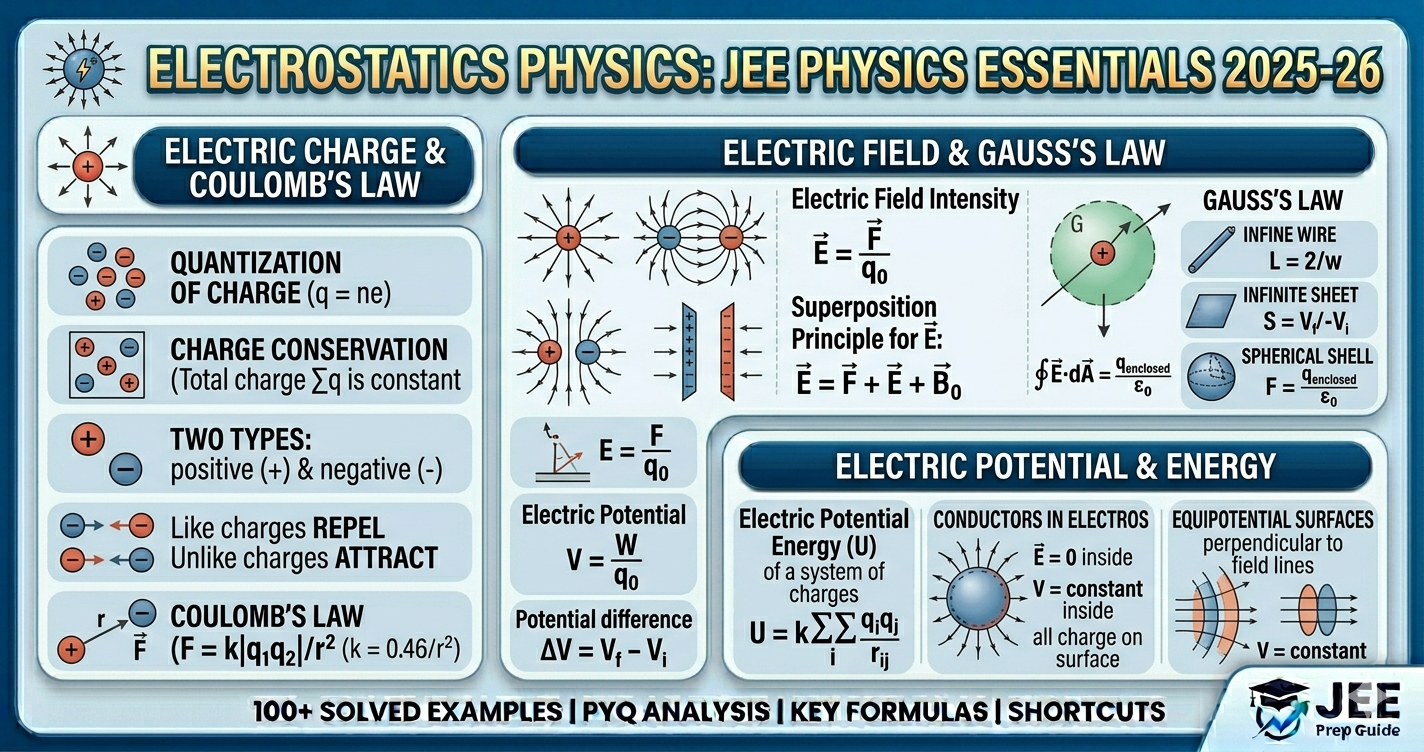
Electrostatics - Complete Guide for JEE 2025-26
Why Electrostatics is Crucial for JEE?
Electrostatics is one of the most important chapters in JEE Physics with a weightage of 10-12% in JEE Main and 12-15% in JEE Advanced. The concepts learned here form the foundation for:
- Current Electricity - Understanding potential difference and capacitance
- Electromagnetic Induction - Electric field concepts
- Modern Physics - Electron behavior in electric fields
- Numerical Problem Solving - Most questions are numerical type
Questions from electrostatics are generally scoring if concepts are clear. Gauss Law and Capacitors are the most frequently asked topics.
Key Topics & Formulas Must Know
1. Coulomb's Law & Superposition
F = kq₁q₂/r², Vector addition for multiple charges
2. Electric Field
E = kQ/r² (point), E = σ/2ε₀ (sheet), E = λ/2πε₀r (line)
3. Gauss Law (Most Important)
∮E·dA = Q/ε₀, Applications to sphere, cylinder, sheet
4. Electric Potential
V = kQ/r, E = -dV/dr, Work = qΔV
5. Capacitors (Highest Weightage)
C = Q/V, C = ε₀A/d, Energy = ½CV², Series/Parallel combinations
📚 How to Study Electrostatics Effectively?
For JEE Main Students:
- Time Required: 12-15 days (3-4 hours/day)
- Master Gauss Law applications - 30% questions from this
- Practice capacitor combinations - both series and parallel
- Solve 100+ numerical problems on electric field and potential
- Focus on dielectric effects - battery connected vs disconnected
- Memorize standard formulas for all charge distributions
For JEE Advanced Students:
- Time Required: 18-20 days (4-5 hours/day)
- Deep dive into complex capacitor networks
- Master energy conservation in electrostatic systems
- Practice variable capacitance problems
- Understand dipole in non-uniform field
- Solve multi-concept integration problems
- Practice derivations - asked in subjective questions
⚠️ Top 10 Mistakes to Avoid in JEE Exam
- Confusing E and V: Electric field is vector, potential is scalar. Use correct formulas.
- Battery connected vs disconnected: When dielectric is inserted, behavior is totally different in these two cases.
- Series capacitor formula: Use 1/C_eq = 1/C₁ + 1/C₂ (reciprocal), not direct sum.
- Gauss Law application: Only works for symmetric charge distributions (sphere, cylinder, sheet).
- Electric field inside conductor: Always zero in electrostatic equilibrium, not outside.
- Sign of charges: In potential energy U = kq₁q₂/r, don't forget to use correct signs.
- Equipotential surfaces: Always perpendicular to electric field, not parallel.
- Energy formula for capacitor: Choose correct formula based on given quantities (Q, V, or C).
- Electric field discontinuity: E changes abruptly at charged surface, but V is continuous.
- Superposition principle: Add vectors for E, but scalars for V (with proper signs).
📊 JEE Previous Year Question Analysis (2015-2024)
| Year | JEE Main | JEE Advanced | Most Asked Topic |
|---|---|---|---|
| 2024 | 3 Questions (12 marks) | 5 Questions (18 marks) | Capacitor with dielectric, Gauss Law |
| 2023 | 4 Questions (16 marks) | 4 Questions (15 marks) | Energy in capacitors, Electric field |
| 2022 | 3 Questions (12 marks) | 6 Questions (21 marks) | Potential energy, Capacitor combinations |
| 2021 | 4 Questions (16 marks) | 5 Questions (18 marks) | Gauss Law applications, Dipole |
Trend Analysis: Capacitor-based questions are increasing year by year. JEE Advanced is focusing more on multi-concept problems combining electrostatics with mechanics (electrostatic force + circular motion) or with calculus (variable capacitance).
📌 Topic-wise Weightage & Priority
Strategy: Focus 60% time on Capacitors and Gauss Law, 30% on Electric Field/Potential, 10% on remaining topics.