
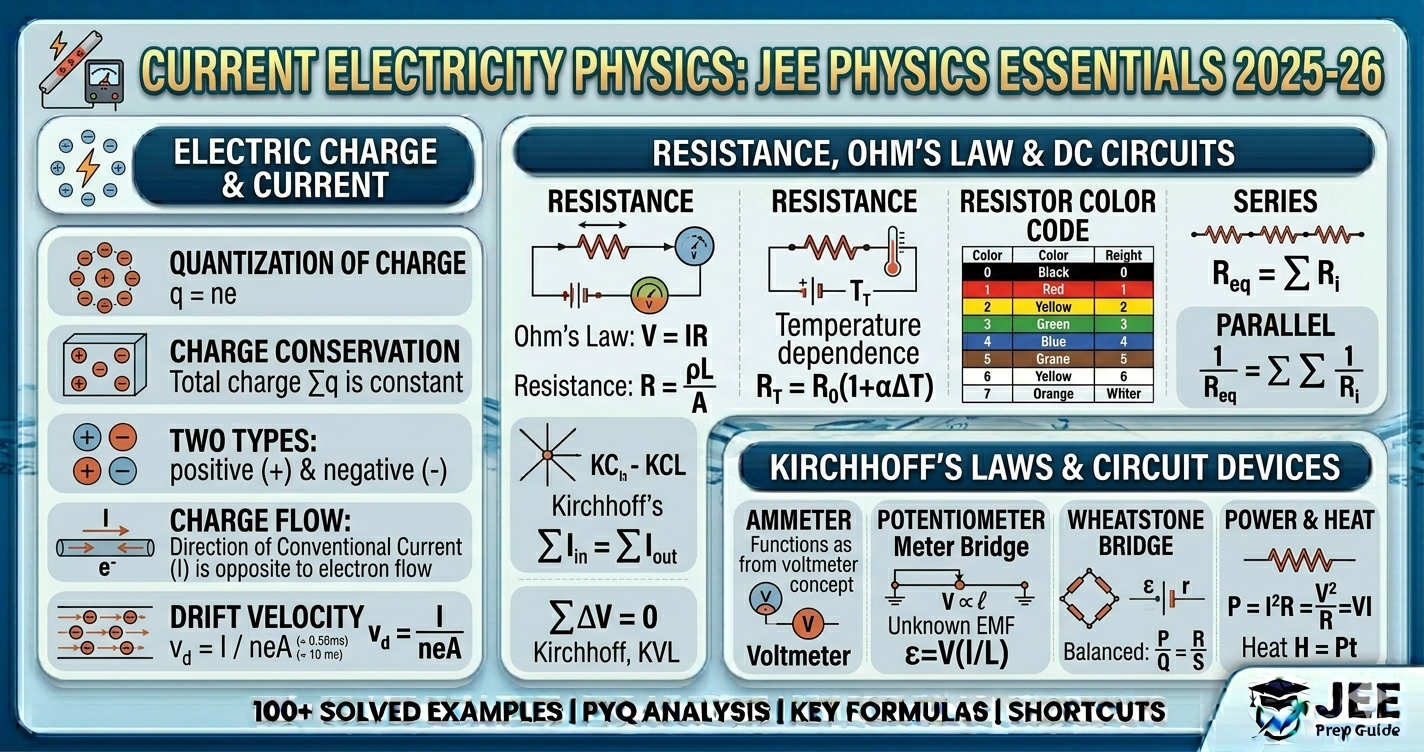
📑 Quick Navigation - Current Electricity

Current Electricity JEE Main & Advanced 2025-26

Master the complete chapter with detailed notes on Ohm's Law, Kirchhoff's Laws, RC Circuits, Wheatstone Bridge, and Potentiometer. Includes 150+ solved problems, important formulas, and all JEE shortcuts.

📚 8 Complete Sections
✍️ 150+ Solved Examples
🎯 Quick Formulas
⭐⭐⭐⭐⭐ 4.8/5
245+ students rated this helpful
150+
Solved Examples
3 hrs
Study Time
Free
Always
Current Electricity JEE notes, Formulas, PYQs
Current Electricity JEE Notes, Formulas, PYQs
1

Electric Current & Drift Velocity

Electric current is the rate of flow of electric charge through a conductor. Understanding the microscopic picture of current flow through drift velocity is fundamental to current electricity.

1.1 Electric Current - Definition

Electric Current Formula

\[I = \frac{dQ}{dt}\]

Where: I = Current (Ampere), Q = Charge (Coulomb), t = Time (second)

SI Unit: Ampere (A) = Coulomb/second (C/s)

Dimension: [I] = [AT]

💡 Important Points

  • Scalar Quantity: Current has magnitude but no direction (direction is conventional)
  • Conventional Current: Flow of positive charge (opposite to electron flow)
  • 1 Ampere: When 1 Coulomb charge flows in 1 second
  • Current Density (J): Current per unit area = I/A

1.2 Drift Velocity

When an electric field is applied across a conductor, free electrons acquire a small average velocity in the direction opposite to the field. This is called drift velocity.

Drift Velocity Formula

\[v_d = \frac{I}{nAe}\]

Where:

• vd = Drift velocity (m/s)

• I = Current (A)

• n = Number density of electrons (m⁻³)

• A = Cross-sectional area (m²)

• e = Charge of electron = 1.6 × 10⁻¹⁹ C

Alternative Form

\[I = nAev_d\]

This shows current is proportional to drift velocity

⚠️ Key Facts about Drift Velocity

  • Drift velocity is extremely small (~10⁻⁴ m/s)
  • Actual speed of electrons is very high (~10⁶ m/s) - thermal velocity
  • Electric field propagates at speed of light, not drift velocity
  • Drift velocity is inversely proportional to area (vd ∝ 1/A)
  • For same current, thinner wire has higher drift velocity

1.3 Current Density

Current Density

\[J = \frac{I}{A} = nev_d\]

SI Unit: A/m² (Ampere per square meter)

Vector Form: \(\vec{J} = ne\vec{v_d}\)

📝 Solved Example 1

Question: A current of 1.6 A flows through a copper wire of cross-sectional area 1 mm². If the number density of free electrons is 8.5 × 10²⁸ m⁻³, find the drift velocity.

Solution:

Given:

I = 1.6 A

A = 1 mm² = 1 × 10⁻⁶ m²

n = 8.5 × 10²⁸ m⁻³

e = 1.6 × 10⁻¹⁹ C

Using formula:

\[v_d = \frac{I}{nAe}\]
\[v_d = \frac{1.6}{8.5 \times 10^{28} \times 1 \times 10^{-6} \times 1.6 \times 10^{-19}}\]
\[v_d = \frac{1.6}{13.6 \times 10^{3}}\]
\[v_d = 1.18 \times 10^{-4} \text{ m/s} = 0.118 \text{ mm/s}\]

Note: This extremely small value shows electrons drift very slowly despite large current!

1.4 Relation between Electric Field and Drift Velocity

Drift Velocity & Electric Field

\[v_d = \frac{eE\tau}{m}\]

Where:

• E = Electric field (V/m)

• τ = Relaxation time (average time between collisions)

• m = Mass of electron = 9.1 × 10⁻³¹ kg

Mobility (μ):

\[\mu = \frac{v_d}{E} = \frac{e\tau}{m}\]

Unit: m²/(V·s)

2

Ohm's Law

Ohm's Law is one of the most fundamental laws in electricity. It relates voltage, current, and resistance in a simple linear relationship - the cornerstone of circuit analysis.

2.1 Statement of Ohm's Law

Ohm's Law

"At constant temperature, the current flowing through a conductor is directly proportional to the potential difference across it."

\[V = IR\]

Where:

• V = Potential difference (Volt)

• I = Current (Ampere)

• R = Resistance (Ohm, Ω)

\[V = IR\]

Voltage Formula

\[I = \frac{V}{R}\]

Current Formula

\[R = \frac{V}{I}\]

Resistance Formula

2.2 Ohmic vs Non-Ohmic Conductors

Aspect Ohmic Conductors Non-Ohmic Conductors
Ohm's Law Obeys (V ∝ I) Does not obey
V-I Graph Straight line through origin Non-linear curve
Resistance Constant (independent of V, I) Changes with V or I
Examples Copper wire, Carbon resistor, Nichrome Diode, Transistor, LED, Thermistor

💡 Conditions for Ohm's Law

  • Temperature must remain constant
  • Physical state should not change
  • No mechanical stress on the conductor
  • Valid only for metallic conductors at constant temperature

2.3 V-I Characteristics

V-I Graphs for Different Materials

Ohmic Conductor

Straight Line

V ∝ I

Slope = R (constant)

Diode

Exponential Curve

Forward bias: rapid increase

Reverse bias: almost zero current

Filament Lamp

Curved (concave up)

Resistance increases with temperature

📝 Solved Example 2

Question: A wire of resistance 10 Ω is connected across a battery of 12 V. Calculate (a) Current through wire (b) Charge flowing in 5 seconds (c) Number of electrons flowing.

Solution:

Given: R = 10 Ω, V = 12 V, t = 5 s

(a) Current:

\[I = \frac{V}{R} = \frac{12}{10} = 1.2 \text{ A}\]

(b) Charge:

\[Q = It = 1.2 \times 5 = 6 \text{ C}\]

(c) Number of electrons:

\[n = \frac{Q}{e} = \frac{6}{1.6 \times 10^{-19}}\]
\[n = 3.75 \times 10^{19} \text{ electrons}\]
3

Resistance & Resistivity

Resistance is the property of a material that opposes the flow of electric current. Understanding resistance, resistivity, and their dependence on various factors is crucial for circuit analysis.

3.1 Electrical Resistance

Resistance Formula

\[R = \frac{\rho L}{A}\]

Where:

• R = Resistance (Ω)

• ρ = Resistivity of material (Ω·m)

• L = Length of conductor (m)

• A = Cross-sectional area (m²)

Key Points:

  • R ∝ L (Resistance increases with length)
  • R ∝ 1/A (Resistance decreases with area)
  • SI Unit: Ohm (Ω)
  • Dimension: [ML²T⁻³A⁻²]

3.2 Resistivity (Specific Resistance)

Resistivity

\[\rho = \frac{RA}{L}\]

SI Unit: Ohm-meter (Ω·m)

Dimension: [ML³T⁻³A⁻²]

Resistivity is an intrinsic property of the material (independent of dimensions)

3.3 Conductivity & Conductance

Conductivity (σ)
\[\sigma = \frac{1}{\rho}\]

Unit: S/m or mho/m or Ω⁻¹m⁻¹

Also called: Siemens per meter

Conductance (G)
\[G = \frac{1}{R}\]

Unit: S (Siemens) or mho or Ω⁻¹

Measure of how easily current flows

3.4 Temperature Dependence of Resistance

Temperature Coefficient of Resistance

\[R_T = R_0[1 + \alpha(T - T_0)]\]

Where:

• RT = Resistance at temperature T

• R0 = Resistance at reference temperature T0

• α = Temperature coefficient of resistance (per °C)

For small temperature changes:

\[\alpha = \frac{R_T - R_0}{R_0(T - T_0)}\]
Material Type α Value Examples Behavior
Metals Positive (+) Cu, Al, Fe R increases with T
Semiconductors Negative (-) Si, Ge, Carbon R decreases with T
Alloys Very small Constantan, Manganin R almost constant
Insulators Negative (-) Glass, Mica R decreases with T

⚠️ Important JEE Facts

  • Resistivity of metals: ~10⁻⁸ to 10⁻⁶ Ω·m
  • Resistivity of semiconductors: ~10⁻³ to 10³ Ω·m
  • Resistivity of insulators: ~10¹¹ to 10¹⁹ Ω·m
  • Best conductors: Silver > Copper > Gold > Aluminum
  • Nichrome wire: Used in heaters (high resistivity, high melting point)

📝 Solved Example 3

Question: A copper wire of length 2 m and cross-sectional area 2 mm² has resistance 0.017 Ω at 20°C. Find (a) Resistivity of copper (b) Resistance at 100°C if α = 0.004 /°C.

Solution:

Given:

L = 2 m, A = 2 mm² = 2 × 10⁻⁶ m²

R₀ = 0.017 Ω at T₀ = 20°C

α = 0.004 /°C

(a) Resistivity:

\[\rho = \frac{RA}{L} = \frac{0.017 \times 2 \times 10^{-6}}{2}\]
\[\rho = 1.7 \times 10^{-8} \text{ Ω·m}\]

(b) Resistance at 100°C:

\[R_{100} = R_0[1 + \alpha(T - T_0)]\]
\[R_{100} = 0.017[1 + 0.004(100 - 20)]\]
\[R_{100} = 0.017[1 + 0.004 \times 80]\]
\[R_{100} = 0.017[1 + 0.32] = 0.017 \times 1.32\]
\[R_{100} = 0.0224 \text{ Ω}\]
4

Kirchhoff's Laws

Kirchhoff's Laws are fundamental to analyzing complex electrical circuits. These laws are based on conservation of charge and energy - two of the most important principles in physics.

4.1 Kirchhoff's Current Law (KCL)

Kirchhoff's Current Law (Junction Rule)

"The algebraic sum of currents meeting at any junction in a circuit is zero."

\[\sum I_{\text{entering}} = \sum I_{\text{leaving}}\]

OR

\[\sum I = 0\]

Sign Convention:

  • Current entering junction: Positive (+)
  • Current leaving junction: Negative (-)

Physical Basis:

Based on Conservation of Electric Charge

Charge cannot accumulate at a junction, so incoming charge = outgoing charge

4.2 Kirchhoff's Voltage Law (KVL)

Kirchhoff's Voltage Law (Loop Rule)

"The algebraic sum of all potential differences (voltages) around any closed loop in a circuit is zero."

\[\sum V = 0\]

OR

\[\sum \text{EMF} = \sum IR\]

Sign Convention for Loop:

  1. Choose direction to traverse the loop (clockwise or anticlockwise)
  2. EMF: Positive if going from - to + terminal
  3. IR drop: Negative if going in direction of current
  4. Rise in potential: Positive
  5. Drop in potential: Negative

Physical Basis:

Based on Conservation of Energy

Work done in moving a charge around a closed path is zero

💡 Steps to Solve Circuit Problems

  1. Label all junctions and assign current directions (assume if not given)
  2. Apply KCL at junctions to relate currents
  3. Identify independent loops in the circuit
  4. Apply KVL to each independent loop
  5. Solve the equations simultaneously
  6. Check: If any current comes negative, its actual direction is opposite to assumed

4.3 Combination of Resistances

Series Combination

Properties:

  • Same current through all
  • Different voltage across each
  • V = V₁ + V₂ + V₃...
\[R_{\text{eq}} = R_1 + R_2 + R_3 + ...\]

For n identical resistors:

\[R_{\text{eq}} = nR\]
Parallel Combination

Properties:

  • Same voltage across all
  • Different current through each
  • I = I₁ + I₂ + I₃...
\[\frac{1}{R_{\text{eq}}} = \frac{1}{R_1} + \frac{1}{R_2} + \frac{1}{R_3} + ...\]

For n identical resistors:

\[R_{\text{eq}} = \frac{R}{n}\]

Important Formulas for Two Resistors

Series (2 resistors):

\[R_{\text{eq}} = R_1 + R_2\]

Parallel (2 resistors):

\[R_{\text{eq}} = \frac{R_1 R_2}{R_1 + R_2}\]

("Product over Sum")

⚠️ Key Points for JEE

  • Series: Req is always greater than largest R
  • Parallel: Req is always smaller than smallest R
  • Current Division (Parallel): I₁/I₂ = R₂/R₁ (inversely proportional)
  • Voltage Division (Series): V₁/V₂ = R₁/R₂ (directly proportional)
  • Maximum Power: Dissipated in highest resistance (series), lowest resistance (parallel)

📝 Solved Example 4 (JEE Main Type)

Question: Find the current through the 6Ω resistor in the circuit below using Kirchhoff's laws.
(Circuit: 10V battery, 2Ω in series, then parallel combination of 6Ω and 3Ω)

Solution:

Step 1: Find equivalent resistance of parallel combination

\[R_{\text{parallel}} = \frac{6 \times 3}{6 + 3} = \frac{18}{9} = 2\text{ Ω}\]

Step 2: Total circuit resistance

\[R_{\text{total}} = 2 + 2 = 4\text{ Ω}\]

Step 3: Main current from battery

\[I = \frac{V}{R} = \frac{10}{4} = 2.5\text{ A}\]

Step 4: Voltage across parallel combination

\[V_{\text{parallel}} = I \times R_{\text{parallel}} = 2.5 \times 2 = 5\text{ V}\]

Step 5: Current through 6Ω resistor

\[I_6 = \frac{V}{R} = \frac{5}{6}\]
\[I_6 = 0.833\text{ A or } \frac{5}{6}\text{ A}\]

Verification using current division: I₆ = I × (3/(3+6)) = 2.5 × (3/9) = 2.5/3 ✓

5

Cells, EMF & Internal Resistance

An electric cell converts chemical energy into electrical energy. Understanding EMF, terminal voltage, and internal resistance is crucial for analyzing battery circuits - a favorite JEE topic!

5.1 EMF and Terminal Voltage

EMF (E or ε)

Electromotive Force is the maximum potential difference a cell can provide when no current flows (open circuit).

When I = 0:

Terminal Voltage (V) = EMF (E)

Terminal Voltage (V)

The actual voltage available across the cell terminals when current flows through external circuit.

When I ≠ 0:

V < E (due to internal resistance)

Relation between EMF, Terminal Voltage & Internal Resistance

\[E = V + Ir\]

OR

\[V = E - Ir\]

Where:

• E = EMF of cell (V)

• V = Terminal voltage (V)

• I = Current (A)

• r = Internal resistance (Ω)

In terms of external resistance R:

\[V = \frac{ER}{R + r}\]
\[I = \frac{E}{R + r}\]

💡 Key Concepts

  • EMF is NOT a force - it's voltage (work per unit charge)
  • Internal resistance (r): Resistance of the electrolyte inside cell
  • Lost voltage: Ir (voltage drop inside cell)
  • Ideal cell: r = 0, V = E always
  • Dead cell: E = 0 (chemical energy exhausted)

5.2 Grouping of Cells

Configuration Circuit Total EMF Total Internal Resistance Current
Series
(n identical cells)
+→-→+→-→+→- Eeq = nE req = nr I = nE/(R+nr)
Parallel
(n identical cells)
All + terminals together
All - terminals together
Eeq = E req = r/n I = E/(R+r/n)
Mixed
(m rows, n cells per row)
m parallel branches
each with n cells in series
Eeq = nE req = nr/m I = nE/(R+nr/m)

Maximum Current & Power Conditions

For Series Connection:

Best when: R >> r

Use when external resistance is high

For Parallel Connection:

Best when: R << r

Use when external resistance is low

Maximum Power Transfer Theorem:

Maximum power is delivered to load when:

\[R = r\]

At this condition: \(P_{\text{max}} = \frac{E^2}{4r}\)

📝 Solved Example 5

Question: A cell of EMF 2V and internal resistance 0.5Ω is connected to a resistor of 3.5Ω. Find (a) Current (b) Terminal voltage (c) Power delivered to external resistor.

Solution:

Given: E = 2V, r = 0.5Ω, R = 3.5Ω

(a) Current:

\[I = \frac{E}{R + r} = \frac{2}{3.5 + 0.5} = \frac{2}{4} = 0.5\text{ A}\]

(b) Terminal Voltage:

\[V = E - Ir = 2 - (0.5)(0.5) = 2 - 0.25\]
\[V = 1.75\text{ V}\]

Alternatively: V = IR = 0.5 × 3.5 = 1.75V ✓

(c) Power to external resistor:

\[P = I^2R = (0.5)^2 \times 3.5 = 0.25 \times 3.5\]
\[P = 0.875\text{ W}\]

Note: Power lost in internal resistance = I²r = 0.25 × 0.5 = 0.125W
Total power = E × I = 2 × 0.5 = 1W ✓

6

Wheatstone Bridge

The Wheatstone bridge is an ingenious circuit used to measure unknown resistance with high precision. It's a must-know topic for JEE, especially for experimental questions.

6.1 Principle of Wheatstone Bridge

Balanced Wheatstone Bridge

When the bridge is balanced, no current flows through the galvanometer (Ig = 0)

\[\frac{P}{Q} = \frac{R}{S}\]

OR

\[PS = QR\]

At Balance Condition:

  • Points B and D are at same potential
  • No current through galvanometer
  • VAB = VAD and VBC = VDC

⚠️ Important Points for JEE

  • Wheatstone bridge gives accurate results only at balance
  • Galvanometer sensitivity doesn't affect balance condition
  • Can be used with AC or DC (for pure resistances)
  • Interchange of battery and galvanometer doesn't affect balance
  • Used in meter bridge, post office box experiments

6.2 Meter Bridge

Meter Bridge Formula

A meter bridge is a practical application of Wheatstone bridge using a 1-meter long wire.

\[\frac{R}{S} = \frac{l}{100-l}\]

Where:

• R = Unknown resistance

• S = Standard resistance

• l = Balance length in cm

Unknown Resistance:

\[R = S \times \frac{l}{100-l}\]
7

Potentiometer

A potentiometer is a versatile instrument for measuring potential difference, comparing EMFs, and finding internal resistance - all without drawing any current!

7.1 Principle of Potentiometer

Potential Gradient

"The potential difference across a length of wire is directly proportional to that length when constant current flows through it."

\[V = kl\]

Where:

• V = Potential difference

• k = Potential gradient (V/m)

• l = Length of wire

Potential Gradient:

\[k = \frac{V}{L} = \frac{IR\rho}{LA} = \frac{I\rho}{A}\]

For uniform wire: k is constant throughout

7.2 Applications of Potentiometer

1. Comparison of EMFs
\[\frac{E_1}{E_2} = \frac{l_1}{l_2}\]

Where l₁ and l₂ are balance lengths for the two cells

2. Measurement of Internal Resistance
\[r = R\left(\frac{l_1 - l_2}{l_2}\right)\]

Where:

• l₁ = Balance length with cell in open circuit

• l₂ = Balance length with resistance R in circuit

8

RC Circuits

RC circuits involve resistor-capacitor combinations and exhibit time-dependent behavior. Understanding charging and discharging is crucial for JEE Advanced.

8.1 Charging of Capacitor

Charging Equations

Charge on capacitor:

\[q(t) = q_0(1 - e^{-t/RC})\]

where q₀ = CE (maximum charge)

Current:

\[i(t) = i_0 e^{-t/RC}\]

where i₀ = E/R (initial current)

Voltage across capacitor:

\[V_C(t) = E(1 - e^{-t/RC})\]

8.2 Time Constant

Time Constant (τ)

\[\tau = RC\]

Time constant is the time in which:

  • Charge reaches 63.2% of maximum value (charging)
  • Charge reduces to 36.8% of initial value (discharging)
  • Current reduces to 36.8% of initial value

At different times:

  • At t = τ: q = 0.632q₀ ≈ 63%
  • At t = 2τ: q = 0.865q₀ ≈ 86%
  • At t = 3τ: q = 0.950q₀ ≈ 95%
  • At t = 5τ: q ≈ 0.993q₀ ≈ 99% (practically full)

📝 Previous Year Questions Analysis

JEE Main (Last 5 Years)

  • ✓ Kirchhoff's Laws: 35%
  • ✓ RC Circuits: 25%
  • ✓ Wheatstone Bridge: 20%
  • ✓ Cells & EMF: 15%
  • ✓ Drift Velocity: 5%

JEE Advanced (Last 5 Years)

  • ✓ Complex Circuits: 40%
  • ✓ RC Circuits (Transient): 30%
  • ✓ Potentiometer: 15%
  • ✓ Temperature Effect: 10%
  • ✓ Mixed Concepts: 5%

Top 10 Most Repeated Question Types

  1. Finding current distribution using Kirchhoff's laws in complex circuits
  2. Wheatstone bridge balance condition and unknown resistance
  3. RC circuit charging/discharging - time to reach certain charge
  4. Internal resistance and terminal voltage of cells
  5. Combination of resistances in series and parallel
  6. Potentiometer - comparison of EMFs and internal resistance
  7. Power dissipation in resistors and efficiency
  8. Temperature dependence of resistance
  9. Drift velocity and current density problems
  10. Grouping of cells for maximum current

Weightage Analysis

JEE Main: 12-16 marks (3-4 questions)
JEE Advanced: 15-20 marks (4-5 questions)
Difficulty Level: Medium to Hard
Time Required: 3-4 hours practice

🎯 Practice Problem Set

Level 1: Basic (JEE Main Standard)

  1. Calculate drift velocity in a copper wire carrying 5A current with cross-section 1mm²
  2. A 10Ω resistor is connected to 12V battery. Find current and power dissipated.
  3. Three resistors 2Ω, 3Ω, 6Ω are connected in parallel. Find equivalent resistance.
  4. Using Kirchhoff's laws, find current in a simple two-loop circuit.
  5. A cell of EMF 1.5V and internal resistance 0.5Ω delivers current to 2Ω resistor. Find terminal voltage.
  6. In a Wheatstone bridge, P=2Ω, Q=3Ω, R=4Ω. Find S for balance.
  7. Find the time constant of RC circuit with R=1MΩ and C=10μF.
  8. How does resistance of a wire change if its length is doubled and area is halved?

Level 2: Intermediate (JEE Main/Advanced)

  1. Find current distribution in a network with 3 resistors using Kirchhoff's laws.
  2. A potentiometer wire of length 4m gives balance point at 2.4m for a cell. If wire is cut to 2m, find new balance length.
  3. Derive expression for current in RC charging circuit.
  4. Four cells each of EMF 2V and internal resistance 1Ω are connected in series-parallel (2×2). Find total EMF and resistance.
  5. In meter bridge, balance point is at 40cm with unknown resistance in left gap and 6Ω in right. Find unknown resistance.
  6. A 100Ω resistor has temperature coefficient 0.005/°C at 20°C. Find resistance at 100°C.
  7. Find equivalent resistance between two opposite corners of a cube made of 12 equal resistors.
  8. A capacitor of 10μF is charged to 100V and discharged through 1MΩ. Find charge after 20 seconds.

Level 3: Advanced (JEE Advanced/Olympiad)

  1. Find current in each branch of a complex network with 4 resistors and 2 batteries using Kirchhoff's laws.
  2. A potentiometer is used to find internal resistance of a cell. Derive the formula and solve a numerical.
  3. In an infinite ladder network of resistors, each horizontal = R and vertical = 2R. Find input resistance.
  4. Two cells of EMF E₁=4V, r₁=1Ω and E₂=2V, r₂=2Ω are connected in parallel to external load. Find current distribution.
  5. A Wheatstone bridge becomes unbalanced when temperature changes. Analyze the effect of temperature coefficient.
  6. Derive energy stored in capacitor during charging and energy dissipated in resistor.
  7. Find condition for maximum power transfer in a circuit with variable load resistance.
  8. Analyze a circuit with capacitor, resistor and inductor (RLC circuit basics).

Related Physics Notes

Current Electricity - Complete Guide for JEE 2025-26

Why Current Electricity is Important for JEE?

Current Electricity is one of the highest weightage chapters in JEE Physics, contributing 10-12% marks in both JEE Main and Advanced. Key reasons:

  • Kirchhoff's Laws - Foundation for circuit analysis (30% questions)
  • RC Circuits - Time-dependent behavior (25% in JEE Advanced)
  • Practical Applications - Wheatstone bridge, Potentiometer (experimental physics)
  • Conceptual Depth - Connects electrostatics with magnetism

In JEE Advanced, questions often involve complex multi-loop circuits with capacitors, requiring strong problem-solving skills.

Key Topics & Formulas to Remember

1. Most Important Formulas

  • • Ohm's Law: V = IR
  • • Resistance: R = ρL/A
  • • EMF & Terminal Voltage: V = E - Ir
  • • Kirchhoff's Laws: ΣI = 0, ΣV = 0
  • • RC Charging: q(t) = q₀(1-e^(-t/RC))
  • • Wheatstone Bridge: P/Q = R/S
  • • Power: P = I²R = V²/R

2. Critical Concepts

  • • Drift velocity ≠ Speed of current propagation
  • • Internal resistance reduces terminal voltage
  • • Time constant τ = RC (63.2% rule)
  • • Maximum power transfer: R = r

📚 How to Study Current Electricity Effectively?

For JEE Main Students:

  1. Time Required: 5-6 days (3 hours/day)
  2. Master Kirchhoff's Laws for simple circuits
  3. Practice 100+ numerical problems on combinations
  4. Focus on Wheatstone bridge and meter bridge
  5. Understand RC circuit basics (charging/discharging)
  6. Solve previous year questions (2015-2024)

For JEE Advanced Students:

  1. Time Required: 8-10 days (4 hours/day)
  2. Deep dive into complex circuit analysis
  3. Master RC circuits with detailed time-dependent analysis
  4. Practice symmetry methods for infinite networks
  5. Study temperature dependence thoroughly
  6. Solve conceptual problems from past JEE Advanced papers

⚠️ Common Mistakes to Avoid in JEE Exam

  • Sign errors in Kirchhoff's laws: Always maintain consistent direction for current/voltage while writing equations
  • Confusing series and parallel formulas: Remember - Series adds R, Parallel adds 1/R
  • Forgetting internal resistance: Always consider 'r' when dealing with real cells
  • Wrong exponential in RC circuits: Charging uses (1-e^(-t/τ)), Discharging uses e^(-t/τ)
  • Assuming ideal ammeter/voltmeter: Remember - ideal ammeter has R=0, ideal voltmeter has R=∞

📊 JEE Previous Year Question Analysis (2015-2024)

Year JEE Main JEE Advanced Topic Focus
2024 3 Questions (12 marks) 4 Questions (16 marks) RC circuits, Kirchhoff's laws
2023 4 Questions (16 marks) 3 Questions (12 marks) Complex circuits, Potentiometer
2022 3 Questions (12 marks) 5 Questions (18 marks) Wheatstone bridge, Transient current

Trend: JEE Advanced is focusing more on time-dependent circuits (RC), complex multi-loop problems, and conceptual questions on internal resistance and power transfer.