
📑 Quick Navigation - Wave Optics

Chapter 22 Optics • Class 12

Wave Optics JEE Main & Advanced 2025-26

Master Huygens Principle, Interference, Young's Double Slit Experiment (YDSE), Diffraction, and Polarization with complete notes, formulas, and 100+ solved problems. All JEE shortcuts included.

📚 6 Complete Sections
✍️ 100+ Solved Examples
🎯 All JEE Formulas
🌊 Wave Patterns
⭐⭐⭐⭐⭐ 4.9/5
195+ students rated this helpful
100+
Solved Examples
3.5 hrs
Study Time
Free
Always
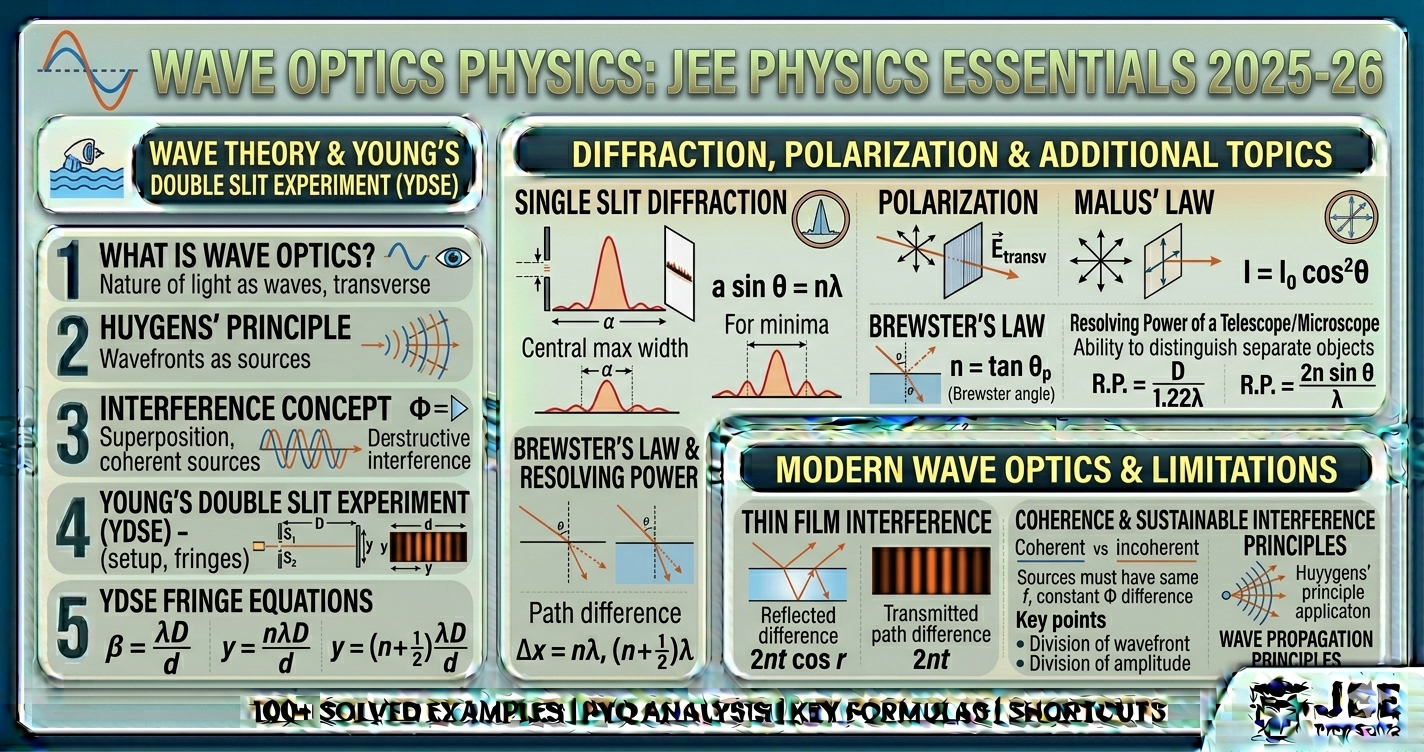
Wave Optics JEE notes - Interference, Diffraction, YDSE, Polarization
Wave Optics JEE Notes — Interference, Diffraction, YDSE, Polarization
1

Huygens Principle & Wave Theory

Huygens Principle provides a geometrical method to determine the position of a wavefront at any instant. It states that every point on a wavefront acts as a secondary source of spherical wavelets, and the new wavefront is the envelope (tangent surface) of all these secondary wavelets.

1.1 Huygens Principle Statement

Huygens Principle

Step 1:

Every point on a given wavefront acts as a source of secondary wavelets that spread out in all directions with the speed of light in that medium.

Step 2:

The new position of the wavefront after time t is the forward envelope (tangent surface) of all these secondary wavelets.

Step 3:

The backward envelope (in opposite direction) is rejected because it doesn't represent actual propagation.

1.2 Types of Wavefronts

Spherical Wavefront
  • Source: Point source
  • Shape: Spherical surface
  • Intensity: I ∝ 1/r²
  • Amplitude: A ∝ 1/r
Cylindrical Wavefront
  • Source: Linear source (slit)
  • Shape: Cylindrical surface
  • Intensity: I ∝ 1/r
  • Amplitude: A ∝ 1/√r
Plane Wavefront
  • Source: Very distant source
  • Shape: Flat plane
  • Intensity: Constant
  • Amplitude: Constant

1.3 Refraction & Reflection using Huygens Principle

💡 Key Results from Huygens Principle

Laws of Reflection:

∠i = ∠r (proved geometrically using Huygens construction)

Laws of Refraction (Snell's Law):

\[\frac{\sin i}{\sin r} = \frac{v_1}{v_2} = \frac{n_2}{n_1}\]

When light goes from rarer to denser medium, it bends towards normal because speed decreases.

⚠️ Wave Optics vs Ray Optics

  • Ray Optics: Treats light as rays (valid when λ << size of obstacle)
  • Wave Optics: Treats light as waves (required when λ ≈ size of obstacle)
  • • Phenomena like interference, diffraction, polarization can ONLY be explained by wave theory
  • • Ray optics is a limiting case of wave optics when wavelength → 0
2

Interference of Light

Interference is the phenomenon in which two or more coherent light waves superpose to produce a resultant wave with intensity that varies from point to point. This is one of the most important phenomena proving the wave nature of light.

2.1 Conditions for Interference

Essential Conditions for Sustained Interference
  1. Coherent Sources: Sources must have constant phase difference (same frequency)
  2. Monochromatic Light: Single wavelength (or narrow range)
  3. Similar Amplitudes: For best contrast/visibility of fringes
  4. Narrow Sources: Sources should be narrow and close together
  5. Same State of Polarization: For maximum contrast

Note: Two independent sources cannot produce sustained interference because they are not coherent (random phase fluctuations).

2.2 Superposition of Waves

When two waves with same frequency meet:

\[y_1 = A_1 \sin(\omega t), \quad y_2 = A_2 \sin(\omega t + \phi)\]

Resultant amplitude:

\[\boxed{A = \sqrt{A_1^2 + A_2^2 + 2A_1 A_2 \cos\phi}}\]

Resultant intensity (since I ∝ A²):

\[\boxed{I = I_1 + I_2 + 2\sqrt{I_1 I_2}\cos\phi}\]

2.3 Constructive & Destructive Interference

Constructive Interference (Bright)

Condition: Waves in phase

\[\phi = 0, 2\pi, 4\pi, ... = 2n\pi\]

Path Difference:

\[\Delta x = n\lambda \quad (n = 0, 1, 2, ...)\]

Resultant Intensity:

\[I_{max} = I_1 + I_2 + 2\sqrt{I_1 I_2}\]

If I₁ = I₂ = I₀: I_max = 4I₀

Destructive Interference (Dark)

Condition: Waves out of phase

\[\phi = \pi, 3\pi, 5\pi, ... = (2n+1)\pi\]

Path Difference:

\[\Delta x = (2n+1)\frac{\lambda}{2} = \left(n + \frac{1}{2}\right)\lambda\]

Resultant Intensity:

\[I_{min} = I_1 + I_2 - 2\sqrt{I_1 I_2}\]

If I₁ = I₂ = I₀: I_min = 0

2.4 Path Difference & Phase Difference Relation

\[\boxed{\phi = \frac{2\pi}{\lambda} \times \Delta x}\]

Or equivalently:

\[\frac{\phi}{2\pi} = \frac{\Delta x}{\lambda} = \frac{\Delta t}{T}\]

Phase difference of 2π corresponds to path difference of λ

Phase difference of π corresponds to path difference of λ/2

💡 Important JEE Formula: Intensity Ratio

\[\frac{I_{max}}{I_{min}} = \left(\frac{A_1 + A_2}{A_1 - A_2}\right)^2 = \left(\frac{\sqrt{I_1} + \sqrt{I_2}}{\sqrt{I_1} - \sqrt{I_2}}\right)^2\]

If amplitude ratio is r = A₁/A₂:

\[\frac{I_{max}}{I_{min}} = \left(\frac{r + 1}{r - 1}\right)^2\]
3

Young's Double Slit Experiment (YDSE)

YDSE is the most important experiment demonstrating interference of light. Performed by Thomas Young in 1801, it provided the first conclusive evidence for the wave nature of light. This is the most frequently asked topic from Wave Optics in JEE.

3.1 YDSE Setup & Path Difference

Path Difference Formula

For a point P at distance y from center on screen:

\[\boxed{\Delta x = \frac{yd}{D}}\]
d = slit separation
D = screen distance
y = distance from center

Approximation: Valid when d << D (usually D ≈ 1m, d ≈ 1mm)

3.2 Fringe Width Formula (Most Important!)

Fringe Width (β) = Distance between two consecutive bright (or dark) fringes

\[\boxed{\beta = \frac{\lambda D}{d}}\]
β = fringe width
λ = wavelength
D = screen distance
d = slit separation

🎯 JEE Key Points:

  • All bright and dark fringes have same width
  • β ∝ λ (red light → wider fringes, violet → narrower)
  • β ∝ D and β ∝ 1/d
  • Central fringe is always bright (path difference = 0)

3.3 Position of Bright & Dark Fringes

Fringe Type Path Difference Position from Center
Central Bright (n=0) Δx = 0 y = 0
nth Bright Fringe Δx = nλ yₙ = nβ = nλD/d
nth Dark Fringe Δx = (2n-1)λ/2 yₙ = (2n-1)β/2
1st Dark Fringe Δx = λ/2 y = β/2

3.4 YDSE Modifications (JEE Advanced)

Glass Slab in Path of One Beam

Extra path introduced:

\[\Delta x_{extra} = (\mu - 1)t\]

Fringe shift:

\[\Delta y = \frac{(\mu - 1)t \cdot D}{d}\]

Central fringe shifts towards the slab.

Source Shifted from Center

If source S is shifted by x₀:

\[\text{Fringe shift} = \frac{x_0 \cdot D}{d'}\]

where d' = distance from source to slits

Note: Shift is in opposite direction to source shift

YDSE in Medium of Refractive Index μ

When entire setup is immersed in medium of RI = μ:

\[\lambda_{medium} = \frac{\lambda_{air}}{\mu}, \quad \beta_{medium} = \frac{\beta_{air}}{\mu}\]

Fringe width decreases when setup is in denser medium.

📝 Solved Example 1 (JEE Main Pattern)

Question: In YDSE, the separation between slits is 1 mm and the screen is placed at 1 m from slits. If the wavelength of light is 500 nm, find (a) fringe width (b) position of 3rd bright fringe (c) position of 2nd dark fringe.

Solution:

Given: d = 1 mm = 10⁻³ m, D = 1 m, λ = 500 nm = 5 × 10⁻⁷ m

(a) Fringe width:

\[\beta = \frac{\lambda D}{d} = \frac{5 \times 10^{-7} \times 1}{10^{-3}} = 5 \times 10^{-4} \text{ m} = 0.5 \text{ mm}\]

(b) 3rd bright fringe (n=3):

\[y_3 = 3\beta = 3 \times 0.5 = 1.5 \text{ mm}\]

(c) 2nd dark fringe (n=2):

\[y = (2n-1)\frac{\beta}{2} = (2 \times 2 - 1)\frac{0.5}{2} = 3 \times 0.25 = 0.75 \text{ mm}\]
\[\beta = 0.5 \text{ mm}, \quad y_{3B} = 1.5 \text{ mm}, \quad y_{2D} = 0.75 \text{ mm}\]

📝 Solved Example 2 (JEE Advanced Pattern)

Question: In YDSE with d = 1 mm and D = 1 m, a thin glass plate of thickness 0.02 mm and μ = 1.5 is placed in front of one slit. Find the shift in central fringe. (λ = 600 nm)

Solution:

Given: t = 0.02 mm = 2 × 10⁻⁵ m, μ = 1.5, D = 1 m, d = 10⁻³ m

Step 1: Extra path difference due to glass

\[\Delta x = (\mu - 1)t = (1.5 - 1) \times 2 \times 10^{-5} = 10^{-5} \text{ m}\]

Step 2: Fringe shift

\[\Delta y = \frac{(\mu - 1)t \cdot D}{d} = \frac{10^{-5} \times 1}{10^{-3}} = 10^{-2} \text{ m} = 10 \text{ mm}\]

Step 3: Number of fringes shifted

\[n = \frac{\Delta y}{\beta} = \frac{(\mu - 1)t}{\lambda} = \frac{10^{-5}}{6 \times 10^{-7}} \approx 16.67 \text{ fringes}\]
\[\text{Central fringe shifts by 10 mm towards the glass plate}\]

💡 Angular Fringe Width

\[\boxed{\theta = \frac{\beta}{D} = \frac{\lambda}{d}}\]

Angular fringe width is independent of screen distance D!

4

Diffraction of Light

Diffraction is the bending of light around the edges of an obstacle or aperture. It occurs when the size of the obstacle/aperture is comparable to the wavelength of light. Single slit diffraction is the most important topic for JEE.

4.1 Types of Diffraction

Fresnel Diffraction
  • Source or screen at finite distance
  • Curved wavefronts involved
  • No lenses used
  • Complex mathematical analysis
  • Example: Shadow of sharp edge
Fraunhofer Diffraction
  • Source and screen at infinite distance
  • Plane wavefronts involved
  • Achieved using lenses
  • Simpler mathematical analysis
  • JEE focuses on this!

4.2 Single Slit Diffraction (Fraunhofer)

Key Formulas for Single Slit

Condition for Minima (Dark fringes):

\[\boxed{a \sin\theta = n\lambda \quad (n = 1, 2, 3, ...)}\]

where a = slit width, θ = angle of diffraction

Condition for Secondary Maxima:

\[a \sin\theta = \left(n + \frac{1}{2}\right)\lambda \quad (n = 1, 2, 3, ...)\]

Width of Central Maximum:

\[\boxed{W = \frac{2\lambda D}{a} = 2\beta_{YDSE} \times \frac{d}{a}}\]

Central maxima width = 2 × width of secondary maxima

Angular Width of Central Maximum:

\[\Delta\theta = \frac{2\lambda}{a}\]

⚠️ YDSE vs Single Slit Diffraction

Feature YDSE (Interference) Single Slit (Diffraction)
Source Two coherent sources Single slit
Central Maximum Same width as others Twice as wide
Intensity Equal for all maxima Decreases for secondary maxima
Fringe Width β = λD/d β = λD/a (secondary)

4.3 Intensity Distribution

Intensity at angle θ:

\[\boxed{I = I_0 \left(\frac{\sin\alpha}{\alpha}\right)^2}\]

where \(\alpha = \frac{\pi a \sin\theta}{\lambda}\)

Central maximum (θ=0): I = I₀ (maximum intensity)

First secondary maximum: I ≈ I₀/22 (4.5% of central)

Second secondary maximum: I ≈ I₀/62 (1.6% of central)

📝 Solved Example 3

Question: Light of wavelength 600 nm passes through a single slit of width 0.3 mm. The screen is at 1 m from the slit. Find (a) width of central maximum (b) position of first minimum.

Solution:

Given: λ = 600 nm = 6 × 10⁻⁷ m, a = 0.3 mm = 3 × 10⁻⁴ m, D = 1 m

(a) Width of central maximum:

\[W = \frac{2\lambda D}{a} = \frac{2 \times 6 \times 10^{-7} \times 1}{3 \times 10^{-4}} = 4 \times 10^{-3} \text{ m} = 4 \text{ mm}\]

(b) Position of first minimum (n=1):

\[y_1 = \frac{n\lambda D}{a} = \frac{1 \times 6 \times 10^{-7} \times 1}{3 \times 10^{-4}} = 2 \times 10^{-3} \text{ m} = 2 \text{ mm}\]
\[\text{Central maximum width} = 4 \text{ mm}, \quad y_1 = 2 \text{ mm}\]

4.4 Resolving Power

Rayleigh's Criterion

Two sources are just resolved when the central maximum of one falls on the first minimum of other.

Minimum angular separation:

\[\theta_{min} = \frac{1.22\lambda}{D}\]

where D = diameter of circular aperture

Resolving Power of Telescope:

\[R.P. = \frac{D}{1.22\lambda}\]
5

Polarization of Light

Polarization is the phenomenon that proves light is a transverse wave. Unpolarized light has electric field vectors oscillating in all directions perpendicular to propagation. Polarized light has electric field oscillating in only one direction.

5.1 Types of Polarization

Plane Polarized
  • E-field oscillates in single plane
  • Also called linearly polarized
  • Produced by Polaroid, reflection
Circularly Polarized
  • E-field rotates in circle
  • Components with 90° phase diff
  • Equal amplitudes
Elliptically Polarized
  • E-field traces ellipse
  • Unequal amplitudes
  • Most general form

5.2 Malus Law (Most Important!)

When plane polarized light passes through an analyzer at angle θ to polarization direction:

\[\boxed{I = I_0 \cos^2\theta}\]

θ = 0°: I = I₀ (maximum)

θ = 90°: I = 0 (crossed polaroids)

θ = 45°: I = I₀/2

θ = 60°: I = I₀/4

💡 Unpolarized Light through Polaroid

When unpolarized light passes through a single polaroid:

\[\boxed{I = \frac{I_0}{2}}\]

The transmitted light is plane polarized. Intensity is halved because only one component passes through.

5.3 Brewster's Law

When light is incident at Brewster's angle, the reflected light is completely plane polarized.

\[\boxed{\tan i_B = \mu = \frac{n_2}{n_1}}\]

At Brewster's angle: Reflected & refracted rays are perpendicular

\[i_B + r = 90°\]

For glass (μ = 1.5): i_B = tan⁻¹(1.5) ≈ 56.3°

For water (μ = 4/3): i_B = tan⁻¹(4/3) ≈ 53.1°

5.4 Methods of Polarization

Method Description Example
Reflection At Brewster's angle, reflected light is polarized Glare from water/glass surfaces
Refraction (Pile of plates) Multiple glass plates at Brewster's angle Transmitted light becomes polarized
Selective Absorption Polaroid absorbs one component Polaroid sheets, sunglasses
Double Refraction Crystal splits light into O and E rays Calcite, Nicol prism
Scattering Light scattered at 90° is polarized Blue sky is partially polarized

📝 Solved Example 4 (JEE Main Pattern)

Question: Unpolarized light of intensity I₀ passes through two polaroids with axes at 30° to each other. Find the intensity of transmitted light.

Solution:

Step 1: After first polaroid (unpolarized → polarized)

\[I_1 = \frac{I_0}{2}\]

Step 2: After second polaroid (Malus law, θ = 30°)

\[I_2 = I_1 \cos^2(30°) = \frac{I_0}{2} \times \left(\frac{\sqrt{3}}{2}\right)^2 = \frac{I_0}{2} \times \frac{3}{4}\]
\[I = \frac{3I_0}{8}\]

📝 Solved Example 5 (JEE Advanced Pattern)

Question: Three polaroids P₁, P₂, P₃ are arranged with P₁ and P₃ having perpendicular axes. P₂ is placed between them with axis at 45° to P₁. Find the intensity of light emerging if unpolarized light of intensity I₀ is incident.

Solution:

Step 1: After P₁:

\[I_1 = \frac{I_0}{2}\]

Step 2: After P₂ (θ = 45° from P₁):

\[I_2 = I_1 \cos^2(45°) = \frac{I_0}{2} \times \frac{1}{2} = \frac{I_0}{4}\]

Step 3: After P₃ (θ = 45° from P₂, since P₃ ⊥ P₁):

\[I_3 = I_2 \cos^2(45°) = \frac{I_0}{4} \times \frac{1}{2} = \frac{I_0}{8}\]
\[I_{final} = \frac{I_0}{8}\]

Without P₂, intensity would be zero (crossed polaroids). P₂ allows some light to pass!

6

Thin Film Interference

When light falls on a thin transparent film (like soap bubble, oil on water), it is partially reflected from both top and bottom surfaces. These reflected waves interfere to produce colorful patterns. Understanding phase change on reflection is crucial here.

6.1 Phase Change on Reflection

Reflection from Denser Medium

Phase change = π (or λ/2)

Example: Light going from air to glass

Reflection from Rarer Medium

Phase change = 0

Example: Light going from glass to air

Important: This is known as "Stokes Treatment" - hard reflection (from denser medium) causes π phase change.

6.2 Thin Film Formulas (Reflected Light)

For Film of Refractive Index μ and Thickness t

Path difference:

\[\Delta x = 2\mu t \cos r\]

where r = angle of refraction inside film

Effective path difference (including phase change at top surface):

\[\Delta x_{eff} = 2\mu t \cos r + \frac{\lambda}{2}\]

Constructive Interference (Bright):

\[\boxed{2\mu t \cos r = \left(n - \frac{1}{2}\right)\lambda \quad \text{or} \quad (2n-1)\frac{\lambda}{2}}\]

Destructive Interference (Dark):

\[\boxed{2\mu t \cos r = n\lambda}\]

⚠️ For Normal Incidence (r = 0, cos r = 1)

Simplified formulas when light falls normally:

\[\text{Bright:} \quad 2\mu t = (2n-1)\frac{\lambda}{2}\]
\[\text{Dark:} \quad 2\mu t = n\lambda\]

Note: These are for reflected light. For transmitted light, conditions are reversed!

6.3 Applications

Colors in Soap Bubbles/Oil Films
  • Different colors seen due to varying thickness
  • Each color has specific wavelength
  • Constructive interference for that λ at that point
  • White light → colorful patterns
Anti-Reflection Coating
  • Coating with μ = √μ_glass
  • Thickness t = λ/4μ
  • Cancels reflection by destructive interference
  • Used in camera lenses, eyeglasses

📝 Solved Example 6

Question: A thin film of thickness 500 nm and refractive index 1.5 is illuminated by white light at normal incidence. Which wavelengths will be strongly reflected?

Solution:

Given: t = 500 nm, μ = 1.5, normal incidence (cos r = 1)

For constructive interference (bright):

\[2\mu t = (2n-1)\frac{\lambda}{2}\]
\[\lambda = \frac{4\mu t}{2n-1} = \frac{4 \times 1.5 \times 500}{2n-1} = \frac{3000}{2n-1} \text{ nm}\]

For visible range (400-700 nm):

  • n = 1: λ = 3000 nm (infrared, not visible)
  • n = 2: λ = 1000 nm (infrared, not visible)
  • n = 3: λ = 600 nm (orange-yellow, visible ✓)
  • n = 4: λ = 428.6 nm (violet, visible ✓)
\[\text{Strongly reflected: } 600 \text{ nm (orange) and } 428.6 \text{ nm (violet)}\]

📝 Previous Year Questions Analysis

JEE Main (Last 5 Years)

  • ✓ YDSE (Fringe Width, Path Diff): 40%
  • ✓ Polarization (Malus Law): 25%
  • ✓ Single Slit Diffraction: 20%
  • ✓ Huygens Principle: 10%
  • ✓ Thin Films: 5%

JEE Advanced (Last 5 Years)

  • ✓ YDSE Modifications: 35%
  • ✓ Polarization (Brewster's, Multiple polaroids): 25%
  • ✓ Combined Ray + Wave Optics: 20%
  • ✓ Diffraction Problems: 15%
  • ✓ Intensity Distribution: 5%

Top 10 Most Repeated Question Types

  1. Fringe width calculation in YDSE (β = λD/d)
  2. Shift in fringe pattern when glass slab is introduced
  3. Malus law problems with 2-3 polaroids
  4. Width of central maximum in single slit diffraction
  5. Brewster's angle calculation
  6. Intensity ratio I_max/I_min in interference
  7. YDSE in different medium (water/other liquid)
  8. Angular fringe width and angular position
  9. Intensity at a point in YDSE (phase difference given)
  10. Thin film interference for anti-reflection coating

Weightage Analysis

JEE Main: 4-8 marks (1-2 questions)
JEE Advanced: 4-8 marks (1-2 questions)
Combined Optics (Ray + Wave): ~10% of Physics
Difficulty Level: Medium

🎯 Practice Problem Set

Level 1: Basic (JEE Main Standard)

  1. In YDSE, d = 0.5 mm, D = 1 m, λ = 500 nm. Find fringe width and position of 5th bright fringe.
  2. Two coherent sources have intensities in ratio 4:1. Find I_max/I_min.
  3. Light of wavelength 6000 Å falls on a single slit of width 0.2 mm. Find width of central maximum at 1 m.
  4. Unpolarized light passes through two polaroids at 60° to each other. Find transmitted intensity.
  5. Find Brewster's angle for glass (μ = 1.5).
  6. In YDSE, if wavelength is changed from 500 nm to 600 nm, by what factor does fringe width change?
  7. The path difference at a point is λ/4. What is the phase difference and intensity (if I_max = 4I₀)?
  8. Angular width of central maximum in diffraction is 0.1 rad. If λ = 500 nm, find slit width.

Level 2: Intermediate (JEE Main/Advanced)

  1. In YDSE, a glass slab (μ = 1.5, t = 2 μm) is placed in front of one slit. Find shift in central fringe (λ = 500 nm, D = 1 m, d = 1 mm).
  2. Three polaroids P₁, P₂, P₃ have axes at 0°, 30°, 60° respectively. Find final intensity if I₀ enters P₁.
  3. In single slit diffraction, first minimum occurs at 30°. Find ratio of slit width to wavelength.
  4. YDSE is performed with white light. Find positions where red (700 nm) and blue (400 nm) maxima overlap.
  5. Two slits have widths in ratio 1:4. Find ratio of intensities at maxima and minima.
  6. A thin film of MgF₂ (μ = 1.38) is used as anti-reflection coating. Find minimum thickness for λ = 550 nm.
  7. In YDSE, screen is moved 5 cm closer to slits. If fringe width changes from 1 mm to 0.8 mm, find original D.
  8. Light is incident on glass (μ = √3) at Brewster's angle. Find angle of refraction.

Level 3: Advanced (JEE Advanced/Olympiad)

  1. In YDSE, one slit is covered with a film that shifts phase by π/2. Find the shift in interference pattern and new intensity at center.
  2. A parallel beam of light falls on a system of two slits S₁ and S₂. S₁ has a thin glass plate (t, μ) in front. Find fringe pattern if source is shifted perpendicular to principal axis.
  3. In single slit diffraction pattern, the intensity at a point where path difference is λ is I₁. Find I₁/I₀.
  4. YDSE is performed in water (μ = 4/3). A glass slab (μ = 1.5, t = 6 μm) is placed in front of one slit. Compare fringe shift with the case in air.
  5. Derive the condition for missing orders in YDSE where diffraction also plays a role (slit width = a, separation = d).
  6. Two polaroids are placed with axes at angle θ. A third polaroid is inserted between them. At what angle should its axis be for maximum transmitted intensity?
  7. In a modified YDSE, one slit has width a₁ and other has a₂. Find the visibility of fringes V = (I_max - I_min)/(I_max + I_min).
  8. White light is incident on a thin soap film (μ = 1.4) at 45°. Find the minimum thickness that appears dark in reflected light for λ = 560 nm.

Related Physics Notes

Wave Optics - Complete Guide for JEE 2025-26

Why Wave Optics is Important for JEE?

Wave Optics is a highly scoring chapter in JEE Physics with predictable question patterns. It carries 4-5% weightage with formula-based questions:

  • YDSE Problems - Fringe width, shifts, modifications (most common)
  • Malus Law - Multiple polaroid problems
  • Single Slit Diffraction - Central maximum width
  • Brewster's Law - Direct formula application

Combined with Ray Optics, the entire Optics section contributes about 10% to JEE Physics.

Key Formulas to Remember

1. YDSE Formulas

  • • Fringe width: β = λD/d
  • • Path difference: Δx = yd/D
  • • Bright: Δx = nλ
  • • Dark: Δx = (2n-1)λ/2
  • • Glass slab shift: Δy = (μ-1)tD/d

2. Diffraction & Polarization

  • • Central maxima width: W = 2λD/a
  • • Minima: a sinθ = nλ
  • • Malus Law: I = I₀cos²θ
  • • Brewster's Law: tan(i_B) = μ

📚 How to Study Wave Optics Effectively?

For JEE Main Students:

  1. Time Required: 3-4 days (2 hours/day)
  2. Master YDSE fringe width formula — most asked!
  3. Practice 30+ numericals on YDSE variations
  4. Memorize Malus law with different angle cases
  5. Solve 10+ single slit diffraction problems
  6. Learn Brewster's angle formula with examples

For JEE Advanced Students:

  1. Time Required: 5-6 days (3 hours/day)
  2. Deep dive into YDSE modifications (glass slab, source shift)
  3. Practice intensity distribution problems
  4. Study thin film interference completely
  5. Solve multi-polaroid problems
  6. Practice combined Ray + Wave optics problems

⚠️ Common Mistakes to Avoid in JEE Exam

  • Confusing bright and dark conditions: In YDSE, bright occurs at Δx = nλ. In single slit diffraction, minima (dark) occurs at a sinθ = nλ. Don't mix them!
  • Forgetting intensity halving for unpolarized light: When unpolarized light passes through first polaroid, intensity becomes I₀/2, not I₀.
  • Wrong unit conversions: Wavelength often given in nm or Å, distances in mm or m. Convert everything to meters before calculation.
  • Phase change confusion in thin films: Remember — reflection from denser medium gives π phase change. Include this in path difference calculation.

📊 JEE Previous Year Question Analysis (2015-2024)

Year JEE Main JEE Advanced Topic Focus
2024 2 Questions (8 marks) 1 Question (4 marks) YDSE fringe width, Polarization intensity
2023 1 Question (4 marks) 2 Questions (8 marks) YDSE glass slab, Multiple polaroids
2022 2 Questions (8 marks) 1 Question (4 marks) Single slit diffraction, Brewster's angle

Trend: YDSE remains the most asked topic. JEE Advanced is asking conceptual questions combining YDSE with other modifications. Polarization questions have increased in frequency.