
📑 Quick Navigation - Fluid Mechanics

Fluid Mechanics JEE Main & Advanced 2025-26

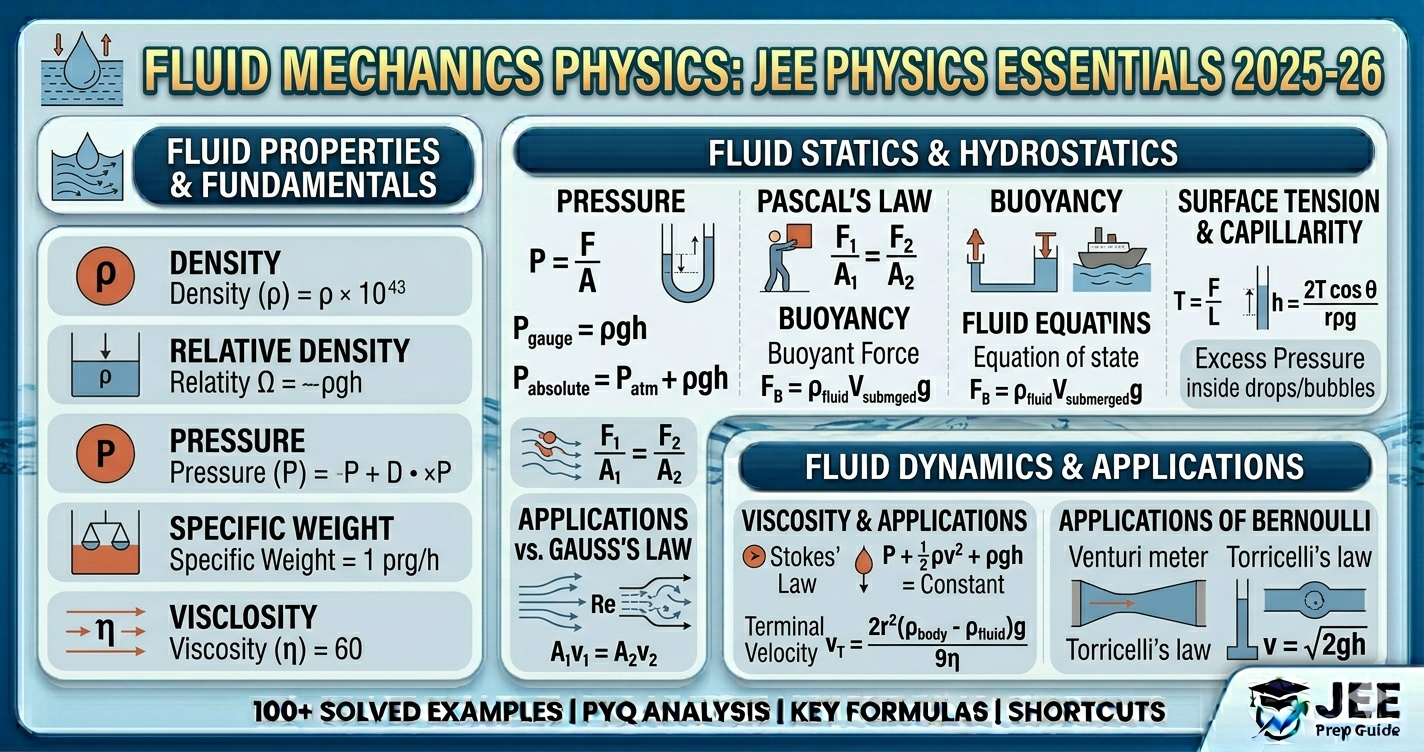
Master the complete chapter with detailed notes on Pascal's Law, Archimedes Principle, Bernoulli's Theorem, Viscosity, Surface Tension & all applications. Includes 150+ solved problems and all JEE shortcuts.

📚 8 Complete Sections
✍️ 150+ Solved Examples
🎯 All Important Formulas
⭐⭐⭐⭐⭐ 4.8/5
245+ students rated this helpful
150+
Solved Examples
3 hrs
Study Time
Free
Always
Fluid mechanics JEE notes, Formulas, PYQs
Fluid mechanics JEE Notes, Formulas, PYQs
1

Introduction & Fluid Properties

Fluid Mechanics is the study of fluids (liquids and gases) at rest and in motion. It is one of the most important and high-scoring chapters in JEE Physics, combining theoretical concepts with practical applications found in everyday life.

1.1 What is a Fluid?

Definition

A fluid is a substance that flows and deforms continuously under the application of shear stress, no matter how small the stress may be.

Key Characteristics:

  • Cannot sustain tangential (shear) stress at rest
  • Takes the shape of the container
  • Offers very little resistance to shape change
  • Includes both liquids and gases

1.2 Types of Fluids

Ideal Fluid (Perfect Fluid)
  • Incompressible: Density remains constant
  • Non-viscous: No internal friction
  • Irrotational: No rotational motion
  • Used in theoretical analysis (doesn't exist in reality)
Real Fluid
  • Compressible/Incompressible: Density may vary
  • Viscous: Has internal friction
  • May be rotational
  • All actual fluids (water, air, oil, etc.)

1.3 Important Fluid Properties

Property Definition Formula SI Unit
Density (ρ) Mass per unit volume ρ = m/V kg/m³
Specific Gravity (SG) Ratio of density to density of water at 4°C SG = ρ/ρwater Dimensionless
Pressure (P) Normal force per unit area P = F/A Pa (N/m²)
Bulk Modulus (K) Resistance to compression K = -ΔP/(ΔV/V) Pa
Compressibility Reciprocal of bulk modulus β = 1/K Pa⁻¹

💡 Memory Trick - Density Values

Common Densities (in kg/m³ or g/cm³):

• Water: 1000 kg/m³ = 1 g/cm³
• Ice: 917 kg/m³ = 0.917 g/cm³
• Mercury: 13,600 kg/m³ = 13.6 g/cm³
• Air (STP): 1.29 kg/m³
• Iron: 7,870 kg/m³
• Aluminum: 2,700 kg/m³

1.4 Streamline vs Turbulent Flow

Streamline (Laminar) Flow
  • Fluid particles move in smooth, parallel layers
  • No mixing between layers
  • Velocity at each point remains constant with time
  • Occurs at low velocities
  • Reynolds number Re < 2000
  • Example: Slow-moving river, blood flow in capillaries
Turbulent Flow
  • Irregular, chaotic fluid motion
  • Extensive mixing between layers
  • Eddies and vortices form
  • Occurs at high velocities
  • Reynolds number Re > 4000
  • Example: Fast river rapids, smoke from chimney

Reynolds Number (Re)

Dimensionless number that predicts flow pattern:

\[Re = \frac{\rho v D}{\eta} = \frac{v D}{\nu}\]

Where:

  • ρ = density of fluid
  • v = flow velocity
  • D = characteristic length (diameter for pipes)
  • η = dynamic viscosity
  • ν = kinematic viscosity = η/ρ
2

Pressure in Fluids

Pressure is one of the most fundamental concepts in fluid mechanics. Understanding how pressure varies with depth and how it is transmitted through fluids forms the basis of hydrostatics.

2.1 Fluid Pressure - Basic Concept

Definition of Pressure

Pressure is the normal force per unit area exerted by a fluid on any surface in contact with it.

\[P = \frac{F_{\perp}}{A}\]

Key Points:

  • Pressure is a scalar quantity
  • Acts perpendicular to the surface
  • Same in all directions at a point in static fluid
  • SI Unit: Pascal (Pa) = N/m²
  • Other units: atm, bar, torr, mmHg, psi

2.2 Pressure Variation with Depth

Hydrostatic Pressure Formula

For an incompressible fluid at rest, pressure increases linearly with depth:

\[P = P_0 + \rho g h\]

Where:

  • P = Absolute pressure at depth h
  • P₀ = Atmospheric pressure at surface (≈ 101,325 Pa = 1 atm)
  • ρ = Density of fluid (kg/m³)
  • g = Acceleration due to gravity (9.8 m/s²)
  • h = Depth below the surface (m)

Gauge Pressure vs Absolute Pressure:

Gauge Pressure: Pgauge = ρgh (pressure above atmospheric)

Absolute Pressure: Pabs = P₀ + ρgh (total pressure)

📝 Solved Example 1 - Pressure at Depth

Question: A diver is 20 m below the surface of a lake. Find the pressure experienced by the diver. (Take atmospheric pressure = 10⁵ Pa, ρwater = 1000 kg/m³, g = 10 m/s²)

Solution:

Given:

  • Depth, h = 20 m
  • Atmospheric pressure, P₀ = 10⁵ Pa
  • Density of water, ρ = 1000 kg/m³
  • g = 10 m/s²

Using formula:

\[P = P_0 + \rho g h\]
\[P = 10^5 + (1000)(10)(20)\]
\[P = 10^5 + 2 \times 10^5\]
\[P = 3 \times 10^5 \text{ Pa} = 3 \text{ atm}\]

Note: The diver experiences 3 times the atmospheric pressure! This is why deep-sea diving requires special equipment.

2.3 Pressure Units & Conversions

Unit Symbol Conversion to Pascal Common Use
Pascal Pa 1 Pa = 1 N/m² SI unit
Atmosphere atm 1 atm = 101,325 Pa ≈ 10⁵ Pa Atmospheric pressure
Bar bar 1 bar = 10⁵ Pa Meteorology
Torr (mm of Hg) torr 1 torr = 133.3 Pa Blood pressure, vacuum
Pound per sq. inch psi 1 psi = 6895 Pa Tire pressure (US)

💡 JEE Quick Facts

  • Standard atmospheric pressure: 1 atm = 76 cm Hg = 10⁵ Pa (approx)
  • For every 10 m depth in water: Pressure increases by ≈ 1 atm
  • Pressure is independent of: Shape of container, horizontal distance
  • Pressure depends only on: Vertical depth and fluid density

2.4 Manometer (Pressure Measurement)

U-Tube Manometer

Device used to measure pressure difference between two points or gauge pressure.

[Diagram: U-tube with liquid, showing height difference h]

For a U-tube manometer:

\[P_{gas} - P_{atm} = \rho_{liquid} \cdot g \cdot h\]

Where h is the height difference of liquid in the two arms.

3

Pascal's Law

Pascal's Law is fundamental to understanding hydraulic systems and forms the basis of many practical applications like hydraulic lifts, brakes, and presses. This is a high-scoring topic in JEE.

3.1 Statement of Pascal's Law

Pascal's Law

"Pressure applied to an enclosed fluid is transmitted undiminished to every portion of the fluid and to the walls of the containing vessel."

\[\Delta P_1 = \Delta P_2 = \Delta P_3 = ... = \text{constant}\]

Important Points:

  • Change in pressure is transmitted equally
  • Absolute pressure may be different at different points (due to ρgh)
  • Works only for incompressible fluids
  • Basis of all hydraulic machines

3.2 Hydraulic Lift/Press (Most Important Application)

Working Principle

[Diagram: Two cylinders of different areas A₁ and A₂ connected, with pistons]

Setup: Two cylinders of different cross-sectional areas connected by a pipe, filled with incompressible liquid.

Force Relationship:

\[\frac{F_1}{A_1} = \frac{F_2}{A_2}\]
\[\boxed{\frac{F_2}{F_1} = \frac{A_2}{A_1}}\]

This is the force multiplication principle!

Displacement Relationship:

Volume of liquid displaced is same:

\[A_1 d_1 = A_2 d_2\]
\[\frac{d_2}{d_1} = \frac{A_1}{A_2}\]

Where d₁, d₂ are displacements of pistons

Work Done (Energy Conservation):

\[W_1 = W_2\]
\[F_1 d_1 = F_2 d_2\]

No energy is gained - force multiplication comes at cost of displacement!

📝 Solved Example 2 - Hydraulic Lift (JEE Main Type)

Question: In a hydraulic lift, the radius of the small piston is 2 cm and that of the large piston is 20 cm. What force must be applied to the small piston to lift a car of mass 1000 kg placed on the large piston?

Solution:

Given:

  • r₁ = 2 cm = 0.02 m (small piston)
  • r₂ = 20 cm = 0.2 m (large piston)
  • m = 1000 kg (mass of car)
  • g = 10 m/s²

Step 1: Calculate areas

\[A_1 = \pi r_1^2 = \pi (0.02)^2 = \pi \times 4 \times 10^{-4} \text{ m}^2\]
\[A_2 = \pi r_2^2 = \pi (0.2)^2 = \pi \times 4 \times 10^{-2} \text{ m}^2\]

Step 2: Force on large piston (weight of car)

\[F_2 = mg = 1000 \times 10 = 10,000 \text{ N}\]

Step 3: Apply Pascal's Law

\[\frac{F_1}{A_1} = \frac{F_2}{A_2}\]
\[F_1 = F_2 \times \frac{A_1}{A_2} = 10,000 \times \frac{\pi \times 4 \times 10^{-4}}{\pi \times 4 \times 10^{-2}}\]
\[F_1 = 10,000 \times \frac{10^{-4}}{10^{-2}} = 10,000 \times 10^{-2}\]
\[F_1 = 100 \text{ N}\]

Conclusion: A force of just 100 N can lift a 1000 kg car! This is force multiplication by a factor of 100 (ratio of areas = (20/2)² = 100).

3.3 Applications of Pascal's Law

1. Hydraulic Lift
  • Used in car service stations
  • Lifts heavy vehicles with small force
  • Force multiplication = A₂/A₁
2. Hydraulic Brakes
  • Used in automobiles
  • Foot pedal applies pressure to master cylinder
  • Transmitted to all wheels simultaneously
3. Hydraulic Press
  • Compress materials (cotton, paper)
  • Metal sheet forming
  • Large force from small input
4. Hydraulic Jack
  • Lift heavy loads (cars, trucks)
  • Portable and convenient
  • Uses oil as working fluid
4

Archimedes Principle & Buoyancy

Archimedes Principle explains why objects float or sink in fluids. This is one of the most important and frequently asked topics in JEE, with direct questions worth 8-12 marks and indirect applications throughout fluid mechanics.

4.1 Buoyant Force (Upthrust)

What is Buoyant Force?

When an object is immersed in a fluid (partially or completely), it experiences an upward force called buoyant force or upthrust.

Cause of Buoyancy:

  • Pressure at bottom of object > Pressure at top
  • This pressure difference creates net upward force
  • Fbottom - Ftop = Buoyant force

4.2 Archimedes Principle

Statement

"When a body is partially or completely immersed in a fluid, it experiences an upward buoyant force equal to the weight of the fluid displaced by the body."

\[\boxed{F_B = \rho_{fluid} \cdot V_{displaced} \cdot g}\]

Where:

  • FB = Buoyant force (N)
  • ρfluid = Density of fluid (kg/m³)
  • Vdisplaced = Volume of fluid displaced = Volume of object submerged (m³)
  • g = Acceleration due to gravity (m/s²)

4.3 Apparent Weight in Fluid

Concept of Apparent Weight

When an object is weighed in a fluid, it appears lighter due to buoyant force.

Formula:

\[W_{apparent} = W_{actual} - F_B\]
\[W_{apparent} = mg - \rho_{fluid} V g\]
\[W_{apparent} = V(\rho_{object} - \rho_{fluid})g\]

Loss in Weight:

\[\text{Loss in weight} = W_{actual} - W_{apparent} = F_B\]
\[\text{Loss in weight} = \rho_{fluid} \cdot V_{submerged} \cdot g\]

4.4 Floating Conditions

Condition Mathematical Relation Result Example
Sinking ρobject > ρfluid W > FB, object sinks Iron in water
Floating (Partial) ρobject < ρfluid W = FB, floats partially submerged Ice in water, wood
Floating (Completely) ρobject = ρfluid W = FB, floats just submerged Submarine adjustment

Floating Body - Fraction Submerged

For a body floating in equilibrium:

\[W = F_B\]
\[\rho_{object} \cdot V_{total} \cdot g = \rho_{fluid} \cdot V_{submerged} \cdot g\]
\[\boxed{\frac{V_{submerged}}{V_{total}} = \frac{\rho_{object}}{\rho_{fluid}}}\]

Fraction submerged = Relative density of object

📝 Solved Example 3 - Ice Floating (Classic JEE Question)

Question: An iceberg floats in sea water with 10% of its volume above water. What is the density of ice? (Density of sea water = 1030 kg/m³)

Solution:

Given:

  • Volume above water = 10% of total = 0.1V
  • Volume submerged = 90% of total = 0.9V
  • Density of sea water, ρwater = 1030 kg/m³

For floating body:

\[W = F_B\]
\[\rho_{ice} \cdot V \cdot g = \rho_{water} \cdot V_{submerged} \cdot g\]
\[\rho_{ice} \cdot V = 1030 \times 0.9V\]
\[\rho_{ice} = 1030 \times 0.9\]
\[\rho_{ice} = 927 \text{ kg/m}^3\]

Note: This explains why 90% of icebergs are underwater - making them dangerous for ships!

📝 Solved Example 4 - Apparent Weight (JEE Advanced Type)

Question: A metallic sphere of mass 2 kg and density 8000 kg/m³ is suspended by a string in water (density 1000 kg/m³). Find the tension in the string. (g = 10 m/s²)

Solution:

Given:

  • Mass, m = 2 kg
  • Density of sphere, ρs = 8000 kg/m³
  • Density of water, ρw = 1000 kg/m³
  • g = 10 m/s²

Step 1: Find volume of sphere

\[V = \frac{m}{\rho_s} = \frac{2}{8000} = 2.5 \times 10^{-4} \text{ m}^3\]

Step 2: Calculate buoyant force

\[F_B = \rho_w \cdot V \cdot g\]
\[F_B = 1000 \times 2.5 \times 10^{-4} \times 10\]
\[F_B = 2.5 \text{ N}\]

Step 3: Calculate actual weight

\[W = mg = 2 \times 10 = 20 \text{ N}\]

Step 4: Find tension (apparent weight)

For equilibrium: T + FB = W

\[T = W - F_B = 20 - 2.5\]
\[T = 17.5 \text{ N}\]

Alternative Method: T = V(ρs - ρw)g = 2.5×10⁻⁴ × (8000-1000) × 10 = 17.5 N

💡 JEE Quick Tips - Archimedes Principle

  • Quick check for floating: If ρobject < ρfluid, it floats
  • Ice in water: 10% above water (standard question)
  • When ice melts in water: Level remains same (very common JEE trap!)
  • String tension: T = Wapparent = W - FB
  • Two liquids: Object can float at interface if ρ₁ < ρobject < ρ₂
5

Fluid Dynamics

Fluid dynamics deals with fluids in motion. This section covers equation of continuity, Bernoulli's theorem, and their applications - the most important topics for JEE Advanced with 15-20% weightage.

5.1 Equation of Continuity

Mass Conservation in Fluid Flow

For an incompressible fluid in steady flow, the mass flow rate remains constant throughout the pipe.

Mathematical Form:

\[\rho_1 A_1 v_1 = \rho_2 A_2 v_2\]

For incompressible fluid (ρ₁ = ρ₂):

\[\boxed{A_1 v_1 = A_2 v_2 = \text{constant}}\]

This is also called Av = constant

Physical Meaning:

  • Velocity is inversely proportional to cross-sectional area
  • Fluid flows faster through narrow sections
  • Fluid flows slower through wider sections
  • Volume flow rate Q = Av remains constant

📝 Solved Example 5 - Equation of Continuity

Question: Water flows through a horizontal pipe of varying cross-section. At section A, area is 40 cm² and velocity is 2 m/s. At section B, area is 20 cm². Find velocity at B and volume flow rate.

Solution:

Given:

  • A₁ = 40 cm² = 40 × 10⁻⁴ m²
  • v₁ = 2 m/s
  • A₂ = 20 cm² = 20 × 10⁻⁴ m²

Part 1: Find v₂ using equation of continuity

\[A_1 v_1 = A_2 v_2\]
\[v_2 = \frac{A_1 v_1}{A_2} = \frac{40 \times 2}{20}\]
\[v_2 = 4 \text{ m/s}\]

Part 2: Volume flow rate

\[Q = A_1 v_1 = 40 \times 10^{-4} \times 2\]
\[Q = 8 \times 10^{-3} \text{ m}^3\text{/s} = 8 \text{ liters/s}\]

Note: As area decreases to half, velocity doubles. This is why water comes out faster when you partially block a pipe opening!

5.2 Bernoulli's Theorem (Most Important!)

Statement

"For an ideal fluid in streamline flow, the sum of pressure energy, kinetic energy, and potential energy per unit volume remains constant."

\[\boxed{P + \frac{1}{2}\rho v^2 + \rho gh = \text{constant}}\]

Or equivalently, per unit mass:

\[\frac{P}{\rho} + \frac{1}{2}v^2 + gh = \text{constant}\]

Energy Interpretation:

P → Pressure energy per unit volume (flow energy)

½ρv² → Kinetic energy per unit volume

ρgh → Potential energy per unit volume

Assumptions for Bernoulli's Equation:

  • Fluid is ideal (incompressible, non-viscous)
  • Flow is steady (streamline)
  • Flow is irrotational
  • No energy loss due to friction

5.3 Applications of Bernoulli's Theorem

1. Torricelli's Theorem (Efflux Velocity)

Speed of liquid flowing out from a hole at depth h below the free surface:

[Diagram: Tank with hole at depth h, liquid flowing out]

\[\boxed{v = \sqrt{2gh}}\]

Remarkable Result: Velocity of efflux = Velocity of free fall from height h!

Derivation using Bernoulli:

At surface: P₀ + 0 + ρgh

At hole: P₀ + ½ρv² + 0

Equating: ρgh = ½ρv² → v = √(2gh)

2. Venturi Meter (Flow Rate Measurement)

Device to measure flow speed in pipes using pressure difference.

Formula for flow speed:

\[v_1 = \sqrt{\frac{2(P_1 - P_2)}{\rho(1 - \frac{A_1^2}{A_2^2})}}\]

Where A₁ > A₂ (throat has smaller area)

3. Aeroplane Wing (Airfoil Lift)

Bernoulli's principle explains how wings generate lift.

  • Air flows faster over curved top surface (larger distance)
  • By continuity, vtop > vbottom
  • By Bernoulli, Ptop < Pbottom
  • Pressure difference creates upward lift force
4. Atomizer/Sprayer/Carburetor

High-speed air creates low pressure, drawing liquid up the tube.

  • Fast-moving air over tube opening → Low pressure
  • Atmospheric pressure in container → High pressure
  • Pressure difference pushes liquid up and out
  • Used in: perfume sprayers, paint sprayers, carburetors

📝 Solved Example 6 - Bernoulli's Theorem (JEE Advanced)

Question: A large water tank has a small hole at depth 10 m below the water surface. Find: (a) Speed of water emerging from hole (b) Range of water jet if hole is 2 m above ground. (g = 10 m/s²)

Solution:

Part (a): Efflux velocity

Using Torricelli's theorem:

\[v = \sqrt{2gh} = \sqrt{2 \times 10 \times 10}\]
\[v = \sqrt{200} = 10\sqrt{2} \approx 14.14 \text{ m/s}\]

Part (b): Horizontal range

Water jet undergoes projectile motion

Initial horizontal velocity: vₓ = 14.14 m/s

Height above ground: H = 2 m

Step 1: Time of flight

\[H = \frac{1}{2}gt^2\]
\[2 = \frac{1}{2} \times 10 \times t^2\]
\[t = \sqrt{0.4} = 0.632 \text{ s}\]

Step 2: Horizontal range

\[R = v_x \times t = 14.14 \times 0.632\]
\[R \approx 8.94 \text{ m}\]

Alternative formula: R = 2√(h₁h₂) where h₁ = depth of hole = 10 m, h₂ = height above ground = 2 m
R = 2√(10×2) = 2√20 ≈ 8.94 m ✓

⚠️ Common Mistakes in Bernoulli's Theorem

  • Forgetting to apply at two points on same streamline
  • Wrong reference level for potential energy (choose wisely!)
  • Not recognizing when P = P₀ (atmospheric pressure)
  • Confusing gauge pressure with absolute pressure
  • Applying Bernoulli to viscous or turbulent flow
6

Viscosity

Viscosity is the internal friction in fluids that opposes their flow. Understanding viscosity is crucial for real fluid behavior - a topic with 10-12% weightage in JEE Advanced.

6.1 What is Viscosity?

Definition

Viscosity is the property of a fluid by virtue of which it opposes the relative motion between its different layers.

Physical Picture:

  • When fluid flows, different layers move at different speeds
  • Viscous forces oppose this relative motion
  • Higher viscosity → more resistance to flow
  • Honey has high viscosity, water has low viscosity

6.2 Newton's Law of Viscosity

Viscous Force Formula

For fluid flowing in layers (laminar flow):

\[F = \eta A \frac{dv}{dx}\]

Where:

  • F = Viscous force (N)
  • η (eta) = Coefficient of viscosity (Pa·s or N·s/m²)
  • A = Area of layer (m²)
  • dv/dx = Velocity gradient (s⁻¹)

Units of Viscosity:

SI: Pa·s = N·s/m² = kg/(m·s)

CGS: Poise (P) = dyne·s/cm²

Conversion: 1 Pa·s = 10 Poise

6.3 Stoke's Law (Very Important for JEE)

Viscous Force on a Sphere

When a small sphere moves through a viscous fluid:

\[\boxed{F = 6\pi \eta r v}\]

Where:

  • η = Coefficient of viscosity of fluid
  • r = Radius of sphere
  • v = Velocity of sphere relative to fluid

Conditions for Stoke's Law:

  • Sphere must be small and smooth
  • Velocity must be small (laminar flow)
  • Fluid must be homogeneous
  • No slip between sphere surface and fluid

6.4 Terminal Velocity

Concept

When a sphere falls through a viscous fluid, it eventually reaches a constant velocity called terminal velocity when:

Force Balance:

\[\text{Weight} = \text{Buoyant force} + \text{Viscous force}\]
\[mg = F_B + F_{viscous}\]
\[\frac{4}{3}\pi r^3 \rho g = \frac{4}{3}\pi r^3 \sigma g + 6\pi \eta r v_t\]

Where ρ = density of sphere, σ = density of fluid

Solving for terminal velocity:

\[\boxed{v_t = \frac{2r^2(\rho - \sigma)g}{9\eta}}\]

Key Points:

  • vt ∝ r² (radius squared!)
  • vt ∝ (ρ - σ) (density difference)
  • vt ∝ 1/η (inversely proportional to viscosity)
  • Larger drops fall faster than smaller drops

📝 Solved Example 7 - Terminal Velocity (JEE Main)

Question: A rain drop of radius 0.3 mm falls through air with terminal velocity 1 m/s. Find the viscosity of air. (Take ρwater = 1000 kg/m³, ρair ≈ 0, g = 10 m/s²)

Solution:

Given:

  • r = 0.3 mm = 0.3 × 10⁻³ m = 3 × 10⁻⁴ m
  • vt = 1 m/s
  • ρ = 1000 kg/m³
  • σ ≈ 0 (air density negligible)
  • g = 10 m/s²

Using terminal velocity formula:

\[v_t = \frac{2r^2(\rho - \sigma)g}{9\eta}\]
\[\eta = \frac{2r^2(\rho - \sigma)g}{9v_t}\]
\[\eta = \frac{2 \times (3 \times 10^{-4})^2 \times 1000 \times 10}{9 \times 1}\]
\[\eta = \frac{2 \times 9 \times 10^{-8} \times 10^4}{9}\]
\[\eta = 2 \times 10^{-4}\]
\[\eta = 2 \times 10^{-4} \text{ Pa·s}\]

Note: Actual viscosity of air ≈ 1.8 × 10⁻⁵ Pa·s. Our answer is in the right order of magnitude!

6.5 Poiseuille's Equation (Flow Through Pipe)

Volume Flow Rate in Cylindrical Pipe

\[Q = \frac{\pi r^4 (P_1 - P_2)}{8\eta L}\]

Where:

  • Q = Volume flow rate (m³/s)
  • r = Radius of pipe
  • P₁ - P₂ = Pressure difference across length L
  • η = Coefficient of viscosity
  • L = Length of pipe

Important Observations:

  • Q ∝ r⁴: Flow rate extremely sensitive to radius!
  • Doubling radius increases flow by 16 times!
  • This is why arteries are better than many capillaries
  • Q ∝ ΔP: Flow proportional to pressure difference
  • Q ∝ 1/η: Higher viscosity → lower flow

💡 JEE Quick Facts - Viscosity

  • Viscosity decreases with temperature for liquids (molecules move faster)
  • Viscosity increases with temperature for gases (more collisions)
  • Ideal fluid: η = 0 (no viscosity)
  • Critical velocity: vc = (Re × η)/(ρD) where Re ≈ 2000
  • Stoke's law: Remember factor 6π (not 2π or 4π!)
7

Surface Tension

Surface tension is responsible for many everyday phenomena like water droplets, soap bubbles, and capillary action. This topic carries 8-10% weightage in JEE and involves beautiful conceptual questions.

7.1 What is Surface Tension?

Definition

Surface Tension (T) is the property of liquid surface to behave like a stretched elastic membrane, tending to contract and occupy minimum surface area.

Two equivalent definitions:

1. Force Definition:

\[T = \frac{F}{L}\]

T = Force per unit length acting perpendicular to an imaginary line on surface

SI Unit: N/m

2. Energy Definition:

\[T = \frac{\text{Surface Energy}}{\text{Area}}\]

T = Energy required to increase surface area by unit amount

SI Unit: J/m² (equivalent to N/m)

Physical Cause:

  • Cohesive forces: Attractive forces between similar molecules
  • Molecules inside liquid: Forces balanced (net force = 0)
  • Molecules on surface: Net inward force (unbalanced)
  • Surface tries to minimize area → behaves like stretched membrane

7.2 Surface Energy

Work Done in Increasing Surface Area

Work done in creating new surface of area ΔA:

\[\boxed{W = T \times \Delta A}\]

Important Cases:

1. Soap Film:

  • Has two free surfaces (front and back)
  • Total surface area = 2 × (geometric area)
  • Work = T × 2ΔA = 2T·ΔA

2. Liquid Drop:

  • Has one free surface
  • Work = T × ΔA

7.3 Excess Pressure (Most Important!)

Pressure Difference Across Curved Surface

Due to surface tension, pressure inside a curved liquid surface is greater than outside.

Type Number of Surfaces Excess Pressure (ΔP)
Liquid Drop 1 (one free surface) ΔP = 2T/R
Soap Bubble 2 (inside & outside) ΔP = 4T/R
Air Bubble in Liquid 1 (one surface) ΔP = 2T/R
⚠️ Most Common JEE Mistake!

Students often confuse:

  • Soap Bubble: 4T/R (two surfaces!)
  • Liquid Drop: 2T/R (one surface!)

Remember: Soap bubble has air on both sides → 2 surfaces → factor of 4!

📝 Solved Example 8 - Excess Pressure (JEE Main)

Question: A soap bubble of radius 3 cm is in equilibrium with atmospheric pressure 10⁵ Pa. If surface tension of soap solution is 0.03 N/m, find pressure inside the bubble.

Solution:

Given:

  • R = 3 cm = 0.03 m
  • Poutside = Patm = 10⁵ Pa
  • T = 0.03 N/m

For soap bubble (2 surfaces):

\[\Delta P = P_{inside} - P_{outside} = \frac{4T}{R}\]
\[P_{inside} = P_{outside} + \frac{4T}{R}\]
\[P_{inside} = 10^5 + \frac{4 \times 0.03}{0.03}\]
\[P_{inside} = 10^5 + 4\]
\[P_{inside} = 100,004 \text{ Pa} \approx 10^5 \text{ Pa}\]

Note: Excess pressure (4 Pa) is very small compared to atmospheric pressure (10⁵ Pa), but it's what keeps the bubble from collapsing!

7.4 Capillarity (Rise/Fall of Liquid in Tube)

Capillary Rise/Depression

When a narrow tube is dipped in a liquid, the liquid level inside tube differs from outside due to surface tension.

\[\boxed{h = \frac{2T\cos\theta}{\rho g r}}\]

Where:

  • h = Height of rise (+ for rise, - for depression)
  • T = Surface tension
  • θ = Angle of contact
  • ρ = Density of liquid
  • r = Radius of capillary tube

Angle of Contact:

  • θ < 90°: Liquid wets the surface → Capillary RISE
  • Example: Water in glass tube (θ ≈ 0°)
  • θ > 90°: Liquid doesn't wet surface → Capillary DEPRESSION
  • Example: Mercury in glass tube (θ ≈ 140°)

Important Observations:

  • h ∝ 1/r: Narrower tube → greater rise
  • h ∝ T: Higher surface tension → more rise
  • h ∝ 1/ρ: Denser liquid → less rise
  • In zero gravity (g=0): h → ∞ (liquid rises to top!)

📝 Solved Example 9 - Capillary Rise

Question: Water rises to 3 cm in a capillary tube of radius 0.2 mm. Find surface tension of water. (Take θ = 0°, ρ = 1000 kg/m³, g = 10 m/s²)

Solution:

Given:

  • h = 3 cm = 0.03 m
  • r = 0.2 mm = 0.2 × 10⁻³ m = 2 × 10⁻⁴ m
  • θ = 0° → cos θ = 1
  • ρ = 1000 kg/m³
  • g = 10 m/s²

Using capillary rise formula:

\[h = \frac{2T\cos\theta}{\rho g r}\]
\[T = \frac{h \rho g r}{2\cos\theta}\]
\[T = \frac{0.03 \times 1000 \times 10 \times 2 \times 10^{-4}}{2 \times 1}\]
\[T = \frac{0.03 \times 10^4 \times 2 \times 10^{-4}}{2}\]
\[T = 0.03 = 3 \times 10^{-2}\]
\[T = 0.03 \text{ N/m} = 30 \text{ dynes/cm}\]

Note: Standard value of surface tension of water ≈ 0.073 N/m at 20°C. Our simplified calculation gives order of magnitude.

7.5 Angle of Contact

Definition

The angle of contact is the angle between the tangent to the liquid surface at the point of contact and the solid surface, measured inside the liquid.

Liquid-Solid Pair Angle θ Meniscus Shape Wetting
Water - Glass ≈ 0° to 8° Concave (↘) Wets
Mercury - Glass ≈ 140° Convex (↗) Doesn't wet
Water - Silver ≈ 90° Nearly flat Neutral

Forces at Contact:

\[\cos\theta = \frac{T_{SG} - T_{SL}}{T_{LG}}\]

Where:

  • TSG = Solid-Gas surface tension
  • TSL = Solid-Liquid surface tension
  • TLG = Liquid-Gas surface tension

💡 JEE Shortcuts - Surface Tension

  • Soap bubble: Always 4T/R (never 2T/R!)
  • Liquid drop: Always 2T/R
  • Capillary rise: h ∝ 1/r (inverse relation)
  • Two bubbles combine: Smaller one shrinks, larger one expands
  • Temperature effect: T decreases with temperature increase
  • Adding impurities: Generally decreases surface tension
8

Applications & Real-World Examples

This section covers important applications of fluid mechanics principles that frequently appear in JEE in the form of conceptual and numerical questions.

8.1 Important Applications

1. Hydraulic Machines
  • Hydraulic Lift: Pascal's law, F₂/F₁ = A₂/A₁
  • Hydraulic Brake: Equal pressure transmission
  • Hydraulic Press: Force multiplication
  • All use incompressible fluid (oil)
2. Buoyancy Applications
  • Ship Design: Displaces weight equal to own weight
  • Submarine: Adjusts density by filling/emptying tanks
  • Hot Air Balloon: ρhot air < ρcold air
  • Hydrometer: Measures density of liquids
3. Bernoulli Applications
  • Airplane Wing: Lift from pressure difference
  • Carburetor: Draws fuel into air stream
  • Venturi Meter: Measures flow rate
  • Magnus Effect: Spinning ball curves
4. Surface Tension Applications
  • Detergents: Reduce surface tension to penetrate dirt
  • Water Strider: Insect walks on water surface
  • Capillary in Plants: Water rises in stems
  • Soap Bubbles: Minimal surface area (sphere)

8.2 Combination Problems (JEE Advanced Level)

📝 Solved Example 10 - Complex Problem

Question: A U-tube contains water and an oil (ρoil = 800 kg/m³) separated by mercury (ρHg = 13,600 kg/m³). Water column height is 20 cm and oil column height is 30 cm. Find height of mercury column on each side if the right side has water. (ρwater = 1000 kg/m³)

Solution:

Concept: Pressure at same horizontal level in connected fluid is equal

Let:

  • h₁ = height of mercury on oil side
  • h₂ = height of mercury on water side

At bottom of U-tube (same level):

\[P_{oil\ side} = P_{water\ side}\]
\[\rho_{oil} g \times 0.3 + \rho_{Hg} g \times h_1 = \rho_{water} g \times 0.2 + \rho_{Hg} g \times h_2\]

Canceling g:

\[800 \times 0.3 + 13600 h_1 = 1000 \times 0.2 + 13600 h_2\]
\[240 + 13600 h_1 = 200 + 13600 h_2\]
\[13600(h_1 - h_2) = -40\]
\[h_2 - h_1 = \frac{40}{13600} \approx 0.003 \text{ m} = 3 \text{ mm}\]
\[\text{Mercury level on water side is 3 mm higher}\]

Explanation: Since oil is less dense than water, the oil column needs to be taller to balance the water column. This results in mercury being pushed higher on the water side.

📝 Previous Year Questions Analysis

JEE Main (Last 5 Years)

  • ✓ Archimedes Principle & Buoyancy: 35%
  • ✓ Bernoulli's Theorem: 25%
  • ✓ Pascal's Law: 15%
  • ✓ Surface Tension: 15%
  • ✓ Viscosity: 10%

JEE Advanced (Last 5 Years)

  • ✓ Bernoulli + Continuity: 30%
  • ✓ Viscosity & Terminal Velocity: 25%
  • ✓ Surface Tension (Excess Pressure): 20%
  • ✓ Floating Bodies: 15%
  • ✓ Mixed Concepts: 10%

Top 15 Most Repeated Question Types

  1. Finding buoyant force on submerged/floating objects
  2. Archimedes principle - fraction of volume submerged
  3. Apparent weight of object in fluid (spring balance reading)
  4. Applying Bernoulli's theorem to find velocities/pressures
  5. Torricelli's theorem - efflux velocity and range
  6. Equation of continuity in pipes of varying cross-section
  7. Excess pressure in soap bubbles vs liquid drops
  8. Capillary rise/depression calculations
  9. Terminal velocity using Stoke's law
  10. Hydraulic lift - force multiplication problems
  11. Venturi meter and flow rate measurement
  12. U-tube manometer and pressure differences
  13. Mixing/separating soap bubbles (size changes)
  14. Viscosity calculation from terminal velocity
  15. Combined problems: Bernoulli + Continuity + Torricelli

Weightage Analysis

JEE Main: 12-16 marks (3-4 questions)
JEE Advanced: 18-24 marks (4-6 questions)
Difficulty Level: Medium to Hard
Time Required: 3-4 hours practice

🎯 Practice Problem Set

Level 1: Basic (JEE Main Standard)

  1. Find pressure at 50 m depth in ocean (ρ = 1030 kg/m³)
  2. A 500 N object weighs 300 N in water. Find buoyant force and volume of object.
  3. In a hydraulic lift, radii are 10 cm and 50 cm. Find force needed to lift 2000 kg.
  4. Wood (ρ = 800 kg/m³) floats in water. What fraction is submerged?
  5. Water flows at 2 m/s through 4 cm² pipe. Find velocity in 1 cm² section.
  6. Find efflux velocity from hole 20 m below water surface.
  7. Calculate excess pressure in water drop of radius 2 mm (T = 0.07 N/m)
  8. Water rises 6 cm in capillary of radius 0.1 mm. Find surface tension.

Level 2: Intermediate (JEE Main/Advanced)

  1. A balloon of mass 10 kg is filled with helium (ρHe = 0.18 kg/m³, ρair = 1.29 kg/m³). Find minimum volume for lift-off.
  2. Oil (ρ = 800) flows through venturi meter. Find velocity if pressure drops 2000 Pa from 4 cm² to 1 cm² section.
  3. Sphere (mass 1 kg, volume 500 cm³) is dropped in water. Find terminal velocity (η = 10⁻³ Pa·s).
  4. Two soap bubbles of radii 2 cm and 3 cm coalesce. Find radius of combined bubble.
  5. Tank with hole at depth h. Find where water jet hits ground distance R from base (tank height H).
  6. Mercury barometer reads 76 cm. What will it read if moved to top of mountain where P = 0.9 atm?
  7. Ice block floats with 90% submerged in water. When melted completely, how much does water level change?
  8. Derive expression for thrust on dam wall of width b, height h, filled with water.

Level 3: Advanced (JEE Advanced/Olympiad)

  1. U-tube has water and oil (ρ = 800) separated by mercury. Find mercury level difference if water height is 10 cm and oil 15 cm.
  2. A wooden cylinder (ρ = 600, length 30 cm) floats vertically in water. Find length above water and time period if pushed down slightly.
  3. Two immiscible liquids (ρ₁ = 800, ρ₂ = 1200) in container. Object (ρ = 1000) floats at interface. Find volume fractions in each liquid.
  4. Derive Poiseuille's equation for flow rate through horizontal pipe of radius r, length L under pressure difference ΔP.
  5. A liquid jet from hole creates parabolic trajectory. Derive range R = 2√(h₁h₂) where h₁ is depth of hole, h₂ is height above ground.
  6. Show that for stability of floating body, metacenter must be above center of gravity.
  7. Two soap bubbles are connected by tube with tap. When tap opens, what happens? Prove using excess pressure.
  8. Derive expression for surface energy of liquid drop when radius changes from r to R. Use to find work done in splitting into n droplets.
  9. A cone (semi-vertical angle α) floats in water with apex downward. Find minimum density for complete submersion.
  10. Siphon tube has exit 1 m below inlet. Find velocity of flow and pressure at highest point 2 m above inlet.

Related Physics Notes

Fluid Mechanics - Complete Guide for JEE 2025-26

Why Fluid Mechanics is Important for JEE?

Fluid Mechanics is one of the high-weightage chapters in JEE Physics, carrying 12-15% marks in JEE Main and 15-20% in JEE Advanced. Key reasons to master this chapter:

  • Archimedes Principle - 30% of questions (easiest scoring topic)
  • Bernoulli's Theorem - 25% of questions (most versatile)
  • Surface Tension - 15% of questions (formulaic and predictable)
  • Viscosity - 15% of questions (JEE Advanced favorite)
  • Pascal's Law - 15% of questions (direct applications)

In JEE Advanced, fluid mechanics is often combined with SHM, rotational motion, and thermodynamics, making it crucial to have crystal-clear concepts.

Key Topics & Formulas to Remember

1. Most Important Formulas

  • • Pressure: P = P₀ + ρgh
  • • Buoyant Force: FB = ρfluidVg
  • • Pascal's Law: F₂/F₁ = A₂/A₁
  • • Bernoulli: P + ½ρv² + ρgh = const
  • • Continuity: A₁v₁ = A₂v₂
  • • Torricelli: v = √(2gh)
  • • Stoke's Law: F = 6πηrv
  • • Terminal Velocity: vt = 2r²(ρ-σ)g/9η
  • • Surface Tension: T = F/L = E/A
  • • Soap Bubble: ΔP = 4T/R
  • • Liquid Drop: ΔP = 2T/R
  • • Capillary Rise: h = 2Tcosθ/ρgr

2. Common Constant Values

ρwater = 1000 kg/m³, ρHg = 13,600 kg/m³, Patm = 10⁵ Pa, Twater = 0.073 N/m

3. Must-Remember Concepts

Soap bubble (2 surfaces) vs Drop (1 surface), Laminar (Re<2000) vs Turbulent (Re>4000), Floating condition: ρobj < ρfluid

📚 How to Study Fluid Mechanics Effectively?

For JEE Main Students:

  1. Time Required: 3-4 days (3 hours/day)
  2. Focus on Archimedes & Bernoulli (60% questions)
  3. Practice 80+ MCQs from previous years
  4. Memorize all 12 key formulas perfectly
  5. Master numerical techniques for quick calculation
  6. Understand physical meaning, not just formulas

For JEE Advanced Students:

  1. Time Required: 6-7 days (4 hours/day)
  2. Deep understanding of Bernoulli derivation
  3. Practice multi-concept problems (Bernoulli + SHM, etc.)
  4. Master all viscosity problems (Stoke's, Poiseuille)
  5. Study surface tension excess pressure thoroughly
  6. Solve 50+ subjective problems minimum

⚠️ Common Mistakes to Avoid in JEE Exam

  • Soap Bubble vs Drop confusion: Soap bubble has 2 surfaces (ΔP = 4T/R) while drop has 1 surface (ΔP = 2T/R). This is the #1 mistake!
  • Forgetting density in buoyancy: Use ρfluid not ρobject in FB = ρVg
  • Wrong reference level in Bernoulli: Choose ground or any convenient level and stick to it throughout problem
  • Gauge vs Absolute pressure: Bernoulli uses absolute pressure (Pgauge + Patm)
  • Terminal velocity formula: Remember denominator is 9η (not 6 or 8!). Factor comes from derivation.
  • Capillary angle confusion: cos θ in formula - for water θ≈0° (rise), for mercury θ≈140° (depression)

📊 JEE Previous Year Question Analysis (2015-2024)

Year JEE Main JEE Advanced Topic Focus
2024 3 Questions (12 marks) 5 Questions (18 marks) Bernoulli, Surface Tension
2023 4 Questions (16 marks) 4 Questions (15 marks) Archimedes, Viscosity
2022 3 Questions (12 marks) 6 Questions (22 marks) Buoyancy, Bernoulli+Continuity

Trend: JEE Advanced is focusing more on viscosity (Stoke's law, terminal velocity, Poiseuille) and combination problems. Surface tension excess pressure is becoming a favorite topic.

🚀 Last Day Revision Checklist

Formulas (Must Know)

  • ✓ Pressure variation: P = P₀ + ρgh
  • ✓ Buoyancy: FB = ρfluidVg
  • ✓ Bernoulli: P + ½ρv² + ρgh = const
  • ✓ Terminal: vt = 2r²(ρ-σ)g/9η
  • ✓ Soap bubble: ΔP = 4T/R

Concepts (Must Understand)

  • ✓ Floating: Weight = Buoyant force
  • ✓ Continuity: A₁v₁ = A₂v₂ always
  • ✓ Bernoulli applies to same streamline
  • ✓ 2 surfaces for bubble, 1 for drop
  • ✓ Capillary: narrow tube → more rise