
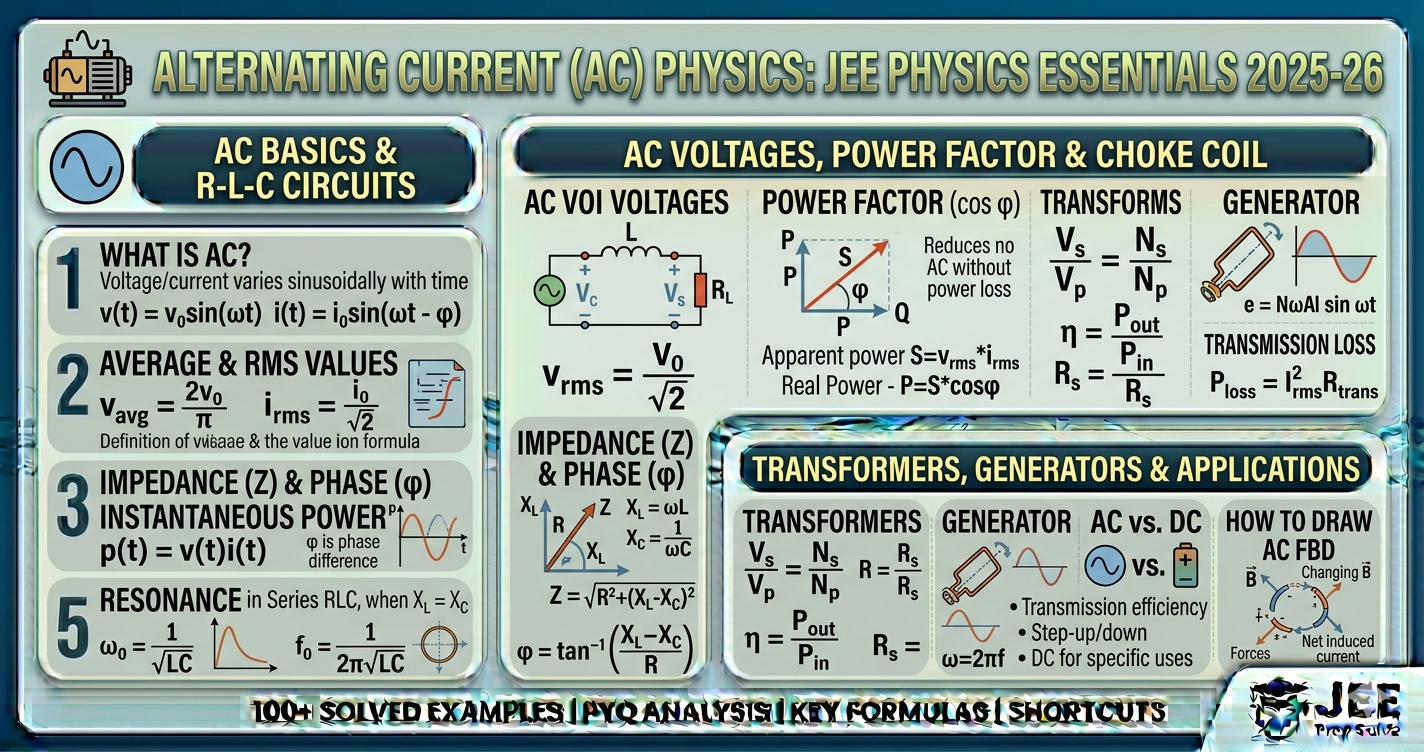
Alternating Current - Complete Guide for JEE 2025-26
Why Alternating Current is Important for JEE?
Alternating Current is one of the most important chapters in JEE Physics with a weightage of 5-8% in JEE Main and 8-12% in JEE Advanced. This chapter tests both conceptual understanding and mathematical skills:
- Phasor Analysis - Foundation for electromagnetic wave questions
- RLC Circuits - Most frequently asked numerical problems
- Resonance - High-weightage in JEE Advanced
- Transformers - Direct application-based questions
- Power Factor - Important for competitive edge
In JEE Advanced, LC oscillations and damped oscillations are frequently combined with SHM concepts for multi-concept problems.
Key Formulas to Remember
1. Basic AC Relations
- • V_rms = V₀/√2, I_rms = I₀/√2
- • X_L = ωL = 2πfL
- • X_C = 1/(ωC) = 1/(2πfC)
2. Series RLC Circuit
- • Z = √[R² + (X_L - X_C)²]
- • tan φ = (X_L - X_C)/R
- • Power Factor = cos φ = R/Z
3. Resonance
- • ω₀ = 1/√(LC), f₀ = 1/(2π√LC)
- • Q = ω₀L/R = 1/(ω₀CR)
- • Bandwidth = f₀/Q
4. Transformer
- • V_s/V_p = N_s/N_p = I_p/I_s
- • η = (P_out/P_in) × 100%
📚 How to Study Alternating Current Effectively?
For JEE Main Students:
- Time Required: 4-5 days (3 hours/day)
- Master phasor diagrams first - everything builds on this
- Practice 50+ series RLC circuit problems
- Memorize all reactance and impedance formulas
- Focus on transformer and power factor questions
- Solve all NCERT examples and exercises
For JEE Advanced Students:
- Time Required: 6-7 days (4 hours/day)
- Deep understanding of resonance phenomenon
- Master LC oscillations and analogy with SHM
- Practice Q-factor and bandwidth problems
- Solve problems on damped oscillations
- Attempt complex multi-concept problems
- Study frequency response curves
⚠️ Common Mistakes to Avoid in JEE Exam
-
❌
Confusing peak and RMS values: Always convert to RMS before calculations unless specifically mentioned
-
❌
Adding voltages algebraically in RLC: V ≠ V_R + V_L + V_C. Use phasor addition!
-
❌
Phase angle sign error: X_L > X_C means inductive (positive φ), not capacitive
-
❌
Wrong power formula: Average power P = VI cos φ (not just VI). Power in pure L or C is zero!
-
❌
Forgetting ω in reactance: X_L = ωL (not just L), X_C = 1/(ωC) (not just 1/C)
-
❌
Transformer DC confusion: Transformers work ONLY with AC, not DC. Never apply transformer equations to DC!
📊 JEE Previous Year Question Analysis (2019-2024)
| Year | JEE Main | JEE Advanced | Topic Focus |
|---|---|---|---|
| 2024 | 3 Questions (12 marks) | 4 Questions (14 marks) | RLC resonance, Transformer, LC oscillations |
| 2023 | 2 Questions (8 marks) | 3 Questions (11 marks) | Power factor, Impedance, Q-factor |
| 2022 | 3 Questions (12 marks) | 3 Questions (12 marks) | Series RLC, Transformer efficiency |
| 2021 | 2 Questions (8 marks) | 4 Questions (15 marks) | Resonance, LC energy, Phasor |
| 2020 | 2 Questions (8 marks) | 3 Questions (10 marks) | RLC circuit, Transmission |
Trend: JEE Advanced increasingly focuses on conceptual problems combining AC with other chapters like SHM and electromagnetic induction. RLC resonance and LC oscillations are favorite topics for paragraph-based questions.
⚡ Quick Revision - Must Remember Points
Phase Relationships:
- • Resistor: φ = 0° (in phase)
- • Inductor: I lags V by 90°
- • Capacitor: I leads V by 90°
- • Remember: "ELI the ICE man"
At Resonance:
- • X_L = X_C
- • Z = R (minimum)
- • I = V/R (maximum)
- • φ = 0°, pf = 1
- • V_L = V_C = QV
Power:
- • True Power P = VI cos φ = I²R
- • Pure L or C: P = 0
- • Apparent Power S = VI
- • Reactive Power Q = VI sin φ