
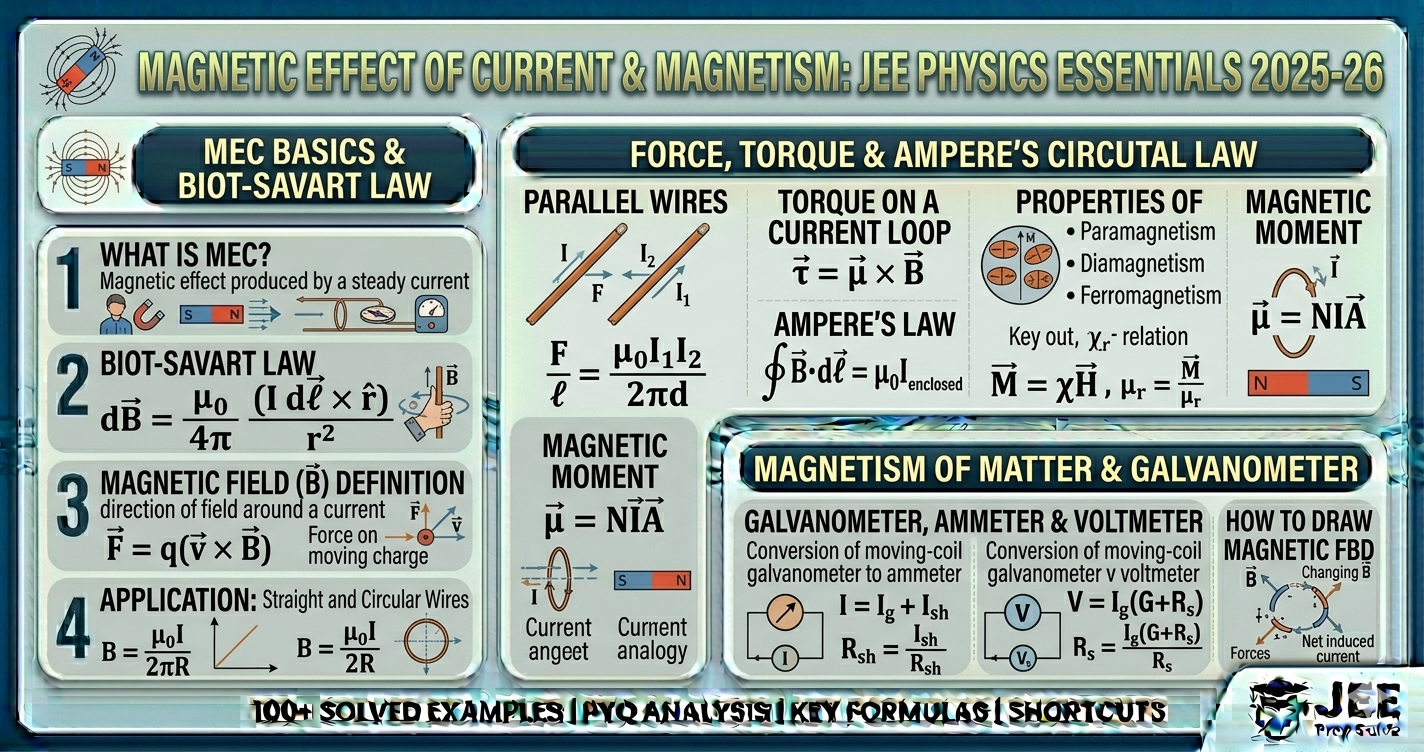
📑 Quick Navigation - Magnetic Effects of Current and Magnetism

Magnetic Effects of Current & Magnetism | JEE 2025-26

Master the complete chapter with detailed notes on Biot-Savart Law, Ampere's Law, Lorentz Force, Cyclotron, Moving Coil Galvanometer, and Magnetism. Includes 200+ solved problems, important formulas, and all JEE shortcuts.

📚 10 Complete Sections
✍️ 200+ Solved Examples
🎯 Quick Formulas
⭐⭐⭐⭐⭐ 4.9/5
312+ students rated this helpful
200+
Solved Examples
4 hrs
Study Time
Free
Always
Magnetic Effects of Current and Magnetism JEE notes, Formulas, PYQs
Magnetic Effects of Current and Magnetism - JEE Notes, Formulas, PYQs
1

Magnetic Field - Fundamentals

A magnetic field is a region around a magnet or current-carrying conductor where magnetic effects can be experienced. Understanding magnetic fields is fundamental to electromagnetism and forms the basis for numerous JEE problems.

1.1 Sources of Magnetic Field

Natural Sources
  • Permanent magnets (lodestone)
  • Earth's magnetic field
  • Celestial bodies (Sun, planets)
Artificial Sources
  • Current-carrying conductors
  • Electromagnets
  • Moving charges

1.2 Magnetic Field (B)

Magnetic Field Definition

The magnetic field B (also called magnetic flux density or magnetic induction) is defined by the force it exerts on a moving charge.

\[\vec{F} = q(\vec{v} \times \vec{B})\]

SI Unit: Tesla (T) = Wb/m² = kg/(A·s²)

CGS Unit: Gauss (G), where 1 T = 10⁴ G

Dimension: [MT⁻²A⁻¹]

1.3 Properties of Magnetic Field Lines

💡 Key Properties

  • Closed curves: Magnetic field lines always form closed loops
  • Never intersect: Two field lines never cross each other
  • Direction: Outside magnet: N to S; Inside magnet: S to N
  • Tangent gives direction: Tangent at any point gives B direction
  • Density indicates strength: Closer lines = stronger field
  • No starting/ending point: Unlike electric field lines

⚠️ Important Distinction

Property Electric Field Lines Magnetic Field Lines
Nature Open curves Closed curves
Starting point Positive charge None (no monopole)
Ending point Negative charge None

1.4 Magnetic Flux

Magnetic Flux (Φ)

\[\Phi = \vec{B} \cdot \vec{A} = BA\cos\theta\]

Where θ is the angle between B and area vector (normal to surface)

SI Unit: Weber (Wb) = T·m² = V·s

Dimension: [ML²T⁻²A⁻¹]

Gauss's Law for Magnetism:

\[\oint \vec{B} \cdot d\vec{A} = 0\]

Net magnetic flux through any closed surface is zero (no magnetic monopoles exist)

2

Biot-Savart Law

Biot-Savart Law is the fundamental law for calculating magnetic fields due to current-carrying conductors. It's the magnetic equivalent of Coulomb's law in electrostatics and is essential for JEE Advanced.

2.1 Statement of Biot-Savart Law

Biot-Savart Law

"The magnetic field dB at a point P due to a small current element Idl is directly proportional to the current I, the length element dl, sine of the angle between dl and r, and inversely proportional to the square of distance r."

\[d\vec{B} = \frac{\mu_0}{4\pi} \frac{I(d\vec{l} \times \hat{r})}{r^2}\]

OR in magnitude form:

\[dB = \frac{\mu_0}{4\pi} \frac{I \cdot dl \cdot \sin\theta}{r^2}\]

Where:

• μ₀ = Permeability of free space = 4π × 10⁻⁷ T·m/A

• I = Current through conductor

• dl = Length of current element

• r = Distance from element to point P

• θ = Angle between dl and r

💡 Direction of Magnetic Field

The direction of dB is given by the Right Hand Rule:

  • Point fingers along current direction (dl)
  • Curl fingers toward r (position vector)
  • Thumb points in direction of dB

Remember: dB is perpendicular to both dl and r (comes out of the plane containing them)

2.2 Magnetic Field Due to Straight Wire

Finite Straight Wire

\[B = \frac{\mu_0 I}{4\pi d}(\sin\phi_1 + \sin\phi_2)\]

Where d is perpendicular distance, φ₁ and φ₂ are angles at point P

Infinite Straight Wire:

(φ₁ = φ₂ = 90°)

\[B = \frac{\mu_0 I}{2\pi d}\]

Semi-infinite Wire:

(φ₁ = 90°, φ₂ = 0°)

\[B = \frac{\mu_0 I}{4\pi d}\]

2.3 Magnetic Field Due to Circular Loop

Circular Current Loop

At Center (x = 0):

\[B_{\text{center}} = \frac{\mu_0 I}{2R}\]

At Axial Point:

\[B_{\text{axis}} = \frac{\mu_0 IR^2}{2(R^2 + x^2)^{3/2}}\]

For N turns (coil):

\[B_{\text{center}} = \frac{\mu_0 NI}{2R}\]

Far from loop (x >> R):

\[B \approx \frac{\mu_0 IR^2}{2x^3} = \frac{\mu_0}{4\pi} \cdot \frac{2M}{x^3}\]

where M = IA = Magnetic dipole moment

2.4 Magnetic Field Due to Arc

Arc of Circle at Center

\[B = \frac{\mu_0 I \theta}{4\pi R}\]

Where θ is the angle subtended in radians

Full Circle (θ = 2π):

\[B = \frac{\mu_0 I}{2R}\]

Semicircle (θ = π):

\[B = \frac{\mu_0 I}{4R}\]

Quarter circle (θ = π/2):

\[B = \frac{\mu_0 I}{8R}\]

📝 Solved Example 1

Question: A circular coil of 100 turns and radius 10 cm carries a current of 1 A. Calculate the magnetic field at (a) the center (b) a point on axis 10 cm from center.

Solution:

Given: N = 100, R = 0.1 m, I = 1 A, x = 0.1 m

(a) At center:

\[B_{\text{center}} = \frac{\mu_0 NI}{2R} = \frac{4\pi \times 10^{-7} \times 100 \times 1}{2 \times 0.1}\]
\[B_{\text{center}} = \frac{4\pi \times 10^{-5}}{0.2} = 2\pi \times 10^{-4}\]
\[B_{\text{center}} = 6.28 \times 10^{-4} \text{ T} = 0.628 \text{ mT}\]

(b) At axial point (x = R):

\[B_{\text{axis}} = \frac{\mu_0 NIR^2}{2(R^2 + x^2)^{3/2}}\]

Since x = R:

\[B_{\text{axis}} = \frac{\mu_0 NIR^2}{2(2R^2)^{3/2}} = \frac{\mu_0 NI}{2R \cdot 2\sqrt{2}}\]
\[B_{\text{axis}} = \frac{B_{\text{center}}}{2\sqrt{2}} = \frac{6.28 \times 10^{-4}}{2.83}\]
\[B_{\text{axis}} = 2.22 \times 10^{-4} \text{ T} = 0.222 \text{ mT}\]
3

Ampere's Circuital Law

Ampere's Circuital Law provides an elegant method to calculate magnetic fields when there is high symmetry. It's the magnetic equivalent of Gauss's law in electrostatics.

3.1 Statement of Ampere's Law

Ampere's Circuital Law

"The line integral of magnetic field B around any closed loop (Amperian loop) is equal to μ₀ times the total current enclosed by that loop."

\[\oint \vec{B} \cdot d\vec{l} = \mu_0 I_{\text{enclosed}}\]

Physical Basis:

Based on the fact that magnetic field lines form closed loops around current-carrying conductors.

💡 When to Use Ampere's Law

Ampere's law is most useful when:

  • Symmetry exists such that B is constant along the Amperian loop
  • B is parallel or perpendicular to dl at all points
  • Common applications: Infinite wire, solenoid, toroid

3.2 Applications of Ampere's Law

Configuration Magnetic Field Where
Infinite Straight Wire B = μ₀I/(2πr) At distance r from wire
Solenoid (inside) B = μ₀nI n = N/L = turns per unit length
Solenoid (outside) B ≈ 0 For ideal solenoid
Toroid (inside) B = μ₀NI/(2πr) r = radius of Amperian loop
Toroid (outside & center) B = 0 No enclosed current
Thick Cylindrical Wire (r < R) B = μ₀Ir/(2πR²) Inside the wire
Thick Cylindrical Wire (r > R) B = μ₀I/(2πr) Outside the wire

3.3 Solenoid

Magnetic Field in Solenoid

A solenoid is a long coil of wire with many turns wound closely together.

Inside (ideal solenoid):

\[B = \mu_0 nI = \frac{\mu_0 NI}{L}\]

Uniform field parallel to axis

At End (finite solenoid):

\[B_{\text{end}} = \frac{\mu_0 nI}{2} = \frac{B_{\text{center}}}{2}\]

Half of center value

Properties of Solenoid:

  • Field inside is nearly uniform
  • Field outside is nearly zero (for ideal solenoid)
  • Acts like a bar magnet
  • End from which field lines emerge is North pole

3.4 Toroid

Magnetic Field in Toroid

A toroid is a solenoid bent into a circular ring shape.

Inside the toroid (within windings):

\[B = \frac{\mu_0 NI}{2\pi r}\]

where r is distance from center of toroid

Outside toroid:

\[B = 0\]

In central cavity:

\[B = 0\]

For thin toroid (R >> a):

\[B = \mu_0 nI \text{ where } n = \frac{N}{2\pi R}\]

📝 Solved Example 2

Question: A solenoid 50 cm long has 500 turns and carries a current of 2 A. Calculate: (a) Magnetic field at the center (b) Magnetic field at one end.

Solution:

Given: L = 0.5 m, N = 500, I = 2 A

n = N/L = 500/0.5 = 1000 turns/m

(a) At center:

\[B_{\text{center}} = \mu_0 nI = 4\pi \times 10^{-7} \times 1000 \times 2\]
\[B_{\text{center}} = 8\pi \times 10^{-4} = 2.51 \times 10^{-3} \text{ T} = 2.51 \text{ mT}\]

(b) At one end:

\[B_{\text{end}} = \frac{B_{\text{center}}}{2} = \frac{2.51}{2}\]
\[B_{\text{end}} = 1.26 \text{ mT}\]
4

Lorentz Force

The Lorentz Force is the total electromagnetic force experienced by a charged particle moving in electric and magnetic fields. This concept is fundamental for understanding particle motion and forms the basis of many JEE questions.

4.1 Lorentz Force Equation

Complete Lorentz Force

\[\vec{F} = q\vec{E} + q(\vec{v} \times \vec{B})\]

Where:

  • qE = Electric force (along E)
  • q(v × B) = Magnetic force (perpendicular to both v and B)

4.2 Magnetic Force on Moving Charge

Magnetic Force

\[\vec{F} = q(\vec{v} \times \vec{B})\]

In magnitude:

\[F = qvB\sin\theta\]

Where θ is angle between v and B

Special Cases:

  • θ = 0° or 180°: F = 0 (v parallel or antiparallel to B)
  • θ = 90°: F = qvB (maximum force)

⚠️ Key Properties of Magnetic Force

  • Always perpendicular to both v and B
  • Does no work on the charged particle (W = 0)
  • Cannot change speed (only direction changes)
  • Kinetic energy remains constant
  • Zero force on stationary charge (v = 0 → F = 0)

4.3 Direction of Magnetic Force

💡 Right Hand Rules

For Positive Charge:

Point fingers along v, curl toward B, thumb gives F direction

For Negative Charge:

Use left hand OR right hand rule gives opposite direction

5

Motion of Charged Particle in Magnetic Field

The motion of charged particles in magnetic fields leads to circular or helical paths, depending on the angle of entry. This concept is crucial for understanding devices like cyclotrons and mass spectrometers.

5.1 Circular Motion (v ⊥ B)

When Velocity is Perpendicular to Magnetic Field

The charged particle moves in a circular path.

Radius of circular path:

\[r = \frac{mv}{qB}\]

Time period:

\[T = \frac{2\pi m}{qB}\]

Frequency:

\[f = \frac{qB}{2\pi m}\]

Angular frequency:

\[\omega = \frac{qB}{m}\]

Key Insight:

Time period T and frequency f are independent of velocity and radius!

This property is used in cyclotrons.

5.2 Helical Motion (v at angle θ to B)

When Velocity is at Angle θ to B

The particle moves in a helical (spiral) path.

Velocity components:

  • v = v cos θ (along B) - causes linear motion
  • v = v sin θ (perpendicular to B) - causes circular motion

Radius of helix:

\[r = \frac{mv\sin\theta}{qB}\]

Pitch of helix:

\[p = v_\parallel \times T = \frac{2\pi mv\cos\theta}{qB}\]

5.3 Cyclotron

Cyclotron - Particle Accelerator

A cyclotron accelerates charged particles using alternating electric field and magnetic field.

Working Principle:

  • Magnetic field keeps particles in circular paths (inside dees)
  • Electric field accelerates particles (in the gap between dees)
  • Time period is constant → Resonance condition

Cyclotron frequency:

\[f_c = \frac{qB}{2\pi m}\]

Maximum KE:

\[KE_{max} = \frac{q^2B^2r_{max}^2}{2m}\]

Maximum velocity:

\[v_{max} = \frac{qBr_{max}}{m}\]

⚠️ Limitations of Cyclotron

  • Cannot accelerate neutrons (uncharged)
  • Cannot accelerate electrons efficiently (too light, become relativistic quickly)
  • Relativistic effects: At high speeds, mass increases, breaking resonance
  • Solution: Synchrotron (varies B and/or f)

5.4 Velocity Selector

Velocity Selector (Wien Filter)

Uses crossed electric and magnetic fields to select particles of specific velocity.

Condition for undeflected path:

Electric force = Magnetic force

\[qE = qvB\]

Selected velocity:

\[v = \frac{E}{B}\]

Independent of charge and mass!

📝 Solved Example 3

Question: A proton (m = 1.67 × 10⁻²⁷ kg, q = 1.6 × 10⁻¹⁹ C) enters a magnetic field of 0.1 T perpendicular to the field with velocity 10⁶ m/s. Find: (a) Radius of path (b) Time period (c) Frequency.

Solution:

Given: m = 1.67 × 10⁻²⁷ kg, q = 1.6 × 10⁻¹⁹ C, B = 0.1 T, v = 10⁶ m/s

(a) Radius:

\[r = \frac{mv}{qB} = \frac{1.67 \times 10^{-27} \times 10^6}{1.6 \times 10^{-19} \times 0.1}\]
\[r = \frac{1.67 \times 10^{-21}}{1.6 \times 10^{-20}} = 0.104 \text{ m} = 10.4 \text{ cm}\]

(b) Time period:

\[T = \frac{2\pi m}{qB} = \frac{2\pi \times 1.67 \times 10^{-27}}{1.6 \times 10^{-19} \times 0.1}\]
\[T = 6.56 \times 10^{-7} \text{ s} = 0.656 \text{ μs}\]

(c) Frequency:

\[f = \frac{1}{T} = \frac{1}{6.56 \times 10^{-7}}\]
\[f = 1.52 \times 10^{6} \text{ Hz} = 1.52 \text{ MHz}\]
6

Force on Current Carrying Conductor

When a current-carrying conductor is placed in a magnetic field, it experiences a force. This principle is the basis of electric motors and many electromagnetic devices.

6.1 Force on Straight Conductor

Force Formula

\[\vec{F} = I(\vec{L} \times \vec{B})\]

In magnitude:

\[F = BIL\sin\theta\]

Where:

• B = Magnetic field (T)

• I = Current (A)

• L = Length of conductor in field (m)

• θ = Angle between L and B

Maximum force:

When θ = 90° (conductor perpendicular to field)

\[F_{max} = BIL\]

6.2 Force Between Two Parallel Conductors

Force Between Parallel Wires

Two parallel conductors carrying currents exert forces on each other.

\[\frac{F}{L} = \frac{\mu_0 I_1 I_2}{2\pi d}\]

Force per unit length between two infinite parallel wires

Same Direction Currents:

ATTRACT

Opposite Direction Currents:

REPEL

Definition of Ampere:

One ampere is that constant current which, when flowing through two parallel infinite conductors placed 1 meter apart in vacuum, produces a force of 2 × 10⁻⁷ N per meter length on each conductor.

💡 Memory Trick

"Like currents attract, unlike currents repel"

This is opposite to charges! (Like charges repel, unlike charges attract)

7

Torque on Current Loop & Moving Coil Galvanometer

A current-carrying loop in a magnetic field experiences torque, which is the working principle of electric motors and galvanometers. This is a high-weightage topic in JEE.

7.1 Magnetic Dipole Moment

Magnetic Dipole Moment (M)

\[\vec{M} = NI\vec{A}\]

Where:

• N = Number of turns

• I = Current

• A = Area of loop

SI Unit: A·m² or J/T

Direction: Perpendicular to plane of loop (by right-hand rule)

7.2 Torque on Current Loop

Torque Formula

\[\vec{\tau} = \vec{M} \times \vec{B} = NI\vec{A} \times \vec{B}\]

In magnitude:

\[\tau = NIAB\sin\theta\]

Where θ is angle between area vector (M) and B

Maximum torque:

When θ = 90° (plane of loop parallel to B)

\[\tau_{max} = NIAB\]

Zero torque:

When θ = 0° or 180° (plane perpendicular to B)

\[\tau = 0\]

7.3 Moving Coil Galvanometer

Working Principle

A moving coil galvanometer measures small currents using the torque on a current loop.

At Equilibrium:

Magnetic torque = Restoring torque of spring

\[NIAB = k\theta\]

Deflection:

\[\theta = \frac{NAB}{k}I = GI\]

where G = NAB/k is galvanometer constant

Current Sensitivity:

\[S_I = \frac{\theta}{I} = \frac{NAB}{k}\]

Voltage Sensitivity:

\[S_V = \frac{\theta}{V} = \frac{NAB}{kR}\]

7.4 Conversion of Galvanometer

To Ammeter

Connect low resistance (shunt S) in parallel

\[S = \frac{I_g G}{I - I_g} = \frac{G}{n-1}\]

where n = I/Ig (multiplication factor)

Range increases, resistance decreases

To Voltmeter

Connect high resistance R in series

\[R = \frac{V}{I_g} - G = G(n-1)\]

where n = V/(IgG) (multiplication factor)

Range increases, resistance increases

⚠️ Important Points for JEE

  • Ideal Ammeter: Zero resistance (shunt S → 0)
  • Ideal Voltmeter: Infinite resistance (R → ∞)
  • Radial magnetic field: Used for uniform torque at all angles
  • Increasing sensitivity: Increase N, A, B or decrease k
8

Bar Magnets & Magnetic Dipoles

A bar magnet behaves like a magnetic dipole, similar to how a current loop creates a magnetic dipole moment. Understanding the analogy between electric and magnetic dipoles is important for JEE.

8.1 Magnetic Field Due to Bar Magnet

Magnetic Field at Various Points

On Axial Line:

\[B_{\text{axial}} = \frac{\mu_0}{4\pi} \cdot \frac{2M}{r^3}\]

(for r >> l)

On Equatorial Line:

\[B_{\text{eq}} = \frac{\mu_0}{4\pi} \cdot \frac{M}{r^3}\]

(for r >> l)

Relationship:

\[B_{\text{axial}} = 2B_{\text{eq}}\]

Axial field is twice the equatorial field at same distance

At General Point (r, θ):

\[B = \frac{\mu_0 M}{4\pi r^3}\sqrt{1 + 3\cos^2\theta}\]

8.2 Bar Magnet in Uniform Magnetic Field

Torque and Energy

Torque:

\[\tau = MB\sin\theta\]

Potential Energy:

\[U = -MB\cos\theta = -\vec{M} \cdot \vec{B}\]

Work done in rotating:

\[W = MB(\cos\theta_1 - \cos\theta_2)\]

8.3 Analogy: Electric vs Magnetic Dipole

Property Electric Dipole Magnetic Dipole
Dipole Moment p = qd M = NIA or M = ml
Axial Field E = 2kp/r³ B = (μ₀/4π)(2M/r³)
Equatorial Field E = kp/r³ B = (μ₀/4π)(M/r³)
Torque τ = pE sinθ τ = MB sinθ
Potential Energy U = -p·E U = -M·B
9

Earth's Magnetism

Earth behaves like a giant bar magnet with its magnetic south pole near the geographic north pole. Understanding Earth's magnetism and related terms is important for JEE.

9.1 Elements of Earth's Magnetism

1. Magnetic Declination (θ)

Angle between geographic meridian and magnetic meridian at a place.

It varies from place to place

2. Angle of Dip (δ or I)

Angle between Earth's magnetic field and horizontal at a place.

  • At equator: δ = 0°
  • At poles: δ = 90°
3. Horizontal Component (BH)

Component of Earth's field in horizontal direction.

\[B_H = B\cos\delta\]

Relations between Components

Horizontal component:

\[B_H = B\cos\delta\]

Vertical component:

\[B_V = B\sin\delta\]

Total field:

\[B = \sqrt{B_H^2 + B_V^2}\]

Angle of dip:

\[\tan\delta = \frac{B_V}{B_H}\]

💡 Key Facts about Earth's Magnetism

  • Geographic North: Near Earth's magnetic South pole
  • Earth's field: Approximately 25-65 μT (varies with location)
  • Magnetic equator: Line where dip = 0°
  • Isogonic lines: Lines of equal declination
  • Isoclinic lines: Lines of equal dip
  • Neutral points: Where BH = 0 (field of magnet cancels BH)
10

Magnetic Properties of Materials

Materials respond differently to external magnetic fields. Understanding diamagnetic, paramagnetic, and ferromagnetic materials is crucial for JEE, especially the concept of magnetic susceptibility and permeability.

10.1 Important Magnetic Terms

Definitions

Magnetization (I or M):

\[I = \frac{\text{Magnetic moment}}{\text{Volume}} = \frac{M}{V}\]

Unit: A/m

Magnetic Intensity (H):

\[H = \frac{B}{\mu_0} - I\]

Unit: A/m

Magnetic Susceptibility (χ):

\[\chi = \frac{I}{H}\]

Dimensionless

Relative Permeability (μr):

\[\mu_r = 1 + \chi\]

Dimensionless

Relation between B, H, and I:

\[B = \mu_0(H + I) = \mu_0 H(1 + \chi) = \mu_0 \mu_r H = \mu H\]

10.2 Classification of Magnetic Materials

Property Diamagnetic Paramagnetic Ferromagnetic
Susceptibility (χ) Negative, small
(-10⁻⁵ to -10⁻⁹)
Positive, small
(10⁻⁵ to 10⁻³)
Positive, large
(10² to 10⁵)
Relative Permeability (μr) Slightly < 1 Slightly > 1 >> 1
Behavior in field Weakly repelled
(moves to weaker field)
Weakly attracted
(moves to stronger field)
Strongly attracted
Temperature dependence Independent χ ∝ 1/T (Curie's law) Above Curie point → paramagnetic
Examples Bi, Cu, Ag, Au, H₂O, N₂ Al, Na, Ca, O₂, Pt Fe, Co, Ni, Gd
Atomic property All electrons paired Unpaired electrons present Domains present

10.3 Hysteresis

Hysteresis Loop

When a ferromagnetic material is magnetized and demagnetized cyclically, the B-H curve forms a loop called hysteresis loop.

Retentivity (Br):

Value of B when H = 0 (magnetic memory)

Coercivity (Hc):

Value of H needed to reduce B to zero

Hysteresis Loss:

Energy lost per cycle = Area of loop

Applications:

  • Permanent magnets: High retentivity, high coercivity (steel, alnico)
  • Electromagnet cores: Low retentivity, low coercivity (soft iron)
  • Transformer cores: Low hysteresis loss (soft iron)

⚠️ Curie's Law & Temperature

Paramagnetic materials:

\[\chi = \frac{C}{T}\]

C = Curie constant

Ferromagnetic materials:

\[\chi = \frac{C}{T - T_c}\]

Tc = Curie temperature (above which → paramagnetic)

📝 Previous Year Questions Analysis

JEE Main (Last 5 Years)

  • ✓ Biot-Savart Law Applications: 30%
  • ✓ Force on Moving Charge/Conductor: 25%
  • ✓ Cyclotron & Motion in B: 20%
  • ✓ Torque on Current Loop: 15%
  • ✓ Magnetism & Materials: 10%

JEE Advanced (Last 5 Years)

  • ✓ Complex B-field Problems: 35%
  • ✓ Motion of Charged Particles: 25%
  • ✓ Ampere's Law Applications: 20%
  • ✓ Force Between Conductors: 12%
  • ✓ Earth's Magnetism: 8%

Top 12 Most Repeated Question Types

  1. Magnetic field at center of circular loop/arc
  2. Magnetic field due to straight wire at a point
  3. Radius and time period of charged particle in magnetic field
  4. Force between two parallel current-carrying conductors
  5. Torque on current loop in magnetic field
  6. Cyclotron frequency and maximum kinetic energy
  7. Conversion of galvanometer to ammeter/voltmeter
  8. Magnetic field inside solenoid and toroid
  9. Motion of charge in combined E and B fields
  10. Helical motion - pitch and radius calculation
  11. Elements of Earth's magnetism
  12. Magnetic properties - susceptibility and permeability

Weightage Analysis

JEE Main: 16-20 marks (4-5 questions)
JEE Advanced: 18-24 marks (5-6 questions)
Difficulty Level: Medium to Hard
Time Required: 6-8 hours practice

Year-wise Question Distribution

Year JEE Main JEE Advanced Key Topics
2024 5 Questions (20 marks) 6 Questions (22 marks) Cyclotron, Biot-Savart, Torque
2023 4 Questions (16 marks) 5 Questions (18 marks) Helical motion, Solenoid, Galvanometer
2022 5 Questions (20 marks) 6 Questions (24 marks) Force on conductor, Ampere's law
2021 4 Questions (16 marks) 5 Questions (20 marks) Circular motion in B, Bar magnet

🎯 Practice Problem Set

Level 1: Basic (JEE Main Standard)

  1. Find the magnetic field at the center of a circular loop of radius 5 cm carrying current 2 A.
  2. A wire carrying 10 A current is placed perpendicular to a magnetic field of 0.5 T. Find force per unit length.
  3. An electron moves with velocity 10⁶ m/s perpendicular to B = 0.1 T. Find the radius of circular path.
  4. Calculate the magnetic field at a distance of 10 cm from an infinite straight wire carrying 5 A current.
  5. A solenoid has 500 turns and length 25 cm. Find magnetic field inside when current is 4 A.
  6. Two parallel wires 10 cm apart carry currents 5 A and 10 A in same direction. Find force per meter.
  7. A rectangular coil of 100 turns, area 20 cm² carries 0.5 A in field 0.2 T. Find maximum torque.
  8. Find the cyclotron frequency for a proton in magnetic field of 1 T.

Level 2: Intermediate (JEE Main/Advanced)

  1. A charged particle enters a uniform magnetic field at 30° to the field direction. Describe its motion and find pitch if v = 10⁶ m/s, B = 0.5 T, q/m = 10⁸ C/kg.
  2. Find the magnetic field at a point on the axis of a circular coil of radius R at distance x from center. Show that at x >> R, B ∝ 1/x³.
  3. A galvanometer of resistance 50Ω shows full-scale deflection for 1 mA. Convert it to (a) ammeter of range 0-5 A (b) voltmeter of range 0-50 V.
  4. Using Ampere's law, derive expression for magnetic field inside and outside a thick cylindrical wire of radius R carrying uniform current I.
  5. A semicircular wire of radius 10 cm carries current 5 A. Find magnetic field at the center due to (a) semicircle (b) straight portion.
  6. An electron enters a region with E = 10⁴ V/m and B = 10⁻² T (perpendicular). Find the velocity for which it passes undeflected.
  7. A toroid has 1000 turns, mean radius 20 cm, and carries 2 A. Find B at a point (a) inside windings (b) in central cavity (c) outside.
  8. The horizontal component of Earth's field is 30 μT. A bar magnet of moment 0.3 Am² is placed in magnetic meridian. Find null points.

Level 3: Advanced (JEE Advanced/Olympiad)

  1. A charged particle of mass m and charge q starts from rest in combined electric (E) and magnetic (B) fields perpendicular to each other. Derive the equation of its trajectory.
  2. Find the magnetic field at the center of a square loop of side 'a' carrying current I. Express in terms of μ₀, I, and a.
  3. Two concentric circular loops of radii R and 2R lie in the same plane and carry currents I and 2I in opposite directions. Find net magnetic field at common center.
  4. A wire is bent into a regular hexagon of side 'a'. Find magnetic field at center if it carries current I.
  5. Derive the time period of oscillation of a bar magnet suspended in Earth's magnetic field. What happens if the magnet is heated above Curie temperature?
  6. In a cyclotron, protons are accelerated using 50 kV potential difference and 1.5 T magnetic field. Find (a) frequency (b) radius after 50 revolutions (c) kinetic energy gained.
  7. A charged particle moves in helical path in a non-uniform magnetic field (B increasing along axis). Explain the magnetic mirror effect.
  8. A current loop of magnetic moment M is placed in a non-uniform magnetic field. Derive expression for force on the loop.

Numerical Answer Type (NAT) Practice

  1. A proton (m = 1.67 × 10⁻²⁷ kg) moves in a circle of radius 20 cm in B = 0.5 T. Find its kinetic energy in MeV. [Answer: ___]
  2. A wire carrying 8 A is bent into a circle of radius 4 cm. Find B at center in mT. [Answer: ___]
  3. At what angle should a charge enter a magnetic field to have pitch equal to circumference of helical path? [Answer: ___ degrees]
  4. A galvanometer (G = 100Ω, Ig = 2mA) is converted to ammeter of range 2 A. Find shunt resistance in Ω. [Answer: ___]
  5. If χ = 0.0015 for a paramagnetic material, find μr. [Answer: ___]

📋 Quick Formula Sheet - Magnetic Effects

Biot-Savart Law

dB = (μ₀/4π)(Idl×r̂)/r²

Straight wire: B = (μ₀I/4πd)(sinφ₁+sinφ₂)

Infinite wire: B = μ₀I/2πd

Circular loop center: B = μ₀I/2R

Arc at center: B = μ₀Iθ/4πR

Ampere's Law

∮B⃗·dl⃗ = μ₀I_enclosed

Solenoid: B = μ₀nI

Toroid: B = μ₀NI/2πr

Cylinder (r

Cylinder (r>R): B = μ₀I/2πr

Lorentz Force

F⃗ = q(E⃗ + v⃗×B⃗)

Magnetic: F = qvBsinθ

On conductor: F = BILsinθ

Parallel wires: F/L = μ₀I₁I₂/2πd

Motion in B Field

Radius: r = mv/qB

Time period: T = 2πm/qB

Frequency: f = qB/2πm

Pitch: p = 2πmvcosθ/qB

Velocity selector: v = E/B

Torque & Galvanometer

Magnetic moment: M = NIA

Torque: τ = MBsinθ = NIABsinθ

Energy: U = -M⃗·B⃗

Shunt (ammeter): S = IgG/(I-Ig)

Resistance (voltmeter): R = V/Ig - G

Magnetism

Axial: B = (μ₀/4π)(2M/r³)

Equatorial: B = (μ₀/4π)(M/r³)

BH = Bcosδ, BV = Bsinδ

tanδ = BV/BH

χ = I/H, μr = 1 + χ

Related Physics Notes

Magnetic Effects of Current and Magnetism - Complete Guide for JEE 2025-26

Why This Chapter is Critical for JEE?

Magnetic Effects of Current and Magnetism is one of the highest-scoring chapters in JEE Physics, contributing 8-10% of total physics marks. Key reasons why you must master it:

  • High Weightage: 4-6 questions in JEE Main, 5-7 in JEE Advanced
  • Conceptual Foundation: Forms base for Electromagnetic Induction & AC
  • Mixed Questions: Often combined with mechanics (charged particle motion)
  • Experimental Questions: Galvanometer, magnetism appear in practicals
  • Predictable Patterns: Similar question types repeat every year

In JEE Advanced, expect complex problems on motion of charges in non-uniform fields, combination of E and B fields, and multi-concept questions linking with mechanics.

Chapter-wise Important Topics

🔴 Must Know (100% Important)

  • • Biot-Savart Law applications (wire, loop, arc)
  • • Motion of charged particle in B field (circular, helical)
  • • Force between parallel conductors
  • • Torque on current loop, magnetic moment
  • • Moving coil galvanometer conversions

🟡 Important (80% Frequency)

  • • Ampere's law (solenoid, toroid)
  • • Cyclotron and velocity selector
  • • Earth's magnetism elements
  • • Magnetic properties of materials

🟢 Good to Know (50% Frequency)

  • • Bar magnet field calculations
  • • Hysteresis loop analysis
  • • Curie's law and temperature effects

📚 How to Study This Chapter Effectively?

For JEE Main Students:

  1. Time Required: 8-10 days (3 hours/day)
  2. Start with Biot-Savart Law - practice all standard configurations
  3. Master right-hand rules for directions
  4. Practice 100+ numerical problems on force and motion
  5. Don't skip galvanometer conversions (guaranteed question)
  6. Memorize all standard results for arc, loop, solenoid
  7. Solve 10 years of PYQs (patterns repeat!)

For JEE Advanced Students:

  1. Time Required: 12-15 days (4 hours/day)
  2. Deep dive into vector calculations for Biot-Savart
  3. Master superposition principle for complex geometries
  4. Practice problems on combined E and B fields
  5. Study non-uniform field effects (magnetic mirror)
  6. Connect with mechanics (centripetal force, energy conservation)
  7. Solve Irodov, Krotov problems for Advanced level

⚠️ Common Mistakes to Avoid in JEE Exam

  • Wrong direction using right-hand rule: Practice extensively - use thumb for current, fingers curl to show B direction
  • Forgetting μ₀/4π factor: Biot-Savart has μ₀/4π, infinite wire has μ₀/2π - don't mix them up!
  • Sign errors in force direction: Like currents attract, unlike repel (opposite to charges!)
  • Confusing θ in torque formula: θ is angle between M (area vector) and B, not between plane and B
  • Using wrong formula for helical motion: Radius uses v⊥ = vsinθ, pitch uses v∥ = vcosθ
  • Ignoring vector nature: B is a vector - superposition requires vector addition, not scalar

🎯 Quick Reference: Important Values to Remember

Physical Constants

  • μ₀ = 4π × 10⁻⁷ T·m/A
  • μ₀/4π = 10⁻⁷ T·m/A
  • e = 1.6 × 10⁻¹⁹ C
  • mₑ = 9.1 × 10⁻³¹ kg
  • mₚ = 1.67 × 10⁻²⁷ kg

Earth's Magnetism

  • B_Earth ≈ 25-65 μT
  • B_H at equator ≈ 30-40 μT
  • Dip at poles = 90°
  • Dip at equator = 0°

Unit Conversions

  • 1 Tesla = 10⁴ Gauss
  • 1 Weber = 10⁸ Maxwell
  • 1 A/m = 4π × 10⁻³ Oersted

🎬 Recommended Video Lectures

For Concept Building:

  • 📺 Physics Wallah - Magnetic Effects One Shot
  • 📺 Unacademy JEE - Biot Savart Complete
  • 📺 Vedantu JEE - Motion in Magnetic Field

For Problem Solving:

  • 📺 Mohit Tyagi - Advanced Problems
  • 📺 IIT JEE Physics by ABJ Sir
  • 📺 Etoos India - PYQ Solutions