
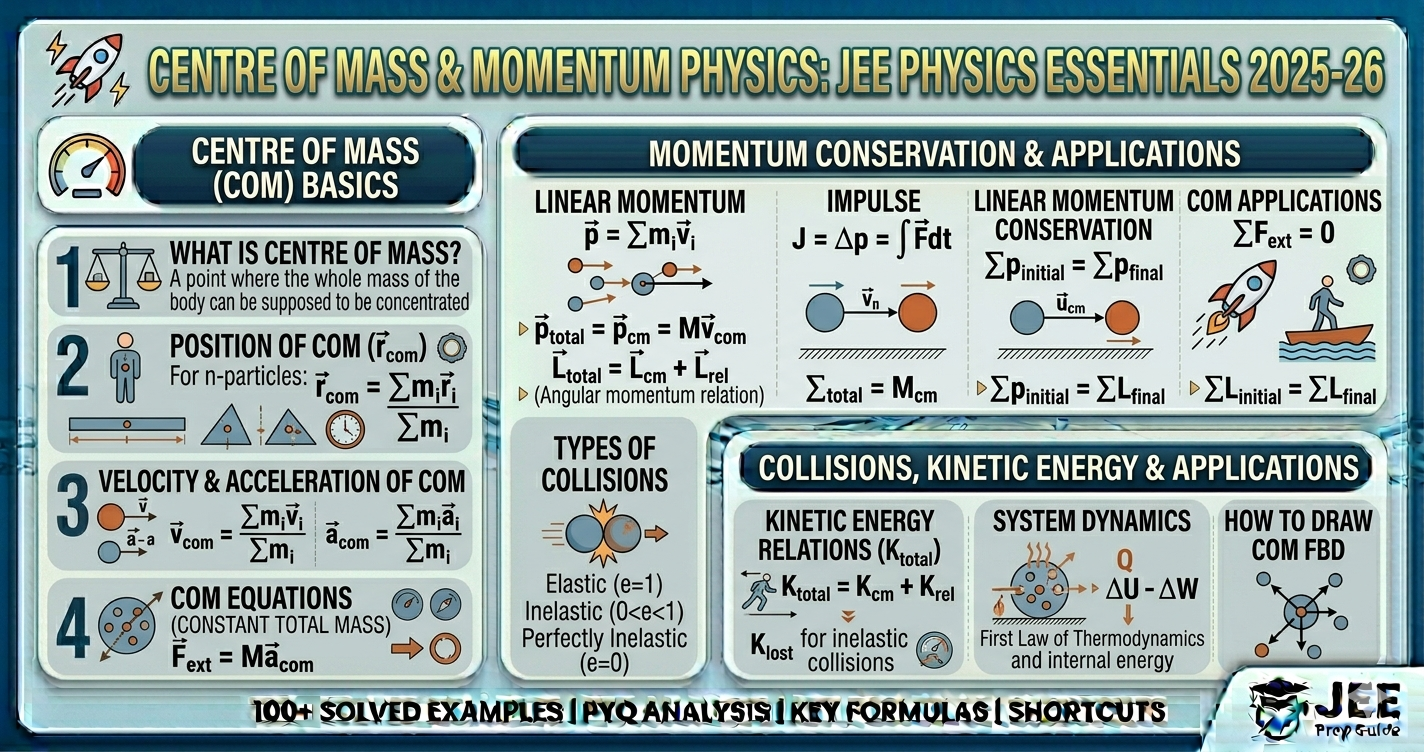
📖 Reading Time: 25 minutes ✅ Solved Examples: 100+ ⚡ Difficulty: Medium to Hard ⏰ Last Updated: 📊 Weightage: 8-12% (JEE Main) 🎯 Questions: 2-4 per exam

📑 Quick Navigation - Centre of Mass

Centre of Mass JEE Main & Advanced 2025-26

Master the concepts of Centre of Mass, Linear Momentum, Conservation Laws, and Variable Mass Systems. Includes complete notes on Rocket Propulsion with 100+ solved problems and JEE shortcuts.

📚 8 Complete Sections
✍️ 100+ Solved Examples
🎯 Quick Formulas
⭐⭐⭐⭐⭐ 4.8/5
290+ students rated this helpful
100+
Solved Examples
4 hrs
Study Time
Free
Always
Centre of Mass and Collision JEE notes, Formulas, PYQs
Centre of Mass and Collision JEE Notes, Formulas, PYQs
1

Introduction to Centre of Mass

The Centre of Mass (COM) is a unique point in a system of particles or an extended body where the entire mass of the system can be considered to be concentrated. It is the point where the weighted position vectors of all the particles sum to zero.

1.1 What is Centre of Mass?

Definition

Centre of Mass is the point at which the entire mass of a body or system of particles can be assumed to be concentrated for analyzing translational motion.

Physical Significance

  • • Point where external force can be applied
  • • Represents average position of mass
  • • Follows Newton's Laws as a point particle

Key Properties

  • • May or may not lie inside the body
  • • Depends on mass distribution
  • • Unique for any given configuration

1.2 Centre of Mass vs Centre of Gravity

Aspect Centre of Mass (COM) Centre of Gravity (COG)
Definition Point where total mass is concentrated Point where total weight acts
Depends on Mass distribution only Gravitational field variation
Uniform g COM = COG (Same point)
Non-uniform g Remains same Changes position
In space (g = 0) Exists Does not exist

💡 JEE Important Point

For all JEE problems near Earth's surface (uniform gravitational field), COM = COG. The distinction only matters for very large objects in non-uniform fields (like satellites extending over large heights).

1.3 Examples Where COM Lies Outside the Body

🍩

Ring/Torus

COM at geometric center

🌙

Hollow Hemisphere

COM inside hollow region

🔺

Boomerang

COM outside material

2

Position of Centre of Mass

2.1 Two Particle System

COM of Two Particles

\[x_{cm} = \frac{m_1x_1 + m_2x_2}{m_1 + m_2}\]

Distance from m₁:

\[d_1 = \frac{m_2 \cdot d}{m_1 + m_2}\]

Distance from m₂:

\[d_2 = \frac{m_1 \cdot d}{m_1 + m_2}\]

💡 Quick Formula

COM divides the line joining two masses in inverse ratio of masses:

\[\frac{d_1}{d_2} = \frac{m_2}{m_1}\]

COM is always closer to the heavier mass!

2.2 System of n Particles (Discrete)

General Formula for n Particles

x-coordinate:

\[x_{cm} = \frac{\sum m_ix_i}{\sum m_i}\]

y-coordinate:

\[y_{cm} = \frac{\sum m_iy_i}{\sum m_i}\]

z-coordinate:

\[z_{cm} = \frac{\sum m_iz_i}{\sum m_i}\]

Vector Form:

\[\vec{r}_{cm} = \frac{\sum m_i\vec{r}_i}{\sum m_i} = \frac{m_1\vec{r}_1 + m_2\vec{r}_2 + ... + m_n\vec{r}_n}{m_1 + m_2 + ... + m_n}\]

2.3 Continuous Mass Distribution

Integration Method

x-coordinate:

\[x_{cm} = \frac{\int x \, dm}{\int dm}\]

y-coordinate:

\[y_{cm} = \frac{\int y \, dm}{\int dm}\]

z-coordinate:

\[z_{cm} = \frac{\int z \, dm}{\int dm}\]

Mass Elements for Different Geometries:

Geometry Linear Density (λ) Mass Element (dm)
1D - Rod/Wire λ = M/L (kg/m) dm = λ dx
2D - Plate σ = M/A (kg/m²) dm = σ dA
3D - Solid ρ = M/V (kg/m³) dm = ρ dV

📝 Solved Example 1 (JEE Main Pattern)

Question: Three particles of masses 1 kg, 2 kg, and 3 kg are placed at (1, 2), (3, 4), and (5, 6) respectively. Find the position of COM.

Solution:

Total mass M = 1 + 2 + 3 = 6 kg

\[x_{cm} = \frac{m_1x_1 + m_2x_2 + m_3x_3}{M} = \frac{1(1) + 2(3) + 3(5)}{6} = \frac{1 + 6 + 15}{6} = \frac{22}{6} = \frac{11}{3}\]
\[y_{cm} = \frac{m_1y_1 + m_2y_2 + m_3y_3}{M} = \frac{1(2) + 2(4) + 3(6)}{6} = \frac{2 + 8 + 18}{6} = \frac{28}{6} = \frac{14}{3}\]
\[\text{COM} = \left(\frac{11}{3}, \frac{14}{3}\right) \approx (3.67, 4.67)\]
3

COM of Common Shapes

These standard results must be memorized for JEE. They save time and are directly applicable in many problems.

3.1 One-Dimensional Objects

Shape Position of COM
Uniform Rod (length L) At center: L/2 from either end
Semi-circular Wire (radius R) y = 2R/π from center (on axis of symmetry)
Quarter circular arc x = y = 2R/π from center

3.2 Two-Dimensional Objects (Laminas)

Shape Position of COM
Triangular Lamina At centroid: h/3 from base (intersection of medians)
Circular Disc At geometric center
Semi-circular Disc (radius R) y = 4R/3π from diameter
Quarter Disc x = y = 4R/3π from center
Sector of Disc (angle 2α) r = (2R sin α)/(3α) from center

3.3 Three-Dimensional Objects

Shape Position of COM
Solid Sphere At geometric center
Hollow Sphere At geometric center
Solid Hemisphere (radius R) y = 3R/8 from flat surface
Hollow Hemisphere (radius R) y = R/2 from flat surface
Solid Cone (height h) y = h/4 from base (3h/4 from apex)
Hollow Cone (height h) y = h/3 from base (2h/3 from apex)

💡 Memory Pattern

Semi-shapes (2D vs Wire):

Semicircular wire: 2R/π

Semicircular disc: 4R/3π

Hemisphere (Solid vs Hollow):

Solid Hemisphere: 3R/8

Hollow Hemisphere: R/2

3.4 Cavity Problems (Negative Mass Method)

When a portion is removed from a body:

\[x_{cm} = \frac{M \cdot x_1 - m \cdot x_2}{M - m}\]

M = mass of complete body, m = mass of removed portion
x₁ = COM of complete body, x₂ = COM of removed portion

📝 Solved Example 2 (JEE Main 2022 Type)

Question: A circular disc of radius R has a circular hole of radius R/2 cut from it. If the center of hole is at R/2 from center of disc, find position of new COM from original center.

Solution:

Let σ = mass per unit area

Mass of complete disc: M = σπR²

Mass of removed part: m = σπ(R/2)² = σπR²/4 = M/4

Remaining mass: M - M/4 = 3M/4

COM of complete disc: x₁ = 0

COM of removed part: x₂ = R/2

\[x_{cm} = \frac{M \cdot 0 - (M/4) \cdot (R/2)}{M - M/4} = \frac{-MR/8}{3M/4} = \frac{-R}{6}\]
\[\text{COM shifts by } \frac{R}{6} \text{ away from the hole}\]
4

Motion of Centre of Mass

The COM of a system moves as if all the mass were concentrated at that point and all external forces were applied there. This is the most powerful concept in this chapter.

4.1 Velocity of COM

\[\vec{v}_{cm} = \frac{d\vec{r}_{cm}}{dt} = \frac{\sum m_i\vec{v}_i}{\sum m_i} = \frac{m_1\vec{v}_1 + m_2\vec{v}_2 + ...}{M}\]

4.2 Acceleration of COM

\[\vec{a}_{cm} = \frac{d\vec{v}_{cm}}{dt} = \frac{\sum m_i\vec{a}_i}{\sum m_i}\]

4.3 Equation of Motion for COM

Newton's Second Law for System

\[\vec{F}_{ext} = M\vec{a}_{cm}\]

The COM accelerates only due to EXTERNAL forces. Internal forces cannot change COM motion!

⚠️ Key Insight (Most Important!)

If Fext = 0:

  • acm = 0 → vcm = constant
  • If system was at rest, COM remains stationary
  • Individual particles may move, but COM doesn't!

4.4 Applications

Man on Boat Problem

When a man walks on a boat (no external horizontal force):

\[m_1 \Delta x_1 + m_2 \Delta x_2 = 0\]

Man moves right → Boat moves left

Explosion in Mid-air

When a projectile explodes at highest point:

  • • COM continues parabolic path
  • • COM lands at same point as original
  • • Individual pieces may land elsewhere

📝 Solved Example 3 (JEE Advanced Pattern)

Question: A 60 kg man stands on one end of a 40 kg boat of length 10 m. He walks to the other end. How far does the boat move? (Neglect water resistance)

Solution:

No external horizontal force → COM remains stationary

Let boat move distance x to left when man moves to right end.

Man's displacement relative to ground = 10 - x (to right)

Using: m₁Δx₁ + m₂Δx₂ = 0

\[60(10 - x) + 40(-x) = 0\]
\[600 - 60x - 40x = 0\]
\[100x = 600\]
\[x = 6 \text{ m (boat moves 6 m opposite to man's motion)}\]
5

Linear Momentum

5.1 Definition

Linear Momentum

\[\vec{p} = m\vec{v}\]

SI Unit

kg·m/s or N·s

Dimensional Formula

[MLT⁻¹]

5.2 Momentum of System

\[\vec{P}_{system} = \sum m_i\vec{v}_i = M\vec{v}_{cm}\]

Total momentum of system = (Total mass) × (Velocity of COM)

5.3 Newton's Second Law in Momentum Form

\[\vec{F} = \frac{d\vec{p}}{dt}\]

Force = Rate of change of momentum

💡 Relation between p and KE

\[p = \sqrt{2mKE}\]
\[KE = \frac{p^2}{2m}\]

• Same KE → Heavier object has more momentum (p ∝ √m)

• Same momentum → Lighter object has more KE (KE ∝ 1/m)

6

Conservation of Linear Momentum

📜 Law of Conservation of Momentum

"If no external force acts on a system, the total linear momentum of the system remains constant."

Mathematical Form

\[\text{If } \vec{F}_{ext} = 0, \text{ then } \vec{P}_{initial} = \vec{P}_{final}\]
\[m_1\vec{u}_1 + m_2\vec{u}_2 = m_1\vec{v}_1 + m_2\vec{v}_2\]

6.1 Conditions for Conservation

✓ Momentum IS Conserved When:

  • • No external force (Fext = 0)
  • • External forces cancel out
  • • In a particular direction if Fext ⊥ that direction

✗ Momentum NOT Conserved When:

  • • Net external force exists
  • • In direction of net external force

6.2 Component-wise Conservation

Momentum can be conserved in one direction but not another!

x-direction:

If Fx,ext = 0

Σpx = constant

y-direction:

If Fy,ext = 0

Σpy = constant

z-direction:

If Fz,ext = 0

Σpz = constant

6.3 Applications

Scenario Application
Collisions Momentum conserved (both elastic and inelastic)
Explosions Total momentum before = Total momentum after
Gun Recoil mbulletvbullet = mgunvrecoil
Rocket Propulsion Momentum of gas = Momentum gained by rocket
Man jumping from boat Horizontal momentum conserved

📝 Solved Example 4

Question: A 5 kg gun fires a 50 g bullet at 400 m/s. Find recoil velocity of gun.

Solution:

Initial momentum = 0 (system at rest)

By conservation of momentum:

\[m_{bullet}v_{bullet} + m_{gun}v_{gun} = 0\]
\[0.05 \times 400 + 5 \times v_{gun} = 0\]
\[v_{gun} = -\frac{20}{5} = -4 \text{ m/s}\]
\[\text{Recoil velocity} = 4 \text{ m/s (opposite to bullet)}\]
7

Variable Mass Systems & Rocket Propulsion

In systems where mass changes with time (like rockets), we cannot directly use F = ma. Instead, we must use the momentum form of Newton's Law. This is a JEE Advanced favorite topic!

7.1 General Equation for Variable Mass

Variable Mass Equation

\[\vec{F}_{ext} + \vec{v}_{rel}\frac{dm}{dt} = m\frac{d\vec{v}}{dt}\]

vrel = velocity of ejected/added mass relative to main body

7.2 Rocket Propulsion

Rocket in Free Space (No Gravity)

Thrust Force:

\[F_{thrust} = v_{rel}\left|\frac{dm}{dt}\right| = v_{rel} \cdot \mu\]

μ = rate of fuel burn (kg/s)

Instantaneous Acceleration:

\[a = \frac{v_{rel} \cdot \mu}{m}\]

m = instantaneous mass

7.3 Rocket Velocity (Tsiolkovsky Equation)

Final Velocity of Rocket

\[v = v_0 + v_{rel} \ln\left(\frac{m_0}{m}\right)\]

m₀ = initial mass, m = final mass (after fuel burn)

If starting from rest (v₀ = 0):

\[v = v_{rel} \ln\left(\frac{m_0}{m}\right)\]

7.4 Rocket with Gravity

Vertical Launch (against gravity)

Net Force:

\[F_{net} = F_{thrust} - mg\]

Condition for liftoff:

\[F_{thrust} > m_0g\]

Velocity after time t:

\[v = v_{rel} \ln\left(\frac{m_0}{m_0 - \mu t}\right) - gt\]

⚠️ Important Sign Convention

  • dm/dt is negative for rocket (mass decreasing)
  • vrel is velocity of exhaust relative to rocket (directed backward)
  • Thrust is always positive and opposite to exhaust direction

📝 Solved Example 5 (JEE Advanced Pattern)

Question: A rocket has initial mass 1000 kg. Gas is ejected at 2 km/s relative to rocket at rate 10 kg/s. Find (a) Initial thrust (b) Initial acceleration (c) Velocity after 50 seconds in free space.

Given: m₀ = 1000 kg, vrel = 2000 m/s, μ = 10 kg/s

(a) Initial Thrust:

\[F_{thrust} = v_{rel} \times \mu = 2000 \times 10 = 20000 \text{ N} = 20 \text{ kN}\]

(b) Initial Acceleration:

\[a_0 = \frac{F_{thrust}}{m_0} = \frac{20000}{1000} = 20 \text{ m/s}^2\]

(c) Velocity after 50 s:

Mass after 50 s: m = 1000 - 10(50) = 500 kg

\[v = v_{rel} \ln\left(\frac{m_0}{m}\right) = 2000 \ln\left(\frac{1000}{500}\right)\]
\[v = 2000 \ln(2) = 2000 \times 0.693\]
\[v \approx 1386 \text{ m/s} \approx 1.4 \text{ km/s}\]
8

Impulse

8.1 Definition of Impulse

Impulse

\[\vec{J} = \vec{F} \cdot \Delta t = \Delta \vec{p} = m(\vec{v} - \vec{u})\]

SI Unit

N·s or kg·m/s

Dimensional Formula

[MLT⁻¹]

8.2 Impulse for Variable Force

\[\vec{J} = \int_{t_1}^{t_2} \vec{F} \, dt = \text{Area under F-t curve}\]

8.3 Impulse-Momentum Theorem

Theorem

\[\vec{J} = \vec{p}_f - \vec{p}_i = \Delta \vec{p}\]

Impulse = Change in momentum

8.4 Applications of Impulse

Short Duration Collisions

When force acts for very short time:

\[J = F_{avg} \cdot \Delta t\]

Used in bat-ball, hammer-nail problems

Impulsive Forces

Very large forces acting for very short time:

  • • Collision forces
  • • Explosion forces
  • • Sudden string becoming taut

💡 Reducing Impact Force

Since J = F × Δt = constant (for same momentum change):

Increasing Δt decreases F

  • Airbags increase collision time → less force
  • Pulling hands back while catching → less impact
  • Cushioned shoes → reduce force on joints

📝 Solved Example 6

Question: A ball of mass 200 g moving at 10 m/s is hit by a bat. It returns at 15 m/s. If contact time is 0.02 s, find (a) Impulse (b) Average force.

Given: m = 0.2 kg, u = 10 m/s, v = -15 m/s (returns), Δt = 0.02 s

(a) Impulse:

\[J = m(v - u) = 0.2(-15 - 10) = 0.2 \times (-25) = -5 \text{ N·s}\]

Magnitude of Impulse = 5 N·s

(b) Average Force:

\[F_{avg} = \frac{J}{\Delta t} = \frac{5}{0.02} = 250 \text{ N}\]
\[J = 5 \text{ N·s}, \quad F_{avg} = 250 \text{ N}\]

📋 Complete Formula Sheet - Centre of Mass

Position of COM

xcm = Σmixi/Σmi

For 2 particles: xcm = (m₁x₁ + m₂x₂)/(m₁ + m₂)

Distance ratio: d₁/d₂ = m₂/m₁

Continuous: xcm = ∫x dm / ∫dm

COM of Shapes

Semicircular wire: 2R/π

Semicircular disc: 4R/3π

Solid hemisphere: 3R/8

Hollow hemisphere: R/2

Solid cone: h/4 from base

Hollow cone: h/3 from base

Motion of COM

vcm = Σmivi/M

acm = Σmiai/M

Fext = Macm

If Fext = 0: vcm = constant

Momentum

p = mv

Psystem = Mvcm

F = dp/dt

p = √(2mKE)

Rocket Propulsion

Thrust = vrel × |dm/dt|

v = v₀ + vrel ln(m₀/m)

a = vrelμ/m

With gravity: Fnet = Thrust - mg

Impulse

J = FΔt = Δp

J = ∫F dt

J = m(v - u)

Favg = J/Δt

📝 Previous Year Questions Analysis

JEE Main (Last 5 Years)

  • ✓ Position of COM: 25%
  • ✓ Conservation of Momentum: 30%
  • ✓ Motion of COM: 20%
  • ✓ Rocket/Variable Mass: 15%
  • ✓ Impulse: 10%

JEE Advanced (Last 5 Years)

  • ✓ COM of continuous bodies: 25%
  • ✓ Variable mass systems: 25%
  • ✓ Multi-body COM problems: 20%
  • ✓ COM motion without external force: 20%
  • ✓ Cavity problems: 10%

Top 10 Most Repeated Question Types

  1. COM of cavity/cutout problems
  2. Man walking on boat (no external force)
  3. Recoil velocity of gun
  4. Rocket thrust and velocity problems
  5. COM of triangle, semicircle, hemisphere
  6. Explosion at highest point of projectile
  7. Two blocks on smooth surface with internal forces
  8. Impulse in collisions
  9. COM of L-shaped or combined objects
  10. Variable mass - sand falling/water leaking

Weightage Analysis

JEE Main: 8-12 marks (2-3 questions)
JEE Advanced: 12-16 marks (3-4 questions)
Difficulty Level: Medium to Hard
Study Time Required: 12-15 hours

🎯 Practice Problem Set

Level 1: Basic (JEE Main Standard)

  1. Two particles of mass 3 kg and 5 kg are at (2, 3) and (4, 5). Find COM.
  2. A uniform rod of length 4 m and mass 2 kg. Find position of COM from one end.
  3. Find COM of semicircular wire of radius 10 cm.
  4. Three particles of equal mass are at vertices of equilateral triangle. Find COM.
  5. A 70 kg man and 30 kg cart. Man walks 5 m forward on cart. How far does cart move?
  6. A bullet of mass 10 g with velocity 500 m/s hits a 5 kg block at rest. Find common velocity.
  7. Calculate impulse when a 1 kg ball moving at 5 m/s is stopped.
  8. A projectile explodes at highest point into two equal pieces. One falls vertically. Where does other land?

Level 2: Intermediate (JEE Main/Advanced)

  1. Find COM of a non-uniform rod of length L with linear density λ = λ₀(1 + x/L).
  2. A disc of radius R has a hole of radius R/3 at distance R/2 from center. Find new COM.
  3. A hemisphere and cone of same base and height are joined. Find COM of combination.
  4. Two blocks 2 kg and 3 kg connected by spring on smooth surface. 2 kg given 10 m/s velocity. Find velocity of COM and individual velocities when spring is maximum compressed.
  5. A 1000 kg rocket ejects 5 kg/s at 1000 m/s. Find acceleration at t = 0 and t = 100 s.
  6. A body explodes into 3 pieces of mass ratio 1:1:2. Two equal pieces fly perpendicular to each other with 30 m/s. Find velocity of third piece.
  7. Sand falls on a conveyor belt at 2 kg/s. Belt moves at 5 m/s. Find force needed to maintain belt speed.
  8. Find COM of a sector of disc with angle 60° and radius R.

Level 3: Advanced (JEE Advanced/Olympiad)

  1. A triangular plate with vertices at (0,0), (a,0), (0,b) has density ρ = kxy. Find COM.
  2. A sphere of radius R has spherical cavity of radius R/2 with center at R/2 from center. Find COM.
  3. Two boats of mass M each carry persons of mass m. Person jumps from boat 1 to boat 2, then from 2 to 1. Find net displacement of boats.
  4. A rocket in gravity-free space starts from rest. Half the mass is fuel. What fraction must be burnt to reach v = vrel?
  5. Chain of length L hanging from table starts falling when L/n hangs. Find velocity of chain when just leaving table.
  6. Two identical blocks connected by spring are on smooth surface. One is given velocity v₀ towards other. Find maximum compression and time period of oscillation.
  7. A rocket has initial mass M and burns fuel at rate μ with exhaust velocity u. Find velocity when mass becomes M/e.
  8. Find COM of a hollow cone of height h and radius R.

Related Physics Notes

Centre of Mass - Complete Guide for JEE 2025-26

Why Centre of Mass is Crucial for JEE?

Centre of Mass is a fundamental chapter that bridges particle mechanics with system mechanics. It carries 8-12% weightage and is essential for:

  • Rotational Motion - COM is the pivot for rotation concepts
  • Collisions - Momentum conservation around COM
  • Gravitation - Orbital mechanics uses COM
  • SHM - Two-body oscillations about COM

Key Topics & Their Weightage

High Priority Topics

  • • Position of COM (discrete & continuous)
  • • Motion of COM (Fext = Macm)
  • • Conservation of Momentum
  • • Rocket Propulsion

Medium Priority Topics

  • • COM of standard shapes (memorize!)
  • • Cavity problems
  • • Impulse calculations

📚 How to Study Centre of Mass Effectively?

For JEE Main Students:

  1. Time Required: 4-5 days (3 hours/day)
  2. Memorize COM of all standard shapes
  3. Master "no external force" problems
  4. Practice 60+ MCQs from previous years
  5. Focus on conceptual understanding

For JEE Advanced Students:

  1. Time Required: 6-8 days (4 hours/day)
  2. Master integration for continuous bodies
  3. Solve complex variable mass problems
  4. Practice cavity and composite body problems
  5. Connect with rotational motion concepts

⚠️ Common Mistakes to Avoid

  • Confusing COM and COG: They're same only in uniform gravitational field
  • Wrong sign in cavity problems: Removed mass is treated as negative mass
  • Ignoring direction in momentum: Momentum is a vector - direction matters!
  • Wrong vrel in rocket: It's velocity of gas relative to rocket, not ground

Trusted by 50,000+ JEE Aspirants

Join thousands of students mastering Centre of Mass

50K+
Students Helped
4.8/5
Rating
100+
Examples
Free
Always
15H
Study Time

📢 Share this guide with your JEE friends: