
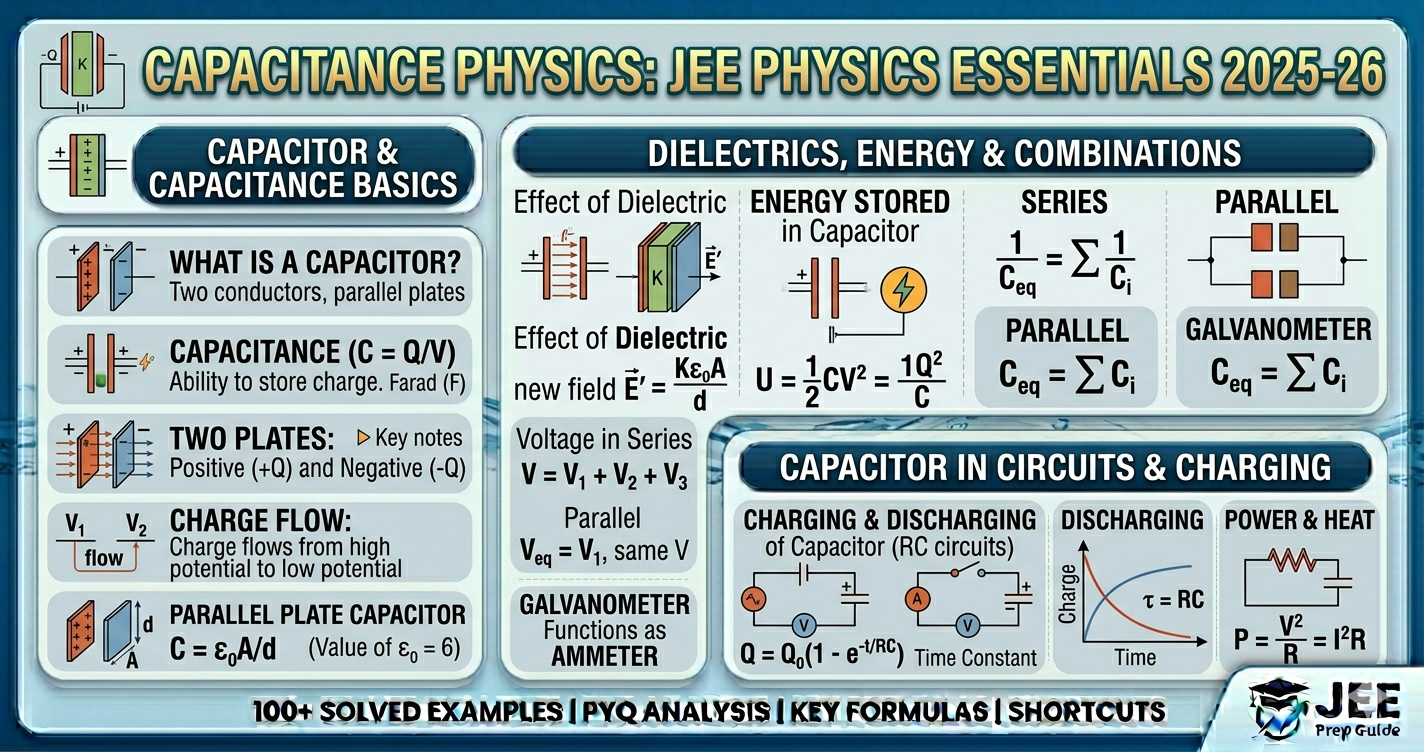
Capacitance - Complete Guide for JEE 2025-26
Why Capacitance is Crucial for JEE?
Capacitance is one of the most important chapters in JEE Physics with a consistent weightage of 6-8% in JEE Main and 8-10% in JEE Advanced. The concepts are highly scoring because:
- Formula-based: Most problems can be solved with direct formula application
- Predictable patterns: Same types of problems repeat every year
- High accuracy: Less scope for calculation errors
- Connected topics: Links to RC circuits in Current Electricity
Capacitor combinations and dielectric problems are the most frequently asked topics, appearing in almost every JEE exam.
Key Topics & Formulas Must Know
1. Capacitance Basics
C = Q/V, C = ε₀A/d (parallel plate)
2. Combinations (Most Important)
Series: 1/C = Σ(1/Cᵢ), Parallel: C = ΣCᵢ
3. Energy Storage
U = ½CV² = ½Q²/C = ½QV
4. Dielectrics
C = KC₀, Battery on vs off behavior
5. RC Circuits
τ = RC, q = Q₀(1-e^(-t/τ)) — see Electromagnetic Induction for related concepts
📚 How to Study Capacitance Effectively?
For JEE Main Students:
- Time Required: 8-10 days (3 hours/day)
- Master series and parallel combinations - 35% questions
- Practice dielectric problems with both conditions
- Solve 80+ numerical problems on energy and charge
- Focus on RC circuit basics - time constant
- Memorize all standard formulas
For JEE Advanced Students:
- Time Required: 12-15 days (4 hours/day)
- Master complex capacitor networks
- Understand charge redistribution completely
- Practice variable capacitance problems
- Study force on dielectric derivations
- Solve multi-concept problems
- Practice derivations for subjective questions
⚠️ Top 10 Mistakes to Avoid in JEE Exam
- Series formula: Using 1/C_eq = 1/C₁ + 1/C₂ correctly (don't forget reciprocal at end!)
- Battery connected vs disconnected: Results are completely different - always check this first
- Dielectric in series vs parallel: Identifying correct arrangement based on geometry
- Energy formula: Choose the right formula based on what's constant (Q or V)
- Area of plates: A is the area of ONE plate, not the total surface area
- RC circuit at t=0: Capacitor acts as short circuit (not open circuit!)
- RC circuit at t=∞: Capacitor acts as open circuit (no current flows)
- Energy loss formula: Using (V₁-V₂)² for same polarity, (V₁+V₂)² for opposite
- Conductor in capacitor: C = ε₀A/(d-t), not ε₀A/d
- Unit consistency: Converting μF to F, mm to m before calculation
📊 JEE Previous Year Question Analysis (2015-2024)
| Year | JEE Main | JEE Advanced | Most Asked Topic |
|---|---|---|---|
| 2024 | 2 Questions (8 marks) | 3 Questions (12 marks) | Dielectric insertion, Energy |
| 2023 | 3 Questions (12 marks) | 4 Questions (15 marks) | Combinations, RC circuits |
| 2022 | 2 Questions (8 marks) | 3 Questions (11 marks) | Charge redistribution, Force |
| 2021 | 3 Questions (12 marks) | 4 Questions (14 marks) | Multiple dielectrics, Networks |
Trend Analysis: JEE Advanced is increasingly focusing on problems combining capacitors with other concepts (e.g., capacitor in circuit with battery and resistor, force problems). Direct formula questions are becoming rare in Advanced.
📌 Topic-wise Weightage & Priority
Strategy: Focus 60% time on Combinations and Dielectrics, 25% on Energy/Force, 15% on RC Circuits.