
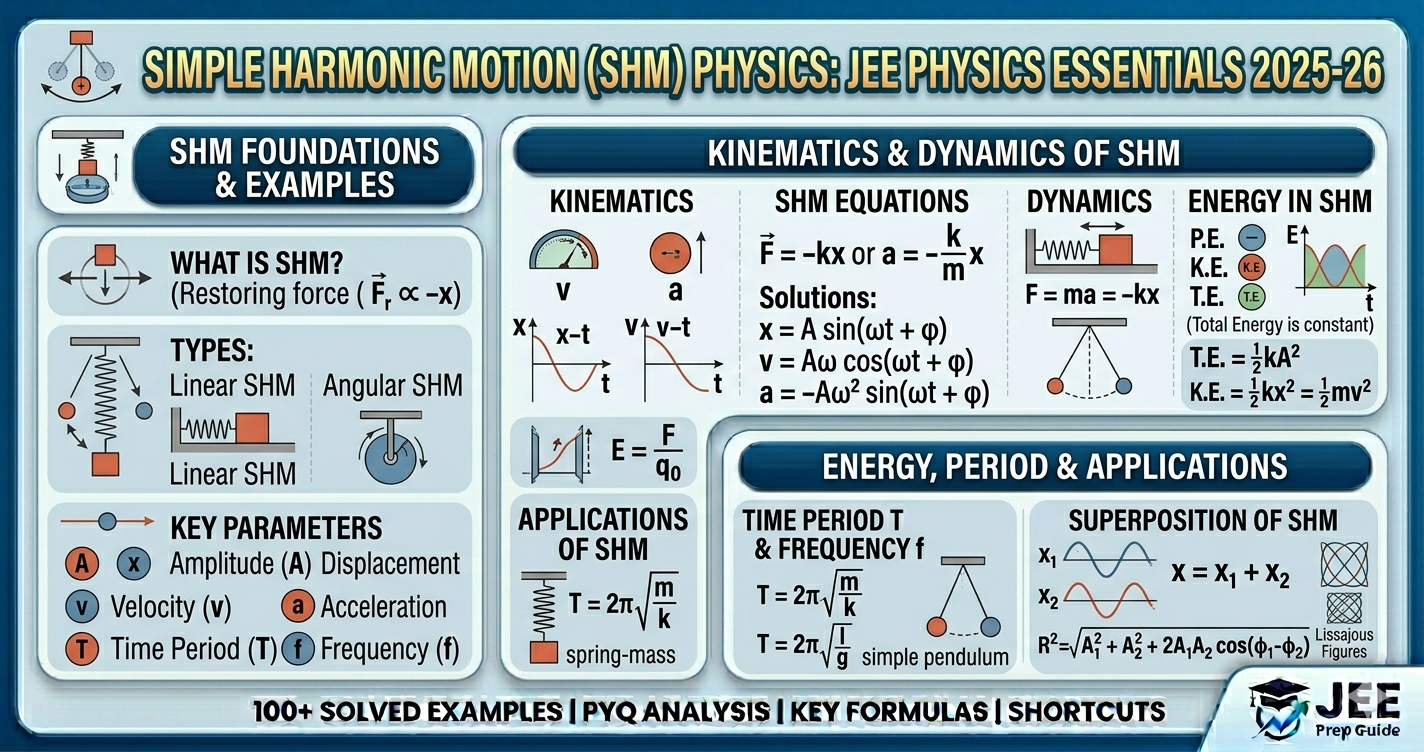
Simple Harmonic Motion - Complete Guide for JEE 2025-26
Why Simple Harmonic Motion is Crucial for JEE?
Simple Harmonic Motion (SHM) is one of the most important chapters in JEE Physics, carrying significant weightage in both JEE Main (12-16 marks) and JEE Advanced (20-28 marks). SHM concepts appear in:
- Mechanics - Springs, pendulums, oscillating systems
- Waves - Wave motion is derived from SHM
- AC Circuits - Alternating current follows SHM equations
- Modern Physics - Quantum oscillators, atomic vibrations
- Thermodynamics - Molecular vibrations in gases
Mastering SHM is essential as it forms the foundation for understanding oscillatory phenomena across all branches of physics.
Key Formulas & Topics to Remember
1. Essential SHM Formulas
- • Time period (spring): T = 2π√(m/k)
- • Time period (pendulum): T = 2π√(L/g)
- • Velocity: v = ω√(A² - x²)
- • Total Energy: E = ½kA²
- • KE = PE position: x = ±A/√2
2. Most Asked Topics
- • Spring-mass systems (horizontal & vertical)
- • Energy conservation in SHM
- • Effect of acceleration/gravity on pendulum
- • Combination of springs (series/parallel)
- • Damped oscillations & resonance (Advanced)
3. Graph Interpretation
x-t, v-t, a-t, E-x graphs - Practice reading and sketching these for 100% accuracy
📚 How to Master Simple Harmonic Motion for JEE?
For JEE Main Students:
- Time Required: 5-6 days (3 hours/day)
- Focus on spring-mass systems and energy concepts
- Master time period formulas for all types of oscillators
- Practice 100+ MCQs focusing on numerical problems
- Memorize all important formulas and their derivations
- Understand graph transformations (x-t to v-t to a-t)
For JEE Advanced Students:
- Time Required: 8-10 days (4 hours/day)
- Deep dive into damped and forced oscillations
- Master compound pendulum and physical oscillators
- Practice complex superposition problems
- Solve multi-concept problems combining SHM with other chapters
- Study resonance applications and Q-factor calculations
- Practice Lissajous figures and analytical problems
⚠️ Top 10 Mistakes to Avoid in SHM
-
❌
Confusing mean position with natural length: In vertical springs, mean position ≠ natural length position
-
❌
Wrong phase relationships: Velocity leads displacement by π/2, NOT lags
-
❌
Forgetting negative sign in a = -ω²x: Acceleration is always OPPOSITE to displacement
-
❌
Energy misconception: Total energy depends ONLY on amplitude, not on position or velocity at any instant
-
❌
Spring combination errors: Series springs: add reciprocals (1/k_eff = 1/k₁ + 1/k₂), Parallel: direct addition
-
❌
Pendulum assumptions: T = 2π√(L/g) is valid ONLY for small angles (< 15°)
-
❌
At resonance misconception: Amplitude is maximum, NOT displacement (displacement lags by π/2)
-
❌
Damping in real systems: All real oscillators are damped; ideal SHM (constant amplitude) is theoretical
-
❌
Unit conversion: Always use SI units (m, kg, s, rad/s) unless specifically asked otherwise
-
❌
Graph reading errors: Carefully note what's plotted on axes - x, v, a, KE, PE, or TE
📊 JEE Previous Year Trend Analysis (2019-2024)
| Year | JEE Main | JEE Advanced | Trending Topics |
|---|---|---|---|
| 2024 | 3 Questions (12 marks) | 5 Questions (24 marks) | Damped oscillations, Energy analysis |
| 2023 | 4 Questions (16 marks) | 4 Questions (20 marks) | Spring combinations, Resonance |
| 2022 | 3 Questions (12 marks) | 6 Questions (28 marks) | Superposition, Compound pendulum |
| 2021 | 4 Questions (16 marks) | 5 Questions (22 marks) | Energy in SHM, Pendulum variations |
Observation: JEE Advanced is increasingly asking conceptual and multi-step problems on damped/forced oscillations. JEE Main focuses more on direct formula-based problems on springs and pendulums. Energy-based questions are common in both.
⚡ Last Minute Quick Revision Points
Must-Remember Formulas:
- • T = 2π√(m/k) - Spring time period
- • T = 2π√(L/g) - Pendulum time period
- • E = ½kA² = ½mω²A² - Total energy
- • vmax = Aω, amax = Aω²
- • Series: 1/keff = 1/k₁ + 1/k₂
- • Parallel: keff = k₁ + k₂
- • Damped: ω' = √(ω₀² - (b/2m)²)
- • Q-factor: Q = ω₀/Δω
Golden Rules:
- • At mean position: v = max, a = 0, KE = max, PE = 0
- • At extreme: v = 0, a = max, KE = 0, PE = max
- • KE = PE at x = ±A/√2
- • Phase: v leads x by π/2, a opposes x
- • ⟨KE⟩ = ⟨PE⟩ = E/2 (time average)
- • Resonance: ω = ω₀, φ = 90°, A = max
- • Superposition: A = √(A₁² + A₂² + 2A₁A₂cosφ)