
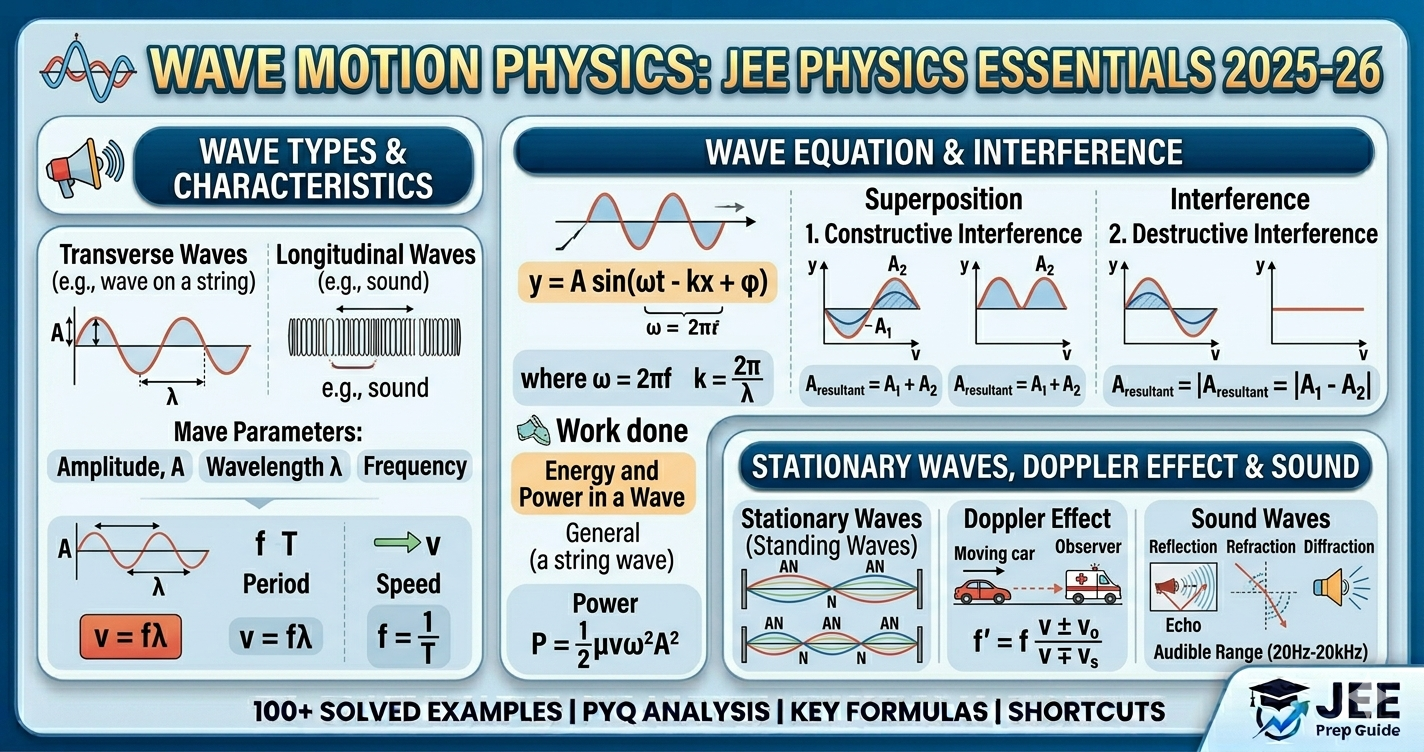
📑 Quick Navigation - Wave Motion

Wave Motion JEE Main & Advanced 2025-26

Master the physics of waves with complete notes on Wave Equation, Standing Waves, Doppler Effect, Sound Waves, Beats, and Resonance. Includes 200+ solved problems and all JEE shortcuts.

📚 10 Complete Sections
✍️ 200+ Solved Examples
🎯 All Important Formulas
⭐⭐⭐⭐⭐ 4.9/5
312+ students rated this helpful
200+
Solved Examples
4 hrs
Study Time
Free
Always
Wave Motion JEE notes, Formulas, PYQs
Wave Motion - Complete JEE Physics Notes
1

Introduction to Wave Motion

Wave motion is a fundamental concept in physics that describes how disturbances propagate through space and time. A wave transfers energy and momentum from one point to another without the permanent displacement of matter. Understanding waves is crucial for topics ranging from sound and light to quantum mechanics.

1.1 What is a Wave?

Definition of Wave

A wave is a disturbance that propagates through a medium (or vacuum) transferring energy from one point to another without the net movement of matter.

Key Characteristics:

  • Transfers energy and momentum
  • Particles oscillate about mean position
  • No net displacement of medium particles
  • Requires a source of disturbance

1.2 Wave Parameters

Parameter Symbol Definition SI Unit
Amplitude A Maximum displacement from mean position m
Wavelength λ Distance between two consecutive crests/troughs m
Frequency f or ν Number of oscillations per second Hz (s⁻¹)
Time Period T Time for one complete oscillation s
Wave Velocity v Speed at which wave propagates m/s
Wave Number k Spatial frequency (k = 2π/λ) rad/m
Angular Frequency ω Angular frequency (ω = 2π/T = 2πf) rad/s
Phase φ State of oscillation at a point rad

1.3 Fundamental Wave Relations

Essential Formulas

Wave Velocity

\[v = f\lambda = \frac{\lambda}{T}\]

Frequency-Period Relation

\[f = \frac{1}{T}\]

Wave Number

\[k = \frac{2\pi}{\lambda}\]

Angular Frequency

\[\omega = 2\pi f = \frac{2\pi}{T}\]

Key Relationship:

\[v = \frac{\omega}{k}\]

🎯 JEE Tip: Quick Conversions

  • v = fλ - Most frequently used formula in wave problems
  • k = 2π/λ = ω/v - Wave number appears in wave equation
  • ω = 2πf = 2π/T - Convert frequency to angular frequency
  • Phase velocity = ω/k = λf - Always equal to wave velocity for non-dispersive medium
2

Types of Waves

Waves can be classified in multiple ways based on their properties, medium requirements, and particle motion. Understanding these classifications is essential for solving JEE problems correctly.

2.1 Based on Medium Requirement

Mechanical Waves

Require a material medium for propagation

  • Sound waves
  • Water waves
  • Seismic waves
  • Waves on a string

Cannot travel through vacuum

Electromagnetic Waves

Do NOT require a medium

  • Light waves
  • Radio waves
  • X-rays
  • Microwaves

Can travel through vacuum at speed c

2.2 Based on Particle Motion

Transverse Waves

Particle vibration to wave propagation

Direction of propagation → Vibration
  • Light waves
  • Waves on a string
  • S-waves (seismic)
  • All EM waves

Can be polarized

Longitudinal Waves

Particle vibration to wave propagation

C R C R C R C = Compression, R = Rarefaction
  • Sound waves
  • P-waves (seismic)
  • Pressure waves in fluids
  • Waves in springs

Cannot be polarized

2.3 Based on Energy Propagation

Property Progressive Waves Stationary Waves
Energy Transfer Energy propagates along with wave No net energy transfer
Amplitude Same for all particles Varies from 0 (nodes) to 2A (antinodes)
Phase Continuously changes along wave Same between consecutive nodes
Formation Single wave from source Superposition of two identical waves
Examples Sound from speaker, light from bulb Vibrating string, organ pipe

2.4 Wave Velocity in Different Media

Important Velocity Formulas

String (Transverse Wave)

\[v = \sqrt{\frac{T}{\mu}}\]

T = Tension, μ = mass per unit length

Rod (Longitudinal Wave)

\[v = \sqrt{\frac{Y}{\rho}}\]

Y = Young's modulus, ρ = density

Fluid (Sound Wave)

\[v = \sqrt{\frac{B}{\rho}}\]

B = Bulk modulus, ρ = density

Ideal Gas (Sound Wave)

\[v = \sqrt{\frac{\gamma RT}{M}} = \sqrt{\frac{\gamma P}{\rho}}\]

γ = Cp/Cv, M = molar mass

📝 Solved Example 1

Question: A string has mass 10 g and length 2 m. It is stretched with a tension of 40 N. Find the velocity of transverse waves in the string.

Solution:

Given: m = 10 g = 0.01 kg, L = 2 m, T = 40 N

Step 1: Calculate linear mass density

\[\mu = \frac{m}{L} = \frac{0.01}{2} = 0.005 \text{ kg/m}\]

Step 2: Apply velocity formula

\[v = \sqrt{\frac{T}{\mu}} = \sqrt{\frac{40}{0.005}}\]
\[v = \sqrt{8000} = 89.44 \text{ m/s}\]
\[\boxed{v \approx 89.4 \text{ m/s}}\]

⚠️ Common Mistakes

  • Wrong: Sound requires air → Correct: Sound can travel through any medium (solid, liquid, gas)
  • Wrong: Longitudinal waves can be polarized → Correct: Only transverse waves can be polarized
  • Wrong: Wave velocity depends on amplitude → Correct: Wave velocity depends on medium properties only
  • Wrong: Frequency changes when wave enters new medium → Correct: Frequency remains constant, wavelength changes
3

Progressive Wave Equation

The mathematical representation of waves is crucial for solving JEE problems. A progressive wave equation describes how the displacement of particles varies with both position and time.

3.1 General Wave Equation

Standard Forms of Progressive Wave

Wave in +x direction

\[y = A\sin(kx - \omega t + \phi)\]

or

\[y = A\sin(\omega t - kx + \phi)\]

Wave in -x direction

\[y = A\sin(kx + \omega t + \phi)\]

or

\[y = A\sin(\omega t + kx + \phi)\]

Alternative Forms:

\[y = A\sin\left[\frac{2\pi}{\lambda}(x - vt)\right] = A\sin\left[2\pi\left(\frac{x}{\lambda} - \frac{t}{T}\right)\right]\]

3.2 Understanding the Wave Equation

Term Symbol Meaning How to Find
Amplitude A Coefficient of sin/cos Direct reading
Wave Number k Coefficient of x λ = 2π/k
Angular Frequency ω Coefficient of t f = ω/2π, T = 2π/ω
Initial Phase φ Constant term Direct reading
Wave Velocity v v = ω/k = coefficient of t / coefficient of x v = ω/k = λf
Direction Sign between kx and ωt Opposite signs → +x; Same signs → -x

3.3 Particle Velocity and Acceleration

Derivatives of Wave Equation

For y = A sin(kx - ωt):

Particle Velocity

\[v_p = \frac{\partial y}{\partial t}\]
\[v_p = -A\omega\cos(kx - \omega t)\]

(v_p)_max = Aω

Particle Acceleration

\[a_p = \frac{\partial^2 y}{\partial t^2}\]
\[a_p = -A\omega^2\sin(kx - \omega t)\]

(a_p)_max = Aω²

Slope

\[\frac{\partial y}{\partial x} = Ak\cos(kx - \omega t)\]

Slope_max = Ak

Important Relation:

\[\frac{\partial y}{\partial t} = -v \cdot \frac{\partial y}{\partial x}\]

Particle velocity = -(Wave velocity) × Slope

💡 Quick Tricks for Wave Equation

  • Direction check: If (kx - ωt) → wave moves in +x direction
  • Velocity = ω/k regardless of the form of equation
  • Max particle velocity = Aω (NOT wave velocity!)
  • Particle velocity ≠ Wave velocity: v_particle oscillates, v_wave is constant
  • At crest/trough: Particle velocity = 0, Particle acceleration = maximum
  • At mean position: Particle velocity = max, Particle acceleration = 0

📝 Solved Example 2 (JEE Main Pattern)

Question: A wave is described by y = 0.02 sin(3x - 2t) where x, y are in meters and t in seconds. Find (a) amplitude, (b) wavelength, (c) frequency, (d) wave velocity, (e) maximum particle velocity.

Solution:

Comparing with y = A sin(kx - ωt):

(a) Amplitude: A = 0.02 m = 2 cm

(b) Wavelength:

\[k = 3 \text{ rad/m} \quad \Rightarrow \quad \lambda = \frac{2\pi}{k} = \frac{2\pi}{3} \text{ m}\]

(c) Frequency:

\[\omega = 2 \text{ rad/s} \quad \Rightarrow \quad f = \frac{\omega}{2\pi} = \frac{2}{2\pi} = \frac{1}{\pi} \text{ Hz}\]

(d) Wave Velocity:

\[v = \frac{\omega}{k} = \frac{2}{3} \text{ m/s}\]

(e) Maximum Particle Velocity:

\[v_{p(max)} = A\omega = 0.02 \times 2 = 0.04 \text{ m/s} = 4 \text{ cm/s}\]

Direction: Wave travels in +x direction (opposite signs of kx and ωt)

3.4 Phase and Phase Difference

Phase Relations

Phase at point (x, t)

\[\phi = kx - \omega t + \phi_0\]

Path Difference to Phase Difference

\[\Delta\phi = \frac{2\pi}{\lambda} \times \Delta x = k \cdot \Delta x\]

Time Difference to Phase Difference

\[\Delta\phi = \frac{2\pi}{T} \times \Delta t = \omega \cdot \Delta t\]

Path Difference to Time Difference

\[\Delta t = \frac{\Delta x}{v} = \frac{T \cdot \Delta x}{\lambda}\]

Special Cases:

  • Δφ = 0, 2π, 4π... → In phase (constructive)
  • Δφ = π, 3π, 5π... → Out of phase (destructive)
  • Δφ = π/2 → Quadrature
4

Superposition of Waves

The principle of superposition states that when two or more waves meet at a point, the resultant displacement is the algebraic sum of individual displacements. This fundamental principle explains interference, beats, and standing waves.

4.1 Principle of Superposition

Mathematical Statement

\[y_{resultant} = y_1 + y_2 + y_3 + ... + y_n\]

The waves maintain their individual properties after superposition - they pass through each other without any permanent change.

4.2 Interference of Two Waves

Resultant of Two Sinusoidal Waves

For two waves: y₁ = A₁sin(kx - ωt) and y₂ = A₂sin(kx - ωt + φ)

\[y = A_R \sin(kx - \omega t + \theta)\]

Resultant Amplitude

\[A_R = \sqrt{A_1^2 + A_2^2 + 2A_1A_2\cos\phi}\]

Phase of Resultant

\[\tan\theta = \frac{A_2\sin\phi}{A_1 + A_2\cos\phi}\]

4.3 Special Cases of Interference

Condition Phase Difference (φ) Path Difference (Δx) Resultant Amplitude
Constructive Interference (Maximum) 0, 2π, 4π, ... (2nπ) 0, λ, 2λ, ... (nλ) A₁ + A₂
Destructive Interference (Minimum) π, 3π, 5π, ... ((2n+1)π) λ/2, 3λ/2, ... ((2n+1)λ/2) |A₁ - A₂|
Equal Amplitudes (A₁ = A₂ = A) Any φ 2A cos(φ/2)

💡 JEE Shortcut for Equal Amplitude Waves

When A₁ = A₂ = A, use this quick formula:

\[A_R = 2A\cos\left(\frac{\phi}{2}\right)\]

This comes from: A_R = √(A² + A² + 2A²cosφ) = A√(2 + 2cosφ) = 2A|cos(φ/2)|

4.4 Intensity and Interference

Intensity Relations

Since Intensity ∝ Amplitude²:

Resultant Intensity

\[I_R = I_1 + I_2 + 2\sqrt{I_1I_2}\cos\phi\]

For Equal Intensities (I₁ = I₂ = I₀)

\[I_R = 4I_0\cos^2\left(\frac{\phi}{2}\right)\]

Maximum and Minimum Intensities:

\[I_{max} = (\sqrt{I_1} + \sqrt{I_2})^2\]
\[I_{min} = (\sqrt{I_1} - \sqrt{I_2})^2\]

📝 Solved Example 3

Question: Two waves of intensities I and 4I interfere. Find the ratio of I_max to I_min.

Solution:

Given: I₁ = I, I₂ = 4I

∴ √I₁ = √I, √I₂ = 2√I

Maximum Intensity:

\[I_{max} = (\sqrt{I_1} + \sqrt{I_2})^2 = (\sqrt{I} + 2\sqrt{I})^2 = (3\sqrt{I})^2 = 9I\]

Minimum Intensity:

\[I_{min} = (\sqrt{I_1} - \sqrt{I_2})^2 = (\sqrt{I} - 2\sqrt{I})^2 = (-\sqrt{I})^2 = I\]
\[\frac{I_{max}}{I_{min}} = \frac{9I}{I} = 9:1\]
5

Standing (Stationary) Waves

Standing waves are formed when two identical waves traveling in opposite directions superpose. They are crucial for understanding musical instruments, resonance in strings and pipes, and many JEE problems.

5.1 Formation of Standing Waves

Mathematical Formation

Incident wave: y₁ = A sin(kx - ωt)

Reflected wave: y₂ = A sin(kx + ωt)

Resultant:

\[y = y_1 + y_2 = 2A\sin(kx)\cos(\omega t)\]

Amplitude = 2A sin(kx) [varies with position] × cos(ωt) [oscillates with time]

5.2 Nodes and Antinodes

Nodes (Zero Amplitude)

Points where amplitude = 0 always

\[\sin(kx) = 0\] \[kx = 0, \pi, 2\pi, 3\pi...\]

Position of nodes:

\[x = 0, \frac{\lambda}{2}, \lambda, \frac{3\lambda}{2}...\]

Distance between consecutive nodes = λ/2

Antinodes (Maximum Amplitude)

Points where amplitude = 2A (maximum)

\[\sin(kx) = \pm 1\] \[kx = \frac{\pi}{2}, \frac{3\pi}{2}, \frac{5\pi}{2}...\]

Position of antinodes:

\[x = \frac{\lambda}{4}, \frac{3\lambda}{4}, \frac{5\lambda}{4}...\]

Distance between consecutive antinodes = λ/2

Standing Wave Pattern

N A N A N A N A N λ/2

N = Node (zero amplitude), A = Antinode (maximum amplitude)

5.3 Properties of Standing Waves

Property Description
Energy Transfer No net energy transfer along the wave
Amplitude Varies from 0 (node) to 2A (antinode)
Phase All particles between two nodes vibrate in phase
Wavelength Distance between alternate nodes = λ; consecutive nodes = λ/2
Node-Antinode Distance λ/4

⚠️ Phase in Standing Waves

  • Particles between two consecutive nodes are in phase (same direction)
  • Particles on opposite sides of a node are 180° out of phase
  • At a node, phase changes by π
  • All particles pass through mean position simultaneously (except at nodes)

5.4 Boundary Conditions and Reflection

Fixed End (Rigid Boundary)
  • Reflection with phase change of π (180°)
  • Reflected wave: y = -A sin(kx + ωt)
  • Node forms at fixed end
  • Example: Fixed end of guitar string
Free End (Open Boundary)
  • Reflection with no phase change
  • Reflected wave: y = A sin(kx + ωt)
  • Antinode forms at free end
  • Example: Open end of organ pipe
6

Sound Waves

Sound waves are longitudinal mechanical waves that require a material medium for propagation. Understanding sound is crucial for JEE as it combines concepts of wave motion with thermodynamics and mechanics.

6.1 Nature of Sound Waves

Key Properties of Sound

  • Longitudinal wave
  • Requires material medium
  • Travels as compressions and rarefactions
  • Cannot be polarized
  • Speed: Solid > Liquid > Gas
  • Audible range: 20 Hz - 20 kHz
  • Infrasound: < 20 Hz
  • Ultrasound: > 20 kHz

6.2 Speed of Sound

Speed of Sound in Different Media

In Gases (Laplace Formula)

\[v = \sqrt{\frac{\gamma P}{\rho}} = \sqrt{\frac{\gamma RT}{M}}\]

γ = Cp/Cv, M = molar mass

In Liquids

\[v = \sqrt{\frac{B}{\rho}}\]

B = Bulk modulus

In Solids (Rod)

\[v = \sqrt{\frac{Y}{\rho}}\]

Y = Young's modulus

6.3 Effect of Various Factors on Speed of Sound

Factor Effect on Speed Explanation
Temperature v ∝ √T Speed increases with temperature
Pressure (at constant T) No effect P and ρ both change proportionally
Humidity Increases with humidity Moist air is less dense than dry air
Molecular Weight v ∝ 1/√M Lighter gases have higher speed

💡 Quick Formula: Temperature Effect

For small temperature changes near 0°C:

\[v_t = v_0 + 0.61t\]

where v₀ = 332 m/s (speed at 0°C), t = temperature in °C

Speed at 0°C ≈ 332 m/s, Speed at 20°C ≈ 344 m/s

6.4 Intensity and Loudness

Intensity of Sound

Definition

\[I = \frac{P_{avg}}{A} = \frac{E}{A \cdot t}\]

Power per unit area (W/m²)

In Terms of Wave Parameters

\[I = \frac{1}{2}\rho v \omega^2 A^2 = 2\pi^2 f^2 A^2 \rho v\]

Intensity Level (Loudness) in Decibels:

\[\beta = 10\log_{10}\left(\frac{I}{I_0}\right) \text{ dB}\]

where I₀ = 10⁻¹² W/m² (threshold of hearing)

📝 Solved Example 4

Question: The intensity of sound from a source is 10⁻⁶ W/m². What is the intensity level in decibels?

Solution:

Given: I = 10⁻⁶ W/m², I₀ = 10⁻¹² W/m²

\[\beta = 10\log_{10}\left(\frac{I}{I_0}\right)\]
\[\beta = 10\log_{10}\left(\frac{10^{-6}}{10^{-12}}\right)\]
\[\beta = 10\log_{10}(10^6) = 10 \times 6\]
\[\beta = 60 \text{ dB}\]
7

Doppler Effect

The Doppler Effect is the change in frequency of a wave as observed when the source and observer are in relative motion. This is one of the most important topics for JEE with guaranteed questions every year.

7.1 Master Formula for Doppler Effect

General Doppler Formula (Sound Waves)

\[f' = f_0 \left(\frac{v \pm v_o}{v \mp v_s}\right)\]

Where:

  • f' = Apparent/observed frequency
  • f₀ = Source/actual frequency
  • v = Speed of sound in medium
  • v_o = Speed of observer
  • v_s = Speed of source

🎯 Sign Convention (Easy Method)

  • Approaching: Use + for v_o (numerator), Use - for v_s (denominator)
  • Receding: Use - for v_o (numerator), Use + for v_s (denominator)

Remember: "+" when moving toward line of sight, "-" when moving away

7.2 Special Cases of Doppler Effect

Case Condition Formula
Source approaches stationary observer v_o = 0, v_s ≠ 0 (approaching) f' = f₀(v/(v - v_s))
Source recedes from stationary observer v_o = 0, v_s ≠ 0 (receding) f' = f₀(v/(v + v_s))
Observer approaches stationary source v_s = 0, v_o ≠ 0 (approaching) f' = f₀((v + v_o)/v)
Observer recedes from stationary source v_s = 0, v_o ≠ 0 (receding) f' = f₀((v - v_o)/v)
Both approaching Both moving towards each other f' = f₀((v + v_o)/(v - v_s))
Both receding Both moving away from each other f' = f₀((v - v_o)/(v + v_s))

💡 JEE Quick Trick: SOFA Rule

Source, Observer, Frequency increases when Approaching

  • Source approaching → f' > f₀ (higher pitch)
  • Source receding → f' < f₀ (lower pitch)
  • Observer approaching → f' > f₀
  • Observer receding → f' < f₀

7.3 Apparent Wavelength

Wavelength Change in Doppler Effect

Key Point:

  • Source moving: Wavelength changes (λ' ≠ λ)
  • Observer moving: Wavelength does NOT change (λ' = λ)
\[\text{When source moves: } \lambda' = \frac{v \mp v_s}{f_0} = \lambda \mp \frac{v_s}{f_0}\]

📝 Solved Example 5 (JEE Main Pattern)

Question: A train moving at 72 km/h emits a whistle of frequency 500 Hz. Find the apparent frequency heard by a stationary observer when (a) train approaches (b) train recedes. (Speed of sound = 340 m/s)

Solution:

Given: v_s = 72 km/h = 20 m/s, f₀ = 500 Hz, v = 340 m/s, v_o = 0

(a) Train approaches:

\[f' = f_0\left(\frac{v}{v - v_s}\right) = 500 \times \frac{340}{340 - 20}\]
\[f' = 500 \times \frac{340}{320} = 531.25 \text{ Hz}\]

(b) Train recedes:

\[f' = f_0\left(\frac{v}{v + v_s}\right) = 500 \times \frac{340}{340 + 20}\]
\[f' = 500 \times \frac{340}{360} = 472.22 \text{ Hz}\]

Answer: (a) 531.25 Hz (b) 472.22 Hz

Note: Approaching gives higher frequency, receding gives lower frequency

📝 Solved Example 6 (JEE Advanced Pattern)

Question: A car moving at 30 m/s honks (frequency 200 Hz) at a wall and hears the echo. What is the beat frequency between the original and reflected sound? (v = 330 m/s)

Solution:

Step 1: Find frequency received by wall (wall is stationary observer, car is approaching source)

\[f_{wall} = f_0\left(\frac{v}{v - v_s}\right) = 200 \times \frac{330}{330 - 30} = 220 \text{ Hz}\]

Step 2: Wall reflects at same frequency 220 Hz. Now wall is source (stationary), car is approaching observer

\[f_{echo} = f_{wall}\left(\frac{v + v_o}{v}\right) = 220 \times \frac{330 + 30}{330}\]
\[f_{echo} = 220 \times \frac{360}{330} = 240 \text{ Hz}\]

Step 3: Beat frequency

\[f_{beat} = |f_{echo} - f_{original}| = |240 - 200| = 40 \text{ Hz}\]

⚠️ Common JEE Mistakes in Doppler Effect

  • Wrong sign: Forgetting that approaching means "+" in numerator, "-" in denominator
  • Reflection problems: Not applying Doppler effect twice (source→wall + wall→observer)
  • Wavelength error: Assuming wavelength changes when observer moves (it doesn't)
  • Unit conversion: Forgetting to convert km/h to m/s
  • Wind effect: When wind blows from source to observer, add wind velocity to v
8

Beats & Resonance

8.1 Beats

Beats occur when two sound waves of slightly different frequencies interfere, resulting in periodic variations in loudness (or intensity).

Beat Frequency Formula

\[f_{beat} = |f_1 - f_2|\]

Beat frequency = Absolute difference of the two frequencies

Mathematical Derivation

Two waves: y₁ = A sin(2πf₁t) and y₂ = A sin(2πf₂t)

\[y = y_1 + y_2 = 2A\cos\left[2\pi\left(\frac{f_1 - f_2}{2}\right)t\right]\sin\left[2\pi\left(\frac{f_1 + f_2}{2}\right)t\right]\]

Resultant Frequency (Heard)

\[f_{resultant} = \frac{f_1 + f_2}{2}\]

Beat Frequency

\[f_{beat} = |f_1 - f_2|\]

💡 Important Points About Beats

  • Beat frequency must be < 10 Hz to be distinguishable by human ear
  • If beat frequency > 10 Hz, we hear a "rough" sound
  • Beats are used for tuning musical instruments
  • Number of beats per second = |f₁ - f₂|
  • Maximum amplitude = 2A (when in phase)
  • Minimum amplitude = 0 (when out of phase)

8.2 Resonance

Resonance is the phenomenon when an object is made to vibrate at its natural frequency by receiving energy from another vibrating object at that same frequency, resulting in maximum energy transfer.

Conditions for Resonance

  1. Driving frequency = Natural frequency of the system
  2. Energy is transferred from driver to driven system
  3. Amplitude becomes maximum at resonance

Examples of Resonance:

  • Tuning fork resonating with air column
  • Radio/TV tuning (electrical resonance)
  • Swing pushed at natural frequency
  • Bridge collapse due to soldiers marching in step
  • Glass breaking with sound wave

📝 Solved Example 7

Question: Two tuning forks A and B give 5 beats per second. Fork A has frequency 256 Hz. On loading fork B with wax, beat frequency becomes 3 beats/s. Find original frequency of B.

Solution:

Step 1: Original beat frequency = 5 Hz

∴ f_B = 256 ± 5 = 251 Hz or 261 Hz

Step 2: After loading with wax, frequency of B decreases

New beat frequency = 3 Hz

Step 3: Analysis

  • If f_B = 261 Hz (originally), after loading f_B decreases → approaches 256 Hz → beat frequency should decrease. Beat becomes 3 Hz (decreased from 5). ✓ This works!
  • If f_B = 251 Hz (originally), after loading f_B decreases → moves away from 256 Hz → beat frequency should increase. But beat decreased to 3 Hz. ✗
\[\boxed{f_B = 261 \text{ Hz}}\]
9

Vibration in Strings & Air Columns

9.1 Vibrating Strings (Both Ends Fixed)

Harmonics in a Fixed String

Condition: Nodes at both ends

\[L = n\frac{\lambda_n}{2} \quad \Rightarrow \quad \lambda_n = \frac{2L}{n}\] \[f_n = n \cdot f_1 = \frac{n}{2L}\sqrt{\frac{T}{\mu}} = \frac{nv}{2L}\]
Harmonic n Frequency Wavelength Loops
Fundamental (1st harmonic) 1 f₁ = v/2L λ₁ = 2L 1
2nd harmonic (1st overtone) 2 f₂ = 2f₁ = v/L λ₂ = L 2
3rd harmonic (2nd overtone) 3 f₃ = 3f₁ = 3v/2L λ₃ = 2L/3 3
nth harmonic n fₙ = nf₁ = nv/2L λₙ = 2L/n n

Key Points:

  • All harmonics (odd + even) are present
  • Frequency ratio → 1:2:3:4:5...
  • Number of loops = harmonic number
  • Number of nodes = n + 1, Number of antinodes = n

Harmonics in a String (Both Ends Fixed)

n=1 (Fundamental) λ = 2L n=2 (1st Overtone) λ = L n=3 (2nd Overtone) λ = 2L/3

Red dots = Nodes (fixed points), Colored lines = Antinodes (maximum displacement)

9.2 Laws of Vibrating Strings

Three Laws of Transverse Vibration

Law of Length

\[f \propto \frac{1}{L}\]

(T and μ constant)

Law of Tension

\[f \propto \sqrt{T}\]

(L and μ constant)

Law of Mass

\[f \propto \frac{1}{\sqrt{\mu}}\]

(L and T constant)

Combined Formula (Mersenne's Law):

\[f = \frac{1}{2L}\sqrt{\frac{T}{\mu}} = \frac{1}{2L}\sqrt{\frac{T}{\pi r^2 \rho}}\]

where μ = mass per unit length = πr²ρ (for wire of radius r and density ρ)

9.3 Open Organ Pipe (Both Ends Open)

Harmonics in Open Pipe

Condition: Antinodes at both ends

\[L = n\frac{\lambda_n}{2} \quad \Rightarrow \quad \lambda_n = \frac{2L}{n}\] \[f_n = n \cdot f_1 = \frac{nv}{2L}\]
Harmonic n Frequency Wavelength
Fundamental 1 f₁ = v/2L λ₁ = 2L
1st Overtone 2 f₂ = 2f₁ λ₂ = L
2nd Overtone 3 f₃ = 3f₁ λ₃ = 2L/3

All harmonics (odd + even) are present

9.4 Closed Organ Pipe (One End Closed)

Harmonics in Closed Pipe

Condition: Node at closed end, Antinode at open end

\[L = (2n-1)\frac{\lambda_n}{4} \quad \Rightarrow \quad \lambda_n = \frac{4L}{2n-1}\] \[f_n = (2n-1) \cdot f_1 = \frac{(2n-1)v}{4L}\]
Harmonic n Frequency Wavelength
Fundamental (1st harmonic) 1 f₁ = v/4L λ₁ = 4L
1st Overtone (3rd harmonic) 2 f₃ = 3f₁ λ₃ = 4L/3
2nd Overtone (5th harmonic) 3 f₅ = 5f₁ λ₅ = 4L/5

Only ODD harmonics are present (1, 3, 5, 7...)

🎯 JEE Quick Comparison: Open vs Closed Pipe

Property Open Pipe Closed Pipe
Boundary Condition A-A (Antinode at both ends) N-A (Node at closed, Antinode at open)
Fundamental Frequency f₁ = v/2L f₁ = v/4L
Harmonics Present All (1, 2, 3, 4...) Only odd (1, 3, 5...)
For Same L Higher fundamental Lower fundamental (f = f_open/2)
Sound Quality Richer (more harmonics) Less rich

9.5 End Correction

End Correction Formula

The antinode doesn't form exactly at the open end but slightly outside. This extra length is called end correction (e).

\[e \approx 0.6r\]

where r = radius of the pipe

Open Pipe (effective length)

\[L_{eff} = L + 2e = L + 1.2r\]

Closed Pipe (effective length)

\[L_{eff} = L + e = L + 0.6r\]

9.6 Resonance Tube Experiment

Finding Speed of Sound

In resonance tube experiment, first resonance occurs at length L₁ and second at L₂:

First Resonance

\[L_1 + e = \frac{\lambda}{4}\]

Second Resonance

\[L_2 + e = \frac{3\lambda}{4}\]

Subtracting to eliminate end correction:

\[L_2 - L_1 = \frac{\lambda}{2} \quad \Rightarrow \quad \lambda = 2(L_2 - L_1)\]
\[v = f\lambda = 2f(L_2 - L_1)\]

End Correction from experiment:

\[e = \frac{L_2 - 3L_1}{2}\]

📝 Solved Example 8

Question: In a resonance tube experiment, first and second resonance are obtained at lengths 20 cm and 62 cm respectively. Find (a) wavelength, (b) speed of sound if frequency = 512 Hz, (c) end correction.

Solution:

Given: L₁ = 20 cm, L₂ = 62 cm, f = 512 Hz

(a) Wavelength:

\[\lambda = 2(L_2 - L_1) = 2(62 - 20) = 2 \times 42 = 84 \text{ cm} = 0.84 \text{ m}\]

(b) Speed of Sound:

\[v = f\lambda = 512 \times 0.84 = 430.08 \text{ m/s}\]

(c) End Correction:

\[e = \frac{L_2 - 3L_1}{2} = \frac{62 - 3 \times 20}{2} = \frac{62 - 60}{2} = 1 \text{ cm}\]

Answers:

(a) λ = 84 cm (b) v = 430 m/s (c) e = 1 cm

10

Reflection & Transmission of Waves

When a wave encounters a boundary or interface between two media, part of it is reflected and part is transmitted. Understanding this is crucial for solving JEE problems on wave behavior at boundaries.

10.1 Reflection at Boundaries

Reflection from Rigid (Fixed) End
  • Phase change of π (180°)
  • Reflected pulse is inverted
  • Node forms at rigid boundary
  • Amplitude sign reverses

Example: Wave on string reflecting from fixed end

Reflection from Free (Open) End
  • No phase change
  • Reflected pulse is upright
  • Antinode forms at free boundary
  • Amplitude sign unchanged

Example: Wave on string with ring sliding on rod

10.2 Reflection at Interface of Two Media

Wave Traveling from Medium 1 to Medium 2

Rarer to Denser (v₁ > v₂)

  • Reflected wave: Phase change π
  • Transmitted wave: No phase change
  • Wavelength decreases in denser medium
  • Frequency remains same

Denser to Rarer (v₁ < v₂)

  • Reflected wave: No phase change
  • Transmitted wave: No phase change
  • Wavelength increases in rarer medium
  • Frequency remains same

10.3 Amplitude of Reflected and Transmitted Waves

Amplitude Relations (Strings)

For wave traveling from string of linear density μ₁ to string of linear density μ₂:

Reflected Amplitude

\[A_r = \frac{v_1 - v_2}{v_1 + v_2} A_i = \frac{\sqrt{\mu_2} - \sqrt{\mu_1}}{\sqrt{\mu_2} + \sqrt{\mu_1}} A_i\]

Transmitted Amplitude

\[A_t = \frac{2v_1}{v_1 + v_2} A_i = \frac{2\sqrt{\mu_2}}{\sqrt{\mu_2} + \sqrt{\mu_1}} A_i\]

Special Cases:

  • If v₂ → ∞ (free end): A_r = A_i, A_t = 2A_i
  • If v₂ → 0 (fixed end): A_r = -A_i, A_t = 0
  • If v₁ = v₂ (same medium): A_r = 0, A_t = A_i (no reflection)

10.4 Energy Relations

Power/Energy Coefficients

Reflection Coefficient (R)

\[R = \left(\frac{A_r}{A_i}\right)^2 = \left(\frac{v_1 - v_2}{v_1 + v_2}\right)^2\]

Transmission Coefficient (T)

\[T = \frac{v_1}{v_2}\left(\frac{A_t}{A_i}\right)^2 = \frac{4v_1v_2}{(v_1 + v_2)^2}\]

Energy Conservation:

\[R + T = 1\]

Total energy = Reflected energy + Transmitted energy

⚠️ Key Points for JEE

  • Frequency never changes when wave changes medium
  • Wavelength changes as velocity changes (λ = v/f)
  • Phase change of π occurs when wave reflects from a denser medium
  • A_r can be negative (indicating phase reversal)
  • A_t is always positive (no phase change in transmission)
  • For intensity: I ∝ A²ρv (depends on medium properties)

📝 Solved Example 9

Question: A wave traveling in a string of linear density 2 g/m enters another string of linear density 8 g/m. If incident amplitude is 4 cm, find the amplitudes of reflected and transmitted waves.

Solution:

Given: μ₁ = 2 g/m, μ₂ = 8 g/m, A_i = 4 cm

Step 1: Find velocity ratio

Since v ∝ 1/√μ (for same tension)

\[\frac{v_1}{v_2} = \sqrt{\frac{\mu_2}{\mu_1}} = \sqrt{\frac{8}{2}} = 2\]

Let v₁ = 2v and v₂ = v

Step 2: Reflected Amplitude

\[A_r = \frac{v_1 - v_2}{v_1 + v_2} A_i = \frac{2v - v}{2v + v} \times 4 = \frac{v}{3v} \times 4 = \frac{4}{3} \text{ cm}\]

Step 3: Transmitted Amplitude

\[A_t = \frac{2v_1}{v_1 + v_2} A_i = \frac{2 \times 2v}{2v + v} \times 4 = \frac{4v}{3v} \times 4 = \frac{16}{3} \text{ cm}\]

Answers:

Reflected amplitude = 4/3 cm ≈ 1.33 cm (same phase - going to denser)

Transmitted amplitude = 16/3 cm ≈ 5.33 cm

📝 Previous Year Questions Analysis (Wave Motion)

JEE Main (Last 5 Years)

  • ✓ Standing Waves & Harmonics: 25%
  • ✓ Doppler Effect: 25%
  • ✓ Wave Equation & Parameters: 20%
  • ✓ Beats & Resonance: 15%
  • ✓ Sound Intensity & Speed: 10%
  • ✓ Superposition: 5%

JEE Advanced (Last 5 Years)

  • ✓ Standing Waves (Strings/Pipes): 30%
  • ✓ Doppler Effect (Complex): 25%
  • ✓ Wave Equation Analysis: 20%
  • ✓ Reflection/Transmission: 10%
  • ✓ Multi-concept Problems: 10%
  • ✓ Phase & Superposition: 5%

Top 15 Most Repeated Question Types

  1. Find frequency/wavelength/velocity from wave equation y = A sin(kx - ωt)
  2. Doppler effect with source/observer moving (train, car problems)
  3. Calculate beat frequency from two sources
  4. Harmonics in string fixed at both ends
  5. Open vs closed organ pipe frequency comparison
  6. Resonance tube experiment - find speed of sound
  7. Standing wave pattern - find nodes and antinodes
  8. Particle velocity vs wave velocity from equation
  9. Phase difference from path difference
  10. Intensity level in decibels calculation
  11. Doppler effect with reflection from wall
  12. Tension in string from frequency of vibration
  13. Interference of two waves - resultant amplitude
  14. Speed of sound variation with temperature
  15. Resonance with tuning fork - beat method

Weightage Analysis

JEE Main: 12-16 marks (3-4 questions)
JEE Advanced: 15-20 marks (4-5 questions)
Difficulty Level: Medium to Hard
Time Required (prep): 8-10 hours complete study

Year-wise Question Distribution

Year JEE Main JEE Advanced Hot Topics
2024 4 Questions (16 marks) 5 Questions (18 marks) Doppler, Standing waves
2023 3 Questions (12 marks) 4 Questions (15 marks) Resonance tube, Beats
2022 4 Questions (16 marks) 5 Questions (20 marks) Wave equation, Organ pipes
2021 3 Questions (12 marks) 4 Questions (16 marks) Superposition, Phase

🎯 Practice Problem Set - Wave Motion

Level 1: Basic (JEE Main Standard)

  1. A wave is represented by y = 5 sin(4πt - 0.02x) where y and x are in cm and t in seconds. Find amplitude, frequency, wavelength, and wave velocity.
  2. Calculate the speed of sound in air at 27°C if it is 332 m/s at 0°C.
  3. Two tuning forks A and B give 4 beats/s. A has frequency 480 Hz. Find possible frequencies of B.
  4. A string 1 m long has fundamental frequency 400 Hz. Find frequency of 3rd harmonic.
  5. A closed organ pipe has fundamental frequency 500 Hz. Find frequencies of first two overtones.
  6. Convert intensity 10⁻⁵ W/m² to decibels.
  7. A train moving at 36 km/h emits sound of 500 Hz. Find apparent frequency when it approaches a stationary observer. (v = 340 m/s)
  8. What is the phase difference between two particles 0.25 m apart if wavelength is 0.5 m?

Level 2: Intermediate (JEE Main/Advanced)

  1. The equation of a wave is y = 0.05 sin(10πx - 200πt) where x, y are in meters and t in seconds. Find (a) wavelength (b) frequency (c) wave velocity (d) max particle velocity (e) max particle acceleration.
  2. Two identical strings have same tension. One is 60 cm and the other is 90 cm long. Find ratio of their fundamental frequencies.
  3. An open pipe and a closed pipe have same fundamental frequency. If length of open pipe is 60 cm, find length of closed pipe.
  4. A train moving at 54 km/h blows a horn of frequency 600 Hz. Find apparent frequency heard by a person moving at 18 km/h (a) towards the train (b) away from the train. (v = 340 m/s)
  5. Two waves y₁ = 3 sin(ωt) and y₂ = 4 sin(ωt + π/2) superpose. Find resultant amplitude and phase.
  6. In resonance tube experiment, first resonance is at 17 cm and second at 51 cm. Find (a) wavelength (b) end correction.
  7. A tuning fork of frequency 340 Hz is vibrated just above a tube of length 100 cm. Find the height of water in tube for resonance. (v = 340 m/s)
  8. A source of sound of frequency 256 Hz moves with velocity 25 m/s towards a wall. What beat frequency is heard by the observer at the source? (v = 330 m/s)
  9. The intensity of sound from a point source at 4 m is 10 W/m². What is the intensity at 8 m?
  10. A string vibrates in 3 loops. If tension is increased by 44%, in how many loops will it vibrate at same frequency?

Level 3: Advanced (JEE Advanced/Olympiad)

  1. A wave pulse is traveling on a string with speed v. The shape of pulse is triangular with height h and base 2l. Find the total kinetic energy of the pulse. (linear density = μ)
  2. Two coherent sources S₁ and S₂ are separated by 4λ. A circular wire of radius r (r >> λ) is placed with center midway between sources. Find number of maxima and minima on the wire.
  3. A tube of length L₁ open at both ends and another tube of length L₂ closed at one end have same fundamental frequency. Find the ratio of 6th harmonic of open pipe to 5th harmonic of closed pipe.
  4. A source of sound moves along a circle of radius R with constant angular velocity ω. An observer is at distance d from center. Find maximum and minimum frequencies heard. (d > R)
  5. Prove that when a wave travels from string of linear density μ₁ to string of linear density μ₂, the reflection and transmission coefficients satisfy R + T = 1.
  6. Two strings of same material and length have radii r and 2r. They are joined and stretched with tension T. A wave in thinner string has amplitude A. Find amplitude of transmitted wave in thicker string.
  7. A cylindrical tube closed at one end contains air column of variable length. The minimum length for resonance with a fork of frequency f is 20 cm. Find the next two lengths for resonance with same fork and also the speed of sound.
  8. A police car sounding a siren of frequency 1000 Hz moves towards a building at 20 m/s. What frequency does the driver hear from the reflected wave? (v = 340 m/s)
  9. Two speakers facing each other are 10 m apart. Both emit sound of frequency 680 Hz. A person walks from one speaker to other. How many maxima will he hear? (v = 340 m/s)
  10. Show that the displacement node is a pressure antinode and vice versa in a standing sound wave.

Conceptual Questions (Theory Based)

  1. Why can't longitudinal waves be polarized?
  2. Explain why sound travels faster in humid air than in dry air.
  3. Why is Laplace's correction necessary for speed of sound formula?
  4. What happens to wavelength when a wave enters from a rarer to denser medium?
  5. Why do closed pipes produce only odd harmonics?
  6. Explain the physical significance of phase velocity and group velocity.
  7. Why does a siren sound higher when approaching and lower when receding?
  8. What is the difference between interference and beats?
  9. Why does resonance occur only at specific frequencies?
  10. Explain end correction in organ pipes with diagram.

📋 Wave Motion - Complete Formula Sheet

Basic Wave Relations

v = fλ = λ/T = ω/k

k = 2π/λ (wave number)

ω = 2πf = 2π/T

y = A sin(kx - ωt + φ)

Wave Velocity

String: v = √(T/μ)

Gas: v = √(γP/ρ) = √(γRT/M)

Solid: v = √(Y/ρ)

Liquid: v = √(B/ρ)

Particle Properties

v_particle = -Aω cos(kx - ωt)

v_max = Aω

a_max = Aω²

v_p = -v × (dy/dx)

Standing Waves

y = 2A sin(kx) cos(ωt)

Nodes: x = 0, λ/2, λ, ...

Antinodes: x = λ/4, 3λ/4, ...

Node-Antinode dist = λ/4

String (Both Ends Fixed)

f_n = nv/2L = (n/2L)√(T/μ)

λ_n = 2L/n

All harmonics present

n = 1, 2, 3, ...

Open Pipe

f_n = nv/2L

λ_n = 2L/n

All harmonics (1,2,3...)

Antinodes at both ends

Closed Pipe

f_n = (2n-1)v/4L

λ_n = 4L/(2n-1)

Only odd harmonics (1,3,5...)

Node at closed, antinode at open

Doppler Effect

f' = f₀[(v ± v_o)/(v ∓ v_s)]

Upper: approaching

Lower: receding

Beat: f_beat = |f₁ - f₂|

Sound & Intensity

I = P/A = ½ρvω²A²

β = 10 log₁₀(I/I₀) dB

I₀ = 10⁻¹² W/m²

v_t = 332 + 0.61t m/s

Related Physics Notes

Wave Motion - Complete Guide for JEE 2025-26

Why Wave Motion is Critical for JEE?

Wave Motion is one of the highest-scoring chapters in JEE Physics with consistent 12-20 marks every year. This chapter bridges mechanics with modern physics and includes:

  • Doppler Effect - 2-3 questions every year (guaranteed!)
  • Standing Waves - Strings and organ pipes (very frequent)
  • Wave Equation Analysis - Extract all parameters from equation
  • Sound Waves - Speed, intensity, resonance
  • Beats - Easy marks with careful calculation

In JEE Advanced, expect multi-concept problems combining wave motion with SHM, thermodynamics, or optics.

Must-Remember Formulas

1. Wave Equation

y = A sin(kx - ωt) → +x direction

v = ω/k = fλ = λ/T

2. Doppler Effect

f' = f₀[(v ± v_o)/(v ∓ v_s)]

Upper sign: approaching, Lower: receding

3. Standing Waves

String: f_n = nv/2L (all harmonics)

Open pipe: f_n = nv/2L (all harmonics)

Closed pipe: f_n = (2n-1)v/4L (odd only)

4. Beats & Intensity

f_beat = |f₁ - f₂|

β = 10 log(I/I₀) dB

📚 How to Master Wave Motion for JEE?

For JEE Main Students:

  1. Time Required: 6-8 days (3 hours/day)
  2. Master wave equation interpretation (k, ω, v, A)
  3. Practice 80+ Doppler effect problems
  4. Memorize formulas for strings and pipes
  5. Solve resonance tube numerical problems
  6. Practice beat frequency calculations

For JEE Advanced Students:

  1. Time Required: 10-12 days (4 hours/day)
  2. Derive all standing wave formulas from first principles
  3. Master complex Doppler problems (reflections, moving medium)
  4. Study superposition and interference thoroughly
  5. Practice reflection/transmission at boundaries
  6. Solve multi-concept problems combining SHM + waves

⚠️ Common Mistakes to Avoid

  • Confusing particle velocity and wave velocity: Particle velocity = Aω cos(...), Wave velocity = ω/k (constant)
  • Wrong sign in Doppler: Use "+" for v_o when approaching in numerator, "-" for v_s when approaching in denominator
  • Open vs Closed pipe confusion: Open → f₁ = v/2L (all harmonics), Closed → f₁ = v/4L (odd only)
  • Frequency change in medium: Frequency NEVER changes when wave enters new medium. Only wavelength changes!
  • Phase change on reflection: Phase change of π at rigid/denser end, no phase change at free/rarer end